Welding is a process that joins two or more pieces of metal (or thermoplastic) by heating them until they melt and fuse together, usually with a filler metal added. When the molten metal cools, it forms one solid piece that is often as strong as, or stronger than, the original metal.
Unlike bolts, rivets or glue, a weld creates a permanent joint at the atomic level. That is why welding holds together bridges, ships, pipelines, cars and the steel frames of buildings.
Welding Definition
The American Welding Society (AWS) defines welding as a joining process that produces coalescence (merging into one) of materials by heating them to welding temperature, with or without pressure, and with or without filler metal. In plain terms: you melt the edges of the parts, they flow together, and they harden as one.
Most welding is fusion welding, where the base metal melts. A smaller group, called solid-state welding, joins metal with pressure, friction or vibration without fully melting it.
How Does Welding Work?
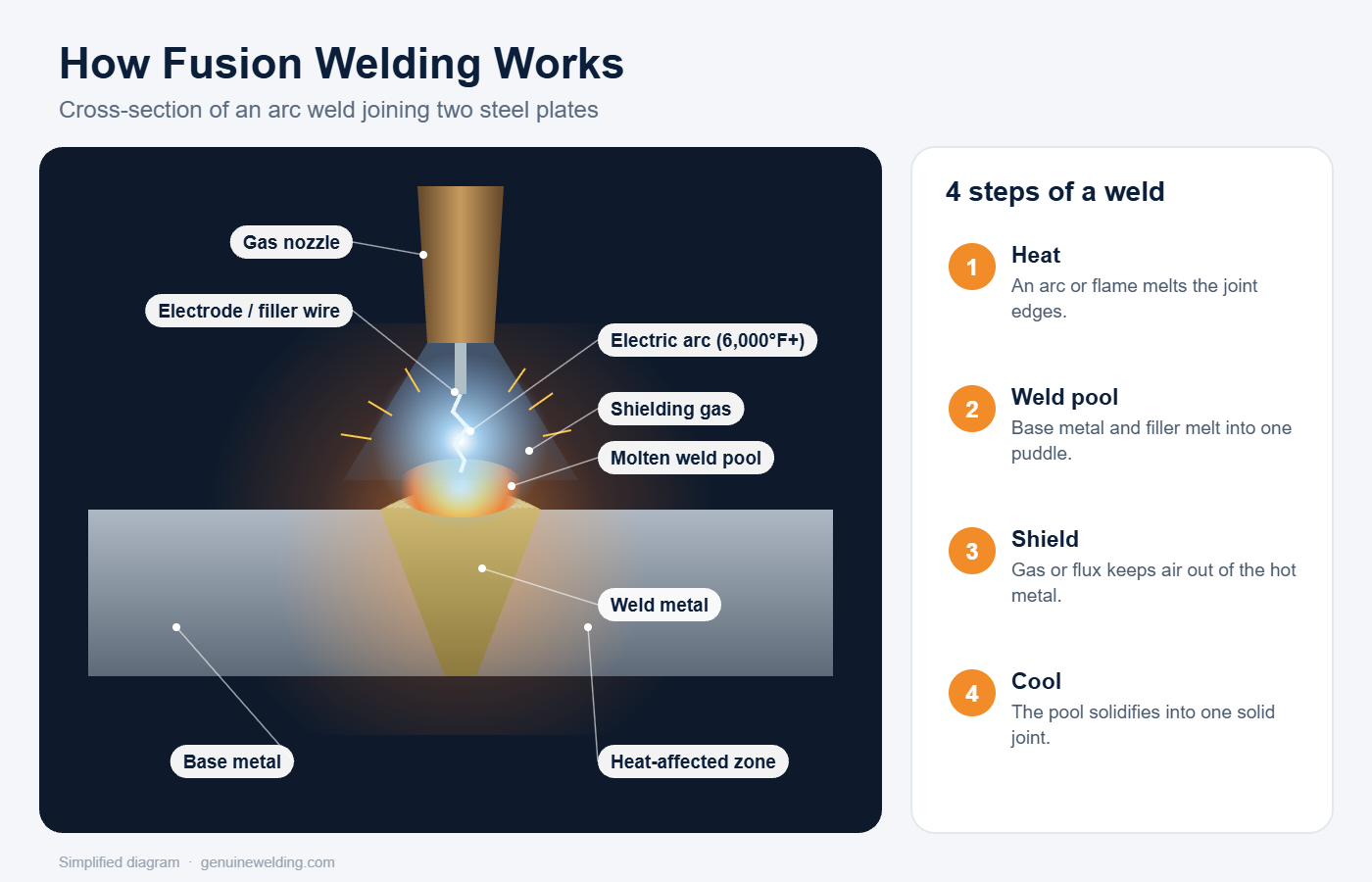
Every fusion weld follows the same basic steps:
- Heat: A heat source melts the joint. In arc welding, an electric arc between the electrode and the metal can exceed 6,000°F. Gas welding uses a flame, and laser welding uses a focused beam.
- Weld pool: The edges of both parts melt into a small puddle of liquid metal called the weld pool.
- Filler metal: A wire, rod or electrode adds extra metal to the pool to fill the gap and build up the joint.
- Shielding: A gas or flux protects the hot metal from oxygen and nitrogen in the air, which would cause porosity and weak welds.
- Cooling: The pool solidifies into weld metal. The metal around it, called the heat-affected zone (HAZ), is changed by heat but does not melt.
Learn the key words in our welding terminology glossary.
Main Types of Welding
There are dozens of welding processes, but four arc processes do most of the work in shops and on job sites.
| Process | Also called | Heat and shielding | Best for |
|---|---|---|---|
| MIG welding | GMAW | Arc + wire feed, shielding gas | Fast work on steel and aluminum; beginners |
| TIG welding | GTAW | Arc from tungsten electrode, argon gas | Clean, precise welds on thin metal, stainless, aluminum |
| Stick welding | SMAW | Arc + flux-coated rod | Outdoor repair, rusty or dirty steel |
| Flux-cored welding | FCAW | Arc + tubular wire with flux | Thick steel, windy outdoor work |
| Oxy-fuel welding | OFW / gas welding | Oxygen-acetylene flame | Thin metal, repairs, brazing |
| Resistance / spot welding | RSW | Electric current + pressure | Car bodies and sheet metal |
| Friction welding | FRW | Friction heat + pressure, no melting | Axles, shafts, dissimilar metals |
| Laser welding | LBW | Focused laser beam | High-speed, precise factory work |
For a deeper comparison, see welding processes: types, uses and how to pick one and what is arc welding.

What Metals Can Be Welded?
Most metals can be welded with the right process and filler:
- Carbon steel: the easiest and most common metal to weld with any process
- Stainless steel: TIG and MIG with matching stainless filler
- Aluminum: TIG (AC) or MIG with a spool gun; needs careful cleaning
- Cast iron: possible, but needs preheat and nickel rods, or brazing instead
- Copper, titanium and nickel alloys: weldable with special shielding and technique
Some combinations, like aluminum to steel, cannot be fusion welded directly. Our guide to what can and can’t be welded covers each metal.
Welding vs Brazing vs Soldering
The key difference is whether the base metal melts. Welding melts the base metal. Brazing and soldering melt only a filler metal, which flows into the joint while the parts stay solid. Brazing filler melts above 840°F (450°C) and soldering filler melts below it.
Read the full comparison: brazing vs soldering vs welding.
Why Welding Matters
Welding is one of the most important manufacturing processes in the world. Without it, there would be no modern skyscrapers, oil and gas pipelines, ships, rail cars, power plants or cars.
- Strength: a good weld can be as strong as the base metal, with no bolts to loosen.
- Cost and weight: welded parts need less material than bolted or riveted ones.
- Repair: welding fixes farm equipment, trailers and machinery that would otherwise be scrapped.
- Jobs: the U.S. has about 437,700 welding jobs, with a median pay of $53,750 a year (BLS, May 2025). See how much welders make.
A Short History of Welding
Blacksmiths have forge-welded iron by heating and hammering it for thousands of years. Modern welding began in the late 1800s with carbon arc and resistance welding, followed by oxy-acetylene welding in the early 1900s. Stick electrodes, then TIG and MIG in the 1940s, made welding the backbone of industry. Read the full history of welding.
Is Welding Dangerous?
Welding is safe when you follow basic precautions. The main hazards are arc flash (UV burns to eyes and skin), fumes, electric shock, burns and fire. Always wear an auto-darkening helmet, fire-resistant clothing and gloves, and weld with good ventilation. See our welding safety guide.
How to Start Welding
- Pick a beginner-friendly process. MIG or flux core is the easiest to learn.
- Get a welder, helmet, gloves and jacket. See our best welders for beginners.
- Practice beads on scrap steel before joining parts.
- Take a class or choose a welding school if you want to work as a welder.
What Is Welding: FAQs
What is welding in simple words?
Welding is melting two pieces of metal at their edges so they flow together and harden into one solid piece.
What are the 4 main types of welding?
The four most common types are MIG (GMAW), TIG (GTAW), stick (SMAW) and flux-cored (FCAW) welding.
Is a weld stronger than the metal?
A properly made weld with the right filler is usually as strong as, or stronger than, the base metal. Poor technique, porosity or cracks make it weaker.
What does a welder do?
A welder reads blueprints, prepares metal, sets up welding equipment and joins parts to build or repair structures, machines and vehicles.
How hot is welding?
A welding arc can exceed 6,000°F, far hotter than the melting point of steel (about 2,500–2,800°F).