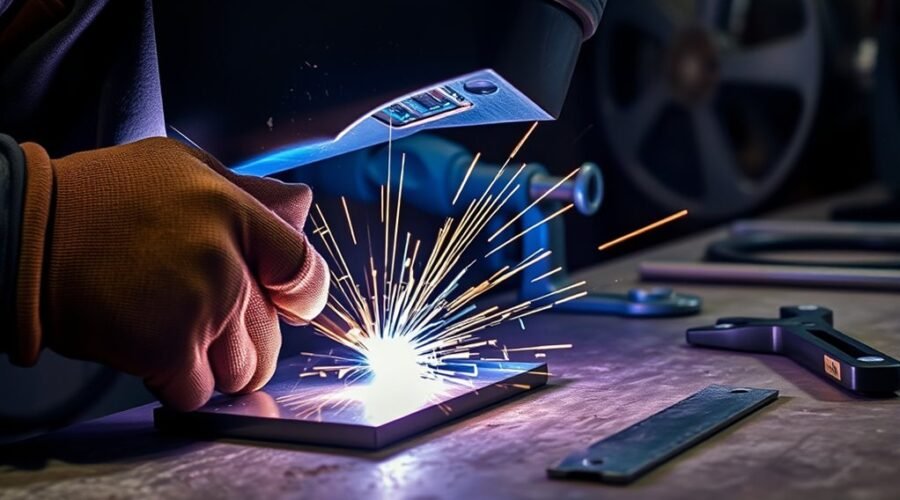
MIG welding is one of the most practical wire-feed welding processes for fabrication, automotive repair, maintenance, and production work. Formally known as Gas Metal Arc Welding (GMAW), it feeds a continuous consumable wire through a welding gun while shielding gas protects the molten weld pool. Good results depend on matching the wire, gas, polarity, voltage, wire feed speed, travel speed, and technique to the metal and joint.
Quick Answer
MIG welding joins metal with a continuously fed wire electrode and shielding gas. Beginners usually start on clean mild steel with solid wire, DCEP polarity, and an argon/CO₂ shielding-gas blend. Use the welder’s setup chart for voltage and wire speed, maintain steady gun position and travel speed, and always use proper PPE and ventilation.
Key Takeaways
- MIG welding, or GMAW, uses a continuously fed consumable wire and shielding gas to create the weld.
- Mild steel, stainless steel, and aluminum can all be welded with GMAW when the correct wire, gas, equipment, and procedure are used.
- Voltage, wire feed speed, travel speed, stickout, polarity, shielding gas, and joint preparation all affect weld quality.
- Short-circuit, globular, spray, and pulsed-spray transfer behave differently and are not interchangeable.
- Beginners should start from the machine manufacturer’s settings chart, run test beads, and change one variable at a time.
- Safety requires more than a welding helmet: use suitable clothing, gloves, safety glasses, ventilation, fire controls, and the correct filter shade for the work.
At a Glance
| Time Required | Allow roughly an hour for first-time setup, safety checks, and practice beads; developing consistent technique takes repeated practice. |
| Difficulty | Beginner-friendly for practice and noncritical work; structural, pressure-containing, and code work may require qualified procedures and personnel. |
| Tools Needed | MIG/GMAW welder, correct wire, shielding gas and flowmeter/regulator, gun and contact tip, work clamp, cleaning tools, PPE, and suitable fire protection. |
| Cost | Varies widely by machine and duty cycle. Recurring costs include wire, shielding gas, contact tips, nozzles, PPE, and metal preparation supplies. |
What Is MIG Welding?
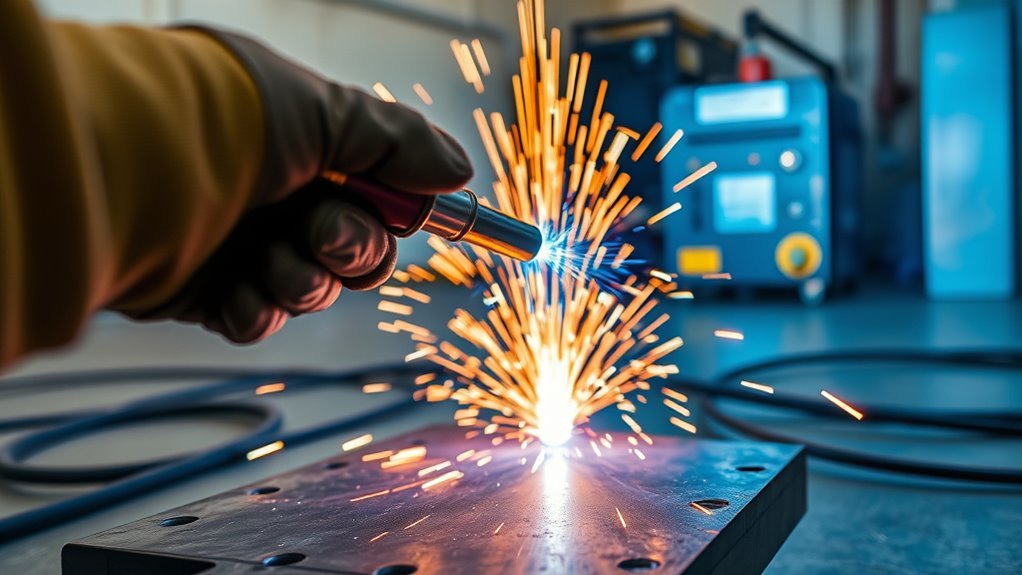
MIG welding is the common shop term for a type of Gas Metal Arc Welding (GMAW). An electric arc forms between a continuously fed consumable wire electrode and the workpiece. The arc melts the wire and base metal, creating a weld pool that solidifies into the joint.
The modern GMAW process was developed in 1948 and originally used inert shielding gas for non-ferrous metals. In everyday North American usage, “MIG” is often used broadly for GMAW even when the shielding mixture contains an active gas such as CO₂.
Most conventional GMAW machines use a constant-voltage power source. Wire feed speed and voltage work together to control arc behavior, deposition, penetration, and bead shape. Travel speed, electrode extension, shielding gas, joint fit-up, and operator technique also matter.
The major transfer modes are short circuit, globular, spray, and pulsed spray. Each produces different heat input, puddle behavior, deposition characteristics, and positional capability.
What Metals Can You MIG Weld?
GMAW is widely used on mild steel, stainless steel, and aluminum. With specialized filler wire, gas, equipment, and welding procedures, it can also be used on some nickel alloys, copper alloys, magnesium alloys, and bronzes.
Machine capability matters as much as the process name. A small 120-volt welder designed for sheet metal cannot be treated like a high-output industrial power source simply because both perform GMAW. Metal thickness, joint design, wire diameter, transfer mode, duty cycle, and available output determine the practical working range.
Mild Steel
Mild steel is usually the easiest material for a beginner. ER70S-6 is a common solid-wire choice because its deoxidizers provide useful tolerance for normal fabrication conditions, although the joint should still be cleaned to bright metal when practical.
Stainless Steel
Stainless steel requires filler wire and shielding gas matched to the alloy and procedure. Argon-rich gas blends with small additions of CO₂ or other gases are commonly used, but there is no single stainless mixture that fits every GMAW application.
Aluminum
Aluminum requires more specialized preparation because its oxide layer melts at a much higher temperature than the underlying aluminum. Degrease first, then remove oxide using a stainless-steel brush reserved for aluminum. Soft aluminum wire can be difficult to push through a long conventional liner, so a spool gun or push-pull system is often used.
For aluminum GMAW, Miller recommends 100% argon for typical applications and specifically warns against argon/CO₂ steel mixtures. Its aluminum guidance lists approximately 20–30 CFH as a common gas-flow range. Miller’s aluminum MIG guidance also explains why a spool gun shortens the wire-feed path.
Note: Do not choose shielding gas only by the base metal. Transfer mode, wire classification, joint requirements, and the manufacturer’s procedure all matter.
How MIG Welding Works
When the trigger is pressed, the welder feeds electrode wire through the gun, energizes the wire, and releases shielding gas. The wire approaches the grounded workpiece, an arc forms, and heat melts both the electrode and the joint surfaces.
A constant-voltage power source responds rapidly to changes in arc length. Wire feed speed strongly influences welding current, while voltage affects arc length and bead characteristics. These settings must be balanced rather than adjusted independently without regard to the other.
The shielding gas keeps atmospheric oxygen, nitrogen, and moisture away from the molten weld pool. Poor gas coverage can create porosity, oxidation, and an unstable arc. Dirty metal, excessive gun angle, leaks, drafts, and excessive electrode extension can create similar symptoms.
Common Shielding Gas Choices
| Application | Common Gas Approach | What to Know |
| Mild steel, short-circuit GMAW | 75% argon / 25% CO₂ is a common all-purpose choice | Good bead appearance and relatively low spatter for general fabrication. |
| Mild steel with 100% CO₂ | 100% CO₂ | Can provide deeper penetration but normally produces more spatter and a rougher bead than C25. |
| Carbon steel, spray or pulsed spray | Argon-rich mixture, typically at least 80% argon | Miller lists 90% argon / 10% CO₂ as a common pulsed-carbon-steel mixture. |
| Aluminum | Usually 100% argon; argon/helium may be used for some applications | Do not use CO₂-containing steel mixtures for ordinary aluminum GMAW. |
| Stainless steel | Procedure-specific argon-rich mixture | Match the gas to the filler metal, transfer mode, and required corrosion/mechanical properties. |
MIG Welding Gear Checklist
Reliable MIG welding starts with equipment matched to the work rather than one arbitrary amperage range.
- MIG/GMAW power source: Choose input power, maximum output, duty cycle, transfer capability, and material capability for the intended work.
- Welding gun and work lead: Both must be rated for the machine’s output and kept in good condition.
- Wire electrode: Match the classification and diameter to the base metal, thickness, transfer mode, and machine.
- Drive rolls and liner: Use components appropriate for the wire type and diameter.
- Correct contact tip and nozzle: The tip must match the wire diameter and feed smoothly.
- Shielding gas, cylinder, regulator, and flowmeter: Gas chemistry matters separately from cylinder size.
- Metal-preparation tools: Use a grinder, dedicated brush, scraper, or approved cleaner as appropriate.
- PPE: Welding helmet with appropriate filter shade, safety glasses, leather welding gloves, flame-resistant clothing, suitable footwear, and hearing protection where required.
- Fire protection: Keep combustibles away and have appropriate fire-control equipment available.
For common mild-steel work, Miller lists .023-inch wire for thinner material, .030-inch as a useful general-purpose size, and .035-inch for heavier work within the welder’s capacity. The machine’s door chart or manual should remain the primary setting reference.
How to Set Up a MIG Welder
A correct setup eliminates many problems before the arc starts. Do not begin by copying somebody else’s voltage and wire-speed numbers without checking your own machine, wire diameter, shielding gas, material, and joint.
1. Prepare a Safe Work Area
Remove combustible material from the welding zone, provide suitable ventilation, protect nearby people from arc radiation, and keep the work area dry and organized. Never rely on an open door alone if fumes can build up around your breathing zone.
2. Inspect the Welder, Gun, Cables, and Work Clamp
Look for damaged insulation, loose connections, worn contact tips, clogged nozzles, damaged gas hoses, and poor cable connections. A weak work-clamp connection can make an otherwise correct setup behave erratically.
3. Choose the Correct Wire and Gas
Match the electrode to the base metal. A common beginner combination for mild steel is ER70S-6 solid wire with 75% argon/25% CO₂. Aluminum normally requires aluminum filler wire and 100% argon, often with a spool gun or push-pull feeder.
4. Verify Polarity
Conventional solid-wire GMAW normally uses DCEP — direct-current electrode positive. Do not assume every wire-feed process uses the same polarity: some flux-cored wires require different polarity, so always follow the electrode label and welder manual.
5. Load the Wire Correctly
Install the spool, use the drive-roll groove that matches the wire diameter and type, thread the wire through the liner, and install the matching contact tip. Set spool-hub and drive-roll tension only high enough to feed consistently. Excessive tension can deform wire and contribute to feeding problems.
6. Connect the Shielding Gas
Secure the cylinder properly, connect the correct regulator/flowmeter and hose, and check for leaks. For mild-steel shop work, Miller gives roughly 20–25 CFH as a common starting range. Light-duty guidance may begin around 20 CFH. Aluminum guidance commonly uses about 20–30 CFH. Drafts, nozzle size, gas type, and equipment can change the needed flow.
A higher gas-flow number is not automatically better. Too little flow can lose shielding, while excessive flow can create turbulence and waste gas. Start with the equipment manufacturer’s recommendation.
7. Clean the Metal and Clamp to Clean Metal
Remove paint, heavy scale, oil, rust, and other contamination from the weld area when practical. Attach the work clamp to clean metal with a solid electrical connection.
8. Set Voltage and Wire Feed Speed From the Machine Chart
Use the chart inside the machine, the owner’s manual, or the manufacturer’s parameter guide. Settings depend on wire diameter, metal type and thickness, gas, joint, position, and process mode. Avoid treating one IPM or voltage value as correct for every 1/4-inch plate, for example.
9. Set Gun Position and Electrode Extension
For ordinary mild-steel GMAW, about 3/8 inch of wire stickout is a useful starting point. Stickout is the unmelted wire extending beyond the contact tip. Contact-tip-to-work distance includes the arc length and can differ by process; aluminum spray procedures commonly use a longer distance than short-circuit steel welding.
10. Run a Practice Bead and Fine-Tune
Make a bead on scrap of the same material and thickness. Watch and listen to the arc, inspect bead profile and penetration, and change one setting at a time. If several variables are changed together, it becomes difficult to identify what improved or worsened the weld.
Warning: Welding produces intense arc radiation, hot metal, sparks, fumes, and electrical hazards. OSHA requires appropriate eye and face protection and addresses ventilation for welding work. Never weld in a confined or poorly ventilated space without the required controls and training.
MIG Welding Transfer Modes Explained
Transfer mode describes how molten electrode metal crosses the arc into the weld pool. The mode is determined by a combination of current, voltage, wire, shielding gas, electrode diameter, and power-source characteristics.
| Mode | Typical Character | Common Use |
| Short circuit | Wire repeatedly contacts the weld pool; relatively low heat input. | Thin steel, root work, and many out-of-position applications. |
| Globular | Large irregular droplets; more spatter and less controlled transfer. | Usually avoided when cleaner short-circuit, spray, or pulse procedures are practical. |
| Spray | Fine droplets cross the arc without repeatedly shorting the wire to the pool. | Higher-deposition welding on suitable thicker material, usually with argon-rich shielding gas. |
| Pulsed spray | Alternates peak and background current to control droplet transfer. | Applications needing spray-like transfer with better heat and puddle control. |
Short Circuit Transfer
In short-circuit transfer, the wire repeatedly touches the weld pool, momentarily short-circuiting the arc. The current rises, the end of the wire melts away, the arc re-establishes, and the cycle repeats rapidly.
This mode operates at lower current and voltage than spray transfer and is well suited to thinner material and many vertical or overhead applications. Its lower heat input helps reduce burn-through risk.
Short-circuit transfer should not be described as automatically “spatter free.” Excessive stickout, incorrect voltage/wire-speed balance, contaminated metal, and unsuitable shielding gas can all increase spatter.
Globular Transfer
Globular transfer forms relatively large droplets at the wire tip that move irregularly into the weld pool. It sits between short-circuit and spray behavior and can produce substantial spatter and a less stable bead appearance.
Although globular transfer has industrial applications, it is usually not the transfer mode a beginner is trying to achieve when clean short-circuit or spray performance is available.
Spray Transfer Mode
Spray transfer sends many small molten droplets axially across the arc. It can produce a smooth bead, high deposition rate, strong fusion, and relatively low spatter when the procedure is correctly established.
Spray transfer requires sufficient current and an appropriate argon-rich shielding gas. Miller notes that carbon-steel spray and pulsed procedures generally need at least 80% argon; 90% argon/10% CO₂ is a common pulsed-steel mixture. Aluminum normally uses 100% argon or an argon/helium mixture.
Because conventional spray transfer creates a fluid, high-energy puddle, it is used primarily where the welding position and material thickness allow safe control of that heat.
Pulse Transfer Benefits
Pulsed-spray transfer alternates between a high peak current and a lower background current. The peak helps detach a controlled droplet while the background portion lowers average heat input compared with conventional spray operation.
The result can be less distortion, reduced spatter, improved puddle control, and broader positional capability. These advantages are especially useful for aluminum, stainless steel, thinner sections, and applications where conventional spray would produce too much heat.
Miller’s pulsed MIG guide provides material-specific shielding-gas guidance and explains how short-circuit, globular, spray, and pulsed-spray transfer differ.
MIG Welding Technique for Beginners
Use the Correct Work Angle
The work angle points the gun into the joint. A butt joint is commonly approached near the center of the joint, while a fillet weld requires the gun to divide heat appropriately between the two pieces. Unequal thicknesses may require directing more heat toward the heavier member.
Keep the Travel Angle Modest
For many GMAW applications, a travel angle around 5–15 degrees is a useful range. Extreme angles can reduce shielding effectiveness, increase spatter, and distort bead shape.
Push or Pull?
Gas-shielded MIG is commonly welded with a push technique, which provides good visibility and gas coverage. Aluminum GMAW is normally pushed. Procedure requirements can vary, so follow the filler-metal, machine, and welding-procedure guidance where specified.
Control Stickout
Excessive stickout changes electrical resistance, reduces heat delivered to the joint, and can weaken gas coverage. About 3/8 inch is a useful general starting point for ordinary mild-steel GMAW unless the procedure specifies otherwise.
Watch the Puddle, Not Only the Arc
A steady travel speed should keep the arc near the leading edge of the puddle while allowing both joint faces to fuse. Traveling too slowly can overheat thin material, create an oversized bead, or encourage cold lap. Traveling too quickly can leave a narrow bead with incomplete fusion.
Pro Tip: Practice on scrap that matches the actual material and thickness. Start with the manufacturer’s recommended settings, then change only one variable at a time so you can see exactly what each adjustment does.
MIG Welding Troubleshooting
Many MIG problems come from setup rather than lack of talent. Before radically changing machine settings, check shielding gas, metal cleanliness, work-clamp contact, wire feeding, contact-tip condition, and gun position.
| Problem | Common Causes | What to Check |
| Porosity | Poor gas coverage, drafts, leaks, dirty material, clogged nozzle, excessive gun angle or stickout | Gas flow, hoses, nozzle cleanliness, metal preparation, wind protection, gun angle, and electrode extension |
| Excessive spatter | Poor voltage/wire-speed balance, contamination, wrong gas, long stickout, poor consumables | Return to recommended settings, clean the joint, inspect tip/nozzle, and shorten excessive stickout |
| Burn-through | Too much heat, slow travel, excessive joint gap, thin material | Reduce heat according to the procedure, increase travel speed appropriately, and improve fit-up |
| Lack of fusion / cold lap | Settings too cold, poor gun angle, incorrect travel speed, arc trailing behind the puddle | Increase heat only as required, correct gun position, and keep the arc near the leading edge of the puddle |
| Irregular wire feeding | Wrong drive-roll groove, excessive or insufficient tension, worn tip, dirty liner, kinked gun cable | Inspect the entire wire path before changing voltage |
| Unstable arc | Poor work connection, wrong settings, inconsistent wire feeding, incorrect polarity | Clean the clamp location, confirm polarity, inspect the feeder, and return to the machine chart |
For a systematic defect guide, see Miller’s MIG weld-defect troubleshooting guidance.
MIG Welding Benefits, Limits, and Uses
MIG/GMAW combines continuous wire feeding with relatively high deposition rates and easy arc starting. That makes it useful for automotive work, general fabrication, manufacturing, structural fabrication under qualified procedures, and automated welding cells.
Key Benefits
- Fast deposition: Continuous wire minimizes electrode-change downtime.
- No flux slag with solid-wire GMAW: This reduces interpass and final cleanup compared with slag-producing processes.
- Broad material capability: Steel, stainless steel, aluminum, and other alloys can be welded with correct consumables and procedures.
- Good automation potential: Continuous wire feeding adapts well to mechanized and robotic systems.
- Accessible learning curve: Beginners can concentrate on gun position and puddle control without manually feeding a separate filler rod.
Common Limits
MIG welding depends on shielding gas, so strong airflow can disturb protection around the weld pool. Outdoor welding may require effective wind shielding or a different process where conditions cannot be controlled.
The equipment is also more complex than a basic stick-welding setup because the system includes a wire feeder, gun liner, drive rolls, contact tips, shielding-gas equipment, and additional consumables.
Solid-wire GMAW is less tolerant of heavy rust, oil, paint, mill contamination, and poor preparation than some flux-bearing processes. Cleaning remains important for reliable fusion and low porosity.
Thin material can suffer burn-through if the machine is set too hot or the operator travels too slowly. At the other end of the range, thick or safety-critical work requires enough machine capacity, proper joint preparation, and an appropriate qualified procedure rather than simply increasing wire speed.
MIG Welding Safety Essentials
MIG welding produces ultraviolet and infrared radiation, visible arc light, sparks, hot metal, fumes, gases, and electrical hazards. Safety should be treated as part of the welding procedure rather than as optional equipment.
- Protect eyes and face: Wear a welding helmet with a filter shade appropriate for the process and welding current, plus safety glasses with side protection.
- Cover exposed skin: Wear flame-resistant clothing, gloves, and suitable boots to protect against UV radiation, sparks, and hot metal.
- Control fumes: Use adequate general or local exhaust ventilation as required by the material, coating, workspace, and applicable regulations.
- Remove hazardous coatings where appropriate: Paints, plating, cleaners, oils, and other surface materials may create dangerous fumes when heated.
- Control fire hazards: Remove combustibles and inspect the area for hidden material that sparks or heat could ignite.
- Inspect electrical equipment: Do not weld with damaged leads, wet gloves, defective insulation, or unsafe connections.
- Treat confined spaces as a separate hazard: They require specific ventilation, atmospheric, access, and rescue precautions and should not be treated like ordinary shop welding.
OSHA’s eye and face protection requirements specify appropriate filter protection by welding operation and current. OSHA’s general welding requirements also address personnel protection and ventilation-related hazards.
How to Choose a MIG Welder and Consumables
The right MIG welder is the machine that matches the available electrical service, material, thickness range, production rate, transfer mode, and duty cycle. A single amperage range such as “30 to 200 A” is not a universal definition of a good welder.
What to Compare
- Input power: 120 V, 240 V, or industrial three-phase service
- Output range: Especially important for very thin and very thick work
- Duty cycle: How long the machine can weld at a stated output before cooling is required
- Wire capacity: Supported electrode diameters and spool sizes
- Aluminum capability: Spool-gun or push-pull compatibility where needed
- Transfer capability: Some machines support only basic short-circuit work, while advanced systems add pulse and synergic programs
- Service and consumables: Contact tips, liners, drive rolls, guns, and replacement parts should be readily obtainable
The original equipment example, the ESAB Warrior Edge 500 DX, illustrates why application matters. ESAB rates it to 500 A and specifies 380–575 V three-phase input, so it is a high-output industrial multiprocess power source rather than a typical beginner garage welder. See the ESAB Warrior Edge 500 DX specifications.
Wire selection also needs context. The original example, OK AristoRod 12.50, is a non-copper-coated solid carbon-steel wire designed for general fabrication and production applications. It can be a useful production consumable, but a beginner should first select a wire classification and diameter compatible with the base metal and welder. See ESAB’s OK AristoRod 12.50 data.
Cylinder volume should be chosen according to portability, run time, refill availability, and shop usage. A 40, 80, or 125 ft³ cylinder does not become suitable for steel merely because of its size; the gas mixture inside the cylinder is what determines process compatibility.
Frequently Asked Questions
Can You Teach Yourself MIG Welding?
You can learn basic MIG skills through a welder manual, reputable training material, supervised practice, and repeated work on scrap. Start with noncritical practice pieces and learn PPE, ventilation, setup, machine settings, joint preparation, and weld inspection first. Structural, pressure-containing, code-regulated, or safety-critical welding may require formal training, qualification, inspection, or an approved welding procedure.
Do Welders Make $100 an Hour?
A $100-per-hour employee wage is not typical in the United States. The U.S. Bureau of Labor Statistics reported a median annual wage of $53,750 for welders, cutters, solderers, and brazers in May 2025, while the highest 10% earned more than $77,530. Specialized contract billing can be much higher than an employee’s wage because a contractor’s rate may also cover equipment, insurance, travel, consumables, overhead, and business costs.
Can You Provide a Beginner’s Guide to MIG Welding?
Start by wearing proper PPE and preparing a ventilated, fire-safe area. Select the correct wire and shielding gas, verify polarity, load the wire and matching contact tip, secure and connect the gas cylinder, clean the metal, and clamp to clean metal. Set voltage and wire feed speed from the machine chart, maintain appropriate stickout and gun angle, run a test bead, and adjust one variable at a time.
Why Do Welders Lose Their Eyesight?
Welders do not inevitably lose their eyesight, but an unprotected welding arc can injure the eyes. Ultraviolet radiation can cause painful arc-eye injury, while intense visible and infrared radiation, sparks, and flying debris create additional hazards. Wear compliant eye and face protection and select a filter shade appropriate for the welding process and current; a single fixed shade is not correct for every GMAW job.
What Shielding Gas Should a Beginner Use for MIG Welding?
For ordinary mild-steel short-circuit GMAW, 75% argon/25% CO₂ is a common beginner-friendly all-purpose mixture. Straight CO₂ can also weld mild steel but normally creates more spatter. Aluminum typically uses 100% argon, while stainless-steel gas selection depends on the filler wire and transfer mode.
Can You MIG Weld Outside?
Yes, but shielding-gas MIG becomes unreliable when wind or drafts blow the gas away from the weld pool. Effective wind screens may help in mild conditions, but simply turning the gas flow excessively high is not a reliable solution. For exposed outdoor work, another welding process may be more practical.
Conclusion
MIG welding is fast, versatile, and approachable, but consistent results come from matching the entire system rather than chasing one voltage or wire-speed number. Select the correct wire and shielding gas, verify polarity, clean the joint, follow the welder’s parameter chart, maintain controlled stickout and gun position, and inspect each practice bead. Short-circuit, spray, globular, and pulsed transfer each behave differently, so the appropriate setup depends on the metal, thickness, position, and required weld quality. Above all, treat ventilation, eye protection, fire prevention, and electrical safety as part of the welding process itself.
Sources
- U.S. OSHA — Eye and Face Protection and General Welding Requirements — filter-shade, PPE, ventilation, and welding-safety requirements.
- Miller — MIG Welding Tips and Techniques for Beginners — GMAW operation, stickout, gas-flow starting guidance, machine settings, and basic technique.
- Miller — Guide to Pulsed MIG Welding — transfer modes and shielding-gas requirements for spray and pulsed welding.
- Miller — Troubleshooting Common MIG Weld Defects — porosity, lack of fusion, burn-through, spatter, and bead-shape troubleshooting.
- ESAB — Warrior Edge 500 DX and ESAB — OK AristoRod 12.50 — equipment and consumable specifications.
- U.S. Bureau of Labor Statistics — Welders, Cutters, Solderers, and Brazers — current U.S. employment and wage data.