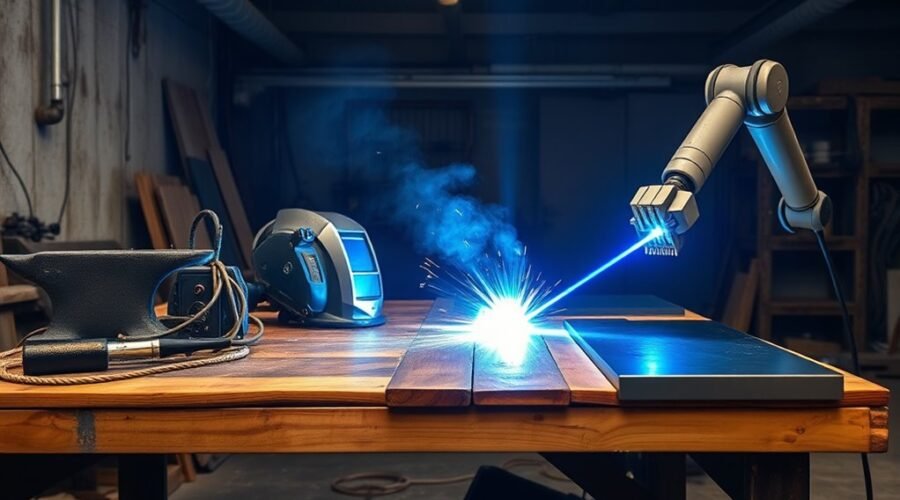
Welding has developed over thousands of years, from heated metal hammered together by ancient craftspeople to electric arcs, gas-shielded processes, lasers, robots, and data-driven manufacturing systems. No single person invented welding. Instead, a long series of discoveries—including the electric arc, consumable electrodes, shielding gases, automation, and solid-state joining—turned an ancient craft into a core industrial technology.
Quick Answer
The history of welding stretches from forge welding used thousands of years ago to practical electric arc welding in the 1880s, coated electrodes in the early 1900s, TIG in 1941, MIG in 1948, industrial welding robots in the late 1960s and 1970s, friction stir welding in 1991, and today’s sensor- and AI-assisted systems.
Key Takeaways
- Early welding relied on heat and pressure, especially forge welding used to join iron and other metals.
- Electric-arc experiments by Humphry Davy and Vasily Petrov in the early 1800s laid the scientific foundation for arc welding.
- Benardos, Olszewski, Slavyanov, Coffin, Thomson, and Kjellberg contributed different breakthroughs in carbon arc, metal-electrode, resistance, and coated-electrode welding.
- TIG and MIG transformed precision and production welding during the 1940s, while automation and robots later increased repeatability and throughput.
- Modern welding includes laser, hybrid, electron-beam, friction-stir, robotic, sensor-monitored, and increasingly data-driven processes.
What Is Welding?
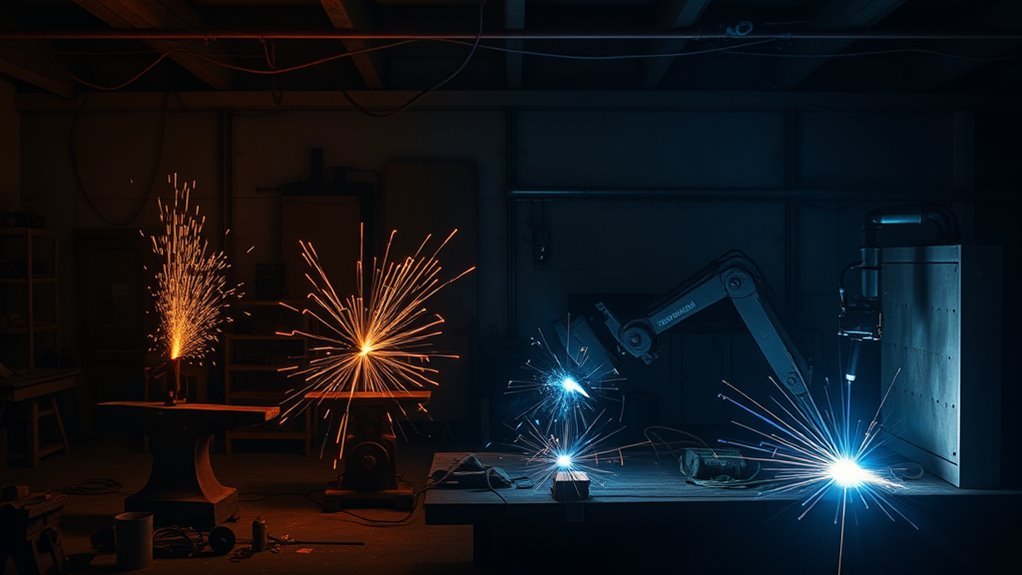
Welding is a group of joining processes that create a metallurgical bond between materials. Many familiar methods are fusion welding processes, which melt the base metal, but not every weld requires melting. Solid-state welding can create a bond through heat, pressure, deformation, or a combination of these while the base materials remain below their melting temperatures.
Welding is broader than simply melting two pieces of metal together: fusion welding melts the joint, while solid-state processes can create a weld without melting the base material.
This distinction separates welding from brazing and soldering. In brazing and soldering, the base materials remain solid while a lower-melting filler metal flows into the joint. The American Welding Society describes fusion and solid-state welding as different routes to the atomic bonding needed for a sound joint. See the AWS Welding Handbook discussion of welding physics.
Different welding processes use electric arcs, flames, electrical resistance, lasers, electron beams, friction, pressure, or other energy sources. Process selection depends on the base material, thickness, joint geometry, production volume, service conditions, and required weld quality.
For beginners, various welding processes offer different balances of ease of use, portability, deposition rate, and precision.
Safety: Welding history explains how the processes developed, but modern welding also requires control of fumes, radiation, heat, fire, electricity, and compressed gases. NIOSH recommends reducing exposure to welding emissions through appropriate engineering controls and work practices.
Welding History Timeline
| Period | Milestone |
|---|---|
| Around 3000 B.C. | Early pressure and forge-welding practices appear in Egypt and the eastern Mediterranean. |
| 1800–1802 | Humphry Davy and Vasily Petrov demonstrate important electric-arc phenomena. |
| 1881–1890 | Carbon-arc welding becomes practical; consumable metal-electrode methods follow. |
| Early 1900s | Coated electrodes improve arc stability and shielding; oxyfuel welding becomes practical. |
| 1920 | The all-welded motor vessel Fullagar is completed, and automatic wire-fed arc welding advances. |
| 1930s | Submerged arc welding gains industrial importance. |
| 1941 | Russell Meredith’s gas tungsten arc welding process becomes the basis of modern TIG welding. |
| 1948 | Battelle Memorial Institute develops modern gas metal arc welding, or GMAW/MIG. |
| 1950s | Flux-cored, plasma-arc, electron-beam, and other advanced processes expand the welding toolbox. |
| 1960s–1970s | Laser materials processing develops, while industrial spot- and arc-welding robots enter factories. |
| 1991 | TWI develops and patents friction stir welding as a solid-state joining process. |
| 2020s | Advanced sensors, machine learning, digital process models, robotic systems, and adaptive controls continue to expand welding automation. |
Welding in Ancient and Medieval Times
Welding long predates electricity. Archaeological evidence summarized by TWI places early pressure-welding practices around 3000 B.C. in Egypt and the eastern Mediterranean. Craftspeople heated small pieces of metal and hammered them together, creating joints through heat, pressure, and plastic deformation.
Ancient Metal Joining
Early metalworkers used variations of pressure and forge joining for jewelry, tools, weapons, and other objects. The exact origin cannot be reduced to one inventor or one workshop because metalworking techniques developed gradually across different regions.
As ironworking improved, smiths learned to heat iron to a highly plastic condition, clean or disrupt surface scale, and hammer pieces together until a solid bond formed. These techniques established the basic logic of forge welding.
Ancient Indian ironwork also shows the scale that forging and joining could reach. Metallurgical literature on the Iron Pillar of Delhi, generally dated to around the fifth century A.D., describes a massive wrought-iron structure assembled from smaller iron masses through forging and welding.
This early craftsmanship eventually developed into the more systematic welding processes and equipment used in later centuries.
Medieval Forge Welding
During the medieval period, blacksmiths used forge welding to make and repair iron tools, agricultural equipment, weapons, chains, hardware, and structural components. Success depended on controlling temperature, surface condition, hammering force, and the fit between the pieces.
Forge welding was valuable because a smith could build a larger or more complicated object from smaller pieces of workable iron. It also allowed damaged items to be repaired rather than replaced.
By the Renaissance, written metallurgical works began documenting practices that metalworkers had learned through generations of experience. Vannoccio Biringuccio’s De la pirotechnia, published in 1540, is one notable early printed metallurgy text discussing metalworking techniques.
How Arc Welding Emerged in the 1800s
The scientific foundation for arc welding appeared at the beginning of the 19th century. Humphry Davy produced an electric arc between carbon electrodes in 1800 and published results in 1801. Russian scientist Vasily Petrov demonstrated a continuous electric arc in 1802 and recognized its ability to generate enough heat to melt metals. Davy later demonstrated a continuous arc in 1808.
These experiments did not immediately produce practical welding machines. Reliable electrical equipment, electrodes, process control, and techniques for protecting molten metal still had to develop.
In 1881, Nikolai Benardos, working from earlier arc experiments, demonstrated a practical carbon-arc welding approach. Benardos and Stanisław Olszewski later obtained patents, including a British patent in 1885 and a U.S. patent in 1887.
The next major change was the move from a non-consumable carbon electrode toward consumable metal electrodes. Nikolai Slavyanov developed a metal-electrode method in 1888, while American inventor C. L. Coffin patented a consumable metal-electrode welding method in 1890. These developments moved arc welding closer to processes recognizable today.
Meanwhile, Edmund Davy had discovered acetylene in 1836. Practical oxyacetylene welding required suitable gas production and torch technology, so its major industrial impact came around the turn of the 20th century rather than immediately after the gas was discovered.
The evolution of reliable electrodes and power supplies also made steady arc performance increasingly important.
Coated Electrodes, Resistance Welding, and Early Industrial Welding
Several important branches of welding developed at roughly the same time. Elihu Thomson obtained patents for resistance-welding technology beginning in the 1880s. Resistance welding creates heat through electrical resistance at the joint and became especially important for sheet-metal production.
Arc welding also improved as engineers learned to protect and stabilize the arc. Early coated electrodes appeared around 1900, while Swedish engineer Oscar Kjellberg developed influential coated-electrode technology in the early 20th century. The coating helped stabilize the arc and protect the weld metal from atmospheric contamination, contributing directly to the evolution of modern shielded metal arc welding.
Thermite welding, developed by Hans Goldschmidt in the 1890s, created another specialized route to joining heavy sections. Its intense exothermic reaction became particularly useful for applications such as rail joining.
How the World Wars Advanced Welding
World War I accelerated interest in welding because military production and repair demanded faster ways to fabricate ships, aircraft, weapons, and equipment. Arc and oxyfuel processes gained practical experience under industrial conditions, although riveting remained dominant in many large structures.
One important milestone followed immediately after the war. The British motor vessel Fullagar was completed and launched in 1920 with an all-welded hull. Contemporary reporting described a vessel constructed without hull rivets. Lloyd’s Register Foundation identifies Fullagar as a pioneering fully welded ocean-going vessel. See the Lloyd’s Register Foundation history of Fullagar.
Fullagar’s 1920 launch showed that an ocean-going metal hull could be constructed by welding instead of relying on thousands of structural rivets.
Automatic arc welding also advanced during this period. In 1920, P. O. Nobel of General Electric developed a system that continuously fed electrode wire while regulating the arc. During the 1930s, submerged arc welding emerged as an important high-deposition process for pipe, shipyard, and heavy fabrication work.
World War II pushed welded fabrication to a much larger scale. Welding became central to rapid construction of ships, vehicles, armaments, pipelines, aircraft components, and industrial equipment. Prefabricated welded sections also helped manufacturers reorganize production away from older all-riveted construction methods.
As welding technology diversified, equipment capable of supporting several processes eventually evolved into modern multi-process welders.
How MIG, TIG, and Stick Welding Developed
Stick, TIG, and MIG welding did not appear at the same time. Each developed from earlier discoveries involving electrodes, electric arcs, shielding, and power control.
Stick Welding Origins
The roots of shielded metal arc welding (SMAW), commonly called stick welding, extend back to the consumable metal-electrode work of Slavyanov and Coffin in the late 1880s and 1890. Those early electrodes were not yet equivalent to modern flux-coated stick electrodes.
The major improvement came from electrode coatings. Early experiments around 1900 were followed by Oscar Kjellberg’s coated-electrode work in the early 20th century. Flux coatings improved arc stability and produced gases and slag that helped protect the molten weld metal.
This combination made stick welding practical for fabrication, construction, maintenance, and field repair because the electrode carries its own shielding system rather than requiring a separate shielding-gas cylinder.
- Portable equipment makes SMAW useful for field work.
- Covered electrodes are available for many steels and specialized applications.
- The process works in multiple welding positions when the correct electrode and procedure are used.
- Wind is generally less disruptive to SMAW than to externally gas-shielded MIG or TIG welding.
TIG Welding Emergence
Gas tungsten arc welding, commonly called TIG welding, was perfected in 1941 by Russell Meredith while working at Northrop. The early process was known as Heliarc because helium was used as the shielding gas.
TIG uses a non-consumable tungsten electrode to create the arc. Filler metal, when required, is normally added separately. This arrangement gives the welder close control of the arc and weld pool, making TIG valuable for thin sections, stainless steel, aluminum, reactive metals, and applications where precise weld appearance and heat control matter.
MIG Welding Emergence
Gas metal arc welding (GMAW), commonly called MIG when an inert shielding gas is used, was developed by Battelle Memorial Institute in 1948 under sponsorship from Air Reduction Company. The process was patented for aluminum welding in the United States in 1949.
MIG/GMAW feeds a continuous consumable wire electrode through the welding gun while shielding gas protects the arc and weld pool. Continuous wire feeding gives the process high deposition potential and makes mechanization easier than with individual stick electrodes.
The process became increasingly useful for steel after carbon dioxide and mixed shielding gases made gas-metal arc welding more economical. Modern machines can produce high-quality welds when wire, gas, voltage, wire-feed speed, travel speed, and joint preparation are matched correctly.
| Process | Core Feature | Typical Strength |
|---|---|---|
| Stick / SMAW | Flux-coated consumable electrode | Portable and versatile for construction and repair |
| TIG / GTAW | Non-consumable tungsten electrode with shielding gas | High control and clean, precise welds |
| MIG / GMAW | Continuously fed wire electrode with shielding gas | High productivity and easy mechanization |
Other Major 20th-Century Welding Processes
The history of welding extends well beyond MIG, TIG, and stick. Several other processes opened new industrial applications during the 20th century.
- Submerged arc welding: developed around 1930 for high-deposition automated welding, especially on long seams and heavy sections.
- Flux-cored arc welding: developed commercially in the 1950s, combining continuous wire feeding with flux inside a tubular electrode.
- Plasma arc welding: developed in the 1950s using a constricted plasma arc for concentrated heat and precise welding.
- Electron-beam welding: emerged as a high-energy-density process in the 1950s, enabling deep, narrow welds in specialized manufacturing.
- Friction welding: advanced through the mid-20th century as a solid-state way to join components using mechanically generated heat and pressure.
These developments show why welding history is not a straight line from one invention to another. Different processes evolved to solve different problems involving thickness, productivity, material compatibility, heat input, portability, and joint quality.
How Lasers and Robots Changed Welding
The invention of the working laser by Theodore Maiman in 1960 created a new high-energy-density tool for materials processing. Laser welding did not instantly become an industrial process in 1960; welding applications developed during the following years as higher-power lasers and better beam-control systems became available. TWI records deep-penetration laser-welding demonstrations around 1970.
A focused laser can deliver a high concentration of energy to a small area. In suitable applications, this allows narrow welds, relatively small heat-affected zones, high travel speeds, and precise automation. Actual performance depends on the laser type, power, material, thickness, joint fit-up, beam delivery, and process settings.
Hybrid laser-arc welding later combined a laser beam with an arc process. The two heat sources can complement each other, allowing greater penetration or productivity in some joints while retaining filler-metal capability. The benefits are application-specific rather than universal.
Robotic Welding History
Industrial welding robots arrived earlier than the 1980s. According to the International Federation of Robotics historical timeline, General Motors installed spot-welding robots at its Lordstown plant in 1969. In 1974, arc-welding robots were already operating in Japan, including systems used to fabricate motorcycle frames.
By the mid-1970s, robots were already performing both spot-welding and arc-welding production tasks—years before the large expansion of robotic welding during the 1980s and later decades.
Robotic systems improved repeatability, cycle consistency, reach, and operator separation from repetitive heat and fume exposure. Later generations added seam tracking, machine vision, offline programming, force sensing, coordinated positioners, and digital process monitoring.
Automation did not eliminate the need for welding expertise. Engineers and technicians still have to select the process, qualify procedures, design fixtures, program or teach paths, manage consumables, inspect welds, and respond to variation in real production.
Related fabrication technologies, including modern plasma cutter technology, have also expanded the speed and flexibility of metal fabrication.
Solid-State Welding and Friction Stir Welding
One of the most important modern reminders that welding does not always require melting is friction stir welding (FSW). TWI developed and patented FSW in 1991.
The process uses a rotating, non-consumable tool that enters the joint between rigidly clamped workpieces. Friction and deformation heat the material enough to soften it without melting it. The rotating tool stirs and consolidates the softened material behind itself, producing a solid-state joint.
FSW became especially important for aluminum structures and has been applied in transportation, marine, aerospace, and other manufacturing sectors. Research and development have also extended it to materials such as magnesium, copper, titanium, and steel.
Note: Calling friction stir welding “emerging” is now misleading. The process dates to 1991 and has decades of industrial use, although new tools, materials, joint configurations, monitoring methods, and applications continue to be developed.
Where Welding Technology Is Going
Modern welding development is increasingly focused on better process sensing, automation, repeatability, energy control, digital integration, and the ability to join difficult combinations of materials.
Robotic welding continues to expand from high-volume automotive work into flexible cells, collaborative systems, and applications where vision or seam-tracking sensors help compensate for real-world part variation.
Laser and hybrid welding continue to benefit from improved beam control, higher-power sources, process monitoring, and integration with automated manufacturing systems.
Solid-state processes remain important where limiting melting, distortion, or metallurgical changes provides an advantage. Friction stir welding is a leading example.
Machine learning and data-driven process control are also active research areas. Research published in 2025 has examined physics-informed and data-driven frameworks for robotic welding, as well as machine-learning models for weld-quality prediction. These systems can analyze process signals and support parameter optimization, defect prediction, or adaptive control, although their maturity depends on the specific process and production environment. See this 2025 Nature Communications study on data-driven robotic welding.
Inspection is developing alongside welding itself. Cameras, electrical signals, acoustic data, thermal imaging, radiography, and other sensors can feed quality-control systems before, during, or after welding. The long-term trend is toward earlier detection of process drift and better traceability rather than relying only on final inspection.
Modern TIG systems also continue to evolve through improved power electronics, waveform control, pulse modes, and AC and DC capabilities for different metals and applications.
Frequently Asked Questions
Why Do Welders Drink Milk After Welding?
Some welders traditionally drank milk because they believed it could protect them from welding fumes or metal fume fever. Milk can provide normal dietary nutrients and fluids, but it should not be treated as protection from inhaled welding fumes. NIOSH guidance focuses on controlling exposure with ventilation, appropriate work practices, respiratory protection when required, and other occupational controls. See the NIOSH welding-fume guidance.
When Was Laser Welding Invented?
The laser itself was demonstrated by Theodore Maiman in 1960. Laser welding developed afterward as engineers created higher-power laser systems suitable for materials processing. Experimental deep-penetration laser welding was demonstrated around 1970, and industrial applications expanded as laser power, reliability, optics, and automation improved.
What Two Metals Cannot Be Welded Together?
There is no simple universal pair of metals that can never be joined by any welding process. Some combinations are extremely difficult. Copper and aluminum, for example, have very different thermal properties and can form brittle intermetallic compounds during fusion welding. Even so, researchers and manufacturers can join Cu/Al combinations with carefully controlled resistance, laser, TIG, friction-based, diffusion, or other specialized techniques. The correct method depends on joint design and required performance.
Is Forge Welding Stronger Than Other Welds?
Not inherently. A well-made forge weld can produce a strong joint, but weld strength depends on the metals, joint design, surface preparation, welding procedure, heat treatment, defects, loading direction, and quality control. MIG, TIG, stick, laser, resistance, and solid-state processes can also produce very strong joints when correctly designed and qualified.
Who Invented Welding?
No single person invented welding. Forge welding developed thousands of years ago. Humphry Davy and Vasily Petrov helped establish electric-arc science; Benardos and Olszewski developed practical carbon-arc welding; Slavyanov and Coffin advanced metal electrodes; Thomson developed resistance welding; Kjellberg improved coated electrodes; and later inventors created TIG, MIG, laser, friction-stir, and other processes.
When Were TIG and MIG Welding Invented?
Modern TIG welding was perfected by Russell Meredith in 1941. Modern GMAW/MIG was developed by Battelle Memorial Institute in 1948 and was patented for aluminum welding in the United States in 1949. Both processes built on earlier experiments with arcs, tungsten electrodes, shielding gases, and consumable wire.
Conclusion
Welding evolved through many separate discoveries rather than one invention. Ancient smiths used heat and pressure; 19th-century scientists learned to create and control electric arcs; early industrial inventors developed carbon and metal electrodes; coated electrodes, resistance welding, oxyfuel welding, TIG, MIG, and submerged arc expanded what manufacturers could build.
The second half of the 20th century added lasers, electron beams, plasma processes, advanced automation, and industrial robots. Friction stir welding then demonstrated how a modern high-performance weld could be created without melting the base metal at all.
Today, welding technology continues to develop through better power electronics, sensors, robotics, high-energy-density processes, solid-state joining, digital inspection, machine learning, and adaptive process control. The tools have changed dramatically, but the objective remains the same: create a reliable joint suited to its material, load, environment, and manufacturing requirements.
Sources
- TWI — The History of Welding — historical milestones including early forge welding, arc welding, TIG, MIG, and later processes.
- American Welding Society — Physics of Welding and Cutting — distinction between fusion welding and solid-state welding.
- International Federation of Robotics — Robot History — early industrial spot-welding and arc-welding robot milestones.
- CDC/NIOSH — Welding Fumes and Manganese — welding-fume exposure and occupational health guidance.
- TWI — Friction Stir Welding — 1991 invention and solid-state process principles.
- Nature Communications — Data-Driven Robotic Welding Research — current work on physics-informed and data-driven welding systems.