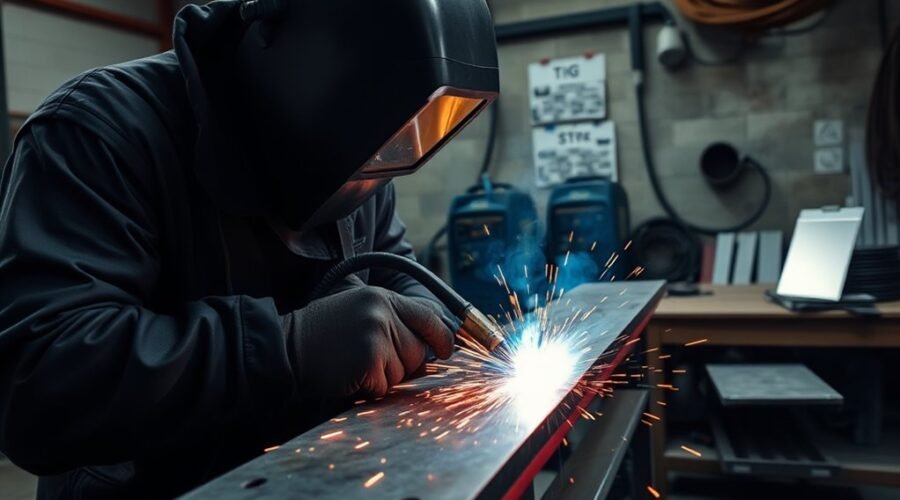
Welding processes differ mainly in how they create heat, feed filler metal, and shield the molten weld pool from the atmosphere. For most shop and field work, the key choices are MIG/GMAW, TIG/GTAW, stick/SMAW, and FCAW, while plasma, submerged arc, laser, and electron beam welding serve more specialized needs. The right process depends on the metal, thickness, weld position, environment, finish, production rate, and operator skill.
Quick Answer
MIG is usually the easiest starting point for clean shop work, TIG gives the most control on thin or high-finish joints, stick is rugged and portable for field repair, and self-shielded FCAW combines wire-feed productivity with outdoor capability. Plasma and laser welding are better suited to controlled, specialized production.
Key Takeaways
- Match the process to the base metal, joint, thickness, position, environment, and required quality rather than choosing by familiarity alone.
- Gas-shielded MIG and TIG need protection from wind; stick and self-shielded FCAW are better suited to exposed field conditions.
- TIG favors precision and appearance, while MIG and FCAW usually provide higher productivity on fabrication work.
- FCAW has self-shielded and gas-shielded versions; only the self-shielded type works without an external shielding-gas cylinder.
- Specialized processes such as PAW, SAW, LBW, and EBW trade portability for tighter process control, automation, or high production rates.
What Are the Main Welding Processes?
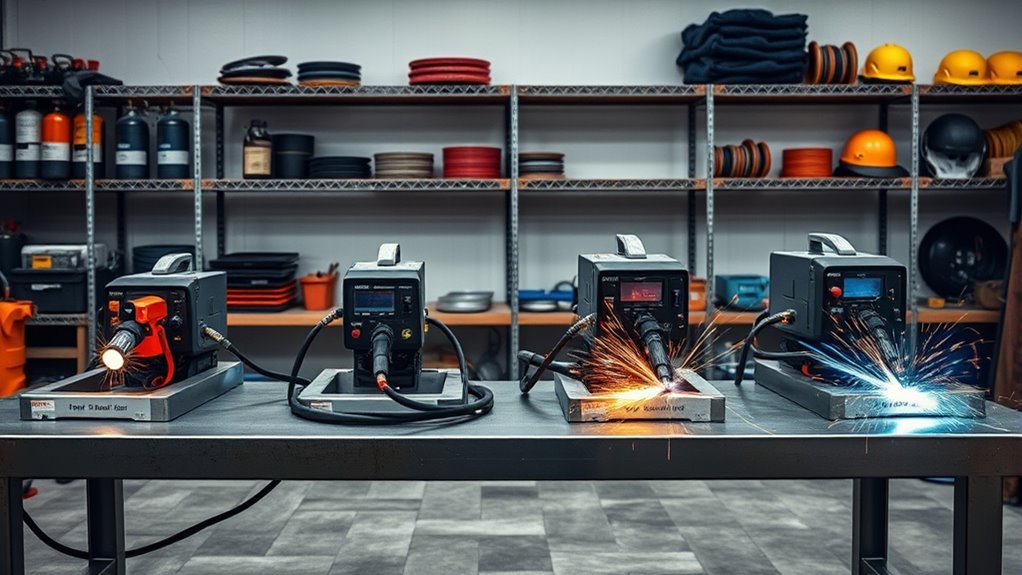
The main welding processes use different combinations of an arc or beam, an electrode or filler metal, and a shielding method. The TWI welding-process classification groups welding broadly into arc, gas, power-beam, resistance, and other process families, while practical process selection also depends on material, product form, quality requirements, mechanization, cost, and available skills.
For everyday fabrication, the four most familiar arc processes are GMAW/MIG, GTAW/TIG, SMAW/stick, and FCAW. PAW, SAW, laser beam welding, and electron beam welding extend the range for precision, heavy plate, or automated production.
| Process | How it works | Where it fits best | Main limitation |
|---|---|---|---|
| MIG/GMAW | Continuous solid wire plus shielding gas | General shop fabrication and production | Wind can disrupt gas coverage |
| TIG/GTAW | Non-consumable tungsten; filler added separately when needed | Thin material, root work, precise or visible welds | Lower deposition and greater skill demand |
| Stick/SMAW | Flux-coated consumable rod creates shielding gas and slag | Construction, maintenance, field repair | Slag removal and electrode changes slow production |
| FCAW | Continuous tubular wire filled with flux | Structural and heavy fabrication | More fumes and slag than solid-wire GMAW |
| PAW | Constricted plasma arc | Controlled precision and mechanized work | More complex torch and setup |
| SAW | Continuous wire under granular flux | Long seams and heavy plate | Limited portability and position flexibility |
| LBW/EBW | Focused laser or electron beam | Automated precision and high-value production | Specialized equipment and process control |
These methods are not interchangeable. A process that excels on thin stainless in a controlled shop may be a poor fit for windy structural repair, and a rugged field process may be unnecessarily slow for repetitive production. For many general projects, MIG welders are attractive because continuous wire feed keeps the workflow simple.
MIG Welding: Fast, Easy, and Versatile
MIG welding, commonly used as a shop term for Gas Metal Arc Welding (GMAW), feeds a continuous consumable wire through the gun while shielding gas protects the weld pool. It is fast to learn compared with processes that require separate filler control, and it scales well from hobby work to production fabrication.
The GMAW/MIG process described by TWI uses a continuously fed wire electrode and shielding gas. That arrangement supports high deposition and productivity on materials such as carbon steel, stainless steel, and aluminum when the wire, gas, polarity, and machine setup match the job.
MIG is most comfortable in a controlled environment because wind can disturb the shielding-gas envelope and cause porosity. Outdoor use is possible with wind protection, but if the job is routinely exposed to wind, stick or self-shielded FCAW is usually a more practical choice.
For a home or small fabrication shop, a machine with multi-process capability can be useful when one project favors wire feed and another needs stick or TIG.
TIG Welding: Precision for Clean Welds
TIG welding, or Gas Tungsten Arc Welding (GTAW), uses a non-consumable tungsten electrode to create the arc while an inert gas protects the weld. Filler metal is added separately when needed, giving the operator unusually fine control over heat and deposit size.
The TWI GTAW/TIG guide notes that the small, intense arc is well suited to high-quality precision welding and thin sections. The tradeoff is productivity: manual TIG is generally slower because filler is added separately and the operator must coordinate torch, arc length, filler, and often current control.
TIG works especially well on stainless steel, aluminum, titanium, nickel alloys, and other jobs where contamination, heat input, and bead appearance matter. The ability to choose appropriate AC and DC capabilities also affects which materials a TIG power source can handle effectively.
TIG Setup Essentials
A sound TIG setup starts with a clean joint, the correct tungsten type and size, suitable shielding gas, and a current range that fits the metal and thickness. Because the tungsten does not supply filler metal, the operator can run an autogenous weld where appropriate or add a separate filler rod only when the joint requires it.
| Element | Purpose | Effect |
|---|---|---|
| Tungsten | Creates a stable, focused arc | Controls arc behavior and weld quality |
| Shielding gas | Protects the molten pool | Limits oxidation and contamination |
| Welding current | Controls heat input | Affects penetration and distortion |
| Filler rods | Add weld metal as needed | Controls joint fill and chemistry |
Surface preparation matters more with TIG than with processes that tolerate mill scale or light contamination. Oil, oxide, paint, rust, and moisture can destabilize the arc or contaminate the weld, so clean the joint and filler before welding.
Clean Weld Advantages
TIG can produce smooth, low-spatter welds because it uses a non-consumable tungsten and no flux. With clean material and correct gas coverage, the operator can maintain a narrow, controlled arc and add only the filler needed for the joint.
That control is valuable for visible assemblies, thin stainless, aluminum, root passes, aerospace components, medical fabrication, and other work where bead shape or heat input matters. It does not mean every TIG weld is automatically stronger; joint design, penetration, filler selection, procedure, and operator technique still determine performance.
Stick Welding: Tough Jobs and Outdoor Work
Stick welding, or Shielded Metal Arc Welding (SMAW), uses a flux-coated consumable electrode that supplies filler metal and creates protective gas and slag as it burns. Because it does not rely on bottled shielding gas at the arc, it is portable and well suited to construction, maintenance, and field repair.
SMAW tolerates wind and less-than-perfect surfaces better than gas-shielded MIG or TIG, but “tolerant” does not mean surface preparation can be ignored. Removing oil, heavy rust, paint, moisture, and loose contamination still improves arc stability and reduces defects.
- Choose an electrode that matches the base metal, position, joint, and required properties.
- Set the current and polarity for that electrode rather than using one setting for every rod.
- Keep the arc length, travel angle, and travel speed consistent to control slag and fusion.
- Remove slag between passes before depositing more weld metal.
Stick welding also demands practice. Arc starts, electrode length changes, slag control, and out-of-position welding add difficulty compared with basic MIG. For demanding sites, the best jobsite ruggedness matters as much as maximum amperage.
FCAW Welding: Speed for Heavy Fabrication
Flux-Cored Arc Welding (FCAW) uses a continuously fed tubular wire filled with flux. It combines wire-feed productivity with flux-based shielding and slag, making it valuable for structural work, shipbuilding, heavy fabrication, and field applications.
The critical distinction is that FCAW comes in self-shielded and gas-shielded forms. The Miller FCAW guide explains that self-shielded FCAW does not need external shielding gas, while gas-shielded FCAW does. That means the common claim that “flux core needs no gas” is true only for FCAW-S.
Both forms produce slag that must be removed, and FCAW generally produces more fumes than solid-wire GMAW. In return, it can deliver strong penetration and high deposition on thicker steel. Wire classification, diameter, polarity, shielding gas, and position capability must match the procedure.
Using the correct flux core welding wires matters because a wire designed for self-shielded outdoor work can have very different operating requirements from a gas-shielded structural wire.
FCAW Speed Benefits
FCAW can place weld metal quickly because the electrode feeds continuously and many wires are designed for high-deposition fabrication. The exact rate is not a universal property of FCAW; it changes with wire diameter, wire feed speed, current, efficiency, position, and procedure.
For example, the ESAB Dual Shield T-75 data lists a 20 lb/h deposition rate for one 3/32-inch gas-shielded wire at a specified high-current setting. That figure shows what a particular industrial setup can achieve; it should not be treated as a standard rate for every FCAW machine or wire.
- Continuous wire feed reduces stops for electrode changes.
- High-deposition wires can shorten fill time on large joints.
- Self-shielded wires keep working where wind makes gas shielding difficult.
- Deep penetration can reduce the number of passes on suitable joints and procedures.
Heavy Fabrication Applications
FCAW is especially useful where large weld volumes, structural steel, and field conditions make productivity important. Gas-shielded FCAW is common in controlled fabrication environments, while self-shielded FCAW is valuable for outdoor construction and repair.
The process is not automatically the best option for every thick section. Joint design, code requirements, position, consumable classification, hydrogen control, required toughness, and available equipment can favor FCAW, SMAW, GMAW, or SAW. For repetitive heavy plate and long seams, submerged arc welding may offer even higher automation and throughput.
PAW and LBW: Precision Welding for Specialized Jobs
Plasma Arc Welding (PAW) and Laser Beam Welding (LBW) use concentrated heat sources to create narrow, controlled welds. They are most useful where repeatability, precision, low distortion, or automation matters more than portability.
PAW resembles TIG but constricts the arc through a nozzle, producing a stiffer, more concentrated plasma jet. This can improve arc stability and penetration control, especially in mechanized work. The process adds torch complexity and requires careful control of plasma gas, shielding gas, current, and travel.
Laser welding focuses energy into a small area. The TWI laser-welding overview describes the process as a high-productivity option that can produce deep, narrow welds with relatively low heat input and distortion. It is commonly automated and used in automotive, aerospace, medical-device, and other precision manufacturing.
Electron Beam Welding (EBW) is another power-beam process used for specialized, highly controlled joining. Conventional EBW is typically carried out in a vacuum and is heavily automated, which makes it powerful for high-value work but far less practical for ordinary field fabrication.
- PAW suits controlled arc welding where a constricted plasma jet improves precision.
- LBW suits high-speed automated joints with tight fit-up and low-distortion requirements.
- EBW suits specialized components where deep penetration and a controlled environment justify complex equipment.
- These processes are usually chosen for manufacturing capability, not as general substitutes for MIG, TIG, stick, or FCAW.
Modern inverter technology can make conventional arc power sources lighter and more controllable, but it does not turn a general multiprocess machine into a PAW, LBW, or EBW system.
How to Choose a Welding Process by Material
Base metal is one of the first filters for process selection because different alloys respond differently to heat, shielding, filler chemistry, and surface oxides. Thickness and joint design still matter, so no material has one universally correct welding process.
| Material | Common process choices | What drives the choice |
|---|---|---|
| Carbon steel | MIG/GMAW, stick/SMAW, FCAW, SAW | Shop vs. field work, thickness, position, production rate |
| Stainless steel | TIG/GTAW, MIG/GMAW, FCAW, stick/SMAW | Heat control, finish, corrosion performance, filler compatibility |
| Aluminum | TIG/GTAW, MIG/GMAW | Thickness, oxide control, production speed, appearance |
| Nickel and reactive alloys | Often TIG/GTAW; other processes where qualified | Cleanliness, shielding, filler match, heat input |
| Cast iron | Often stick/SMAW for repair with suitable electrodes | Iron grade, cracking risk, preheat strategy, machinability |
MIG can be efficient for carbon steel and aluminum where wire-feed speed and production matter. TIG is often preferred on stainless steel, aluminum, and reactive alloys when thin sections, appearance, or precise heat control matter more than deposition rate.
Stick remains useful for carbon-steel field repair and some cast-iron repairs with the correct electrode and procedure. FCAW is strong on structural carbon steel, especially where high deposition or outdoor capability is important. Understanding welding process versatility helps when you need one machine to cover more than one kind of project.
Best Welding Processes for Each Job Site
Job-site conditions can eliminate a process before metal type does. Wind, access, available power, portability, weld position, production volume, and required cleanup all affect which process is practical.
- Controlled indoor fabrication: MIG/GMAW is efficient for clean, repeatable work, while gas-shielded FCAW can handle heavier structural fabrication.
- Outdoor construction and repair: Stick/SMAW or self-shielded FCAW avoids dependence on an external gas shield at the arc.
- Thin, visible, or high-spec joints: TIG/GTAW gives the operator fine control over arc and filler addition.
- Heavy plate and long repetitive seams: FCAW or SAW may reduce cycle time where the joint and position suit the process.
- Automated precision production: PAW, LBW, or EBW may be justified when repeatability and low distortion outweigh equipment complexity.
TIG machines with AC/DC functionality can cover a broader mix of ferrous and non-ferrous work, but process capability still depends on amperage range, torch setup, gas, filler, and operator skill.
How to Choose the Right Welding Process
Choose the welding process by working from the joint requirements outward. Start with the base metal and thickness, then rule out methods that do not fit the environment, position, quality requirement, production rate, or available equipment.
- Identify the base metal. Confirm the alloy or material family before choosing filler and process.
- Check thickness and joint design. Thin sheet, open-root pipe, thick plate, and long fillet welds favor different processes.
- Consider the environment. Wind is a major limitation for gas-shielded MIG and TIG unless the work area is protected.
- Define the required quality and appearance. A visible stainless joint has different priorities from a hidden structural fillet.
- Match the weld position. Confirm that the chosen electrode or wire is classified and practical for flat, horizontal, vertical, overhead, or pipe work.
- Balance skill and production rate. MIG is often easier to start with; TIG takes more coordination; stick and FCAW need solid puddle and slag control.
- Check the governing procedure or code. Structural, pressure, pipeline, and other critical work may require a qualified WPS, approved consumables, and qualified welders.
Budget belongs near the end of the decision, not the beginning. A cheaper machine can become the expensive choice if it cannot supply the process, duty cycle, polarity, or current range the joint requires. If TIG fits the work, comparing TIG welders under $1,000 can help narrow equipment choices after the process requirements are clear.
Welding Safety Applies to Every Process
Every welding process can expose you to arc radiation, hot metal, sparks, fire hazards, and fumes or gases. The exact risk changes with the process, base metal, coatings, consumables, ventilation, and work area, so safety controls must match the job rather than the process name alone.
Warning: Do not rely on odor, visible smoke, or a home remedy to judge welding-fume safety. Use suitable ventilation or local exhaust, keep your head out of the fume plume, wear appropriate eye, skin, and respiratory protection for the hazard, and follow the machine, consumable, and workplace safety instructions.
The OSHA welding-fume guidance identifies health hazards from welding fumes and points to eye protection, protective clothing, confined-space controls, and ventilation requirements. Coated or plated metals can add specific hazards, so remove coatings only with a safe method and use controls appropriate to the material.
Good housekeeping also matters. Keep combustibles away from sparks and hot work, secure cylinders correctly when gas is used, inspect leads and torches, and make sure nearby people are protected from arc flash and spatter.
Note: For structural, pressure, pipeline, lifting, or other safety-critical work, follow the applicable code and qualified welding procedure. If you are unsure about procedure qualification, consumable selection, or acceptance criteria, use a qualified welding professional rather than improvising.
Frequently Asked Questions
What Are the Four Types of Welding Processes?
Four common arc-welding processes are GMAW/MIG, GTAW/TIG, SMAW/stick, and FCAW. They are not the only types of welding; SAW, resistance welding, oxyfuel welding, plasma arc welding, laser welding, electron beam welding, and solid-state processes are also used.
What Are the 7 Basic Types of Welding?
There is no single official list limited to seven basic welding types. A practical overview may include MIG/GMAW, TIG/GTAW, stick/SMAW, FCAW, SAW, resistance welding, and oxyfuel welding, while plasma, laser, electron beam, and other processes extend the list.
Why Do Welders Drink Milk After Welding?
Some welders drink milk because of an old belief that it protects against welding fumes, but it does not prevent metal fume fever or protect the lungs. The Cancer Council explains the milk-and-welding-fume myth; exposure should be controlled with ventilation, fume extraction, work practices, and suitable respiratory protection where required.
What Is 1G, 2G, 3G, 4G, 5G, 6G Welding?
These labels describe groove-weld test positions. On plate, 1G is flat, 2G horizontal, 3G vertical, and 4G overhead; on fixed pipe, 5G has the pipe axis horizontal, while 6G fixes the pipe at about 45 degrees so the welder works through multiple positions.
Which Welding Process Is Easiest for Beginners?
MIG/GMAW is often the easiest process for beginners to start because the machine feeds the wire continuously and the operator can focus on gun angle, travel speed, and puddle control. Stick may be a better first process for outdoor repair, while TIG usually requires more coordination.
Which Welding Process Works Best Outdoors?
Stick/SMAW and self-shielded FCAW are usually the most practical outdoor choices because they do not depend on an external shielding-gas envelope at the arc. Gas-shielded MIG, TIG, and FCAW can be used outside only when wind is controlled well enough to protect the weld pool.
Is TIG Always Better Than MIG?
No. TIG gives excellent control and clean, precise welds, but MIG is usually faster and easier to scale for production. Choose TIG when heat control, thin material, or appearance matters most; choose MIG when wire-feed productivity and straightforward operation better fit the job.
Conclusion
The right welding process is the one that fits the metal, joint, position, environment, quality requirement, and production goal. Use MIG for efficient shop fabrication, TIG for precision, stick or self-shielded FCAW for exposed field work, and specialized processes such as SAW, PAW, LBW, or EBW when their automation or heat-control advantages justify the equipment.
Sources
- TWI Welding and Joining Process Classification: process families and selection factors.
- TWI MIG Welding: GMAW/MIG operation, shielding, materials, and productivity.
- TWI TIG/GTAW Welding: tungsten electrode, shielding gas, precision, and applications.
- Miller Flux-Cored Welding Basics: self-shielded versus gas-shielded FCAW and outdoor use.
- ESAB Dual Shield T-75: example FCAW deposition data.
- TWI Laser Welding: laser process characteristics, automation, productivity, and distortion.
- OSHA Welding Fumes: fume hazards, PPE, ventilation, and confined-space controls.
- Cancer Council Australia: evidence against the milk-and-welding-fume myth.