Flux core has a reputation for ugly beads, and a few online arguments claim the welds are weak. The reality is more useful: flux-cored wire is a code-recognized filler metal that builds strong, sound welds when it is matched to the job and run properly. What people call “bad flux core welds” usually come from wrong polarity, low settings, damp wire or poor technique, not from the process itself.
The short version
- Flux-cored wires are classified under AWS A5.20, and common types such as E71T-11 are rated in the 70 ksi tensile class like many mild steel MIG and stick filler metals.
- One Lincoln Electric E71T-11 data sheet lists minimum yield strength of about 390 MPa and tensile strength of 490 to 670 MPa as welded.
- Self-shielded flux core is good outdoors and on dirty steel, but it makes more spatter and slag than solid MIG wire.
- Gas-shielded (dual-shield) flux core such as E71T-1 gives cleaner, more ductile welds and deep penetration for structural work.
- Poor results most often trace back to wrong polarity, a stuck wire feed, low heat or rusty and wet material.
Flux core compared with other processes
| Factor | Self-shielded flux core | Gas-shielded flux core | Solid MIG wire | Stick (E7018) |
|---|---|---|---|---|
| Needs gas bottle | No | Yes | Yes | No |
| Works in wind | Yes, light to moderate | Poor | Poor | Yes |
| Spatter and cleanup | Highest | Medium | Lowest | Medium |
| Penetration | Deep | Deep | Moderate | Medium |
| Dirty or rusty steel | Tolerates it better | Moderate | Needs clean metal | Tolerates it |
| Typical tensile class | 70 ksi | 70 ksi | 70 ksi | 70 ksi |
How strong are flux core welds?
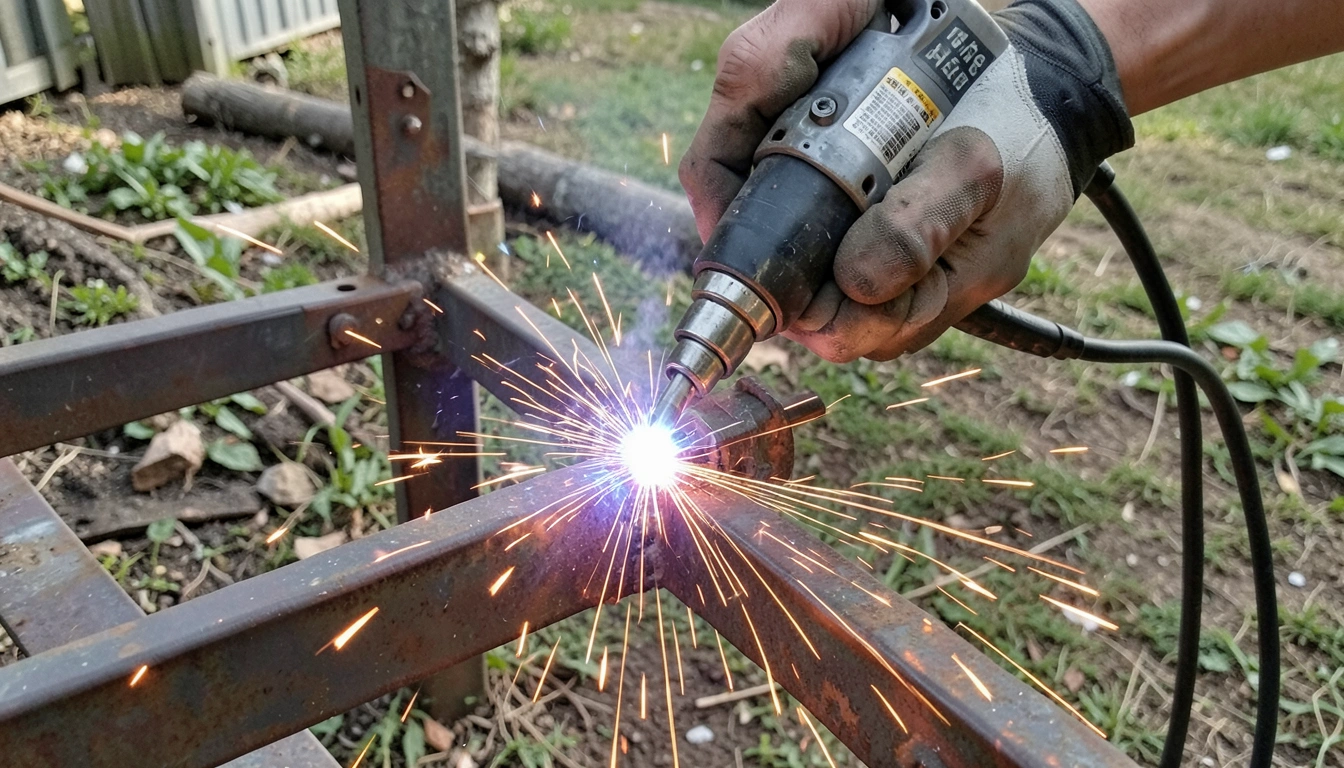
Strength depends on the wire classification, not on whether the weld looks pretty. A weld made with an E71T-series wire is designed to match the strength of mild steel base metal, which is the same job done by common stick and MIG fillers. Manufacturer data for one self-shielded wire shows minimum yield and tensile figures well in line with that goal, along with at least 20 percent elongation in the as-welded condition.
Where flux core can fall short is toughness and ductility in demanding service. Some self-shielded wires deposit weld metal that is less ductile than gas-shielded solid wire or low-hydrogen stick. For code work such as bridges, pressure vessels or cold-temperature structures, the procedure and wire must be qualified for the application.
Where flux core works well
Self-shielded wires shine for outdoor repairs, farm equipment, trailers, gates and general fabrication on mild steel in thicker sections. They run on small machines with no gas bottle, and the arc cuts through light rust and mill scale better than solid wire. That combination is why many gasless hobby machines use them. If you are choosing a machine, see our best flux core welders roundup.
Why some flux core welds fail
- Wrong polarity. Most self-shielded wire runs electrode negative (DCEN), while solid MIG runs electrode positive. Reversed polarity makes a poor arc and weak, porous weld metal.
- Too little heat or too fast travel. This causes cold lap, where the weld sits on top of the base metal without fusing.
- Slag left between passes. Trapped slag creates inclusions that weaken multi-pass welds.
- Damp or old wire. Flux absorbs moisture, which leads to porosity.
- Contaminated material. Thick rust, oil or paint can still cause pores.
Thin metal and structural limits
Flux core runs hot and penetrates deeply, so it is a poor match for thin sheet and body panels where burn-through is common. For auto body or sheet work, solid wire with gas is easier. For safety-critical structures, follow the engineer or code requirements instead of treating a flux core weld as automatically acceptable. Our flux core vs solid wire guide covers the wire differences in more depth.
Tips for better flux core welds
- Check the wire manufacturer’s polarity and set your machine to match.
- Use a drag (pull) angle of about 10 to 15 degrees, since a push angle can trap slag.
- Keep a stickout of about 3/4 inch and a steady speed.
- Chip and wire-brush slag fully before the next pass.
- Store wire in a dry place and replace spools that have rusted.
FAQs
Are flux core welds as strong as MIG welds?
They can be. A properly run weld using a wire in the same 70 ksi class matches mild steel strength. Differences show up more in ductility, cleanliness and appearance than in basic strength.
Are flux core welds good for structural work?
Gas-shielded flux core is widely used in structural fabrication when the procedure is qualified. Self-shielded wire is used in the field, but code requirements and the engineer decide what is acceptable.
Why do my flux core welds look bad?
Common causes are wrong polarity, wire speed and voltage that do not match, excessive stickout and dirty metal. Adjust one setting at a time and practise on scrap.
Is flux core stronger than stick welding?
Neither is automatically stronger. Both can produce welds that match mild steel strength. E7018 stick is valued for toughness, while flux core is valued for speed.
Bottom Line
Flux core welds are good when the wire is right for the job and the setup is correct. For outdoor, repair and thicker-steel work they are fast and strong. For thin material or situations that demand the cleanest, most ductile weld, solid wire with gas or low-hydrogen stick is the safer pick.
Sources
- Lincoln Electric: Powercraft T-11 flux cored wire data (AWS A5.20 E71T-11)
- AWS Welding Digest: Flux Cored Arc Welding (FCAW)
- WeldGuru: Flux-Core vs. MIG Welding
- Welding Tips and Tricks: Flux core vs solid wire