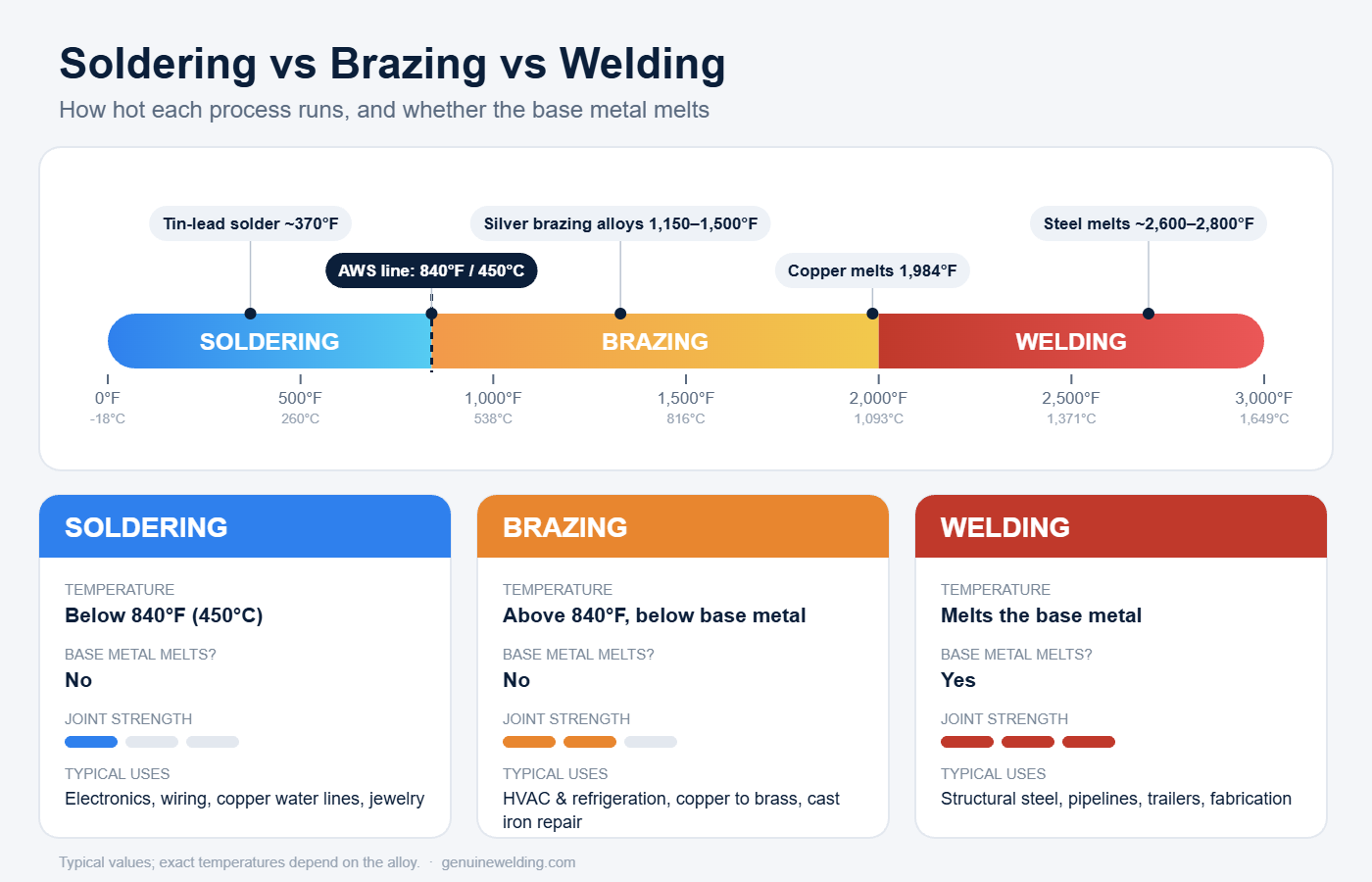
The main difference between brazing, soldering and welding is temperature and whether the base metal melts. Welding melts the base metals and fuses them. Brazing and soldering melt only a filler metal that flows into the joint. Brazing filler melts above 840°F (450°C); soldering filler melts below 840°F.
That one difference changes everything: joint strength, which metals you can join, the tools you need and the jobs each process is best for. This guide compares all three side by side so you can pick the right one.
Brazing vs Soldering vs Welding: Comparison Table
| Factor | Soldering | Brazing | Welding |
|---|---|---|---|
| Filler melting point | Below 840°F (450°C) | Above 840°F (450°C) | Similar to base metal |
| Does the base metal melt? | No | No | Yes |
| How the joint forms | Capillary action + surface bond | Capillary action + metallurgical bond | Fusion of base and filler metal |
| Joint strength | Lowest | High; can match the base metal | Highest |
| Typical heat source | Soldering iron, propane torch | Oxy-acetylene or air-fuel torch, furnace, induction | Electric arc, flame, laser, resistance |
| Joins dissimilar metals? | Yes | Yes, very well | Limited |
| Distortion risk | Very low | Low | Higher |
| Common uses | Electronics, plumbing water lines, jewelry | HVAC and refrigeration, copper tubing, carbide tools, cast iron repair | Structural steel, pipelines, vehicles, fabrication |
What Is Soldering?
Soldering joins metals with a filler (solder) that melts below 840°F (450°C). The solder flows into a tight joint by capillary action and bonds to the surface of the parts, which never melt. Common solders include tin-lead (60/40 melts around 370°F) and lead-free tin-silver-copper alloys used for drinking water and electronics.
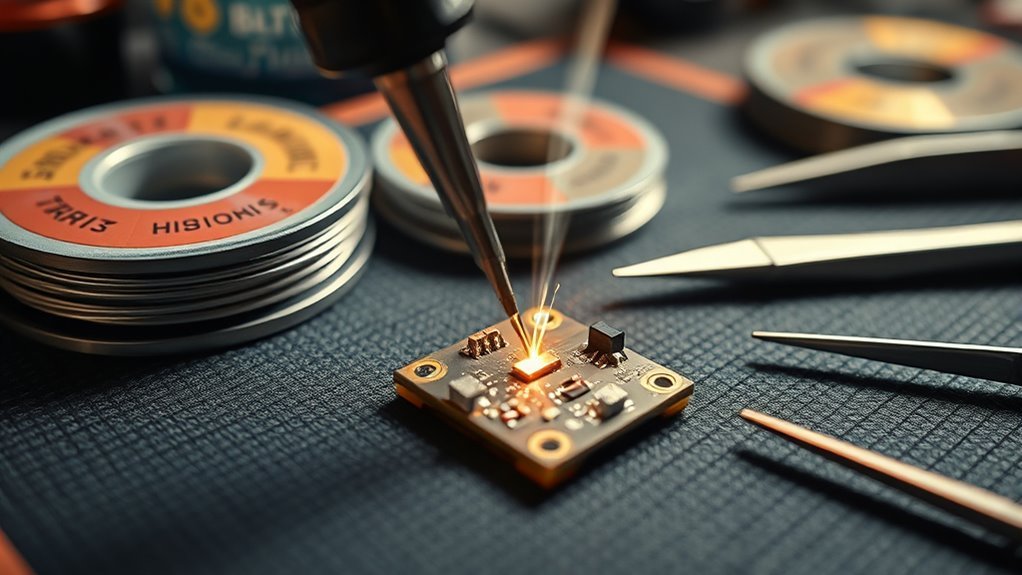
Best for: circuit boards, wiring, copper water pipes, sheet-metal gutters and jewelry. Soldered joints are not suited to high loads or high service temperatures; solder generally cannot handle more than about 200°F in service.
Learn more in our soldering guide and how to solder aluminum.
What Is Brazing?
Brazing joins metals with a filler that melts above 840°F (450°C) but below the melting point of the base metals. The parts are heated, flux cleans the surface, and molten filler is drawn into the joint by capillary action. Joint gaps of about 0.002–0.005 in. give the best capillary flow.
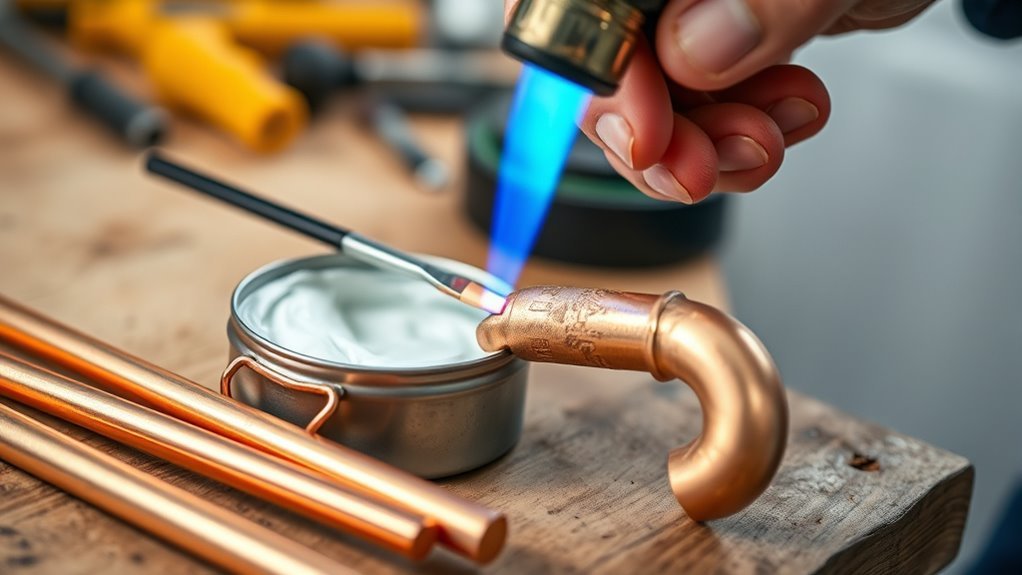
Common brazing fillers include silver alloys (BAg), copper-phosphorus rods (BCuP, self-fluxing on copper), aluminum-silicon alloys for aluminum and brass/bronze rods for steel and cast iron. A well-made brazed joint can be as strong as, or stronger than, the base metals.
Best for: HVAC and refrigeration lines, copper-to-brass fittings, carbide-tipped tools, bicycle frames, cast iron repairs and joining dissimilar metals.
Go deeper with brazing explained, silver brazing, copper brazing and aluminum brazing.
What Is Welding?
Welding melts the edges of the base metals, usually adds a filler metal, and lets them fuse into one piece as they cool. Heat comes from an electric arc (MIG, TIG, stick, flux core), a gas flame, a laser or electrical resistance. Steel melts at around 2,500–2,800°F, so welding needs far more heat than brazing or soldering.
Best for: structural steel, pipelines, trailers, heavy equipment and any joint that carries big loads. For a full overview, read what is welding? and welding processes and how to pick one.
Which Is Strongest?
- Welding is the strongest because the base metals fuse into one continuous piece.
- Brazing is close behind; a properly designed brazed joint with enough overlap can match the base metal strength.
- Soldering is the weakest and is meant for sealing and electrical connections, not structural loads.
Pros and Cons
Soldering
- Pros: low heat, cheap tools, no distortion, easy to undo, great electrical conductivity
- Cons: weak joints, low service temperature, not for structural parts
Brazing
- Pros: strong, leak-tight joints; joins dissimilar and thin metals; little distortion; clean appearance
- Cons: needs tight fit-up and clean surfaces; filler (especially silver) can be expensive; lower heat resistance than a weld
Welding
- Pros: strongest joints, works on thick sections, ideal for structural and heavy-duty work
- Cons: more heat and distortion, harder to join dissimilar metals, higher equipment cost and skill, bigger safety hazards (arc flash, fumes)
When to Use Each Process
- Choose soldering for electronics, wiring and low-pressure copper water lines.
- Choose brazing for refrigeration and HVAC lines, copper to brass or steel, thin parts that would burn through, and cast iron repairs.
- Choose welding for load-bearing steel, thick metal, pipelines, trailers and anything that must take impact or vibration.
Tools You Need to Solder, Braze or Weld
You can start soldering and light brazing with a few inexpensive tools. Here are reliable picks for each job. (As an Amazon Associate, we earn from qualifying purchases.)
For soldering
Weller WLC100 Soldering Station

A 40-watt station with an adjustable temperature dial and a stand, bundled with lead-free solder wire. Good for electronics, wiring and small hobby jobs.
Oatey Safe-Flo Lead-Free Plumbing Solder Kit

Lead-free, silver-bearing plumbing solder with flux for sweating copper water lines. Lead-free solder is required for drinking-water pipes.
For brazing
Bernzomatic TS8000 Trigger-Start Torch

A trigger-start, high-heat torch head that runs on propane or MAP-Pro cylinders. With MAP-Pro it handles soldering and small copper brazing jobs; larger joints need oxy-acetylene.
Harris Stay-Silv 15 Brazing Rods

A 15% silver copper-phosphorus (BCuP-5) alloy that flows well and self-fluxes on copper-to-copper joints. A standard choice for HVAC and refrigeration lines.
Harris Stay-Silv White Brazing Flux

Paste flux for brazing copper to brass, bronze or steel, where phos-copper rods cannot self-flux. The brush-cap bottle makes it easy to apply.
For welding
Welding needs a dedicated welder, helmet, gloves and jacket. If you are just starting out, see our picks for the best welders for beginners.
What Is Braze Welding?
Braze welding uses a brazing filler (usually a bronze rod) and a torch, but lays the filler in a groove or fillet like a weld instead of relying on capillary action. The base metal still does not melt. It is popular for repairing cast iron and joining galvanized steel because it needs less heat than fusion welding.
Brazing vs Soldering vs Welding: FAQs
What temperature separates brazing from soldering?
The American Welding Society uses 840°F (450°C). Fillers that melt above it are brazing; below it is soldering.
Is brazing stronger than welding?
No. Welding is generally stronger, but a well-designed brazed joint can match the strength of the base metal, which is enough for many jobs.
Can you braze without a welder?
Yes. Brazing only needs a torch hot enough for the filler, such as an oxy-acetylene, MAPP or air-acetylene torch, plus flux and brazing rod.
Is soldering the same as welding?
No. Soldering never melts the base metal and uses a low-temperature filler, while welding melts and fuses the base metals.
Which is better for copper pipe: brazing or soldering?
Solder is standard for household water lines. Brazing is required for refrigeration and HVAC lines, which see higher pressure and vibration.