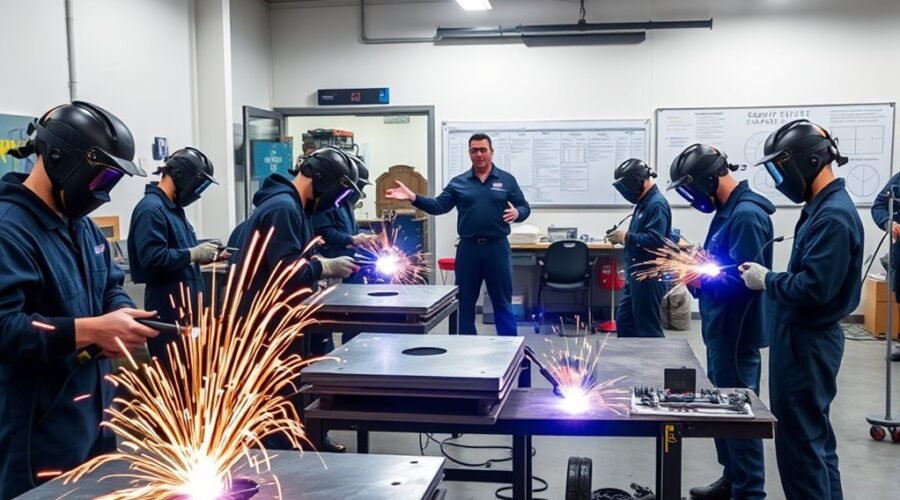
Choosing a welding school takes more than comparing advertised tuition. Program length, hands-on shop time, welding processes taught, required tools, certification testing, financial aid, safety standards, and career support can all change the real value of a program. The best comparison is the total cost to finish the training against the skills, credentials, and employment preparation you actually receive.
Quick Answer
Welding school costs and timelines vary widely by program. Compare the full price—not tuition alone—including tools, PPE, consumables, testing, transportation, and living costs. Also verify hands-on training hours, accreditation or state authorization, financial-aid eligibility, welding processes taught, certification preparation, safety standards, and documented graduate outcomes before enrolling.
Key Takeaways
- Compare the total cost of completion, including tuition, tools, safety gear, consumables, books, testing, transportation, and other required fees.
- Program length may range from short skills courses to multi-year college programs, and the same number of clock hours can take very different amounts of calendar time depending on the weekly schedule.
- Look for substantial hands-on practice in processes relevant to your goals, such as SMAW/Stick, GMAW/MIG, GTAW/TIG, and FCAW.
- Verify institutional accreditation or state authorization separately from participation in welding-industry programs such as AWS SENSE.
- Do not accept a placement percentage or salary promise at face value. Ask how outcomes are calculated and whether jobs are actually welding-related.
- Financial aid, scholarships, payment plans, veterans’ benefits, workforce funding, and apprenticeships may reduce out-of-pocket costs, but eligibility varies.
How Much Does Welding School Cost?
There is no single national price for welding school. Costs vary by school type, location, program length, number of welding processes taught, lab time, credential level, and what the school includes in its published price.
That is why a student should compare the total cost of completion rather than relying on a broad national estimate. One current example shows how quickly the total can rise: Elite Welding Academy’s published 2026 catalog lists its 1,000-hour Structural and Pipe Welding Program at $23,639.41 for tuition, tools, and supplies, with a separate $100 admission fee.
Other programs may cost considerably less or more. Public colleges may price courses by credit hour and residency status, while private career schools often publish one program price. Short process-specific training can also cost much less than a comprehensive structural-and-pipe program.
| Cost to Check | Questions to Ask |
|---|---|
| Tuition | Is tuition charged by course, term, credit hour, clock hour, or entire program? |
| Tools and PPE | Are the helmet, jacket, gloves, boots, hand tools, and measuring tools included? |
| Consumables | Are electrodes, wire, gas, coupons, grinding discs, and practice metal included? |
| Testing | Are certification or qualification tests included, discounted, or paid separately? |
| Books and technology | Are textbooks, online access, laptops, or software required? |
| Living and travel costs | Will you need housing, parking, fuel, public transportation, or relocation? |
| Lost work time | Will a full-time schedule reduce your income while you train? |
Pro Tip: Ask every school for a written estimate showing the total amount required to graduate. Compare that number after subtracting grants and scholarships—not the advertised tuition figure alone.
If you must buy personal equipment, compare durability and required specifications before purchasing. A guide to reliable welding gear can also help when budgeting for equipment outside the school’s required package.
Choose the Right Type of Welding School
Once you understand the cost, compare the type of training that best fits your career goal, schedule, and preferred learning environment. Welding instruction is available through vocational and technical schools, community colleges, private welding academies, employer programs, and apprenticeships.
| Training Route | Typical Strength | What to Verify |
|---|---|---|
| Trade or technical school | Focused hands-on occupational training | Lab hours, equipment access, total cost, credentials, and placement methodology |
| Community or technical college | May combine welding with broader academic or technical coursework | Residency tuition, required general education, transferability, and shop availability |
| Private welding academy | Intensive welding-focused schedules | Total charges, instructor access, testing fees, and financing terms |
| Registered Apprenticeship | Paid work experience plus structured instruction | Entry requirements, occupation, wage progression, related instruction, and employer availability |
Registered Apprenticeships are particularly different from tuition-based school programs because apprentices are employees. A registered program combines paid work experience, progressively increasing wages, classroom or related instruction, and a recognized credential.
Check Accreditation, Authorization, and AWS SENSE Separately
Do not treat every quality label as the same thing. Institutional accreditation, state authorization, federal student-aid eligibility, and participation in an industry curriculum framework can serve different purposes.
- Institutional accreditation: Check whether the school is accredited by an agency recognized for that institution or program.
- State approval or authorization: Career schools may also need authorization from the appropriate state agency.
- Federal aid eligibility: Confirm that the specific school and program qualify before assuming FAFSA-based aid will apply.
- AWS SENSE: SENSE provides welding-education standards and guidelines covering areas such as SMAW, GMAW, FCAW, GTAW, safety, testing, and related knowledge. It should not automatically be treated as a substitute for institutional accreditation.
Note: A school completion certificate and an AWS Certified Welder credential are not automatically the same thing. Ask exactly what credential you receive, who issues it, what test is required, and whether additional testing fees apply after graduation.
Students who want exposure to several processes may also benefit from understanding the versatility in welding techniques before comparing course lists.
Compare Welding School Program Lengths
Program length depends on both the number of required training hours and the weekly schedule. Two programs with similar clock hours can finish months apart if one runs full time and the other meets at night.
| Program Type | Common Calendar Pattern |
|---|---|
| Short skills or process course | Several days to several months |
| Certificate or diploma program | Several months to about a year or longer |
| Associate degree program | Often about two academic years |
Current programs illustrate the difference. A 1,000-hour structural-and-pipe program can be completed in roughly 26 weeks on an intensive day schedule but can take about 44 weeks on a night schedule. Another 720-hour diploma program may run approximately 32 weeks once its course schedule, holidays, and breaks are included.
For any clock-hour program, estimate the instructional portion with this calculation:
Program clock hours ÷ scheduled training hours per week = approximate instructional weeks.
Then add holidays, breaks, orientation, testing days, and other school-specific scheduling requirements.
Students should also consider the ease of setup and equipment differences among welding processes when deciding what type of practice they want during training.
What’s Included in Welding School Tuition?
Never assume that tuition represents the entire welding-school bill. One school may bundle consumables and tools, while another may charge separately for lab fees, equipment, PPE, textbooks, testing, uniforms, or technology.
- Ask whether welding consumables and practice metal are included.
- Confirm whether hand tools and PPE are supplied, rented, or purchased separately.
- Ask whether certification or welder-qualification tests are included.
- Check for registration, technology, lab, graduation, and admission fees.
- Ask whether a failed test requires a paid retest.
- Get the refund and withdrawal policy in writing.
- Confirm whether the published price can change after enrollment.
A low tuition figure can therefore produce a higher final bill than a more expensive-looking program that bundles equipment and consumables. Applicants should compare the complete written cost rather than marketing headlines.
When equipment must be purchased separately, understanding which included accessories normally come with welding machines can also help prevent duplicate purchases.
Add Up Tools, Supplies, and Gear
Tools, consumables, and personal protective equipment can be a meaningful part of the total cost, but there is no reliable universal add-on amount. Some schools include most shop consumables, while others require students to buy substantial equipment packages.
Possible expenses include:
- welding helmet and appropriate lenses;
- welding jacket, sleeves, or other flame-resistant clothing;
- welding gloves and work gloves;
- safety glasses and hearing protection;
- appropriate work boots;
- chipping hammer, wire brush, pliers, clamps, soapstone, and measuring tools;
- grinding and cutting accessories;
- electrodes, wire, shielding gas, and practice material when not included.
Warning: Welding exposes workers to hazards such as fumes, ultraviolet radiation, burns, eye injury, electrical shock, sparks, and hot metal. A training shop should teach appropriate ventilation, work practices, and PPE—not simply provide welding machines.
Students who expect to buy their own consumables should also learn how electrode selection affects practice and cost. This guide to long-term savings and general-purpose electrodes can provide additional equipment context.
Check Welding Certification Costs
Certification and qualification expenses should be separated from school tuition. As of the AWS price list effective January 1, 2026, the Certified Welder application is $70 and the annual maintenance subscription is $105. The practical welding test is priced separately by the AWS Accredited Testing Facility.
For Certified Welding Inspector candidates, the 2026 initial CAWI/CWI exam price is $1,255 for qualifying AWS members and $1,520 for non-members. Training packages, retests, endorsements, and recertification are separate expenses.
These fees can change, so candidates should always check current AWS pricing before paying a school or testing facility.
Students practicing for certification may also compare commonly used equipment such as the Hobart Handler 140, although owning a particular machine does not substitute for training or a required performance test.
AWS Welder Fees
For 2026, the principal AWS Certified Welder charges listed by AWS are:
| Item | 2026 AWS Price |
|---|---|
| Certified Welder application | $70 |
| Annual maintenance subscription | $105 |
| Practical Certified Welder exam | Testing-facility pricing varies |
Ask the testing facility what its quoted test price includes, especially if you need multiple processes, positions, materials, or retests.
CWI Exam Costs
The Certified Welding Inspector path is significantly more expensive than an entry-level welder performance test because the credential has different eligibility requirements and a multi-part examination process.
Current 2026 AWS pricing lists the initial CAWI/CWI exam at:
- $1,255 for qualifying AWS members
- $1,520 for non-members
The initial exam bundled with Part B training is listed at $2,000 for members and $2,265 for non-members. Candidates should also confirm eligibility requirements before buying exam preparation.
Exam Prep Expenses
CWI preparation can cost considerably more than the examination itself. AWS’s 2026 price list includes several preparation formats rather than one universal prep price.
- CWI seminar-and-exam packages are listed at $3,070 for members and $3,335 for non-members for certain formats.
- A two-week in-person CWI seminar-and-exam package is listed at $3,935 for members and $4,200 for non-members.
- Standard Prometric CWI endorsements are listed at $445 for members and $540 for non-members, while some MT/PT endorsements have different prices.
Prices are subject to change, so the current AWS price list should be checked immediately before registration.
How to Pay for Welding School
Students may have several ways to pay for welding training, but the options depend on the institution, program, location, and individual eligibility.
Possible funding sources include scholarships, grants, federal student aid at eligible schools, veterans’ education benefits, workforce-development funding, school payment plans, employer sponsorship, and paid apprenticeships.
Tuition and Fees
Before financing tuition, calculate the complete amount you expect to spend:
Tuition + mandatory fees + tools/PPE + consumables + testing + books/technology + transportation/housing − grants and scholarships = estimated out-of-pocket training cost.
Also compare how much debt you would carry at graduation and how long the program keeps you away from full-time paid work.
Optional equipment and nonessential purchases should remain separate from required training costs. For example, items from lists of safety features and welder accessories should not be mistaken for mandatory school expenses unless the program specifically requires them.
Financial Aid Options
The FAFSA can provide access to federal grants, work-study, and federal student loans for eligible students attending eligible colleges, career schools, and trade schools. However, submitting the FAFSA does not mean every welding program will qualify for every form of aid.
For the 2026–27 award year, the maximum Federal Pell Grant is $7,395 for eligible students. Actual awards depend on eligibility and enrollment factors.
| Aid Type | Typical Characteristic | Repayment |
|---|---|---|
| Scholarship | Award based on specified eligibility criteria | Generally no |
| Grant | Often need-based or program-based aid | Generally no, subject to program rules |
| Federal student loan | Borrowed education funding | Yes |
| Federal Work-Study | Part-time employment for eligible students | No repayment of wages |
| VA/WIOA or other workforce support | Eligibility and approved programs vary | Depends on program rules |
The AWS Foundation also awards welding-related scholarships. Award amounts and eligibility differ by scholarship, so students should review the current application requirements rather than assuming a fixed award.
Payment Plans Available
Some schools let students divide tuition into installments, but payment-plan terms are school-specific. Before signing:
- ask whether there is interest or a processing fee;
- confirm when each installment is due;
- ask what happens if a payment is late;
- review withdrawal and refund rules;
- find out whether an outstanding balance can prevent graduation, testing, or release of records.
A payment plan can improve cash flow, but it does not reduce the program’s total price unless a discount or other aid applies.
What You’ll Learn in the Welding Curriculum
A well-rounded welding curriculum may include several major arc-welding processes along with fabrication, safety, inspection, and blueprint skills. The exact mix should match the type of work you want after graduation.
Common subjects include:
- SMAW/Stick welding
- GMAW/MIG welding
- GTAW/TIG welding
- FCAW/Flux-Cored Arc Welding
- oxyfuel and plasma cutting;
- welding symbols and blueprint reading;
- joint preparation and fit-up;
- metallurgy and material identification;
- visual inspection and weld discontinuities;
- flat, horizontal, vertical, and overhead welding positions;
- shop safety and PPE;
- equipment setup, troubleshooting, and maintenance.
AWS SENSE educational standards include process modules for SMAW, GMAW, FCAW, and GTAW and use written and practical assessments for applicable SENSE certificate pathways.
Shop time matters: compare how many supervised hours you will actually spend setting up equipment, preparing joints, welding, inspecting results, and correcting defects—not just the program’s total clock hours.
Programs may also use visual inspection, bend testing, or other assessments to evaluate weld quality. These exercises can improve readiness for performance qualification testing, but completing a school program does not automatically mean a graduate holds every certification an employer may require.
Strong technical instruction should also prepare students for realistic employer expectations, including attendance, safe work practices, blueprint interpretation, quality standards, and the ability to produce acceptable welds consistently.
What Job Placement Help You Should Expect
Career assistance can be useful, but prospective students should evaluate the evidence behind a school’s placement claims. A large percentage means little unless you know who was counted, which jobs qualified, and how the data were verified.
Useful career services may include:
- resume and application preparation;
- mock interviews;
- employer introductions and job leads;
- career fairs or recruiting events;
- help identifying entry-level positions that match the processes taught;
- continued assistance after graduation.
Ask the school these questions:
- What percentage of completers found work?
- What percentage found jobs specifically related to welding?
- What time period is used—30 days, 90 days, six months, or longer?
- Are graduates already employed before enrollment included?
- Are part-time and temporary jobs counted?
- How many graduates were excluded from the calculation?
- What was the response rate used to build the placement statistic?
- Can the school provide the methodology in writing?
Programs teaching several processes may prepare students for a broader set of entry-level roles. Understanding multi-process welding can help applicants recognize the differences among those processes when reviewing curricula.
How to Compare Welding Schools Before You Enroll
Use the same checklist for every school so that marketing language does not hide important differences.
- Define the job you want. Structural fabrication, production welding, pipe work, repair, and specialty TIG work may require different skills.
- Compare total cost. Get tuition, mandatory fees, tools, PPE, consumables, testing, books, and technology in writing.
- Count hands-on hours. Ask how much time is spent welding rather than watching demonstrations or completing general coursework.
- Inspect the shop. Look at ventilation, machine availability, booth condition, safety practices, and how many students share equipment.
- Check instructors. Ask about industry experience, qualifications, class size, and how much individual booth feedback students receive.
- Verify credentials. Confirm institutional accreditation or authorization, SENSE participation when claimed, and exactly which external credentials or tests are included.
- Verify outcomes. Request completion, placement, debt, and starting-pay information with definitions.
- Read the enrollment agreement. Understand cancellation, refund, attendance, financing, and retest policies before paying a deposit.
Warning: Be cautious if a recruiter pressures you to enroll immediately, promises a guaranteed welding job, or presents a high salary as the normal starting wage. Ask for written evidence and compare the claims with independent labor-market data.
Is Welding School Worth the Cost?
Whether welding school is worth the cost depends on the program price, debt required, quality of hands-on training, local employment opportunities, and whether the training matches the work you want.
Current U.S. Bureau of Labor Statistics data provide a useful reality check. The median annual wage for welders, cutters, solderers, and brazers was $53,750 in May 2025. The lowest 10% earned less than $39,240, while the highest 10% earned more than $77,530.
BLS projects about 40,300 openings for welders, cutters, solderers, and brazers each year on average from 2025 to 2035, even though total employment is projected to grow only 2% over the decade.
This distinction matters. Welding can offer many replacement openings, but the national occupation is not projected to experience unusually fast growth.
A useful way to judge value is to compare:
- your expected out-of-pocket cost and debt;
- the amount of supervised shop practice;
- the program completion rate;
- documented welding-related placement outcomes;
- local entry-level wages;
- the processes and qualifications employers near you request;
- the cost and availability of alternatives such as community college or apprenticeship.
Buying your own equipment is a separate decision from paying for training. Guides to equipment value, such as this comparison of long-term savings on MIG welders, can help with personal equipment budgeting but should not be counted as evidence that a particular school is worth its tuition.
Frequently Asked Questions
How Much Does Welding School Cost and How Long Does It Take?
There is no single price or duration. Short process courses may last weeks, while comprehensive certificate or diploma programs may last several months to a year or longer, and associate degrees commonly take about two academic years. Compare each school’s total published cost, required equipment, testing expenses, and weekly schedule.
Can You Make $100,000 a Year Welding?
Some welders can exceed $100,000 through specialized work, extensive overtime, travel, supervisory responsibilities, or unusually high-paying industries and locations, but that is not the typical national wage. BLS reports a $53,750 median annual wage for welders, cutters, solderers, and brazers in May 2025, with the highest 10% earning more than $77,530.
How Long Is a 900-Hour Welding Program?
It depends on the weekly schedule. At 40 scheduled training hours per week, 900 hours equals about 22.5 instructional weeks before holidays and breaks. At 30 hours per week, it equals 30 instructional weeks. Divide 900 by the school’s scheduled hours per week, then add breaks and other calendar interruptions.
Are Welding Schools Worth It?
A welding program can be worth the cost when it provides substantial supervised practice, relevant processes, safe facilities, credible instruction, reasonable financing, and documented outcomes that fit your local job market. Compare the program against community-college options, apprenticeships, and employer training before deciding.
Does Graduating From Welding School Make You an AWS Certified Welder?
Not automatically. A school may issue its own completion certificate or participate in an AWS SENSE program, while the AWS Certified Welder credential requires the applicable performance test and AWS application process. Ask the school exactly which credentials and testing fees are included.
Can Welding School Be Completed Online?
Some theory, safety, blueprint, and technical coursework can be delivered online or in a blended format, but developing welding ability requires substantial hands-on practice with real equipment and materials. Ask how many supervised lab hours an online or blended program includes.
Can Financial Aid Pay for Welding School?
It can for eligible students attending eligible programs. FAFSA-based aid may include grants, work-study, and federal student loans. Scholarships, veterans’ benefits, workforce-development programs, employer assistance, and school payment plans may also be available. Verify eligibility before enrolling rather than assuming every welding course qualifies.
Conclusion
Choosing a welding school is about much more than finding the lowest tuition. Compare the full cost to graduate, supervised shop time, welding processes, safety practices, instructor access, credentials, financial-aid eligibility, and documented graduate outcomes. Verify accreditation and career claims independently, understand what certification testing is actually included, and compare tuition-based programs with apprenticeship or employer-training options. A careful side-by-side comparison makes it much easier to identify training that fits both your budget and the type of welding work you want to pursue.
Sources
- American Welding Society — Certification & Education Programs Price List — current Certified Welder, CWI, endorsement, seminar, and renewal pricing.
- U.S. Bureau of Labor Statistics — Welders, Cutters, Solderers, and Brazers — current national wages, education, employment, and 2025–2035 outlook.
- Federal Student Aid — FAFSA Student Steps — federal grants, work-study, and loan information for eligible college, career-school, and trade-school students.
- U.S. Department of Education — Database of Accredited Postsecondary Institutions and Programs — accreditation verification.
- American Welding Society — SENSE — welding-education standards, curriculum framework, and SENSE credential information.
- Occupational Safety and Health Administration — Welding, Cutting, and Brazing Hazards — welding hazards, work practices, and PPE considerations.