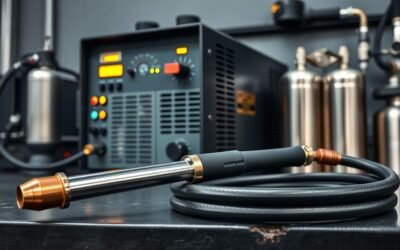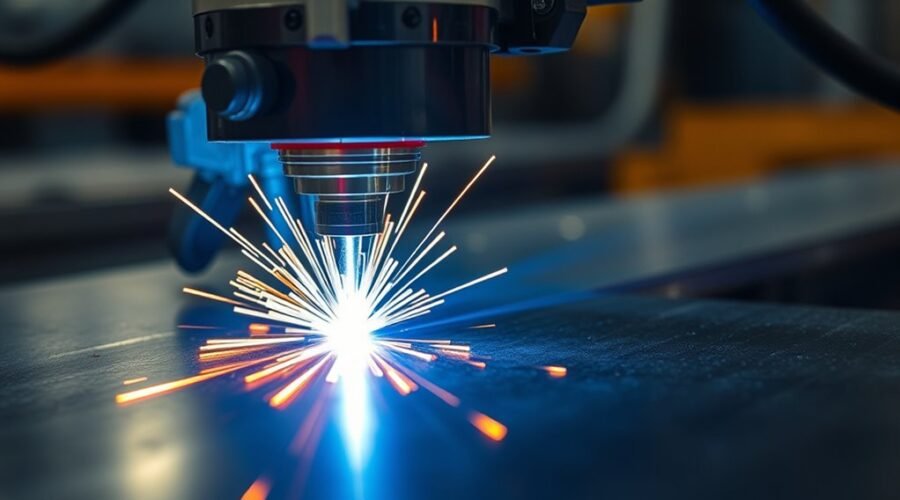
Laser welding uses a concentrated beam of light to melt material at a joint and form a metallurgical bond as the molten pool solidifies. Its tightly controlled heat source can produce narrow welds, high travel speeds, a small heat-affected zone, and low distortion when the material, joint fit-up, laser source, and process parameters are matched correctly. It is widely used in automotive, medical-device, aerospace, electronics, battery, and precision-manufacturing applications.
Quick Answer
Laser welding joins metals or certain thermoplastics by focusing laser energy onto a small area until the joint melts and fuses. It can make fast, narrow, low-distortion welds, but results depend on material, power, wavelength, travel speed, joint fit-up, shielding, and precise process control.
Key Takeaways
- Laser welding concentrates energy into a small area, allowing narrow welds and relatively low distortion in properly controlled applications.
- Conduction welding makes shallow, wider welds, while keyhole welding uses higher power density to achieve deeper penetration.
- Fiber-delivered solid-state lasers are common in automated metal welding, but the best laser source and wavelength depend on the material and application.
- Joint fit-up, surface cleanliness, focus, power, travel speed, shielding, and beam position strongly affect weld quality.
- A laser weld is not automatically stronger than another weld; penetration, defects, metallurgy, joint design, and process qualification determine final performance.
- High-power industrial laser welders can present serious direct and reflected beam hazards and require engineered laser-safety controls.
What Is Laser Welding and How Does It Work?
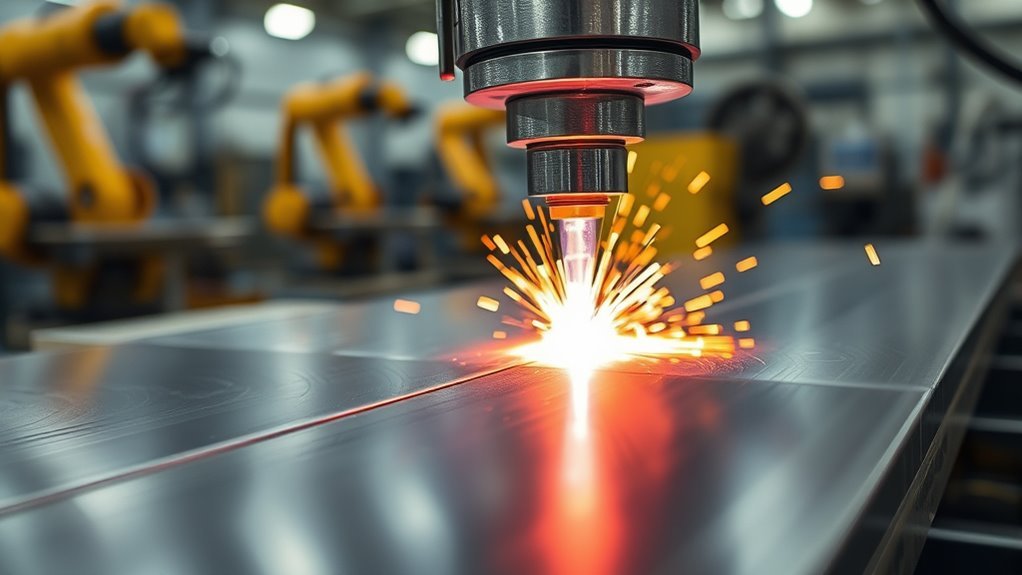
Laser welding is a fusion-welding process in which a concentrated high-energy beam is directed at a joint. The material absorbs part of that energy, heats rapidly, and forms a localized molten pool. As the beam travels along the joint and the pool solidifies, the two sides become joined by a metallurgical bond.
Laser welding concentrates heat into a small region, allowing narrow, precise welds while limiting how much surrounding material is heated.
The process can operate in conduction-limited or keyhole mode. According to TWI’s explanation of laser welding, conduction welding primarily heats and melts the surface, while higher power density can vaporize material and form a narrow cavity called a keyhole.
Because the energy can be concentrated into a small spot and the beam can move quickly, laser welding often produces a relatively narrow heat-affected zone (HAZ) and less distortion than slower processes that heat a larger area. The exact result still depends on material thickness, thermal conductivity, weld speed, penetration requirement, and process settings.
Laser welding can join many metals and, with suitable techniques, some thermoplastics. Automated systems can repeat beam position, power, focus, and travel speed accurately, which makes the process attractive for high-volume and high-precision manufacturing.
Laser Welding Methods and Laser Types
The two fundamental process modes are conduction welding and keyhole welding. They differ mainly in power density and how deeply the laser energy interacts with the workpiece.
| Feature | Conduction Welding | Keyhole Welding |
|---|---|---|
| Energy level | Lower power density; material melts without intentionally creating a deep vapor cavity | Higher power density; melting and vaporization create a keyhole |
| Weld shape | Relatively shallow and wider than it is deep | Narrower, deeper, high aspect-ratio weld |
| Typical use | Thin sections, visible seams, precision components | Deeper penetration, high-speed production, thicker sections |
| Main control concern | Consistent absorption and adequate fusion | Stable keyhole formation without excessive porosity or spatter |
Keyhole welding does not automatically create a large HAZ. High travel speed can keep overall heat input and distortion low even while achieving deep penetration. However, unstable keyhole behavior can contribute to pores, spatter, undercut, or inconsistent penetration. NIST research on laser keyholes notes that a vapor cavity can improve laser absorption but can also contribute to trapped porosity if the process becomes unstable.
Fiber Lasers
Fiber lasers are widely used for metal welding because they combine high beam quality, compact equipment, efficient solid-state operation, and flexible fiber delivery to a robotic or fixed processing head. Efficiency varies by design and operating point; for example, IPG lists greater than 40% energy efficiency for some current high-power fiber-laser products. That figure should not be treated as a specification for every fiber laser.
CO2 Lasers
CO2 lasers remain an established industrial technology, especially in legacy and specialized installations. Their approximately 10.6-micrometer wavelength has traditionally required mirror-based beam delivery rather than the flexible silica-fiber delivery used by many near-infrared solid-state lasers. This can make highly flexible robotic beam routing more complicated, although CO2 systems remain technically capable welding tools.
Nd:YAG, Disk, and Other Solid-State Lasers
Nd:YAG lasers historically expanded robotic laser welding because their shorter wavelength allowed flexible optical-fiber beam delivery. Modern disk and other solid-state laser architectures can provide similar manufacturing flexibility with different combinations of beam quality, power, efficiency, and pulse characteristics.
Visible and Green Lasers for Reflective Metals
Material absorption changes with wavelength. Copper is especially challenging for some near-infrared processes because it is highly reflective before heating. Wavelength-specific systems can improve process stability. For example, TRUMPF documents substantially higher room-temperature copper absorption with green laser light than with infrared light in its system.
Note: There is no single “best” laser type for every weld. Material, thickness, reflectivity, penetration, joint geometry, production rate, automation needs, and equipment cost all affect laser-source selection.
Why Laser Welding Can Produce Clean, Low-Distortion Joints
Because the beam is tightly focused, laser welding can place energy close to the joint instead of heating a wide area. This can reduce overall distortion, limit the HAZ, and create a narrow bead with little excess weld metal.
Laser welding can also generate relatively little spatter when the melt pool or keyhole remains stable. However, a clean-looking weld is not proof that the joint is structurally sound. Penetration, internal porosity, cracks, underfill, lack of fusion, metallurgy, and joint design still have to meet the application’s acceptance criteria.
Shielding gas may be used to protect the molten metal, control oxidation, protect optics, or influence plume behavior. Argon, helium, nitrogen, and gas mixtures may be appropriate depending on the alloy and process, so gas selection should follow a qualified welding procedure rather than a one-gas-fits-all rule.
In some applications, a correctly tuned laser process produces a finished bead that needs little grinding or cosmetic finishing. That can reduce post-processing, but it depends on seam requirements and weld quality rather than being guaranteed by the process itself.
A narrow heat-affected zone can reduce distortion, but final joint strength still depends on penetration, metallurgy, defects, joint design, and process qualification.
What Controls Laser Weld Quality?
Laser welding has a relatively small process window in many applications. A change in only one variable can alter penetration, bead shape, porosity, or surface quality.
- Laser power: affects melting rate and potential penetration.
- Travel speed: changes energy delivered per unit length and influences penetration and heat input.
- Focus position: changes spot size and power density at the joint.
- Beam diameter and beam shape: influence melt-pool dimensions and stability.
- Beam oscillation or wobble: can widen the effective weld area and improve gap tolerance in some applications.
- Joint alignment: becomes especially important when the focused beam is narrower than the allowed joint-position variation.
- Surface condition: oil, coatings, oxide, dirt, and inconsistent reflectivity can change absorption or create contamination.
- Shielding and plume control: can affect oxidation, optical stability, and weld appearance.
- Material composition: affects cracking, vaporization, absorption, cooling behavior, and final microstructure.
Joint Fit-Up Matters
Laser welding is usually less tolerant of large gaps than conventional arc welding because the focused beam and weld pool can be very narrow. TWI notes that autogenous butt-joint gaps commonly need to remain below about 10% of material thickness in conventional laser-welding setups to avoid defects.
That limitation can be reduced with accurate clamping, seam tracking, beam oscillation, filler wire, twin-spot techniques, or hybrid laser-arc welding. These methods broaden the usable joint gap but may also change travel speed, penetration, heat input, or equipment complexity.
Pro Tip: Treat part preparation and fixturing as part of the laser-welding process. A powerful laser cannot compensate reliably for inconsistent joint position, contamination, or a gap that exceeds the qualified procedure.
Common Laser Welding Defects
Laser welding can produce excellent joints, but it is not defect-proof. Problems generally point to an unstable process, incorrect energy input, poor fit-up, contamination, or an unsuitable material/process combination.
- Porosity: gas or metal vapor can become trapped as an unstable keyhole collapses.
- Lack of fusion: insufficient energy, poor beam alignment, excessive speed, or a large gap can leave parts incompletely fused.
- Incomplete penetration: power, focus, speed, or joint geometry may not provide the required weld depth.
- Spatter: unstable vapor pressure or melt-pool behavior can eject molten material.
- Undercut or underfill: excessive energy, poor parameter balance, or an unsupported joint gap can reduce material at the weld edge or surface.
- Cracking: susceptible alloys may crack because of composition, restraint, solidification behavior, or rapid cooling.
- Oxidation or discoloration: inadequate shielding or poor gas coverage can expose hot metal to the atmosphere.
Production welds may therefore require visual inspection plus appropriate nondestructive or destructive testing based on the component’s risk level, applicable welding code, and acceptance standard.
Where Laser Welding Is Used Most
Major industries use laser welding where precision, automation, repeatability, high travel speed, or low thermal distortion provide a manufacturing advantage.
Laser welding is most valuable when precise energy placement, repeatable automation, and control of distortion matter more than tolerance for loose joint fit-up.
- Automotive manufacturing: body structures, tailored blanks, drivetrain parts, battery components, and automated assemblies.
- Medical devices: precision housings, instruments, and qualified implantable-device components where small, repeatable welds may be required.
- Aerospace: thin-wall and precision components where heat input and dimensional control are important.
- Electronics and electrical manufacturing: connectors, sensor packages, battery tabs, terminals, and small metal assemblies.
- Jewelry production: small repairs, delicate seams, and localized joining where surrounding material should receive as little heat as practical.
Laser welding also works well with robotic automation because many solid-state systems can deliver the beam through a flexible fiber to a multi-axis processing head. That allows narrow seams and complex three-dimensional weld paths to be repeated with tight positional control.
Laser Welding Safety
Warning: High-power industrial and handheld laser welders can expose operators and bystanders to hazardous direct and reflected laser radiation. Properly designed enclosures, interlocks, controlled areas, wavelength-rated eye protection where required, training, fume control, fire precautions, and manufacturer-specified safeguards are essential.
Laser welding introduces hazards beyond ordinary hot-metal joining. The U.S. Food and Drug Administration states that Class IV lasers can present immediate eye and skin hazards from the direct or reflected beam and may also create a fire hazard.
The American Welding Society’s guidance on handheld laser welding also identifies high-power handheld units as Class 4 laser equipment and emphasizes the danger from reflected as well as direct beams.
Safe operation can require:
- an enclosed or appropriately controlled laser area;
- interlocks, beam stops, barriers, and non-reflective surroundings where specified;
- wavelength- and power-appropriate laser protective eyewear when the risk assessment requires it;
- training for operators and anyone who may enter the controlled area;
- local exhaust ventilation for welding fumes and process emissions;
- fire prevention and removal of unnecessary combustible materials;
- protection from hot metal, electrical, compressed-gas, and mechanical hazards;
- following the laser manufacturer’s instructions and applicable workplace laser-safety standards.
Protective eyewear alone should not be treated as a substitute for engineering controls. Industrial laser safety should be designed around preventing access to hazardous direct and reflected radiation.
Is Laser Welding the Right Choice?
Choosing laser welding depends on whether the application benefits enough from speed, automation, precise heat placement, low distortion, and repeatability to justify its tighter process controls and equipment cost.
For suitable thin sections, laser welding can operate at travel speeds of many metres per minute, and deeper keyhole welds may replace multiple passes required by some conventional processes. The actual productivity advantage depends on the material, required penetration, joint geometry, competing welding method, loading and unloading time, inspection, and the level of automation.
Laser welding is particularly attractive when:
- high production volume makes automation valuable;
- distortion or dimensional change must be tightly controlled;
- the joint is accessible to the beam;
- parts can be manufactured with consistent fit-up;
- a narrow weld or small HAZ is beneficial;
- repeatability matters more than tolerance for variable fabrication.
It may be a poorer choice when parts have inconsistent gaps, highly variable surfaces, difficult beam access, low production volume, or when the capital cost and safety infrastructure cannot be justified.
Autogenous, Filler-Wire, or Hybrid Welding?
An autogenous laser weld uses the parent material without added filler and can be extremely fast, but it generally demands accurate fit-up. Filler wire can bridge larger gaps, adjust weld-metal composition, or compensate for missing joint volume, although some laser energy must then melt the filler.
Hybrid laser-arc welding combines a laser with an arc process. It can increase gap tolerance and deposition while retaining some of the speed and penetration advantages of laser welding. The trade-off is a more complex process with additional equipment and parameters.
Frequently Asked Questions
How Thick Will a Laser Welder Weld?
There is no universal thickness rating for laser welding. Capability depends on laser power, beam quality, wavelength, material, joint design, focus, and travel speed. Heat-conduction welding is normally shallow; TRUMPF describes weld depths from a few tenths of a millimeter to about 1 mm for that mode, while specialized deep-penetration systems can reach far greater depths and TRUMPF cites up to 25 mm in suitable applications.
What Are the Disadvantages of Laser Beam Welding?
The main disadvantages are high equipment and safety-infrastructure costs, demanding joint fit-up, precise beam alignment, sensitivity to contamination and reflective surfaces, specialized training, and the possibility of porosity, cracking, spatter, or lack of fusion when parameters are poorly controlled. Some jobs also require filler wire, seam tracking, or hybrid processing to tolerate wider gaps.
What Is the Average Lifespan of a Laser Welder?
There is no reliable universal average lifespan for all laser welders. Service life depends on the laser source, optics, cooling system, duty cycle, contamination, maintenance, and replaceable components. As one manufacturer-specific example, IPG states that its high-power fiber lasers often operate for more than a decade even under aggressive duty cycles. Always use the service-life and maintenance information for the exact system being evaluated.
Can You Weld Stainless Steel With a Laser Welder?
Yes. Many stainless steels are routinely laser welded. Successful results still require suitable power, focus, travel speed, shielding, joint preparation, and control of heat input. The exact procedure should be qualified for the stainless grade, thickness, joint design, and required mechanical or corrosion performance.
Is Laser Welding Stronger Than TIG Welding?
Not automatically. Either process can make a strong, code-compliant joint when properly designed and qualified. Laser welding can produce a narrow HAZ and deep penetration, but defects such as porosity, cracking, or incomplete fusion can reduce strength. TIG offers different advantages, including manual control and greater tolerance for some joint conditions. Mechanical performance should be compared using the actual material, joint, procedure, and test requirements.
Does Laser Welding Need Shielding Gas?
Many laser-welding applications use shielding or process gas, but the requirement and gas type depend on the material, laser, power level, weld geometry, and desired surface quality. Gas may protect molten metal from oxidation, help control the plume, or protect processing optics. The correct gas and flow should come from a qualified procedure rather than a universal setting.
Conclusion
Laser welding is a highly controllable joining process that can deliver high speed, narrow welds, precise energy placement, and low distortion in the right application. Fiber and other solid-state lasers have made automated beam delivery especially flexible, while specialized wavelengths can improve processing of difficult reflective materials.
Those advantages do not eliminate the need for good engineering. Joint fit-up, surface condition, power, focus, travel speed, shielding, metallurgy, inspection, and laser safety all affect the final result. A laser weld should therefore be judged by its qualified performance and measured quality rather than by assumptions that the process is automatically cleaner, stronger, or suitable for every thickness.
Sources
- TWI — What Is Laser Welding and How Does It Work? — laser-welding fundamentals, conduction mode, and keyhole mode.
- TWI — Increasing Laser-Welding Joint Fit-Up Tolerance — joint-gap limitations, clamping, filler wire, beam manipulation, and hybrid processing.
- National Institute of Standards and Technology — Laser Keyhole Research — keyhole absorption, instability, and porosity risk.
- U.S. Food and Drug Administration — Laser Products and Instruments — laser classifications and Class IV eye, skin, and fire hazards.
- American Welding Society — Handheld Laser Welding Safety — Class 4 laser-welding hazards and workplace precautions.
- TRUMPF — Deep Penetration Welding — keyhole welding, penetration, speed, heat-affected zone, and distortion.