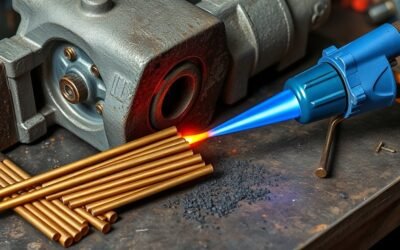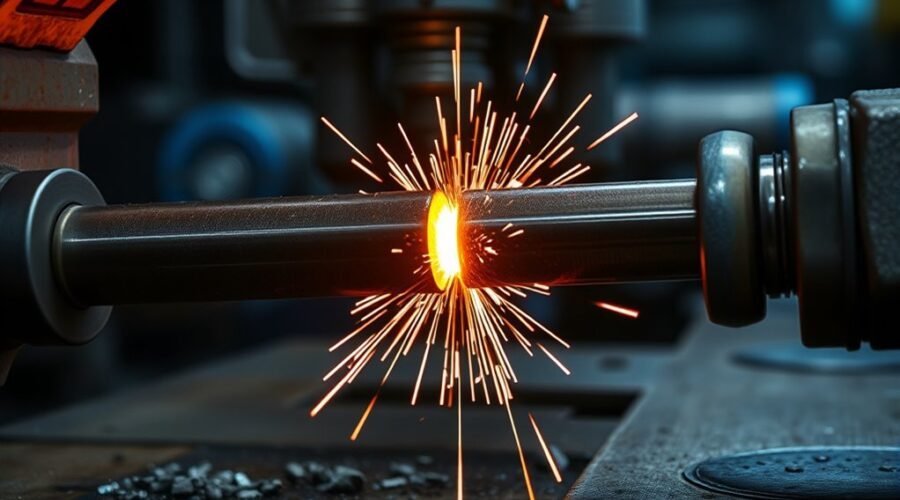
Friction welding is a solid-state joining process that bonds materials through frictional heat and pressure, without melting the base metals. A rotating or reciprocating part creates interface heat, then axial force forges a clean joint. Common types include rotary friction welding, linear friction welding, friction stir welding, and inertia friction welding. It is used in aerospace, automotive, pipelines, and medical devices, especially for dissimilar metals. Its key advantages include low distortion, strong joints, and high repeatability, with more details ahead.
Key Takeaways
- Friction welding joins metals in the solid state using heat from friction and pressure, avoiding melting and reducing distortion.
- The process uses a forge phase and holding phase to consolidate the bond and improve joint quality.
- Common types include rotary, linear, friction stir, friction spot, and inertia friction welding.
- It produces strong, repeatable joints with fewer cracks, pores, and contamination issues than fusion welding.
- It is used in aerospace, automotive, pipelines, manufacturing, and medical devices, especially for dissimilar metals.
What Is Friction Welding?
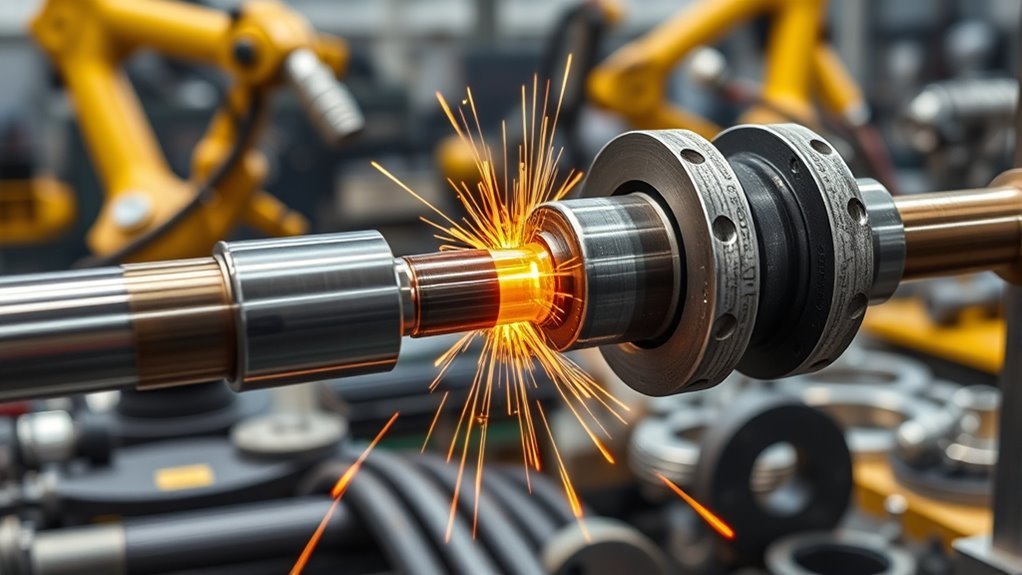
Friction welding is a solid-state joining process that uses mechanical friction to generate heat at the interface of two workpieces, allowing them to bond without reaching the melting point.
As a solid-state joining technique, it relies on controlled pressure and relative motion rather than filler metals, enabling efficient material union with minimal distortion. The method is classified among friction welding processes and includes rotary friction welding, linear friction welding, and friction stir welding, each selected according to geometry and alloy behavior.
Because the interface softens without liquefaction, dissimilar metals such as aluminum and titanium can be joined without shielding gases. This capability supports high bond quality and repeatability, qualities valued in aerospace, automotive, and other critical sectors.
Dissimilar metals like aluminum and titanium can join without shielding gases, supporting strong, repeatable bonds.
Its technical appeal lies in disciplined energy use and the reduction of conventional joining constraints, giving manufacturers a practical path toward stronger, cleaner, and more autonomous fabrication outcomes.
How Friction Welding Works
The process begins by bringing two workpieces into controlled relative motion so that mechanical friction rapidly generates heat at the interface without melting the base materials.
In the friction welding process, this heating creates a plasticized zone, enabling intimate contact and diffusion across the joint. One component is kept stationary while the other moves, and the resulting temperature rise softens the interface in a precise, machine-governed cycle.
Because it is a solid state joining technique that welds without fusion, the method preserves base-metal integrity and reduces distortion.
After sufficient softening, the forge phase applies axial pressure to consolidate the interface and expel minor surface irregularities. A holding phase then maintains pressure during cooling, stabilizing the bond and improving joint quality.
Each stage is tightly controlled, producing repeatable, consistent welds that support efficient, liberated manufacturing where reliability replaces guesswork.
Rotary Friction Welding Process
Rotary friction welding (RFW) applies controlled rotational motion to one workpiece while pressing it against a stationary component, converting mechanical energy into interface heat without melting the base metals. In this bonding process, the initial frictional contact rapidly raises temperature at the interface while plasticization remains confined to the joint zone.
The cycle advances through friction, forge, and holding phases, each governed by programmed pressure, speed, and time to secure a sound solid-state bond. Because the materials never liquefy, rotary friction welding can unite dissimilar metals and preserve distinct bulk properties, enabling engineered combinations that expand design freedom.
The result is a homogeneous joint with repeatable mechanical performance, often exceeding parent-material behavior in fatigue-sensitive service. Machine control minimizes operator variation, reduces human error, and eliminates consumables and shielding gases, improving cost efficiency.
For industries seeking material autonomy, this friction-based process offers a precise, clean, and scalable route to strong assembly.
Main Types of Friction Welding
The main friction welding variants are distinguished by the mode of relative motion used to generate interfacial heat and plastic deformation.
Rotary Friction Welding employs continuous rotation.
Linear Friction Welding uses reciprocating linear motion.
Friction Stir Welding relies on a rotating tool to mechanically bond materials below melting temperature.
Each process is selected according to joint geometry, alloy behavior, and production constraints.
Rotary Friction Welding
Spinning one workpiece at high speed against a stationary counterpart, rotary friction welding generates heat through friction until the interface softens and a solid-state bond forms.
In friction welding, this joining process advances through frictional contact, friction heating, forging, and holding, each phase governed by controlled pressure and temperature.
Because no melting occurs, the method can unite dissimilar metals such as aluminum and copper while preserving material integrity.
The resulting interface is highly homogeneous, with reduced pores and cracks compared with fusion-based methods.
Machine control and automation improve repeatability, quality assurance, and productivity, while lowering human error and production cost.
For industries seeking liberation from brittle joints and wasteful rework, rotary friction welding offers a precise, resilient, and efficient path to reliable assembly.
Linear Friction Welding
Linear friction welding uses a linear reciprocating motion between one workpiece and a stationary component to generate frictional heat and form a solid-state bond. It suits high-strength materials and supports liberated design choices in aerospace manufacturing.
| Parameter | Effect | Result |
|---|---|---|
| Motion | Linear reciprocation | Frictional heating |
| State | Solid-state | No melting |
| Output | Strong joint | Defect-free welds |
Friction Stir Welding
Friction stir welding employs a non-consumable rotating tool to generate frictional heat and plasticize the joint interface, allowing materials to be mixed and joined without reaching the melting point.
In friction stir welding, the non-consumable tool traverses the seam, consolidating softened metal under pressure and creating a solid-state bond with minimal distortion. Lower operating temperatures suppress pores, cracks, and other fusion defects, improving reliability.
The process is especially effective for aluminum alloys, including challenging 2xxx and 7xxx series materials. These characteristics produce high-strength, nearly defect-free joints suited to demanding industrial applications in aerospace and automotive manufacturing.
Benefits of Friction Welding
Among the main advantages of this joining method is its ability to produce strong, high-quality joints without filler materials, preserving base-metal integrity while reducing contamination risk.
In friction welding, the solid-state mechanism limits melting, so thermal distortion remains low and common fusion defects, including cracks and pores, are greatly reduced. This controlled energy input supports consistent metallurgical performance and greater dimensional stability, qualities valued where freedom from rework matters.
The process also expands material combinations, enabling dissimilar metals such as aluminum and copper to be joined with dependable integrity. Because no consumables are required and pre-weld preparation is minimal, manufacturing costs can fall considerably.
Machine-controlled operation further improves repeatability, making joint quality less dependent on individual operator skill. As a result, friction welding offers a precise, efficient, and technically robust route to durable assemblies.
Friction Welding Applications
Industrial applications of friction welding span sectors that require high joint integrity, low distortion, and reliable performance under demanding service conditions.
In aerospace, it is used for joining titanium and aluminum alloy components where weight reduction and structural endurance are critical.
In aerospace, it joins titanium and aluminum components, reducing weight while preserving structural endurance.
Pipeline fabrication employs girth welding of duplex stainless steel, producing joints that resist corrosion, pressure cycling, and severe operating environments.
Automotive manufacturers apply the process to improve vehicle efficiency and component performance, especially where controlled thermal input supports lightweight design.
Friction stir welding, a related solid-state method, is central to defect-free aluminum structures in transportation and construction, where dimensional control is essential.
Research also shows that ultrafine grained materials can be joined effectively, preserving or improving mechanical properties for demanding service.
Across these sectors, friction welding enables engineered freedom from excessive heat, distortion, and weak fusion defects, supporting advanced structures that must perform with consistency under load.
How Friction Welding Joins Dissimilar Metals
Friction welding joins dissimilar metals by generating heat through relative motion without melting the base materials, allowing controlled plasticization at the interface.
The softened layers are then forged together under pressure, promoting solid-state bonding while limiting intermetallic formation.
This process extends metal pair compatibility, enabling combinations such as aluminum to copper or titanium that are often difficult by conventional fusion methods.
Heat Without Melting
By generating heat through mechanical rubbing rather than bulk melting, this process enables dissimilar metals such as aluminum, copper, and titanium to be joined in the solid state.
In friction welding, heat through mechanical action softens only the interface, not the entire workpiece, preserving base metal structure. The solid-state condition limits intermetallic growth, a common weakness in fusion joining of unlike alloys.
As the interface plastically deforms, intimate contact develops and molecular bonding proceeds without filler metal. The resulting joint can match, or exceed, parent-material strength and toughness when parameters are controlled precisely.
This capability broadens design freedom, allowing advanced assemblies that resist mismatched expansion, thermal damage, and conventional welding constraints. Engineers gain a practical route to stronger, lighter, and more adaptable structures.
Controlled Forge Bonding
Controlled forge bonding in friction welding joins dissimilar metals by using heat generated at the interface and sustained compressive force to soften and consolidate only the contact zone. This solid-state mechanism avoids bulk melting, allowing aluminum to couple with copper or copper with titanium while preserving parent-metal properties.
In rotary friction welding, a rotating workpiece is driven against its mate under controlled pressure, and the interface material is forged into a dense bond as temperature rises locally. Because no filler metal or shielding gas is required, the process reduces contamination and defect pathways.
The resulting joint exhibits high integrity, limited intermetallic growth, and reliable performance. Such controlled bonding broadens engineering design space, supporting lighter, stronger assemblies for aerospace and automotive systems and enabling material combinations that resist conventional welding constraints.
Metal Pair Compatibility
Metal pair compatibility in friction welding depends on the process’s ability to generate interfacial heat and pressure without melting the base metals, allowing dissimilar materials such as aluminum to copper or titanium to form solid-state bonds.
In this regard, friction welding enables a dissimilar material pair to unify through localized plasticization and molecular bonding rather than fusion. The absence of filler material reduces contamination and defect formation, producing a clean interface.
Microstructural refinement at the weld zone further improves compatibility, helping metals that resist conventional joining achieve durable attachment.
This controlled mechanism expands engineering freedom, supporting lighter, stronger, and more adaptable designs for aerospace and automotive systems, where material choice must remain unconstrained by conventional weldability limits.
Friction Welding Quality Benefits
Friction welding delivers strong quality advantages through its machine-controlled operation, which promotes consistent results and minimizes human error across repeated production cycles.
Machine-controlled friction welding promotes consistent results and reduces human error across repeated production cycles.
In friction welding, repeatability supports quality assurance by producing uniform joints across demanding applications. Its solid-state mechanism forms high-integrity bonds without the pores, cracks, or other discontinuities commonly linked to fusion-based methods. The resulting welds often match or exceed the mechanical properties of the parent materials, supporting durability, reliability, and service life.
By avoiding filler materials, flux, and shielding gases, the process reduces contamination risk and streamlines production while preserving weld quality. These characteristics make the method analytically attractive where disciplined performance is required and material integrity must remain uncompromised.
Extensive testing and evaluation further confirm component longevity and functional stability.
Automation in Friction Welding
Automation extends the quality advantages of friction welding by standardizing loading, positioning, forging, and part removal within a tightly controlled production sequence. Robot-based automation improves throughput and repeatability, reducing human error while preserving weld integrity across demanding duties. Modern friction welding machines, such as compact modular systems with forge capacities to 400 tons, support a wide range of joints and materials.
| Capability | Effect |
|---|---|
| Robotic handling | Faster cycle times |
| Process control | Higher repeatability |
This automation enables complex geometries and high-performance components for aerospace and automotive production, where liberated design is paired with disciplined execution. At KUKA’s Halesowen facility, subcontract welding services leverage decades of experience to deliver expert automation solutions for diverse material combinations. The result is a process that scales efficiently, maintains consistent quality, and expands access to advanced manufacturing without sacrificing technical control or reliability.
Choosing the Right Process
Selecting the appropriate friction welding process begins with material behavior, joint geometry, and production requirements, since each variant offers distinct advantages.
For dissimilar metals, rotary friction welding and linear friction welding often outperform traditional welding because they limit bulk melting and reduce metallurgical incompatibility. Rotary friction welding suits cylindrical parts, shafts, and tubes; linear friction welding better serves linear interfaces and complex profiles.
Friction stir welding is particularly effective for aluminum and other lightweight alloys, delivering strong, nearly defect-free joints for aerospace and automotive structures.
Friction stir welding excels with aluminum and lightweight alloys, producing strong, nearly defect-free joints for demanding structures.
When materials are sensitive to deformation or heat, low force friction welding can reduce stress by adding external heat.
Production volume also matters: automated cells improve repeatability, throughput, and process control across all methods.
The ideal choice consequently depends on matching process physics to geometry, alloy response, and liberation from unnecessary rework.
Frequently Asked Questions
What Are the Applications of Friction Welding?
Friction welding is applied in automotive components, aerospace applications, and industrial machinery, where high-strength, defect-minimized joints are required.
It also serves pipeline construction in oil and gas, offshore mooring chains, and electronics, especially for joining dissimilar metals such as aluminum to copper.
The process enables lightweight, durable assemblies without filler material, supporting efficient production and structural reliability while reducing dependence on conventional joining constraints.
Is Friction Welding Stronger Than Welding?
Yes, friction welding is often stronger than conventional fusion welding in a strength comparison.
Its solid-state process preserves base-metal properties, reduces porosity and cracking, and improves material compatibility, including dissimilar metals.
Lower thermal input limits brittle intermetallics, while controlled automation enhances process efficiency and repeatability.
The result is a joint that can equal or exceed parent-metal performance, offering technically reliable strength with fewer defect-related weaknesses.
What Are the 7 Basic Types of Welding?
Like a toolbox opening, the seven basic welding types are SMAW, GMAW, GTAW, FCAW, SAW, ESW, and FW.
In broader classification, Arc Welding includes SMAW, GMAW, GTAW, FCAW, and SAW; Resistance Welding joins metal by electrical heat and pressure; Laser Welding uses concentrated photons for precision; and Friction Welding is solid-state.
These processes expand industrial autonomy, enabling varied materials, strengths, and applications with controlled efficiency.
How Does a Friction Welder Work?
A friction welder works by pressing two components together while one moves relative to the other, creating the friction welding process through controlled heat generation methods.
The interface softens, then forges under pressure until a solid-state bond forms.
Machine control manages speed, force, and time, while material compatibility factors determine joint quality.
No filler or shielding gas is required, and the process yields repeatable, liberated production without molten-metal dependence.
Conclusion
Friction welding unites materials through controlled heat and pressure rather than melting, producing strong joints with low distortion and excellent repeatability. Its rotary, linear, and hybrid variants support diverse geometries, while automation improves consistency and throughput. The process is especially effective for dissimilar metals, where conventional fusion methods often fail. For modern manufacturing, friction welding remains a reliable, efficient, and surprisingly elegant solution—an industrial handshake with the poise of a master craftsman from a bygone age.