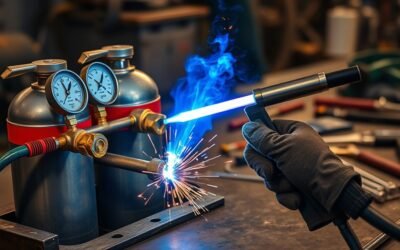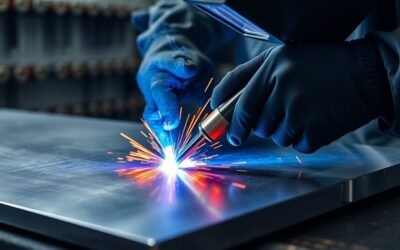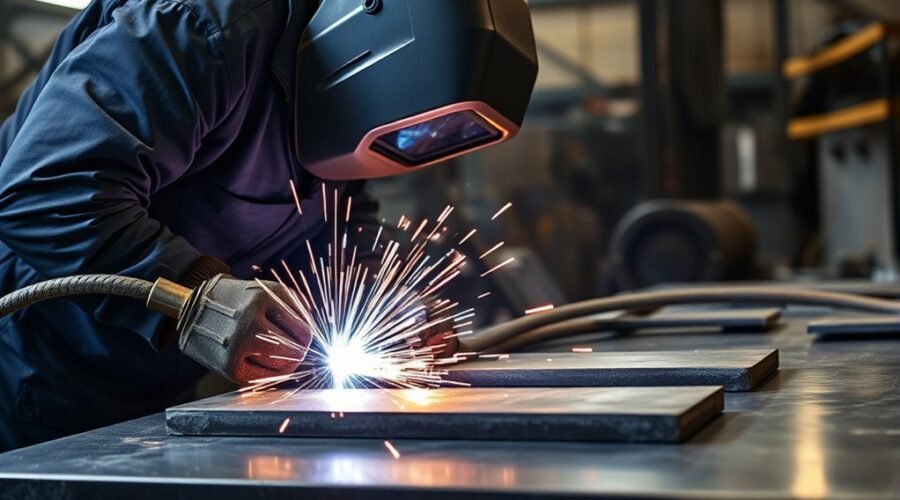
Arc welding is a family of fusion-welding processes that use an electric arc between an electrode and the workpiece to melt metal at the joint. Depending on the process, the electrode may also supply filler metal, while shielding gas or flux protects the molten weld pool from air. Common arc processes include GMAW (MIG), GTAW (TIG), SMAW (stick), FCAW, and SAW.
Quick Answer
Arc welding joins metal by striking an electric arc between an electrode and the workpiece. The arc melts the base metal and, in many processes, filler metal. MIG/GMAW favors speed, TIG/GTAW favors control, stick/SMAW favors portability, FCAW supports high deposition and outdoor work, and SAW suits long, heavy welds.
Key Takeaways
- Consumable electrodes become part of the weld, while GTAW uses a non-consumable tungsten electrode and may use separate filler metal.
- Shielding can come from external gas, flux-generated gas and slag, or a granular flux blanket, depending on the process.
- Polarity is not governed by one rule for all arc welding; the correct AC, DCEP, or DCEN setup depends on the process and consumable.
- Preheating is required only when the material, thickness, restraint, hydrogen risk, code, or welding procedure calls for it.
- A sound weld depends on the complete procedure, including joint preparation, filler metal, current, voltage, shielding, technique, and inspection.
What Is Arc Welding?
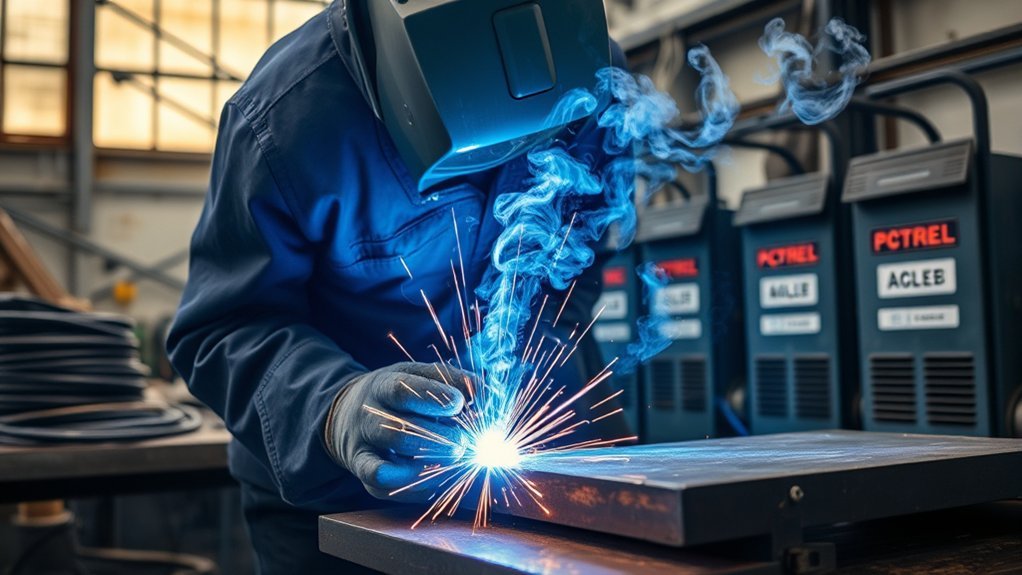
Arc welding uses an electric arc as the heat source for melting and joining metal. The arc forms across a small gap between the electrode and the workpiece, creating enough concentrated heat to melt the base metal and form a weld pool.
The exact temperature of a welding arc varies with the process and operating conditions, so a single temperature should not be treated as universal. What matters in practice is that the arc supplies enough localized energy to melt the metal while the welder controls the size, shape, and penetration of the pool.
Some processes use a consumable electrode that melts and becomes filler metal. Others, most notably GTAW or TIG, use a non-consumable tungsten electrode and can be run with or without separately added filler metal.
The molten pool also needs protection from oxygen and nitrogen in the surrounding air. GMAW and GTAW normally use an external shielding gas, SMAW relies on a flux-covered electrode, FCAW uses flux inside a tubular wire, and SAW covers the arc with granular flux.
This basic principle gives arc welding broad industrial value. A shop may use one process for production work and another for precision or field repairs, which is why multi-process welders are useful when several techniques are needed from one power source.
Arc Welding Types
The major arc welding processes differ mainly in their electrode, filler delivery, and shielding method. Understanding those differences makes it easier to match the process to the metal, joint, work location, production speed, and finish you need.
Beginners often start with MIG or stick before learning processes that demand finer manual control. A machine with several beginner-friendly welding processes can make it easier to practice those differences on one platform.
| Type | Electrode | Key trait |
|---|---|---|
| GMAW (MIG) | Continuous consumable wire | Fast, gas-shielded production welding |
| GTAW (TIG) | Non-consumable tungsten | Precise control; filler metal is optional |
| FCAW | Continuous flux-cored consumable wire | High deposition; self- or gas-shielded versions |
| SMAW (stick) | Flux-covered consumable rod | Portable and suited to field welding |
| SAW | Continuous consumable wire | Granular flux and long mechanized welds |
No process is automatically best for every job. MIG emphasizes speed, TIG emphasizes control, stick emphasizes portability, FCAW combines wire-feed productivity with flux shielding, and SAW is designed for long, high-productivity welds on suitable work.
Common Arc Welding Processes
Five processes account for much of the arc welding readers encounter in fabrication, construction, repair, manufacturing, and heavy industry. Each creates an electric arc, but the way it feeds filler metal and shields the molten pool changes how it performs.
GMAW (MIG): Fast Wire-Feed Welding
Gas metal arc welding feeds a continuous consumable wire through a welding gun while an external gas shields the weld pool. The wire acts as both the electrode and filler metal, which supports fast travel and continuous welding without stopping to replace rods.
The American Welding Society’s GMAW overview describes the process as a continuously fed wire-electrode system used across automotive, aerospace, energy, and manufacturing applications.
GMAW is commonly called MIG welding in everyday use. However, GMAW can use different shielding-gas mixtures, including gases that are not completely inert, so GMAW is the more precise process name.
GTAW (TIG): Precise, Controlled Welding
Gas tungsten arc welding uses a non-consumable tungsten electrode to establish the arc. The operator can add a separate filler rod when needed, but GTAW can also make suitable joints without added filler metal.
AWS notes that GTAW uses a tungsten electrode and inert shielding gas and is valued where fine control and high-quality welds matter. It is widely associated with stainless steel, aluminum, piping, aerospace components, and thin sections.
Direct-current TIG commonly uses electrode-negative polarity for steels and stainless steels, while alternating current is commonly used for aluminum. That is why AC/DC TIG capability expands the range of metals one machine can handle.
SMAW (Stick): Portable, Flux-Shielded Welding
Shielded metal arc welding uses a short, flux-covered consumable electrode held in an electrode holder. Both the metal core and the coating are consumed as the weld progresses.
The metal core supplies filler, while the coating helps stabilize the arc and creates shielding gases and slag that protect the molten and cooling weld metal. Because SMAW does not rely on an external shielding-gas cylinder, it remains useful for field construction, repair, structural work, and other locations where portability matters.
Stick welding requires the operator to maintain arc length manually and replace electrodes as they are consumed. Slag normally must also be removed between passes and after the weld is complete.
FCAW: High-Deposition Wire Welding
Flux-cored arc welding uses a continuously fed tubular wire containing flux. It combines the productivity of a wire feeder with flux-based shielding and is widely used for structural steel and heavy fabrication.
According to the AWS guide to flux-cored arc welding, FCAW has two main forms. Self-shielded FCAW develops protection from the flux inside the wire, while gas-shielded FCAW also uses an external shielding gas.
Self-shielded wire is useful where wind would interfere with an external gas shield. Gas-shielded FCAW is common in fabrication and heavy production where high deposition rates and out-of-position capability are important.
SAW: Mechanized Welding Under Granular Flux
Submerged arc welding creates the arc beneath a blanket of granular flux. A continuously fed wire melts into the joint while the flux shields the arc and molten metal from the atmosphere.
The AWS practical guide to SAW describes it as a high-deposition process that is usually mechanized or automated. It is especially useful for long, repetitive welds in structural steel, shipbuilding, large pipe, tanks, and pressure-vessel fabrication.
How Do You Choose an Arc Welding Process?
Choose the process by matching it to the base metal, thickness, joint design, welding position, work environment, production rate, and required quality. A process that is efficient on a clean indoor production line may be inconvenient on a windy construction site.
- Need fast production on clean material? GMAW is often a practical starting point.
- Need precise heat control or a clean finished bead? GTAW offers fine control.
- Need portable field equipment? SMAW is simple to move and does not need external shielding gas.
- Need high deposition on structural or heavy work? FCAW can be highly productive.
- Need long, repetitive welds on heavy sections? SAW is designed for mechanized production.
Where Arc Welding Is Used
Arc welding is used wherever metal components need permanent fusion joints, from small repairs to large engineered structures. The exact process varies because the priorities in a vehicle plant are different from those in a shipyard, pipeline project, or aerospace shop.
Automotive and general manufacturing use GMAW and other automated arc processes for frames, brackets, exhaust components, fabricated assemblies, and repair work. Production equipment is often selected for repeatability and speed, which are also important when comparing MIG welding equipment.
Construction and infrastructure rely heavily on SMAW and FCAW for structural steel, equipment, field erection, repairs, and multipass joints. On code-governed structural work, the approved welding procedure and qualification requirements matter as much as the process name.
Shipbuilding and marine fabrication use processes such as FCAW, GMAW, and SAW for structural sections and long welded seams. SAW is particularly useful where a mechanized system can follow long joints in a suitable welding position.
Aerospace fabrication often uses GTAW where heat control, cleanliness, thin sections, or difficult alloys demand more precise control. Other joining processes are also used according to the component and engineering specification.
Pipeline and energy work may use SMAW, FCAW, GMAW, GTAW, or combinations of processes for different passes. The approved welding procedure determines the filler, electrical settings, joint preparation, preheat, and inspection requirements.
- Automotive and industrial manufacturing
- Construction and structural steel
- Shipbuilding and marine fabrication
- Aerospace and precision fabrication
- Pipeline, energy, and heavy-equipment work
Arc Welding Electrodes, Polarity, and Preheating
Electrode choice, electrical polarity, and thermal preparation can all change how an arc behaves and how the finished weld performs. These variables must be matched to the process, filler-metal classification, base metal, joint, and welding procedure rather than treated as universal settings.
Arc Welding Rods and Electrodes
The word rod is most often associated with consumable stick electrodes or separate TIG filler rods. GMAW and FCAW normally use continuously fed wire, while GTAW uses a non-consumable tungsten electrode to carry the arc.
In SMAW, the flux-covered electrode supplies filler metal as it melts. Its coating can stabilize the arc, provide shielding, form slag, and influence weld-metal properties. The correct electrode classification depends on the base material, required strength and toughness, position, current type, polarity, and governing procedure.
How Polarity Affects Arc Welding
Polarity describes how the electrode and workpiece are connected in a direct-current welding circuit. DCEP means direct current electrode positive, while DCEN means direct current electrode negative; alternating current repeatedly reverses direction.
There is no reliable rule that says one polarity always creates deeper penetration across every arc-welding process. Miller’s welding polarity guidance notes that carbon-steel TIG commonly uses DCEN, while stick and GMAW commonly use DCEP, and that the required polarity can depend on the electrode or filler metal.
- GMAW with solid wire: typically DCEP.
- GTAW on many steels and stainless steels: typically DCEN; AC is commonly used for aluminum.
- SMAW: polarity depends on the electrode classification and procedure; many electrodes use DCEP, while some also allow AC or DCEN.
- FCAW: polarity depends on the wire; many self-shielded wires use DCEN, while many gas-shielded wires use DCEP.
- SAW: DC or AC may be used depending on the system and welding procedure.
The electrode or wire manufacturer’s data sheet and the approved welding procedure should control the actual setup. Using the wrong polarity can cause an unstable arc, poor bead shape, excessive spatter, inadequate fusion, or other weld-quality problems.
When Is Preheating Needed?
Preheating raises the temperature of the base metal before welding so the joint cools more slowly. It may be specified to help control hard microstructures, moisture, residual stress, and hydrogen-assisted cracking in susceptible steels.
Miller’s preheating guidance explains that preheat is commonly used on steel and steel-alloy pipe or plate where cracking risk and cooling rate need control. The required temperature is not determined by thickness alone.
Steel chemistry, section thickness, joint restraint, hydrogen level, ambient conditions, filler metal, and the governing code or welding procedure can all affect the requirement. For structural work, selecting suitable low-hydrogen welding rods may also be part of a procedure intended to reduce hydrogen-assisted cracking risk.
Arc Welding Safety Basics
Arc welding exposes the operator and nearby workers to intense light, hot metal, fumes, electrical hazards, and fire risks. Safe work requires suitable equipment, training, protective clothing, ventilation, and control of combustibles around the welding area.
Warning: Welding arcs can injure unprotected eyes and skin, hot metal can cause severe burns, welding fumes can be hazardous, and damaged or improperly used electrical equipment can cause shock. Follow the welder manufacturer’s instructions and the safety rules that apply to your workplace.
The OSHA welding, cutting, and brazing guidance identifies hazards including fumes, ultraviolet radiation, burns, eye damage, electrical shock, and other workplace injuries.
- Use a suitable welding helmet, eye protection, gloves, protective clothing, and footwear.
- Provide appropriate ventilation or fume controls, especially in confined spaces or when welding coated, stainless, or otherwise hazardous materials.
- Inspect cables, electrode holders, connectors, and the work area before welding.
- Remove or protect combustible materials and account for sparks, slag, and hot metal after welding stops.
- Keep other people protected from direct exposure to the arc with suitable barriers or screens where required.
Frequently Asked Questions
What Is Arc Welding Vs Stick Welding?
Arc welding is the broader category, while stick welding is one specific arc-welding process. Stick welding is formally called shielded metal arc welding, or SMAW, and uses a flux-covered consumable electrode. Other arc processes include GMAW, GTAW, FCAW, and SAW.
Is Arc Welding the Same as MIG?
No. MIG, formally gas metal arc welding or GMAW, is one type of arc welding. It uses a continuously fed consumable wire and external shielding gas, while the wider arc-welding family also includes TIG, stick, flux-cored, submerged arc, and other processes.
What Are the Four Types of Welding?
There is no single official list of exactly four welding types. The four arc processes most often grouped for beginners are MIG/GMAW, TIG/GTAW, stick/SMAW, and flux-cored/FCAW. Submerged arc welding and other arc processes also exist, while oxyfuel, resistance, laser, and solid-state welding belong to other process families.
What Is MIG, TIG, and Arc Welding?
MIG feeds a consumable wire continuously through a gun, while TIG uses a non-consumable tungsten electrode and may use separate filler metal. Arc welding is the larger family that includes both processes, along with stick, flux-cored, submerged arc, and several other electric-arc methods.
Can Arc Welding Use AC and DC?
Yes. Arc welding can use alternating current or direct current depending on the process, electrode, wire, base metal, and welding procedure. Many GMAW setups use DCEP, many DC GTAW applications use DCEN, and SMAW, SAW, and other processes may use different current and polarity combinations.
Which Arc Welding Process Makes the Strongest Weld?
No arc-welding process is automatically the strongest. Joint design, base metal, filler metal, penetration, heat input, workmanship, defects, and the qualified welding procedure determine whether the finished joint meets its required strength. MIG, TIG, stick, FCAW, and SAW can all produce sound engineered welds when correctly specified and performed.
Conclusion
Arc welding is not one single technique but a family of processes built around the same basic heat source: an electric arc. GMAW, GTAW, SMAW, FCAW, and SAW each solve different production, precision, portability, and heavy-fabrication needs.
The best results come from matching the process, electrode or wire, shielding method, polarity, preheat requirements, and safety controls to the actual material and joint. For code-governed work, follow the qualified welding procedure rather than relying on general rules of thumb.
Sources
- American Welding Society — GMAW Overview: GMAW definition, continuous wire electrode, shielding gas, and applications.
- American Welding Society — GTAW Overview: Non-consumable tungsten electrode, shielding gas, optional filler, and applications.
- American Welding Society — FCAW Guide: Flux-cored wire, self-shielded and gas-shielded FCAW.
- American Welding Society — SAW Guide: Granular flux, mechanized welding, deposition, and industrial applications.
- Miller — Welding Polarity Guide: DCEP and DCEN terminology and common polarity choices for TIG, stick, and GMAW.
- Miller — Welding Preheat Guide: Why preheat is used and how it helps control cooling and cracking risk.
- Occupational Safety and Health Administration — Welding Hazards and Solutions: Welding fumes, radiation, burns, eye injury, electrical shock, and protective measures.