TIG tungsten color codes help you identify electrode composition, but color alone does not tell you the whole setup. The best tungsten depends on the power source, AC or DC output, amperage, and the metal you are welding. Modern inverter machines also change some older rules, especially the advice to use green pure tungsten for every AC aluminum job.
Quick Answer
For most modern TIG work, 2% lanthanated blue or 2% ceriated grey tungsten covers both AC and DC well. Red 2% thoriated remains a proven DC option but contains radioactive thorium. Green pure tungsten is mainly a legacy AC choice, while zirconiated tungsten is designed for clean, stable AC welding.
Key Takeaways
- Read the classification on the package as well as the color band, because suppliers and standards can differ on some specialty electrodes.
- For inverter AC, ceriated and lanthanated tungsten are usually better choices than pure green tungsten because they hold a more focused tip.
- Electrode diameter should be matched to current, not chosen only by material thickness.
- Grind the taper lengthwise on a clean, dedicated wheel to reduce arc wandering and contamination.
- Control grinding dust, especially with thoriated tungsten, and use local exhaust or other suitable protection.
What Does Tungsten Color Mean?
Tungsten color identifies the electrode composition so you can quickly distinguish pure, thoriated, ceriated, lanthanated, and zirconiated types. The current AWS A5.12M/A5.12:2024 specification covers tungsten classification, product identification, and color coding.
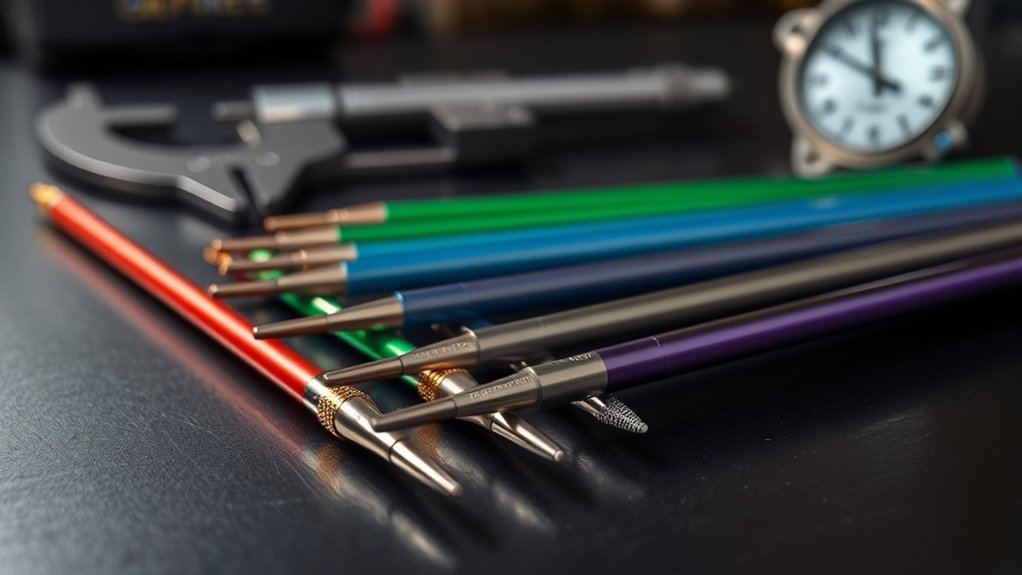
The most familiar colors are green for pure tungsten, red for 2% thoriated, grey for 2% ceriated, gold for 1.5% lanthanated, blue for 2% lanthanated, and white for 0.8% zirconiated. Brown is also used for a lower-zirconium grade. The CK Worldwide tungsten chart shows these common AWS and ISO designations side by side.
Do not rely on paint alone when the electrode is unfamiliar. Check the package designation, especially for rare-earth blends and imported electrodes. Purple and other specialty colors may identify proprietary or less common formulations rather than one universal composition.
If you are comparing shielding choices across welding processes, this guide to the best gas for MIG welding explains how gas selection differs from TIG tungsten selection.
Tungsten Color Codes Explained
The color band is a shortcut; the classification is the precise identifier. The table below covers the most common electrode types and the jobs they are normally chosen for.
| Color | Common classification | Typical use |
|---|---|---|
| Green | Pure tungsten | Legacy transformer AC, especially aluminum and magnesium |
| Red | 2% thoriated | DC welding on steel, stainless steel, nickel alloys, copper alloys, and titanium |
| Grey | 2% ceriated | AC or DC; strong low-current starting and general-purpose work |
| Gold | 1.5% lanthanated | Versatile AC and DC welding |
| Blue | 2% lanthanated | Broad AC and DC use with stable starts and good tip life |
| White | 0.8% zirconiated | AC aluminum and magnesium where contamination resistance matters |
Yellow is commonly associated with a lower-thoria grade, while black can identify 1% lanthanated tungsten. Brown can identify a zirconiated grade. Because exact color assignments can vary by standard or manufacturer, the printed electrode classification should settle any doubt.
Knowing your machine matters too. This overview of types of TIG welding machines helps explain why an older transformer and a modern inverter may favor different tungsten choices.
Which Tungsten Works for AC or DC?
For modern inverter TIG machines, ceriated and lanthanated tungsten are strong all-around choices because they work on both AC and DC. Pure green tungsten is mainly a traditional AC option, while red thoriated tungsten is primarily used for DC work.
Miller’s AC TIG tungsten guidance notes that pure tungsten is no longer the preferred choice for modern inverter AC machines. Ceriated and lanthanated electrodes can hold a more focused tip and generally provide better arc control on these power sources.
- AC aluminum or magnesium on a modern inverter: start with ceriated or lanthanated tungsten unless the machine manual or welding procedure says otherwise.
- AC on an older transformer machine: pure or zirconiated tungsten can be appropriate because both can form a stable rounded end.
- DCEN steel, stainless, titanium, nickel, or copper alloys: lanthanated, ceriated, or thoriated tungsten are common choices.
- Low-current precision work: ceriated tungsten is well known for reliable arc starting at low amperage.
If you are learning how polarity and process choice fit together, this beginner welding process guide adds useful context.
When to Use Pure Tungsten
Pure tungsten, identified by a green band, is most useful for traditional AC TIG setups, especially older transformer machines. It readily forms a rounded or balled end, but it carries less current than many alloyed electrodes and is a weak choice for most DC work.
Best for Legacy AC Aluminum
Green tungsten has a long history in AC aluminum and magnesium welding. On transformer machines, its rounded end can produce the broad arc shape those power sources were designed around.
On a modern inverter, however, ceriated or lanthanated tungsten is usually a better starting point. If you are choosing equipment for a home shop, this guide to home TIG welder options can help you identify whether a machine uses modern inverter controls.
What a Clean Balled Tip Does
A smooth, centered ball helps a traditional AC arc remain predictable. The ball should form evenly; an oversized or lopsided end can widen the arc, wander, or shed tungsten into the puddle.
Do not deliberately ball every tungsten just because you are welding aluminum. Inverter AC machines commonly run a pointed or truncated alloyed tungsten instead.
Limitations in DC Use
Pure tungsten is generally a poor DC choice because it starts less cleanly and has lower current capacity than ceriated, lanthanated, or thoriated electrodes. It also tends to erode faster under the kinds of concentrated arcs normally used for DCEN steel and stainless work.
When to Use Thoriated Tungsten
Red 2% thoriated tungsten is a proven DC electrode with strong arc starting, good stability, and high current-carrying ability. It remains useful when a qualified procedure specifies it, but it contains thorium, a naturally radioactive element.
Warning: Grinding thoriated tungsten creates dust that can contain radioactive thorium. Use local exhaust or suitable respiratory protection, keep grinding areas controlled, and follow your workplace safety procedures.
The International Atomic Energy Agency guidance on thoriated tungsten identifies inhalation of grinding dust as the main concern and recommends ventilation, dust control, and suitable personal protection.
For most general shop work, non-radioactive ceriated or lanthanated tungsten can provide similar practical performance without the thorium-handling issue. If you are choosing a higher-capacity TIG machine, this guide to AC/DC TIG machine capability can help match the power source to the electrode.
Ceriated vs. Lanthanated Tungsten
Ceriated and lanthanated tungsten are both non-thoriated options with good arc stability. Ceriated tungsten is especially useful at low current, while lanthanated tungsten is a broad general-purpose choice across AC and DC.
- 2% ceriated, grey: easy starts, good low-amperage control, and useful performance on both AC and DC.
- 1.5% lanthanated, gold: versatile across many TIG applications and power sources.
- 2% lanthanated, blue: a common general-purpose choice with stable starts and good tip durability.
- For mixed shop work: either ceriated or lanthanated can reduce the need to change electrode type every time polarity changes.
Modern multi-process machines can add another layer of setup choices. This guide to multi-process welders explains how TIG capability differs across machine types.
When to Use Zirconiated Tungsten
Zirconiated tungsten is designed mainly for AC welding of aluminum and magnesium. It combines a stable rounded tip with strong resistance to tungsten contamination, making it useful where weld cleanliness matters.
Zirconiated for AC Aluminum
White 0.8% zirconiated tungsten is a common AC choice, especially on equipment or procedures that favor a rounded tip. It resists spitting better than pure tungsten and can hold a clean end under AC heat.
Brown is also used for a lower-zirconium grade. Always check the package classification before relying on the color alone.
White Tip Advantages
The main advantage of white zirconiated tungsten is clean AC behavior. It can maintain a stable rounded end while reducing the risk of tungsten transfer into the weld pool compared with pure tungsten.
That makes it attractive for aluminum and magnesium work where contamination control is more important than having one electrode type for every process.
Best Use Cases
Use zirconiated tungsten when your procedure, machine, or application calls for a dedicated AC electrode with a rounded end. It is less useful as a universal electrode because ceriated and lanthanated types cover a wider mix of AC and DC work.
Tungsten is a nonconsumable TIG electrode, which is different from the filler or stick electrodes covered in this guide to all-around welding rods.
What Tungsten Size Should You Use?
Choose tungsten diameter by amperage first, then confirm it suits the machine, electrode type, and welding procedure. A tungsten that is too small can overheat and erode; one that is too large can make low-current arc starting less responsive.
Miller’s tungsten selection guidance emphasizes matching electrode diameter to welding current. The ranges below are a practical inverter reference, not a universal limit, because AC balance, waveform, electrode composition, and machine design all affect current capacity.
| Tungsten diameter | DCEN range | AC range |
|---|---|---|
| 1.0 mm (.040 in.) | 15–80 A | 15–80 A |
| 1.6 mm (1/16 in.) | 70–150 A | 70–150 A |
| 2.4 mm (3/32 in.) | 150–250 A | 140–235 A |
| 3.2 mm (1/8 in.) | 250–400 A | 225–325 A |
| 4.0 mm (5/32 in.) | 400–500 A | 300–400 A |
| 6.4 mm (1/4 in.) | 750–1000 A | 500–630 A |
The ranges above apply to the alloyed tungsten table in a Miller inverter manual and are intended as guidance. For most general shop work, 1.6 mm and 2.4 mm electrodes cover a wide range of practical TIG currents, while larger sizes suit sustained high-amperage work.
If you are sizing a machine and tungsten together, this guide to welders for home use can help you compare the power range you actually need.
How to Grind Tungsten
Grind tungsten lengthwise so the grinding marks run in the same direction as the electrode. Use a clean, dedicated grinding wheel or tungsten grinder, keep the taper centered, and avoid contaminating the electrode with steel or other metals.
Miller’s TIG basics guide recommends grinding in the long direction and making the point about 2.5 times the electrode diameter. A dedicated diamond or other suitable fine abrasive wheel helps keep the point clean and consistent.
- Cut away any badly contaminated end before sharpening.
- Use a dedicated wheel or tungsten grinder that has not been used on other metals.
- Hold the electrode so the grind marks run lengthwise, not around the circumference.
- Keep the point centered so the arc does not favor one side.
- Use a longer, sharper taper for lower-current precision work and a blunter truncated tip as current rises.
Pro Tip: Keep one grinding surface only for tungsten. Iron, aluminum, or other metal embedded in a shared wheel can transfer contamination to the electrode and then into the weld.
During grinding, wear suitable eye, hand, and respiratory protection for the hazard. Gloves with good control can help you handle the electrode safely; see these TIG welding glove options for examples.
Which Tungsten Tip Shape Is Best?
The best tip shape depends on the power source, polarity, electrode type, and current. A pointed or lightly truncated tip concentrates the arc, while a rounded tip suits the older AC setups and electrode types designed to ball.
| Tip shape | Best fit | Why |
|---|---|---|
| Pointed | Low-current DC and precision work | Focuses the arc for narrow heat input |
| Truncated point | Higher current and many inverter AC/DC jobs | Keeps arc focus while giving the tip more heat capacity |
| Rounded or balled | Pure or zirconiated tungsten on traditional AC equipment | Supports stable AC behavior on setups designed around a rounded end |
CK Worldwide’s tungsten-angle guidance uses 25° for a wider surface-focused arc, 35° as a balanced general-purpose angle, and 45° for a narrower, higher-energy arc. Treat these as starting points; your procedure and machine settings still control the final choice.
A long sharp point is not automatically better. At higher current, the tip can overheat and erode, so a small flat or truncated end usually lasts longer. On modern inverter AC, do not assume aluminum requires a large ball.
Good tip preparation improves arc control in TIG, just as setup affects weld quality with MIG equipment.
Common Tungsten Selection Mistakes
Most tungsten problems come from choosing by habit instead of matching the electrode to the machine and current. Fixing the tungsten setup can often solve arc-starting or wandering problems before you change other machine settings.
- Using green tungsten on every aluminum job: modern inverter AC machines often perform better with ceriated or lanthanated tungsten.
- Choosing diameter only by material thickness: current range is the better starting point.
- Grinding across the electrode: circumferential grind marks can encourage arc wandering.
- Using a shared grinding wheel: embedded metal can contaminate the tungsten.
- Running a needle point at high amperage: the tip can overheat and shed material.
- Ignoring the package designation: color codes can be confusing on specialty or manufacturer-specific electrodes.
Frequently Asked Questions
What are the different colors for TIG tungsten?
Common TIG tungsten colors include green for pure, red for 2% thoriated, grey for 2% ceriated, gold for 1.5% lanthanated, blue for 2% lanthanated, and white for 0.8% zirconiated. Brown, yellow, black, and specialty colors also exist, so always confirm the classification printed on the package.
What tungsten should I use for aluminum?
For a modern inverter AC TIG machine, ceriated or lanthanated tungsten is usually the best starting point. Pure green or zirconiated tungsten is more closely associated with older transformer AC equipment and procedures that use a rounded or balled tip.
What tungsten should I use for stainless steel?
For stainless steel on DCEN, 2% lanthanated, 2% ceriated, or 2% thoriated tungsten are common choices. Lanthanated and ceriated options avoid thorium and work well across a broad range of currents.
What is the rule of 33 in TIG welding?
The source article described a “rule of 33” as choosing a tungsten diameter near one-third of the base-metal thickness. Treat that only as a rough shop rule, not a standard sizing method. Electrode diameter should be matched to amperage, electrode type, polarity, and the machine manufacturer’s guidance.
What sizes of tungsten electrodes are used in TIG welding?
Common TIG tungsten diameters include 1.0, 1.6, 2.4, 3.2, 4.0, 4.8, and 6.4 mm. Smaller electrodes suit lower current, while larger diameters carry more current. The correct range still depends on electrode composition, AC or DC output, and the power source.
Conclusion
TIG tungsten selection comes down to four things: electrode type, AC or DC output, current, and tip preparation. For a modern shop, ceriated or lanthanated tungsten covers most work, while pure, thoriated, and zirconiated electrodes still make sense in specific machines or procedures. Match the diameter to amperage, grind lengthwise, and confirm the package classification before you strike the arc.
Sources
- American Welding Society, AWS A5.12M/A5.12:2024: classification, identification, color coding, and scope of tungsten electrode standards.
- CK Worldwide Tungsten Electrode Chart: common tungsten compositions, AWS/ISO designations, and color bands.
- Miller, How to Choose the Best Tungsten for AC TIG Welding: modern inverter AC selection and tip-shape guidance.
- Miller, Guide to TIG Welding Basics: tungsten selection and lengthwise grinding guidance.
- Miller, All About Tungsten in TIG Welding: electrode diameter, current matching, and tip-shape guidance.
- CK Worldwide, Tungsten Sharpening Angles: 25°, 35°, and 45° grind-angle behavior.
- International Atomic Energy Agency: thoriated tungsten radiation and grinding-dust safety guidance.