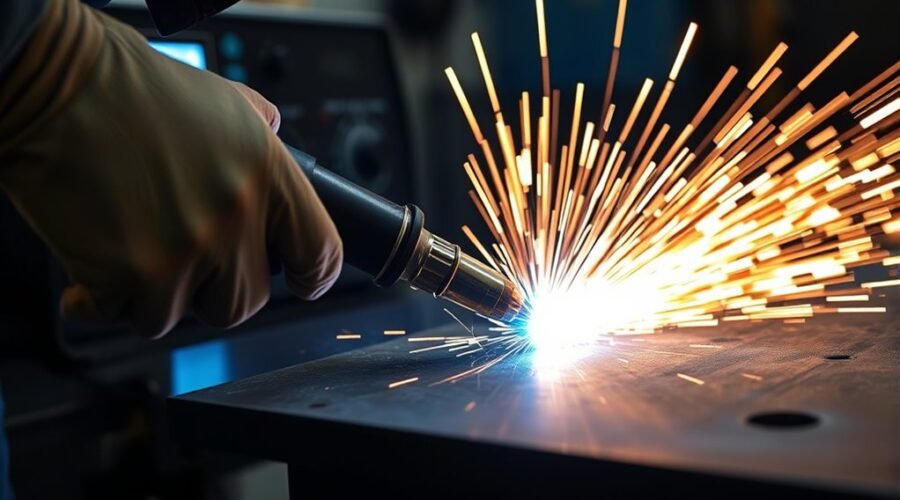
Amperage, voltage, and travel speed set weld quality by controlling deposition, arc behavior, and heat input. Amperage mainly drives penetration and filler delivery, with thicker steel requiring more current. Voltage governs arc length and bead width, so higher voltage produces a wider, flatter bead. Travel speed determines heat input; slower movement increases pool temperature and burn-through risk. These variables must be balanced together to maintain fusion and stable bead formation, with more detail to follow.
Key Takeaways
- Amperage controls deposition and penetration; a useful starting point is about 1 amp per 0.001 inch of material thickness.
- Voltage controls arc length and bead shape; higher voltage makes wider, flatter beads, while low voltage can weaken fusion.
- Travel speed controls heat input; slower movement increases heat and burn-through risk, while faster movement can reduce penetration.
- Amps, volts, wire feed, and travel speed must be balanced together for stable arc performance and consistent weld quality.
- Monitor the puddle and adjust settings as material thickness and joint profile change to maintain proper fusion.
What Amps, Volts, and Travel Speed Do
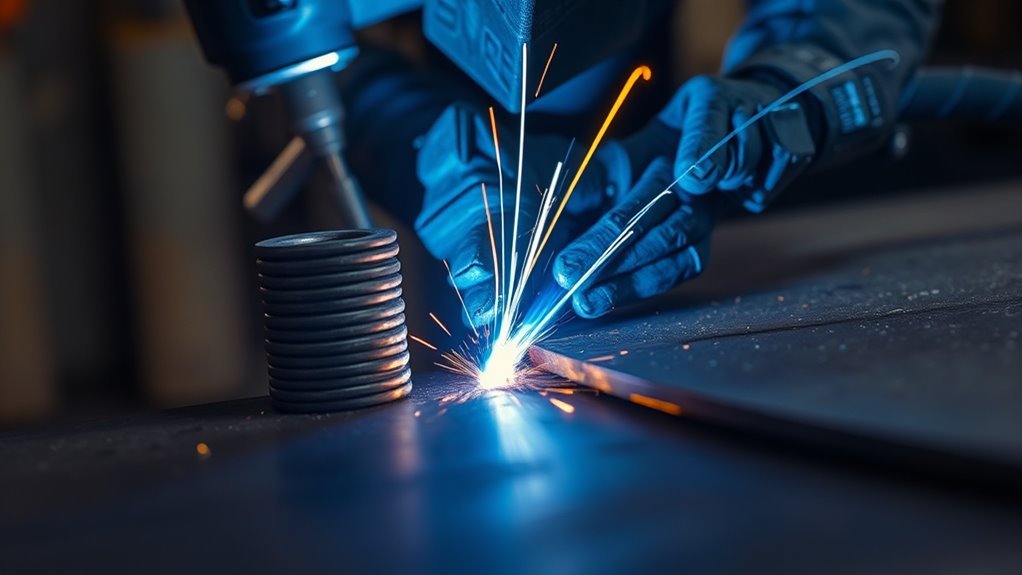
Amperage controls weld metal deposition and is commonly estimated at roughly 1 amp per 0.001 inch of material thickness, so 1/4 inch steel requires about 250 amps.
In MIG welding, amps set the amount of filler delivered, while volts regulate arc length and bead profile. Higher volts produce a wider, flatter weld bead; lower volts concentrate energy and can narrow the bead.
Travel speed governs heat input with direct efficiency: slower travel raises heat input and can improve fusion, while faster travel reduces heat input and helps prevent distortion on thin stock.
Wire feed speed and amps are linked, so increasing feed raises current and demands controlled setup. Proper balance of amps, volts, and travel speed keeps deposition stable, supports predictable penetration, and maintains heat input near the 0.5-2 kJ/mm range for mild steel.
This parameter control enables disciplined welding practice and material liberation from unnecessary defects.
How Amperage Affects Penetration
Penetration depth rises predictably as current increases, with a common rule of thumb of about 1 mm of added penetration for every 50 amps applied. Amperage thus functions as a primary control on penetration and weld quality, especially when matched to base metal thickness and travel speed. Higher welding current raises melt-off rates and drives a deeper weld; lower current reduces fusion and can leave weak root ties.
| Process | Material | Amperage |
|---|---|---|
| MIG | 1/8-inch steel | 125-150 |
| MIG | 1/4-inch steel | 175-220 |
| Stick | 1/4-inch steel | 180-200 |
These welding variables support predictable results and disciplined freedom from defects. Consistent monitoring of amperage is necessary because small changes alter penetration depth quickly. Proper adjustment helps maintain sufficient fusion across the base metal without sacrificing weld quality or the intended joint profile.
Why Voltage Changes Arc Shape and Bead Width
Voltage governs arc length and, by extension, bead geometry: as voltage rises, the arc gap lengthens, producing a wider, flatter bead, while lower voltage shortens the arc and concentrates the weld into a narrower profile.
In MIG welding, welding voltage is thus a primary control on bead width and bead appearance. A shift from 16 to 18 volts on 1/8-inch steel can noticeably flatten the arc, and even 0.1 volt may add roughly 0.5 mm of width. Such sensitivity makes voltage adjustment a disciplined means of shaping liberated, predictable fusion.
Excessive voltage can create undercutting and a concave surface; insufficient voltage can leave cold laps and weak fusion. Stable electrical current, matched with amperage settings and wire feed, supports arc stability and weld penetration.
Travel speed should remain a separate variable, because voltage chiefly alters arc form, not motion.
How Travel Speed Controls Heat Input
Travel speed exerts a direct control over heat input in welding: as the torch or gun moves more slowly, heat is deposited for a longer time and the weld pool grows hotter, while faster motion reduces the energy applied per unit length. This relationship is expressed by the formula for heat input, where voltage and amperage are divided by travel speed, so a decrease in feed speed raises the delivered energy.
On mild steel, ideal heat input commonly falls between 0.5 and 2 kJ/mm, a range that supports stable weld penetration without excess distortion. Slower travel speeds can overheat the joint and invite burn-through; overly fast motion can produce narrow beads and weak penetration.
In semiautomatic work, 10 to 12 IPM is typical, though skilled operators may reach 18 to 20 IPM while maintaining quality. Consequently, travel speed remains a primary lever for controlled, liberated parameter selection.
How to Set Welding Parameters Together
Setting welding parameters requires treating amperage, wire feed speed, voltage, and travel speed as one coordinated system rather than isolated controls. A baseline of 1 amp per 0.001 inch of thickness gives a disciplined starting point for welding setup. | Parameter | Control effect |
| — | — |
|---|---|
| Amperage | Sets penetration |
| Wire feed speed | Demands matching amperage |
| Voltage | Governs arc length |
| Travel speed | Regulates heat input |
| Puddle observation | Refines bead shape |
As wire feed speed rises, amperage must rise to preserve arc stability and a free weld puddle. Voltage then fine-tunes arc length, influencing bead shape and penetration. Travel speed near 10–12 inches per minute suits semiautomatic work, yet it must shift with the required heat input. The heat input formula links voltage, amperage, and travel speed, exposing excess energy before burn-through occurs. Continuous monitoring of arc characteristics allows real-time correction, enabling a liberated, precise weld instead of a constrained compromise.
Frequently Asked Questions
What Is the Typical Travel Speed for Welding?
Typical welding travel speed is about 10 to 12 inches per minute, with skilled operators reaching 18 to 20 IPM.
Welding techniques must balance heat input, material thickness, joint design, welding positions, and filler material to maintain arc stability and weld penetration.
Proper safety measures and equipment maintenance support consistency.
Faster movement lowers heat input; slower movement raises it, shaping quality and liberating the process from defects through precise control.
What Voltage and Wire Speed Should I Set My MIG Welder?
A masterful setup begins with matching voltage settings and wire feed to material thickness, as if the metal itself were dictating the terms of liberation.
For MIG techniques, 1/8-inch steel often prefers 15–22 volts, while 1/4-inch steel may need 23–26 volts and about 200–300 inches per minute wire feed.
Shielding gas, electrode type, joint preparation, weld penetration, arc stability, and heat input should be tuned together for control.
How Many Amps Does a 120 Volt MIG Welder Use?
A 120-volt MIG welder typically uses 30 to 140 amps, depending on material thickness and wire diameter.
Lower amperage settings suit thin steel, while higher values improve weld penetration on thicker stock.
Welder power, machine efficiency, and duty cycle shape actual draw, and voltage drop can reduce arc stability.
Heat input must be matched to the task so operators can work with precision, safety, and liberated control.
What Is the Recommended Travel Speed for SMAW Welding?
Travel speed for SMAW is typically 4 to 12 inches per minute, a measured river guiding molten metal to shore.
Weld quality depends on electrode type, joint design, material thickness, arc stability, heat input, technique variations, position welding, and safety measures.
Thicker sections usually need slower movement for penetration, while thinner material tolerates faster travel.
Precise control liberates the operator from defects, preserving fusion, bead shape, and consistency.
Conclusion
In welding, the simplest controls—amps, volts, and travel speed—prove inconveniently powerful. A slight increase in amperage can deepen penetration, while a modest voltage shift can widen the bead and alter arc stability. Travel speed, meanwhile, quietly decides whether heat is concentrated or squandered. The irony is clear: a process often treated as routine depends on these small settings, each precise enough to improve a weld or expose every weakness in it.