

A multi-process welder should let you switch between MIG, TIG and stick work without filling the shop with separate machines. The hard part is separating useful process coverage from features that look similar on a product page but work differently in practice.
The Hobart Multi-Handler 200 is the best overall pick because it combines 120/240V power, 200A-class output, a clear LCD and established service support. The Weldpro MIG210LCD is the best value choice.
We compared manufacturer specifications, current retailer availability, warranty coverage, recall records and repeated owner feedback from independent sources.
Multi-Process Welders Compared
| Product | Best for | Processes | Input / connection | Warranty | Score |
|---|---|---|---|---|---|
|
Mid-range
|
Best value | MIG/FCAW, DC Stick, Lift TIG | 120/240V | 3-year power-source warranty | 88/100 |
|
Premium
|
Best overall | MIG/FCAW, DC TIG, Stick | 120/240V MVP | 5/3/1 limited warranty structure | 91/100 |
|
Budget
|
Aluminum MIG on compatible Hobart welders; accessory only | Spool-gun accessory, not a welder | Direct plug-in to compatible Hobart machines | 1 year; 90 days industrial use | 82/100 |
Multi-Process Welder: Our Top Picks
1. Weldpro MIG210LCD

Bottom line: The Weldpro MIG210LCD is a practical pick for home shops that want MIG, flux-core, stick and Lift TIG from one 120/240V machine. Its main catch is that TIG is DC Lift TIG, so aluminum TIG is not part of the feature set.
- Processes: MIG/FCAW, DC Stick, Lift TIG, covers common shop work
- Input power: 120/240V, works across common garage and shop circuits
- Max output: 200A on 240V, suited to medium-duty fabrication
- Rated duty cycle: 30% at full output, plan cooling breaks
- Aluminum setup: Optional spool gun, aluminum MIG requires an add-on
The color LCD and auto-set menu are the strongest convenience features. You choose the process, gas, electrode and plate thickness, then the machine supplies a starting point for current or voltage and wire speed. Manual adjustment remains available when you need to tune the arc.
The MIG spot timer is useful for plug welds and repeatable tacks. Stick mode also provides hot-start and arc-force controls. The machine accepts 2 lb and 10 lb wire spools, which makes it easier to keep a small shop setup compact.
For aluminum, use the compatible spool-gun path rather than expecting AC TIG capability. That keeps the machine flexible, but it also means aluminum work requires another accessory.

- MIG, flux-core, Stick and Lift TIG in one machine
- Dual-voltage 120/240V input
- Color LCD with auto-set menu and manual tuning
- MIG spot timer and spool-gun support
- Lift TIG is DC only, so it does not provide AC TIG for aluminum
- Aluminum spool gun is sold separately
- Full-output duty cycle is 30%, limiting long high-amperage runs
2. Hobart Multi-Handler 200
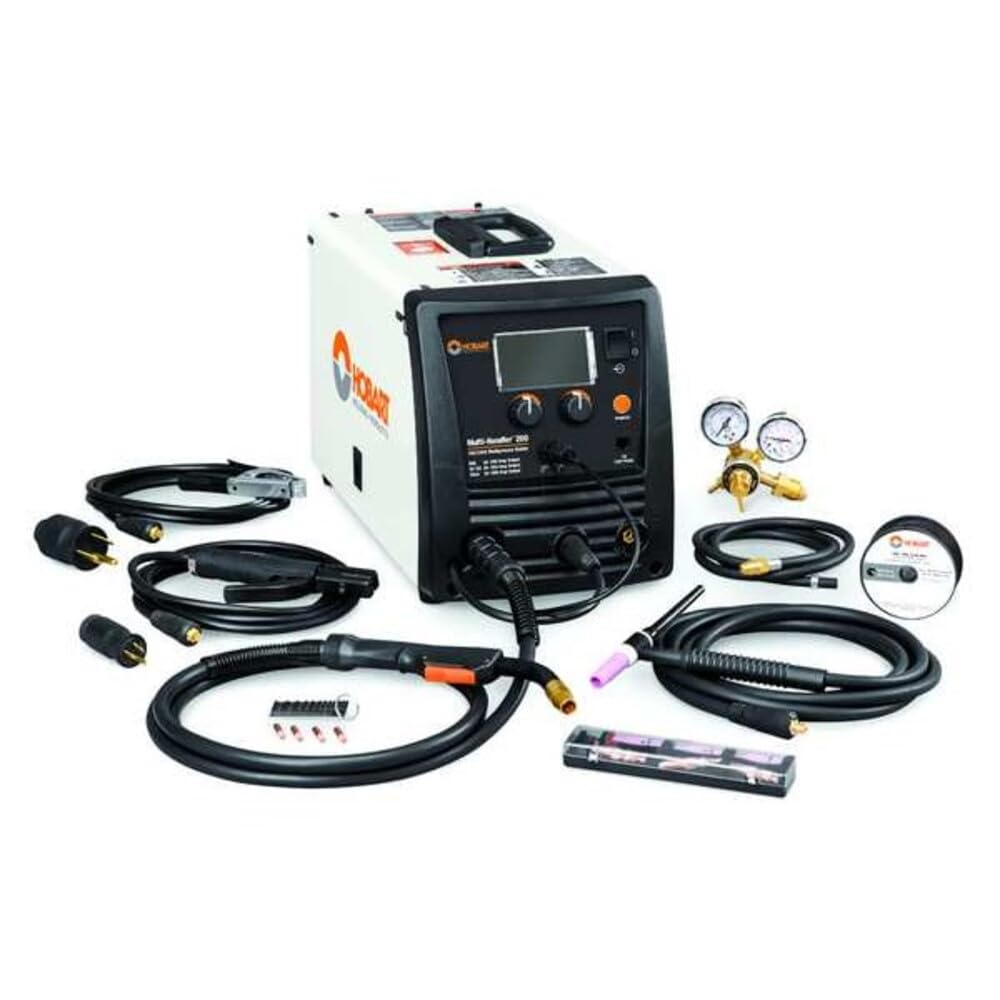
Bottom line: The Hobart Multi-Handler 200 is the strongest all-round choice here for buyers who want a lighter 120/240V machine, clear controls and established service support. Its TIG process is DC only, so aluminum TIG still requires a different machine.
- Processes: MIG/FCAW, DC TIG, Stick, covers core shop processes
- Input power: 120/240V MVP, plug changes without tools
- Max output: 200A, supports thicker steel on 240V
- Rated duty cycle: 165A MIG at 30% on 240V, moderate-duty use
- Aluminum setup: Spool-gun ready, aluminum MIG needs an optional gun
The Multi-Handler 200 combines a color LCD with two knobs and a process button. A parameter chart inside the door gives starting settings, while run-in technology slows the wire before arc initiation to improve MIG starts.
The MVP system is useful when you move between a home garage and a 240V shop circuit. Hobart also includes the MIG gun, TIG torch, electrode holder, regulator, gas hose and common consumables with the standard 500578 package.
Its main limitation is process scope rather than power. DC TIG works for steel and stainless, but it cannot provide AC TIG for aluminum. For aluminum MIG, the machine is designed to accept a compatible spool gun.

- MIG, flux-core, DC TIG and Stick capability
- 120/240V MVP system simplifies power changes
- Color LCD, parameter chart and run-in technology aid setup
- Spool-gun ready with a 5/3/1 warranty structure
- DC TIG only, so no AC TIG aluminum welding
- Spool gun and TIG foot control are optional
- 30% rated duty cycle is not aimed at continuous production welding
3. Hobart SpoolRunner 100
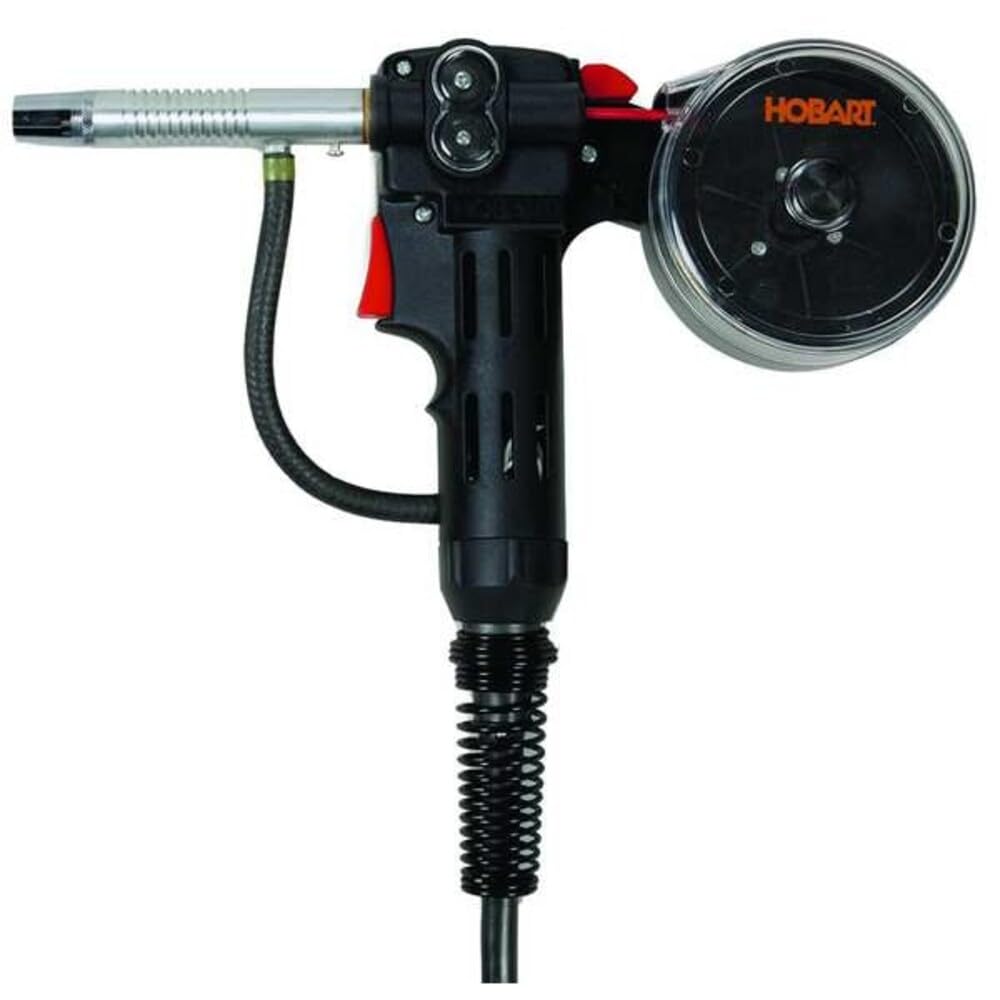
Bottom line: The Hobart SpoolRunner 100 is a spool-gun accessory, not a multi-process welder, so it does not qualify as a main pick in this roundup. It remains here because it was part of the original article and can add aluminum MIG capability to compatible Hobart welders.
- Rated output: 150A at 60% duty cycle
- Cable: 10 ft, fixed lead length
- Wire capacity: .023–.035 in aluminum, steel and stainless
- Spool capacity: 4 in rolls
- Compatibility: Handler 190, Handler 210 MVP and Multi-Handler 200
The gun feeds wire from a small spool at the torch, which helps reduce the feeding problems common with soft aluminum wire. Hobart includes a carrying case, extra contact tips and an extra nozzle.
Compatibility matters more than raw amperage here. Confirm your exact Hobart welder supports the 300796 SpoolRunner 100 before buying it, because this accessory is not a standalone power source.

- Direct plug-in support for several compatible Hobart welders
- 150A output rating at a 60% duty cycle
- Handles .023–.035 in aluminum, steel and stainless wire
- Includes a case, extra tips and an extra nozzle
- It is an accessory, not a multi-process welder
- Compatibility is limited to supported Hobart machines
- Fixed 10 ft cable may limit reach on larger work
Hobart Multi-Handler 200 vs Weldpro MIG210LCD: Is the Upgrade Worth It?
The core trade-off is support and integration versus price and lighter weight. Both cover MIG, flux-core, DC TIG and stick-type work, but neither gives you AC TIG for aluminum.
- Warranty and support: Hobart uses a longer 5/3/1 warranty structure; Weldpro lists a 3-year power-source warranty.
- Controls: Hobart uses a color LCD and parameter chart; Weldpro adds an auto-set menu and MIG spot timer.
- Portability: Weldpro lists a lower machine-only weight, while Hobart remains under 39 lb.
- Aluminum: Both rely on an optional compatible spool gun for aluminum MIG.
Which Multi-Process Welder Should You Buy?
- You want the strongest all-round shop pick: get the Hobart Multi-Handler 200.
- You want better value and a spot timer: get the Weldpro MIG210LCD.
- You move between 120V and 240V power often: the Hobart Multi-Handler 200 makes plug changes simple with MVP.
- You want a lighter machine with auto-set controls: the Weldpro MIG210LCD is the better fit.
- You need aluminum MIG: choose either verified welder, then confirm the correct compatible spool gun before buying.
How We Chose
- Process coverage: We prioritized true welding power sources that handle MIG, TIG and stick-related work.
- Power and duty cycle: We checked manufacturer output ranges, input voltage and rated duty-cycle information.
- Usability: We compared setup controls, included accessories, spool-gun support and portability.
- Ownership: We reviewed warranty terms, current availability, recall records and repeated owner trends across independent sources.
Customer Preferences
Most buyers in this category need process flexibility first, then enough input power and duty cycle for the metal they actually weld. Aluminum changes the decision because a DC-only TIG machine needs a spool-gun path for practical aluminum MIG work.
Setup speed also matters. Clear controls, starting parameters and accessible service support can save more time over the life of the machine than a long feature list you rarely use.
How to Choose a Multi-Process Welder
Start With the Processes You Will Actually Use
MIG is the easiest path for many garage repairs and fabrication jobs. Flux-core is useful when shielding gas is inconvenient. Stick is valuable for outdoor repairs and less-clean steel. TIG gives more control on thin steel and stainless. If those are your main needs, both the Hobart Multi-Handler 200 and Weldpro MIG210LCD cover the core processes.
Match Input Power to Your Shop
A dual-voltage machine gives you more flexibility, but available output changes with the supply. Household 120V is convenient for lighter work. A suitable 240V circuit gives these 200A-class machines access to their higher output range. Always follow the manufacturer manual and local electrical requirements for circuit sizing.
Read the Duty Cycle, Not Just the Maximum Amps
Maximum amperage tells you the upper output setting. Duty cycle tells you how long the machine can weld within a defined period before cooling is required. For longer high-amperage beads, rated duty-cycle data matters more than the headline amp number.
Plan for Aluminum Before You Buy
Neither verified welder here provides AC TIG for aluminum. For aluminum MIG, the Hobart Multi-Handler 200 and Weldpro MIG210LCD use optional compatible spool-gun setups. Confirm the gun, wire size and shielding gas requirements before ordering accessories.
Check What Comes in the Box
A multiprocess machine may include the power source, MIG gun, TIG torch, electrode holder, work clamp and regulator, but specialty controls and spool guns are often separate. Compare the exact package contents so a lower machine price does not turn into an unexpected accessory bill.
Warranty and Service Matter
Inverter welders combine many functions in one chassis, so access to parts and service can matter over a long ownership period. Compare the power-source warranty, torch coverage, local service options and replacement accessory availability before treating two machines as equivalent.
Mistakes to Avoid When Buying a Multi-Process Welder
- Confusing DC TIG with AC TIG: DC TIG does not give you the usual AC process used for aluminum TIG.
- Ignoring duty cycle: A 200A maximum does not mean continuous 200A welding.
- Assuming a spool gun is included: Check the exact package and compatible part number.
- Buying for features you will not use: Match the machine to your common materials and repairs.
- Skipping electrical planning: Confirm your outlet, breaker and wiring meet the manual requirements.
FAQs
Which welding processes do I need in a multi-process welder?
Choose the processes that match your regular work. MIG suits fast garage fabrication and sheet metal, flux-core helps when gas is inconvenient, Stick is useful outdoors, and TIG gives more control on thin steel and stainless. A machine does not become a better buy just because it lists more modes.
Can one multi-process welder replace dedicated welders?
For many home, farm and light-fabrication jobs, yes. A good multi-process welder can cover MIG, flux-core, TIG and Stick work while saving space. Dedicated machines still make sense when you need specialized AC TIG, very high duty cycles, advanced pulse control or production-level output.
Can these welders TIG aluminum?
No. The two verified welders in this roundup use DC TIG or Lift TIG, not AC TIG. Aluminum TIG normally requires a machine that explicitly supports AC TIG. For aluminum MIG, both verified machines can use a compatible optional spool gun when set up with the correct wire and shielding gas.
Should I use 120V or 240V for a multi-process welder?
Use the input voltage that matches both your circuit and the job. A 120V supply is convenient for lighter work, while 240V lets these machines access more of their output range. Follow the exact branch-circuit requirements in the manufacturer manual instead of assuming any outlet is suitable.
What duty cycle should I look for?
Look for a duty cycle that matches how long you weld at higher amperage. Short repair beads and occasional fabrication place less demand on a machine than long production welds. Compare duty cycle at a stated amperage, not just the maximum output number printed on the front panel.
Do I need a spool gun for aluminum MIG welding?
Usually, a spool gun is the simplest path on these two machines because soft aluminum wire can be difficult to push through a long conventional MIG liner. Check the welder’s approved spool-gun model, supported wire sizes and gas requirements before buying the accessory.
Final Verdict
The best multi-process welder in this roundup is the Hobart Multi-Handler 200 for its balanced process coverage, MVP input flexibility and established warranty structure. The Weldpro MIG210LCD remains the value-focused alternative with useful auto-set controls and a spot timer.
If value matters more than the longer Hobart warranty structure, compare the Weldpro MIG210LCD.
| Weldpro 200A MIG Welder | Hobart 500578 Multi-Handler 200 | Hobart Spool Gun, 100 A, 10 ft. | |
|---|---|---|---|
|
|
|
|
|
| Rating | 4.6/5 (244 reviews) | 4.4/5 (86 reviews) | 4.5/5 (313 reviews) |
| Weight | 54.9 pounds | 38.4 pounds | 8 pounds |
| Power Output | 200 Amps | 200 Amps | 100 Amps |
| Material Thickness Capacity | Up to 3/8 inch (MIG) and 1/4 inch (TIG) | Up to 3/8 inch (MIG), 3/16 inch (TIG) | Suitable for up to 1/4 inch aluminum |
| Shop Now | Shop Now | Shop Now |



[…] code compliance determines whether the weld can stand free and valid. Additionally, understanding multi-process welders can enhance your capability in meeting diverse project […]
[…] and preserves the freedom to weld without interruption or excess compromise. Understanding power output requirements is crucial for selecting the right […]
[…] use, while lap joints may benefit from pull technique behavior. Additionally, understanding process support and power range can significantly impact the choice between these techniques depending on the specific welding […]
[…] material integrity and operational freedom under severe service conditions. Additionally, utilizing multi-process welders can enhance versatility in achieving full penetration in diverse […]
[…] seeking greater technical autonomy. This innovation laid the groundwork for today’s multi-process welders, which combine various welding methods for enhanced […]
[…] structural integrity, and the practical freedom of reliable fabrication. Understanding the multi-process welders can also enhance your welding skills and adaptability in various […]
[…] uninterrupted work, the figure is not decorative; it is a control parameter. Understanding duty cycle and cooling reliability helps prevent overheating, limits equipment damage, and preserves weld quality and safety under […]
[…] understanding these weld size dimensions helps prevent a weld from being placed or sized differently from the design […]
[…] choice is also tied to the capabilities of the machine. A multi-process welder may support several processes, but each process still requires the correct shielding setup, filler […]
[…] Arc is common on modern DC TIG and multi-process welders. However, the presence of Lift TIG does not automatically mean a machine can TIG-weld aluminum; […]
[…] not be confused with the arc-welding equipment covered in guides such as welders for beginners, multi-process welders, or conventional MIG, TIG, and stick […]
[…] several processes may prepare students for a broader set of entry-level roles. Understanding multi-process welding can help applicants recognize the differences among those processes when reviewing […]
[…] damaged or moisture-affected coatings can change arc behavior. A stable power source and adequate duty cycle and cooling reliability are useful, but settings and technique should be checked […]
[…] multi-process welder can be useful if you routinely switch between MIG, TIG, and stick projects, but a multi-process […]
[…] support MIG, TIG, stick, and flux-cored work can make early training easier. A comparison of the importance of process support can help beginners understand which capabilities matter for different […]
[…] before cutting and reduce wasted stock. If one machine will handle most of the project, a multi-process welder can also be useful for a shop that handles several fabrication […]
[…] for engineers seeking reliable, durable connections between dissimilar metals. Additionally, using multi-process welders can improve the flexibility and effectiveness of these […]
[…] and extends material freedom through reliable structural continuity. Additionally, understanding duty cycle and cooling reliability is crucial for maintaining weld quality and performance over […]
[…] technicians to inspect, compare, and correct results with discipline. Additionally, understanding duty cycle and cooling reliability is crucial for ensuring consistent performance in welding […]
[…] pool from atmospheric contamination and preserves weld integrity. Additionally, understanding duty cycle and cooling reliability is crucial for maintaining optimal weld […]
[…] durable fabrication and disciplined resistance to structural collapse. Additionally, understanding duty cycle and cooling reliability is crucial for ensuring optimal welding […]
[…] may crack, and aluminum demands higher currents plus careful electrode management. Additionally, multi-process welders offer versatility that can enhance welding capabilities across various […]
[…] industries because it combines efficiency, adaptability, and structural integrity. Additionally, multi-process welders are increasingly popular for their versatility in handling various welding […]
[…] welding with SAW offers disciplined, repeatable performance. Additionally, the versatility of multi-process welders enhances the adaptability of operations across varying […]
[…] the weld and reduce the chance that stainless steel loses its intended performance. Additionally, understanding process support is crucial for achieving successful welds in various […]
[…] depends on precise preparation, stable arc control, and restraint. Additionally, understanding multi-process welders can enhance versatility and efficiency when working with different […]
[…] Welder duty cycle and cooling capacity can affect shop productivity, but they do not establish structural joint strength. Those machine-specific issues are covered separately in our multi-process welder guide. […]
[…] same principle also helps when comparing gas welding with other equipment. A multi-process welder guide explains how MIG, TIG, and stick systems differ from flame-based […]
[…] you want both processes available from one machine, a multi-process welder can provide more flexibility, provided its output, duty cycle, polarity options, and wire-feed […]