

Choosing a budget AC/DC TIG welder is harder than comparing amp numbers. You need true AC for aluminum, useful DC control for steel and stainless, and enough duty cycle for the work you actually do.
Weldpro 200A AC/DC TIG Welder is the strongest verified fit in this lineup because it supports AC/DC TIG, pulse modes and dual-voltage input. It is also the value pick among the products that passed the live fit check.
We checked linked listings, manufacturer specifications, current model documentation and recall signals before rebuilding the roundup. Three original products remain for transparency but are not recommended because they do not meet the AC/DC TIG requirement.
Budget AC/DC TIG Welders Compared
| Product | Best for | TIG current | Input power | Weight |
|---|---|---|---|---|
|
Budget
|
Best overall | AC/DC TIG; AC/DC pulse | 120/240 V | About 31 lb power source |
| MIG, Stick and DC TIG | DC TIG | 120/240 V | 38 lb | |
| MIG/Stick with DC Lift TIG | DC Lift TIG; DC Pulse Lift TIG | 120/230 V | 45.4 lb | |
| Home-shop multiprocess repairs | DC TIG | 120/230 V | 43 lb |
Budget AC/DC TIG Welders: Our Top Picks
1. Weldpro 200A AC/DC TIG Welder
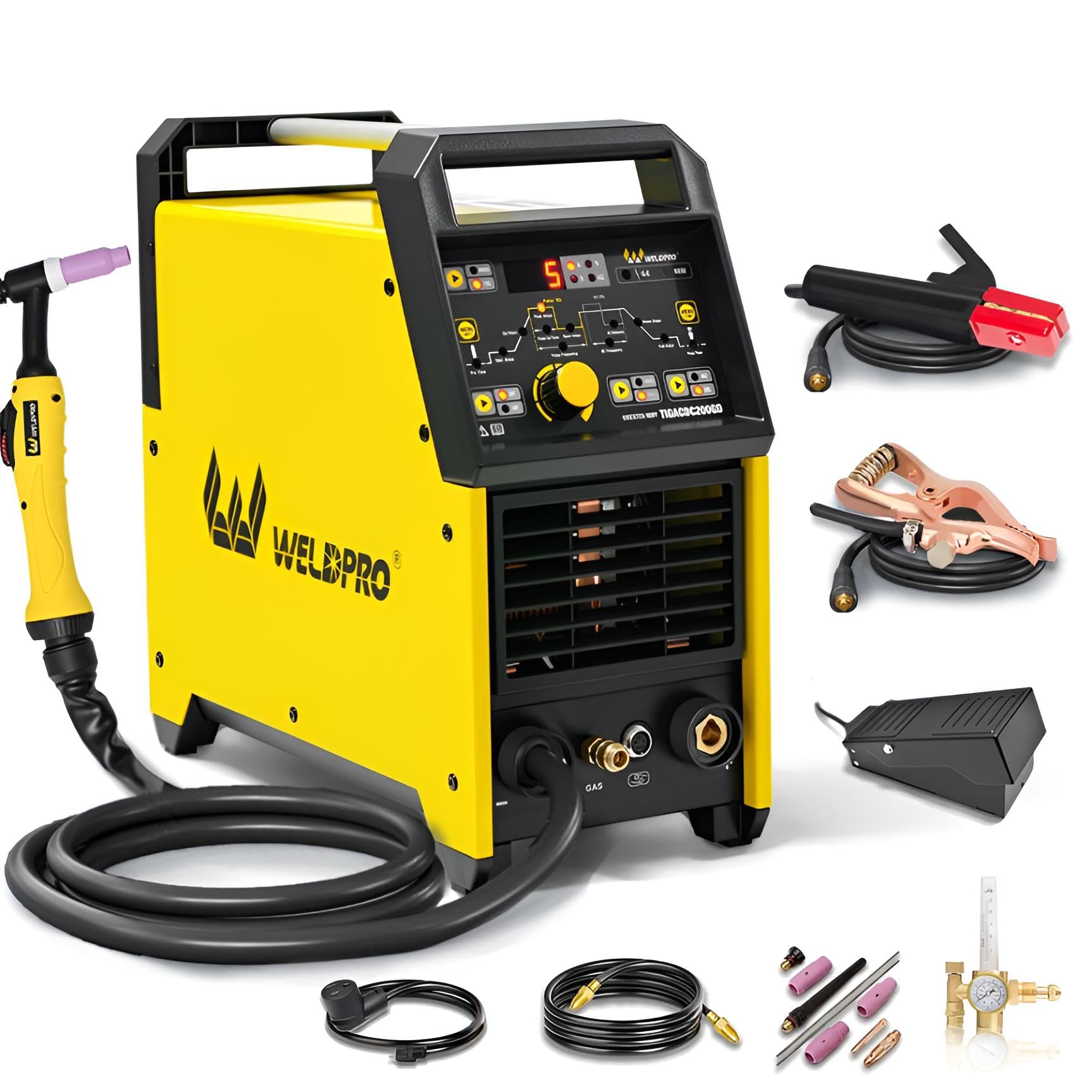
Bottom line: This is the best match in the original lineup if you need true AC/DC TIG for aluminum, steel and stainless. It combines pulse control, dual-voltage input and a foot pedal in one TIG-and-stick package.
- TIG current: AC/DC TIG with AC/DC pulse, covers aluminum and ferrous metals
- Input power: 120/240 V dual voltage, supports home and shop circuits
- Rated output: 200 A TIG at 40% duty cycle, useful high-current headroom
- Weight: about 31 lb power source, easier to move around a shop
The linked machine is a TIG-and-stick welder, not a MIG welder. Its current feature set includes high-frequency AC TIG, DC TIG, AC pulse TIG, DC pulse TIG and stick welding. That makes it a better fit for readers focused on controlled TIG work than for someone who needs wire-feed welding.
Weldpro lists adjustable pre-flow, post-flow, upslope, downslope, AC balance, AC frequency and pulse controls. Those settings give you more control over arc behavior and heat than a basic lift-TIG machine. The current KT26 package also includes a foot pedal, flow meter, gas hose, ground clamp and consumables.
The main limit is duty cycle at maximum output. The manufacturer rates TIG at 40% duty cycle at 200 amps on the higher-voltage input, so long high-amperage runs still require cooling time. For routine home-shop fabrication, the dual-voltage design gives you more flexibility than a single-voltage TIG machine.
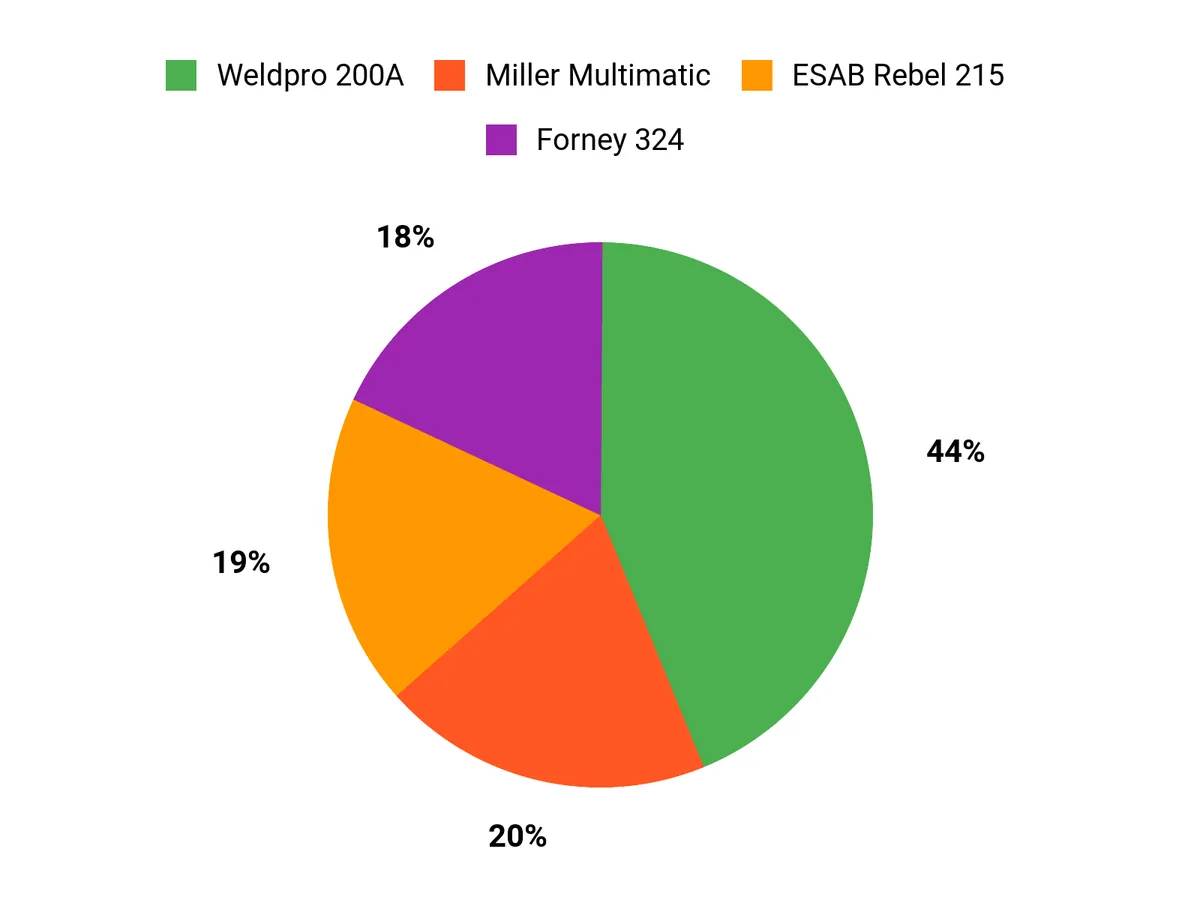
Original sentiment snapshot: The chart below is retained from the source roundup. The current recommendation here is based on verified specifications and listing fit, not the chart alone.

- True AC/DC TIG plus pulse modes for aluminum, steel and stainless
- Dual-voltage input gives more flexibility between home and shop power
- Foot pedal, flow meter, gas hose and core TIG accessories are included
- Manufacturer rates TIG at 200 A with a 40% duty cycle on higher-voltage input
- No MIG process for readers who also need wire-feed welding
- Maximum-output work still requires cooling breaks at the stated duty cycle
- Controls offer more adjustment than a basic TIG machine, so setup takes learning
2. Miller Multimatic 215

Bottom line: The Multimatic 215 is a capable portable MIG, flux-cored, stick and DC TIG machine, but it is not an AC TIG welder. That makes it a poor fit for an AC/DC TIG roundup even though it remains useful for general multiprocess work.
- TIG current: DC TIG only, suited to steel and stainless rather than AC aluminum TIG
- Input power: 120/240 V, supports common shop and jobsite power
- Rated output: 190 A TIG at 20% duty cycle on 240 V, built for varied repair work
- Weight: 38 lb, relatively easy to move between work areas
Miller specifies the 907693 Multimatic 215 as a DC TIG, MIG, flux-cored and stick welder. Its Auto-Set Elite interface, multi-voltage plug and compact chassis are useful for repair work where process switching matters more than AC TIG control.
The machine-only package includes the MIG gun, electrode holder, work clamp, regulators and adapter plugs. Miller lists the TIG kit separately, so buyers planning to TIG should confirm the exact package contents before ordering accessories.
For aluminum, the Multimatic 215 can handle MIG with the proper setup, but its TIG process is DC only. If your main reason for shopping this roundup is AC TIG on aluminum, choose an AC/DC TIG model instead.
Original sentiment snapshot: This source chart is retained unchanged. It does not change the model’s verified DC-only TIG specification.

- MIG, flux-cored, stick and DC TIG in one compact machine
- 120/240 V input with Miller’s multi-voltage plug system
- 38 lb chassis is practical for mobile repair and jobsite movement
- Auto-Set Elite helps simplify common MIG setup choices
- No AC TIG, so it fails the key requirement of this roundup
- TIG kit is not included with the machine-only configuration
- A dedicated AC/DC TIG machine is still needed for TIG welding aluminum
See the Miller Multimatic 215 listing on Amazon.
3. ESAB Rebel EMP 215ic

Bottom line: The Rebel EMP 215ic is a strong MIG, stick and DC Lift TIG platform, including DC Pulse Lift TIG on current documentation. It does not provide AC TIG, so it should not be a recommended pick in an AC/DC TIG roundup.
- TIG current: DC Lift TIG and DC Pulse Lift TIG, no AC TIG mode
- Input power: 120/230 V, flexible across common power sources
- Rated output: 180 A TIG at 30% duty cycle on 230 V, suited to repair and fabrication
- Weight: 45.4 lb, portable for a full multiprocess platform
ESAB positions the EMP 215ic as a MIG/MAG, flux-cored, stick and DC TIG machine. Its sMIG system can simplify MIG setup, while the steel roll-cage design and multi-handle body are aimed at shop and field use.
For TIG, the important distinction is current type and start method. ESAB lists DC Lift TIG and DC Pulse Lift TIG rather than AC high-frequency TIG. That is fine for many steel and stainless jobs, but it does not meet the aluminum TIG requirement that drives this roundup.
The current manufacturer page also lists a three-year handle-to-handle warranty. Buyers who mainly want MIG and stick may still find the platform relevant, but AC TIG shoppers should move to an AC/DC-specific model.
Original sentiment snapshot: This source chart is retained unchanged. The fit decision above follows the current ESAB process specification.

- MIG, flux-cored, stick and DC TIG processes in one platform
- DC Pulse Lift TIG adds more TIG control than basic lift-only machines
- 120/230 V input supports different shop and jobsite power sources
- ESAB lists a three-year handle-to-handle warranty
- No AC TIG, so it does not meet this roundup’s core requirement
- Lift TIG is different from high-frequency AC TIG used for common aluminum work
- Heavier than the dedicated Weldpro TIG power source
See the ESAB Rebel EMP 215ic listing on Amazon.
4. Forney 324 190 MP

Bottom line: The Forney 324 is a practical MIG, flux-cored, stick and DC TIG machine for repair work, but Forney specifies DC CC/CV output rather than AC TIG. It therefore does not meet the AC/DC TIG qualifier for this roundup.
- TIG current: DC TIG, not AC TIG
- Input power: 120/230 V, works across common power options
- Rated output: 170 A at 20% duty cycle, aimed at light fabrication and repair
- Weight: 43 lb, manageable for shop or farm movement
Forney’s specification sheet lists MIG, flux-cored, stick and TIG processes with DC CC/CV welding mode. The package includes a MIG gun, ground cable, stick electrode holder, gas hose, regulator and power adapter.
The TIG torch is not listed among the included items, so TIG setup requires extra hardware. An optional spool gun supports aluminum MIG work, but that does not convert the TIG process into AC TIG.
The 324 remains useful when you want a serviceable multiprocess repair machine. For shoppers who came here specifically for aluminum TIG, however, current type is the deciding limitation.
Original sentiment snapshot: This source chart is retained unchanged. The current fit assessment is based on Forney’s published DC welding specification.

- MIG, flux-cored, stick and DC TIG support common repair tasks
- 120/230 V input gives flexibility between locations
- 43 lb weight is manageable for a multiprocess shop machine
- Forney’s 5/3/1 warranty structure covers major power components
- No AC TIG, so it is not a true fit for this roundup
- TIG torch is not listed in the included package
- Optional spool gun is for aluminum MIG, not AC TIG
See the Forney 324 190 MP listing on Amazon.
Which AC/DC TIG Welder Should You Buy?
- Need AC TIG for aluminum: get the Weldpro 200A AC/DC TIG Welder.
- Need DC TIG for steel and stainless too: get the Weldpro 200A AC/DC TIG Welder.
- Want pulse controls for thin material: get the Weldpro 200A AC/DC TIG Welder.
- Want one verified dual-voltage TIG-and-stick choice from this list: get the Weldpro 200A AC/DC TIG Welder.
Customer Preferences
The original roundup included the comparison chart below, so it is retained unchanged. Because three linked machines do not meet the AC/DC TIG qualifier, use the verified process specifications above rather than treating this legacy chart as a current recommendation ranking.
How We Chose
- True AC/DC TIG capability: We checked whether each exact model supports both AC and DC TIG, not just TIG as a generic process.
- Useful TIG control: We compared pulse functions, arc-start method, amperage control and duty-cycle information where the manufacturer publishes it.
- Power and portability: We checked input voltage and manufacturer-listed machine weight because these affect where you can realistically use the welder.
- Package contents: We checked whether core TIG parts such as the torch, foot pedal, regulator or flowmeter are included or optional.
- Current documentation: We used manufacturer product pages and spec sheets first, then the linked Amazon listing for exact model matching and availability signals.
Buying Guide for Budget AC/DC TIG Welders
AC vs DC TIG
AC TIG is the key feature to confirm if you plan to TIG weld aluminum. DC TIG is the normal choice for steel and stainless. A true AC/DC machine lets you cover both groups with one power source. In this lineup, the Weldpro 200A AC/DC TIG Welder is the only linked model that passed that check.
Output and Duty Cycle
Maximum amperage tells only part of the story. Duty cycle tells you how long the machine can weld at a stated output before it needs cooling. Match that rating to your normal work instead of chasing the largest number. The Weldpro 200A AC/DC TIG Welder is rated at 40% duty cycle at its full TIG output on higher-voltage input.
Pulse and Arc Controls
Pulse can help manage heat and timing on thin material, while AC balance and AC frequency matter when tuning aluminum TIG behavior. High-frequency start also avoids scratching the tungsten on the work to initiate the arc. The Weldpro 200A AC/DC TIG Welder combines high-frequency start with adjustable AC and pulse controls.
Input Voltage and Portability
Dual-voltage input is useful when you move between a home garage and a higher-voltage shop circuit. It does not mean both inputs deliver identical output, so check the manual for each voltage. Machine weight also matters if the welder regularly leaves the bench, but compare power-source weight rather than shipping weight when possible.
Torch, Foot Pedal and Gas Hardware
A low machine price can become less attractive if you still need a TIG torch, pedal, regulator and fittings. Check exactly what comes in the linked configuration. The current Weldpro 200A AC/DC TIG Welder package includes the TIG torch, foot pedal, flow meter, gas hose and common starting accessories.
Mistakes to Avoid When Buying an AC/DC TIG Welder
- Assuming every TIG machine is AC/DC: verify the current type in the manufacturer specifications.
- Confusing aluminum MIG with aluminum TIG: spool-gun compatibility does not mean the TIG process supports AC.
- Buying by maximum amps alone: compare duty cycle at the output you actually expect to use.
- Ignoring package contents: confirm whether the TIG torch, foot pedal and gas hardware are included.
- Skipping power requirements: match the input circuit, plug and breaker to the manufacturer manual.
FAQs
Do I need AC/DC TIG for aluminum?
Yes, if TIG welding aluminum is a regular part of your work. AC helps remove the oxide layer while you weld, while DC TIG is the normal choice for steel and stainless. A machine with both AC and DC lets you move between those materials without changing to a second TIG power source.
What duty cycle should I consider?
Match duty cycle to the amperage you actually use, not just the machine’s maximum output. Short repairs and thin material can work well with a moderate duty cycle. Longer welds at high amperage need more cooling time unless the machine carries a stronger duty-cycle rating at that working current.
Which TIG accessories matter most?
A suitable TIG torch, gas regulator or flowmeter, ground clamp and a responsive amperage control are the key items to check. A foot pedal is especially useful when you want to change heat while welding. Also confirm that the torch, connector style and consumables match the exact machine you plan to buy.
Is a 200-amp AC/DC TIG welder enough for a home shop?
For many home-shop and light-fabrication jobs, a 200-amp-class AC/DC TIG machine gives a useful range for steel, stainless and aluminum. Actual capacity still depends on material thickness, joint design, input power and duty cycle. The Weldpro’s current documentation lists TIG output up to 200 amps on higher-voltage input.
Is pulse TIG worth having?
Pulse TIG is useful when you want tighter control over heat input and bead timing, especially on thinner material. It is not required for every job, but adjustable pulse can make repeatable work easier. The Weldpro in this roundup provides pulse controls in both AC and DC TIG modes.
Can a dual-voltage TIG welder run from a household outlet?
Yes, a dual-voltage model can run from its supported lower-voltage supply when the correct plug, adapter and circuit are used. Output can be lower than it is on the higher-voltage input. Always follow the machine manual and circuit requirements rather than assuming every household outlet can support maximum welding current.
Final Verdict
For a budget AC/DC TIG welder from the original lineup, the Weldpro 200A AC/DC TIG Welder is the only linked machine that passed the full current-type and category-fit check. It gives you AC/DC TIG, pulse control, dual-voltage input and a complete core TIG setup.
The other three products remain in the article for transparency, but their verified TIG processes are DC-only. They should not be treated as equivalent AC/DC TIG alternatives.
The Weldpro 200A AC/DC TIG Welder is also the verified value pick in this version. No premium pick is named until another linked AC/DC TIG model passes the same checks.



[…] cleaner results, and greater freedom at the bench. Additionally, selecting a torch that aligns with AC/DC functionality can enhance versatility for various welding […]
[…] high-quality welds without sacrificing accuracy, finish, or freedom in design. Additionally, multi-process capability makes TIG welding versatile for various applications, enhancing its value in multiple […]
[…] time to control the puddle closely. Welders comparing equipment for detailed work may also value multi-process capability when one machine must cover several types of […]
[…] you also use TIG, AC/DC TIG capability is a separate equipment consideration; AC/DC functionality does not correct ordinary MIG […]
[…] machines may also provide pulse-control features that cycle welding current between higher and lower levels. These controls can help manage heat […]
[…] need both aluminum TIG and DC TIG capability, an AC/DC machine may be useful. This comparison of AC/DC TIG welder options discusses machines intended for more than one type of […]
[…] design, penetration, heat input, preparation, procedure, and operator technique. Additionally, multi-process capability can let a shop choose the process that best fits each […]
[…] TIG modes serve different materials and applications. An AC/DC machine therefore provides broader AC/DC functionality than a DC-only TIG […]
[…] source still needs stable TIG control even if it offers other processes. Features described as multi-process capability are secondary to reliable DC TIG performance, suitable gas control, and a torch setup that can […]
[…] perform both processes may use the same gas supply where the equipment permits. The requirements of AC/DC TIG equipment are different from MIG settings even though the shielding gas can be the […]
[…] enough reserve gas also supports consistent TIG welding performance during longer […]