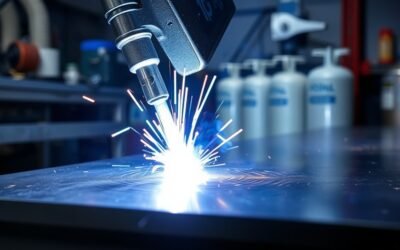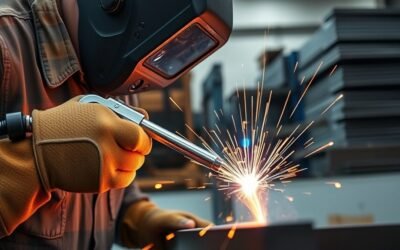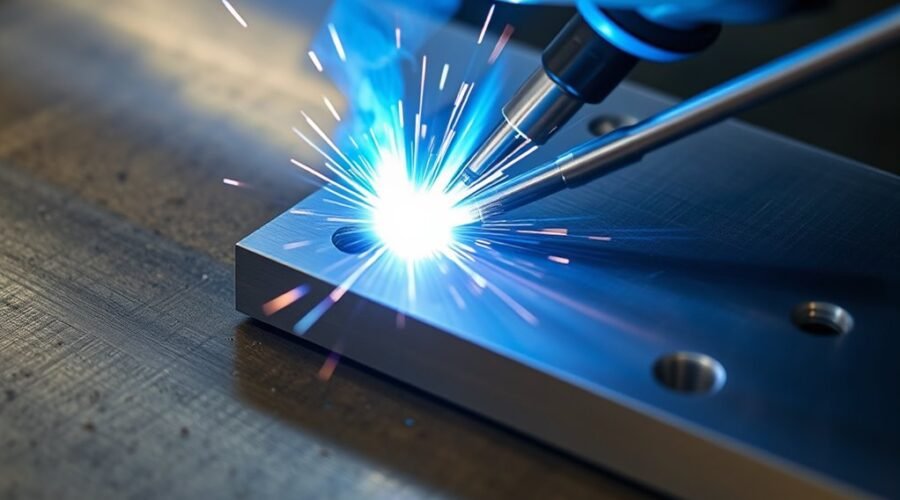
Aluminum welding requires stricter control than steel because of its oxide layer, rapid heat dissipation, and sensitivity to filler choice. TIG offers precision and clean beads, while MIG provides faster deposition on thicker material. Effective prep includes degreasing, oxide removal with a stainless-steel brush, and preheating when needed. Spool guns, push-pull feeders, and argon shielding improve stability. Proper filler selection and inspection limit porosity, cracking, and weak joints, with deeper detail available next.
Key Takeaways
- Aluminum welding needs thorough cleaning because its oxide layer, oil, and moisture can cause poor fusion and porosity.
- TIG welding gives precise, clean aluminum welds, while MIG welding is faster for thicker material and higher deposition rates.
- Use AC-capable TIG machines, stable wire feed systems, argon shielding gas, and proper filler metal for reliable results.
- Choose filler carefully: 4043 for general use, 5356 for higher strength, and 4943 for aluminum-to-magnesium joints.
- Prevent common problems with preheating, fast heat control, and inspection methods like visual checks, dye penetrant, bend, and ultrasonic testing.
What Makes Aluminum Welding Different?
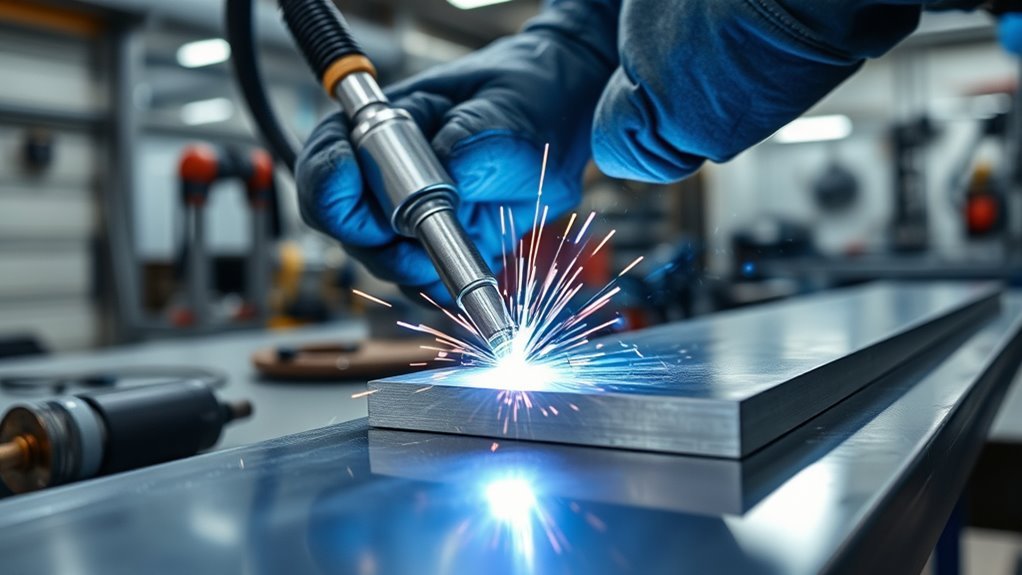
Aluminum welding differs from steel welding primarily because aluminum rapidly forms a tenacious oxide layer that melts at a much higher temperature than the base metal.
Effective fusion depends on thorough surface cleaning. This oxide layer obstructs arc transfer and can trap contamination, reducing weld quality if pre-weld cleaning is incomplete.
Thorough surface cleaning is essential; oxide can obstruct arc transfer and trap contamination, reducing weld quality.
Aluminum also conducts heat quickly, so heat input must be controlled to prevent burn-through and distortion while still achieving penetration.
Because of these properties, specialized welding techniques such as MIG welding aluminum and TIG welding aluminum are used instead of conventional steel methods.
The choice of filler metal is equally critical, since alloy compatibility affects crack resistance, porosity, and strength.
Moisture, oil, and oxide residues are common issues that promote defects, so solvent cleaning and dry handling are essential.
In practice, aluminum demands disciplined process control, not improvisation, if durable, clean, and structurally sound joints are to be produced.
Which Aluminum Welding Process Is Best?
TIG welding is often considered the superior choice for aluminum when precision, bead control, and weld cleanliness are primary requirements.
MIG welding, by contrast, is typically preferred where higher travel speed and deposition rate are more important, particularly on thicker sections.
The appropriate process depends on the balance between weld quality, productivity, and material thickness.
Tig Welding Precision
When precision is the priority, tungsten inert gas welding is often regarded as the best aluminum welding process because it offers tight control over heat input and produces clean, strong joints with minimal atmospheric contamination.
In TIG welding, the aluminum oxide layer is addressed effectively by a square-wave machine, which improves fusion quality. A 2% ceriated tungsten electrode, combined with pure argon, supports arc stability and consistent shielding. This setup is valuable in aluminum applications where distortion must be limited and weld integrity preserved.
Control of heat input, torch angle, and travel speeds enables exact placement of filler and reduces burn-through in thin sections. The result is clean welds with high precision, making the process well suited to fabricators seeking technical autonomy and reliable structural performance.
Mig Welding Speed
Where TIG welding offers maximum control, MIG welding becomes the stronger choice when speed and deposition rate matter most in aluminum fabrication.
MIG supports higher travel speeds, allowing aluminum sections—thin or thick—to be joined efficiently without sacrificing productivity. Because aluminum conducts heat rapidly, the operator must regulate heat and maintain a “hot and fast” welding process to avoid burn-through while securing fusion.
Stable wire feed is critical; a spool gun improves delivery, limiting tangling and wire deformation. Proper filler metals, such as 4043 or 5356, help produce strong welds and reduce porosity.
When travel speed, deposition, and controlled penetration are balanced, MIG offers a practical, high-output route to durable aluminum welds and greater fabrication freedom.
How Do You Prep Aluminum for Welding?
Proper preparation of aluminum for welding begins with thorough surface cleaning to remove oil, dirt, moisture, and the naturally forming oxide layer. Clean aluminum supports stable welding, while neglected contamination increases porosity and weakens fusion.
Experienced welders treat the base material and filler metal as equally vulnerable to residue, because moisture or debris can compromise aluminum welding techniques and reduce weld freedom.
Experienced welders guard both base metal and filler from residue, since contamination can undermine aluminum welding and weaken fusion.
- Degrease with acetone or butanol, then let the surface dry fully.
- Use a dedicated stainless-steel wire brush to remove the oxide layer immediately before welding.
- Wipe again just before welding to clear shavings and airborne contaminants.
- Preheat thicker sections when necessary, accounting for high thermal conductivity and burn-through risk.
This disciplined sequence preserves weld integrity, limits defects, and enables cleaner arc behavior.
Proper preparation also shortens troubleshooting, since most failures originate in inadequate cleaning rather than in the welding process itself.
What Equipment Helps Aluminum Weld Better?
Aluminum welding benefits from spool guns or push-pull feeders, which maintain stable delivery of soft wire and reduce feed disruption.
Proper tungsten selection and an AC-capable power source improve arc stability, oxide cleaning, and penetration.
Shielding gas choice, typically argon-based, further supports arc consistency and limits contamination during the weld.
Spool Guns and Feeders
A spool gun often provides the most reliable wire delivery for MIG welding aluminum, particularly when the power source must sit at a distance from the work area.
In aluminum welding, spool guns stabilize wire feeding by shortening the path from the aluminum filler to the arc, reducing wire tangling and sticking in drive rolls. The result is tighter control and less contamination risk from damaged wire.
A push-pull gun offers a more advanced alternative, using paired motors to maintain tension and preserve wire shape.
Proper equipment matters: U-grooved drive rolls and non-metallic liners support smooth feed and consistent delivery.
- Spool guns improve access.
- Push-pull gun systems enhance precision.
- Matching components limits failure.
- Controlled feed supports liberated, efficient MIG welding.
Tungsten and Shielding Gas
The electrode and shielding setup governs arc quality in aluminum TIG welding. A 2% ceriated tungsten delivers strong arc stability, supporting precise TIG welding on reflective, heat-sensitive metal.
Pure argon is the preferred shielding gas because it protects the molten metal, preserves a clean weld pool, and limits contamination.
A square-wave inverter welder improves cleaning action at the cathode, disrupting the oxide layer that resists fusion.
Tungsten projection should remain near 1/8 inch beyond the gas cup to maintain control without excessive exposure.
Preparation matters as well: a dedicated stainless-steel wire brush removes the oxide layer without transferring debris.
Together, these choices give the operator disciplined control, cleaner fusion, and a more liberated welding process.
Which Filler Metal Should You Use?
Selecting the proper filler metal depends on the base alloy and the service requirements of the finished weld. In aluminum welding, 4043 and 5356 are the dominant choices: 4043 is generally favored for versatile, low-stress applications, while 5356 supports higher strength demands.
Selection must track the base alloy, because different compositions respond differently to thermal input and welding techniques. Proper pairing improves fusion and helps reduce porosity and hot cracking, preserving weld integrity.
- 4043: best for broad, general-purpose welds and smooth arc behavior.
- 5356: preferred where strength and structural retention matter.
- 4943: useful for aluminum-to-magnesium joints, with strong corrosion resistance.
- Service conditions: evaluate strength, corrosion resistance, and weldability before committing to a filler metal.
A disciplined choice allows the weld to perform as intended, without sacrificing compatibility or long-term reliability.
How Do You Prevent Common Aluminum Weld Problems?
Preventing common aluminum weld problems depends on controlling the factors that most often disrupt fusion, integrity, and heat distribution. In aluminum welding, clean surfaces are essential: acetone and a stainless-steel wire brush remove the oxide layer and reduce porosity. For thicker sections, preheat limits rapid heat loss and supports seam stability. The hot and fast technique compensates for thermal conductivity, delivering enough energy before the joint cools. Proper filler metal selection must match the alloy so the bead can tolerate the load and motion of the work.
| Control | Effect |
|---|---|
| Clean surfaces | Reduce porosity and oxide interference |
| Preheat and hot and fast technique | Stabilize heat input and limit distortion |
| Joint design and filler metal | Lower stress, incomplete fusion, and common problems |
Controlled joint design, with minimal gaps, further reduces stress concentration and hot cracking. Together, these measures create more reliable welds and preserve material freedom through disciplined process control.
How Do You Inspect an Aluminum Weld?
Inspection of an aluminum weld begins with a careful visual examination for cracks, undercuts, porosity, discoloration, or black residue, since these surface indicators can signal contamination, overheating, or reduced structural integrity.
For aluminum welds, visual inspection remains the first control for obvious defects and weld quality.
- A dye penetrant test, sometimes misspelled penetant test, is used to expose fine surface cracks that escape the naked eye.
- A bend test evaluates ductility and joint strength, showing whether the weld can endure service loads without failure.
- Ultrasonic testing detects hidden defects below the surface, revealing internal discontinuities that visual inspection cannot reach.
- Cleanliness checks confirm that contamination has not degraded fusion or introduced porosity.
Each method adds a distinct layer of evidence. Together, these inspections support precise assessment, protect structural freedom from avoidable failure, and help verify that aluminum welds meet demanding performance requirements.
Frequently Asked Questions
What Are Common Aluminum Welding Mistakes?
Common aluminum welding mistakes include aluminum cleanliness issues, incorrect filler selection, poor joint fit up, inadequate preheat techniques, overheating aluminum parts, improper shielding gas, lack of proper equipment, insufficient training, neglecting safety protocols, and ignoring weld inspection.
These errors typically produce porosity, weak fusion, distortion, and inconsistent bead formation.
Technical control of material preparation, heat input, shielding, and verification is essential for reliable joints and liberated, high-integrity fabrication.
Why Do Welders Drink Milk After Welding?
Welders drink milk after welding because, in theory, it offers milk benefits that may ease metal-fume symptoms.
Its calcium absorption support, cooling effects, and digestive aid can complement hydration support and a nutritional boost.
As a routine practice, it is believed to reduce welding fatigue, accelerate body recovery, and preserve mental focus.
Yet its value remains limited; ventilation, not milk, delivers genuine liberation from exposure.
How Do You Prep Aluminum Before Welding?
Aluminum is prepped by using solvent-based contaminant removal strategies, then applying Aluminum cleaning techniques with a dedicated stainless brush.
Surface preparation methods should match Welding joint configurations and Aluminum alloy characteristics.
Preheating aluminum parts may stabilize thicker sections.
Tool selection criteria should favor dry, noncontaminating tools.
Protective coatings application must wait until after welding.
Welding environment considerations require low moisture, and use of solvents should occur immediately before weld to preserve liberated seam integrity.
What Are the 7 Common Welding Defects?
The seven common welding defects are porosity, incomplete fusion, cracking, undercut, distortion, slag inclusion, and underfill.
In a hypothetical rail repair, a weld bead showed porosity issues and incomplete fusion after contamination, while overheating effects intensified cracking types and distortion causes.
Inconsistent penetration, alignment errors, and slag inclusion further reduced integrity, and underfill problems weakened the joint.
Such defects constrain reliable fabrication and disciplined technical freedom.
Conclusion
In conclusion, aluminum welding rewards careful judgment, disciplined preparation, and the right process selection. Its low melting point, oxide layer, and thermal conductivity can make the material somewhat less forgiving, yet these traits are manageable with controlled cleaning, proper filler choice, and stable equipment settings. When welds are inspected with rigor and defects are addressed early, the final joint is typically sound, efficient, and aesthetically refined. The result is a highly capable connection, achieved with measured precision.