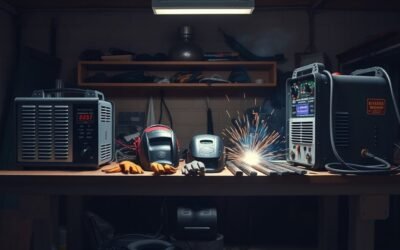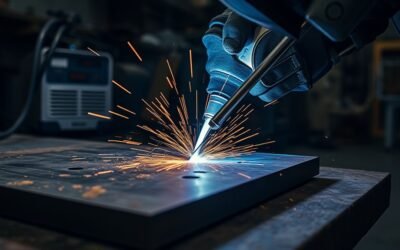
The five main types of welders are MIG (wire feed with gas), flux-core (gasless wire feed), stick (SMAW), TIG (GTAW) and multi-process machines that combine two or more of these. MIG is the easiest to learn for steel, aluminum and stainless in a shop; flux core and stick are best outdoors and on dirty or thick steel; TIG gives the cleanest, most precise welds on thin metal and aluminum; and multi-process welders do a bit of everything in one box.
Choosing the right type of welder depends on what you weld, where you weld and how much you want to spend. This guide compares every common type side by side, then shows you which one fits your work.
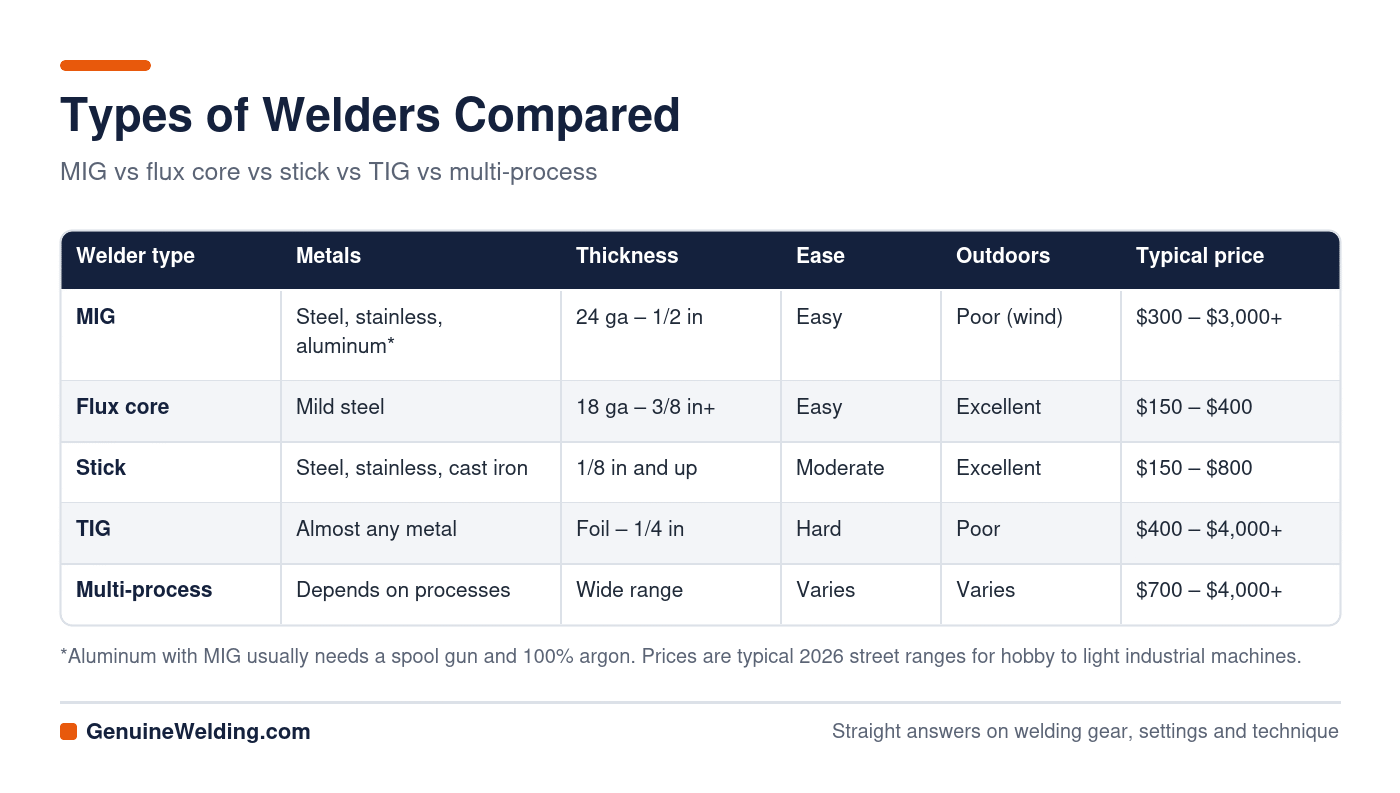
1. MIG Welders (GMAW)
A MIG welder feeds a solid wire electrode through a gun while shielding gas (usually 75% argon / 25% CO2 for steel) protects the weld. You pull the trigger and the machine does much of the work.
- Best for: home garages, auto body, fabrication and production on steel, stainless and (with a spool gun) aluminum
- Thickness: about 24 gauge up to 1/4 in on 120V machines; up to 1/2 in or more in multiple passes on 240V machines
- Pros: fast, easy to learn, clean welds with little cleanup
- Cons: needs a gas cylinder; wind blows away shielding gas outdoors
Learn the basics in our MIG welding guide and see top picks in best MIG welders.
2. Flux-Core Welders (FCAW)
Flux-core welders feed a hollow wire filled with flux. Gasless (self-shielded) flux core needs no cylinder, because the flux creates its own shielding and slag. Most MIG welders can also run flux core by switching polarity and drive rolls.
- Best for: outdoor repairs, farm work, fences, trailers and rusty or painted steel
- Thickness: about 18 gauge to 3/8 in or more depending on wire and machine
- Pros: no gas bottle, great in wind, deep penetration, cheap entry price
- Cons: more spatter, slag to clean, smoky; steel only
See flux core welding and flux core vs MIG.
3. Stick Welders (SMAW)
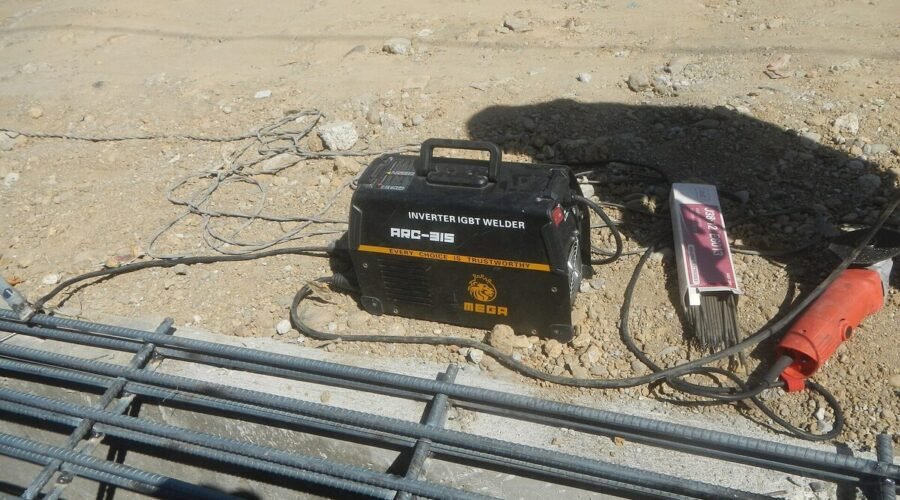
Stick welders use a consumable electrode covered in flux. They are the simplest machines: a power source, a stinger and a work clamp. Modern inverter stick welders are small enough to carry with one hand.
- Best for: structural steel, farm and heavy equipment repair, pipe, outdoor and field work
- Thickness: about 1/8 in and up; excellent on thick steel
- Pros: works in wind and on dirty metal, cheap, no gas, huge range of rods
- Cons: harder to learn, slag to chip, slow on thin metal
Read our stick welding guide and the 7018 rod guide.
4. TIG Welders (GTAW)
TIG welders use a non-consumable tungsten electrode and pure argon shielding gas. You add filler rod by hand and control heat with a foot pedal or torch switch. AC/DC TIG machines can weld aluminum; DC-only machines handle steel and stainless.
- Best for: thin metal, aluminum, stainless, chrome-moly, motorsports, aerospace and anything that must look perfect
- Thickness: foil-thin sheet up to about 1/4 in on most hobby and shop machines
- Pros: cleanest, most precise welds; welds nearly any metal; no spatter
- Cons: slowest process, hardest to learn, needs clean metal
Start with our TIG welding guide and see best TIG welders.
5. Multi-Process Welders
Multi-process welders combine MIG, flux core, stick and often DC or AC/DC TIG in one inverter. Many add plasma cutting as well.
- Best for: hobbyists who want to learn everything, small shops and mobile welders
- Pros: one machine, one footprint, many processes
- Cons: some features (like TIG) may be basic; if it fails, you lose every process at once
Compare models in best multi-process welders.
Other Types of Welders and Welding Machines
- Engine-driven welders: gas or diesel welder-generators for pipelines, farms and job sites with no power. See best welder generators.
- Oxy-acetylene (gas) welding outfits: torches that weld, braze, heat and cut with no electricity. See oxy-fuel welding.
- Spot (resistance) welders: join overlapping sheet metal in auto body and manufacturing.
- Submerged arc, laser and friction stir welders: industrial machines for production work.
- Plasma cutters: not welders, but often sold alongside them for cutting metal.
Inverter vs Transformer Welders
Any of the processes above can come in two power-source designs. Transformer welders are heavy, simple and durable. Inverter welders use electronics to be much lighter, more efficient and more adjustable, which is why most new machines are inverters. Read inverter vs transformer welders for details.
120V vs 240V Welders
120V welders plug into a household outlet and handle thin to medium steel. 240V welders need a dedicated circuit (often a NEMA 6-50 outlet) but weld much thicker metal with higher duty cycles. Many machines are dual-voltage. See welder plug types for outlet details.
Which Type of Welder Should You Buy?
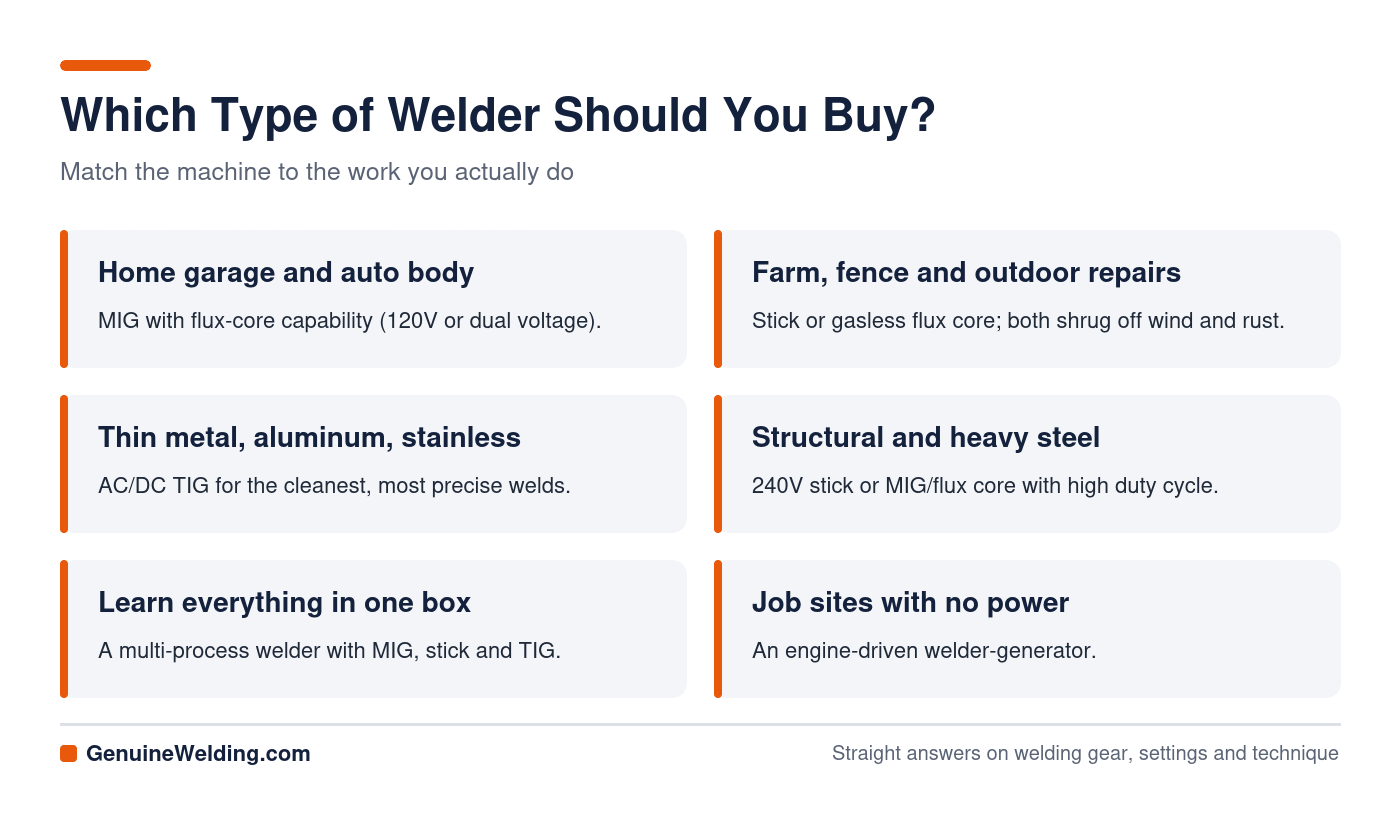
Still deciding? Our how to choose a welder guide walks you through power, process and budget, and best welders for beginners lists easy starter machines.
Types of Welders: FAQs
What is the easiest type of welder to use?
MIG is the easiest for most beginners, followed by gasless flux core. TIG is the hardest to learn.
What type of welder is best for home use?
A 120V or dual-voltage MIG welder that can also run flux core covers most home projects. A multi-process unit adds stick and TIG if you want to grow.
Which welder is best for thick steel?
A 240V stick welder or a 240V MIG/flux-core machine. Stick is especially good for thick, dirty or outdoor work.
Can one welder do MIG, TIG and stick?
Yes. Multi-process welders do all three, though AC TIG for aluminum is only available on certain models.
What type of welder do I need for aluminum?
An AC/DC TIG welder gives the best results. A MIG welder with a spool gun and 100% argon also works well on thicker aluminum.