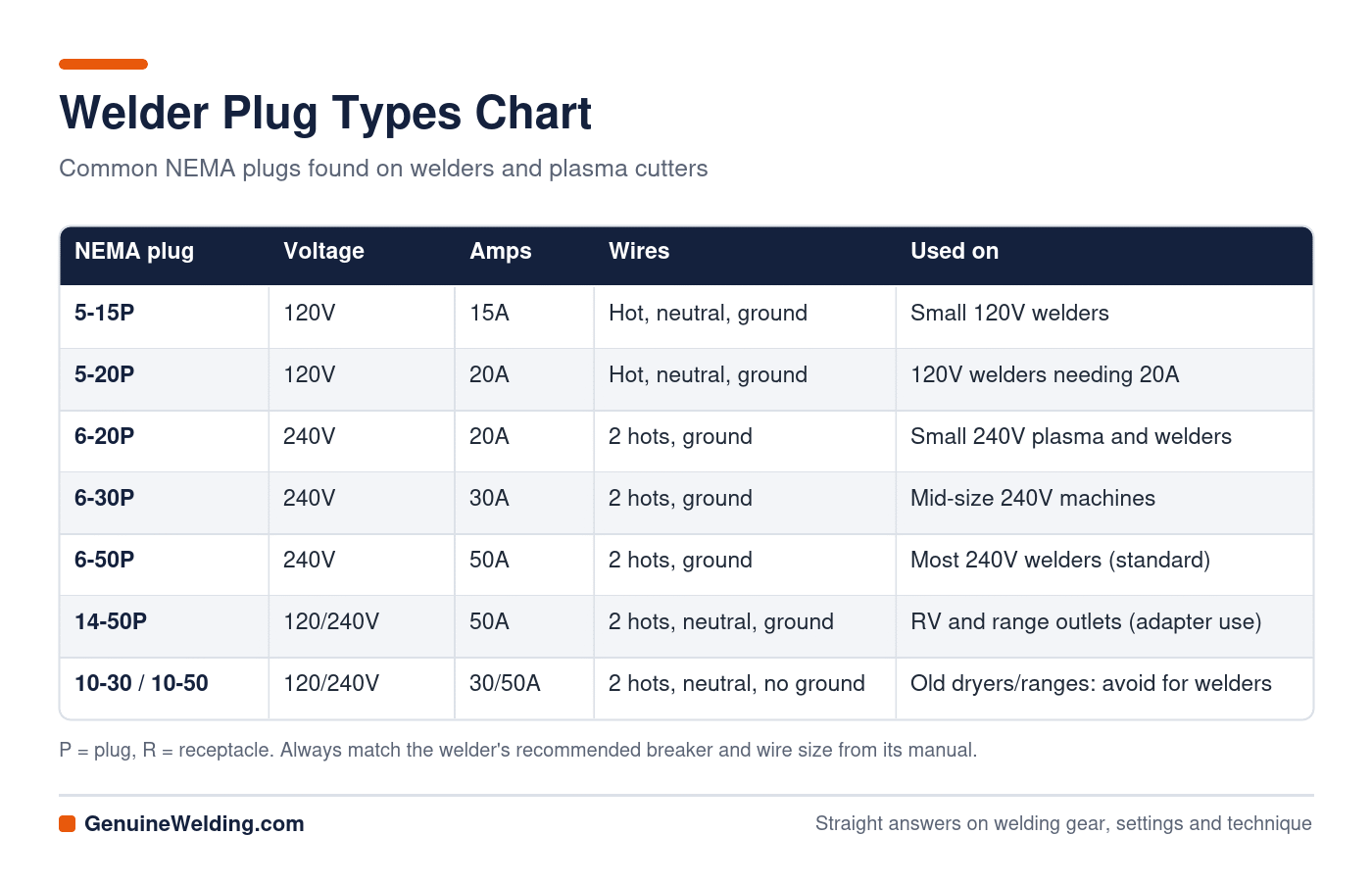
Most 240V (often called 220V) welders use a NEMA 6-50 plug: a three-prong, 250-volt, 50-amp plug with two hot blades and a ground pin, and no neutral. Smaller 240V welders and plasma cutters may use a NEMA 6-30 or 6-20, while 120V welders use standard NEMA 5-15 or 5-20 household plugs. A 6-50 outlet is usually wired on a dedicated 50-amp breaker with copper wire sized to your welder’s manual and local code, and it should be installed by a licensed electrician.
Plug confusion is one of the first problems new welders run into. This guide explains how NEMA plug names work, which plug your welder uses and how to set up a safe outlet in your garage or shop.
How to Read NEMA Plug Names
NEMA (the National Electrical Manufacturers Association) codes describe the plug’s voltage, wiring and amp rating:
- First number (configuration): 5 = 125V with ground; 6 = 250V with ground (two hots, no neutral); 10 = old 125/250V without a ground; 14 = 125/250V with ground and neutral (four wires).
- Second number (amps): 15, 20, 30 or 50.
- Letter: P for plug, R for receptacle (outlet). An L in front (like L6-30) means a twist-locking design.
So a NEMA 6-50P is a 250V, 50A, grounding plug, and a 6-50R is the matching outlet.
NEMA 6-50: The Standard 240V Welder Plug
The 6-50 is used on most 240V stick, MIG, TIG and multi-process welders sold in the U.S. It has two flat hot blades (one horizontal, one vertical on the outlet face) and a round or U-shaped ground pin. Because welders run on 240V only, they don’t need a neutral wire.
Why 50 amps? Welders draw high current in bursts. A 50A circuit gives enough headroom for 200 to 250 amp class machines at their rated duty cycle. Smaller machines may be fine on a 30A circuit; your welder’s manual lists the recommended breaker and wire size. See duty cycle in welding for why current draw varies.
120V Welder Plugs: NEMA 5-15 and 5-20
120V welders use the same plug shape as household appliances. Many have a 5-15P plug but recommend a 20A circuit, and some ship with a 5-20P (one blade turned sideways) that only fits 20A outlets. Plug a 120V welder into a dedicated 20A circuit when possible to avoid tripping breakers. If you are still choosing a machine, our guide on how to choose a welder compares 120V and 240V options, and types of welders explains which processes need which power.
NEMA 6-50 vs 14-50: What’s the Difference?
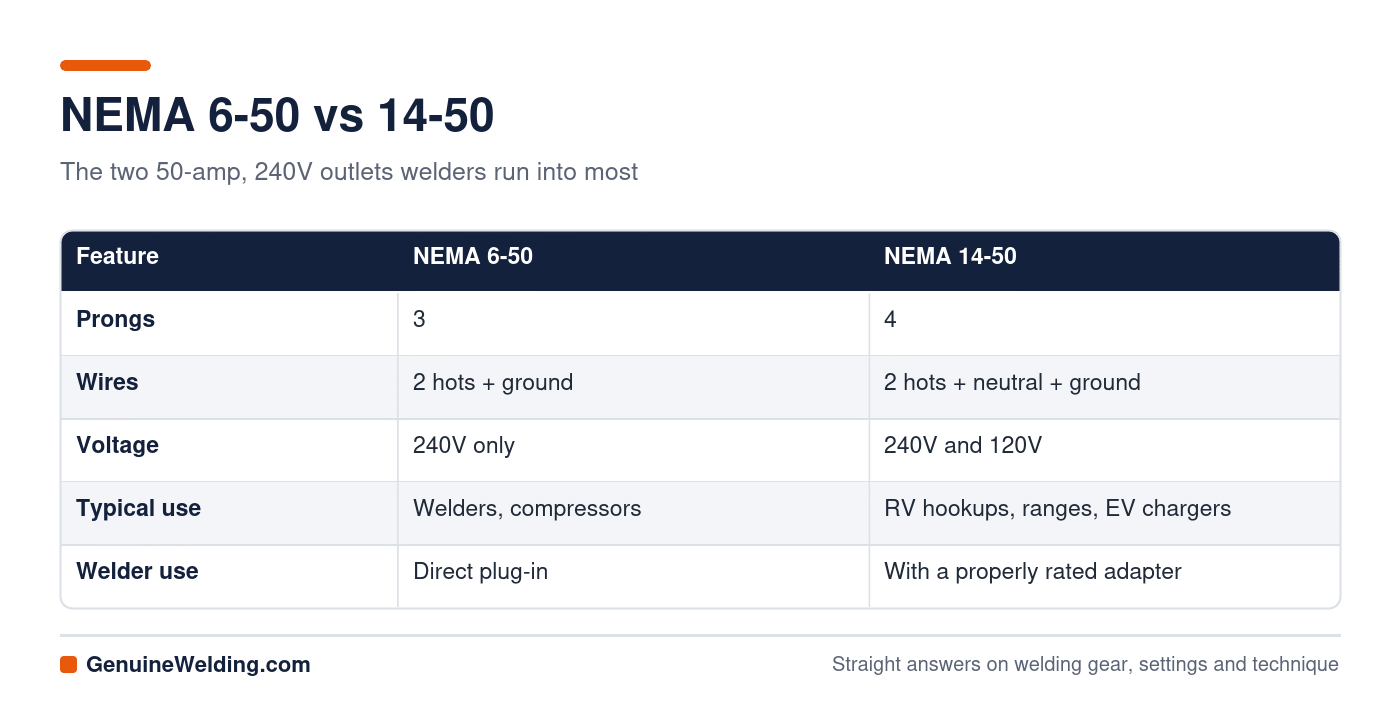
Because a 14-50 outlet carries the same two 240V hots and a ground, a properly made adapter from a 6-50 plug to a 14-50 outlet can work; the neutral is simply unused. The adapter must be rated for the current and built correctly. Never adapt to an old three-prong 10-30 or 10-50 dryer or range outlet: those have no equipment ground, so a fault could energize the welder’s case.
Dual-Voltage Welders and Adapter Plugs
Many dual-voltage welders come with interchangeable plugs or adapter pigtails, letting you switch between a 120V 5-15/5-20 plug and a 240V 6-50 plug without tools. Always use the manufacturer’s adapters, and remember the machine’s output and duty cycle are lower on 120V.
How to Install a 240V Welder Outlet
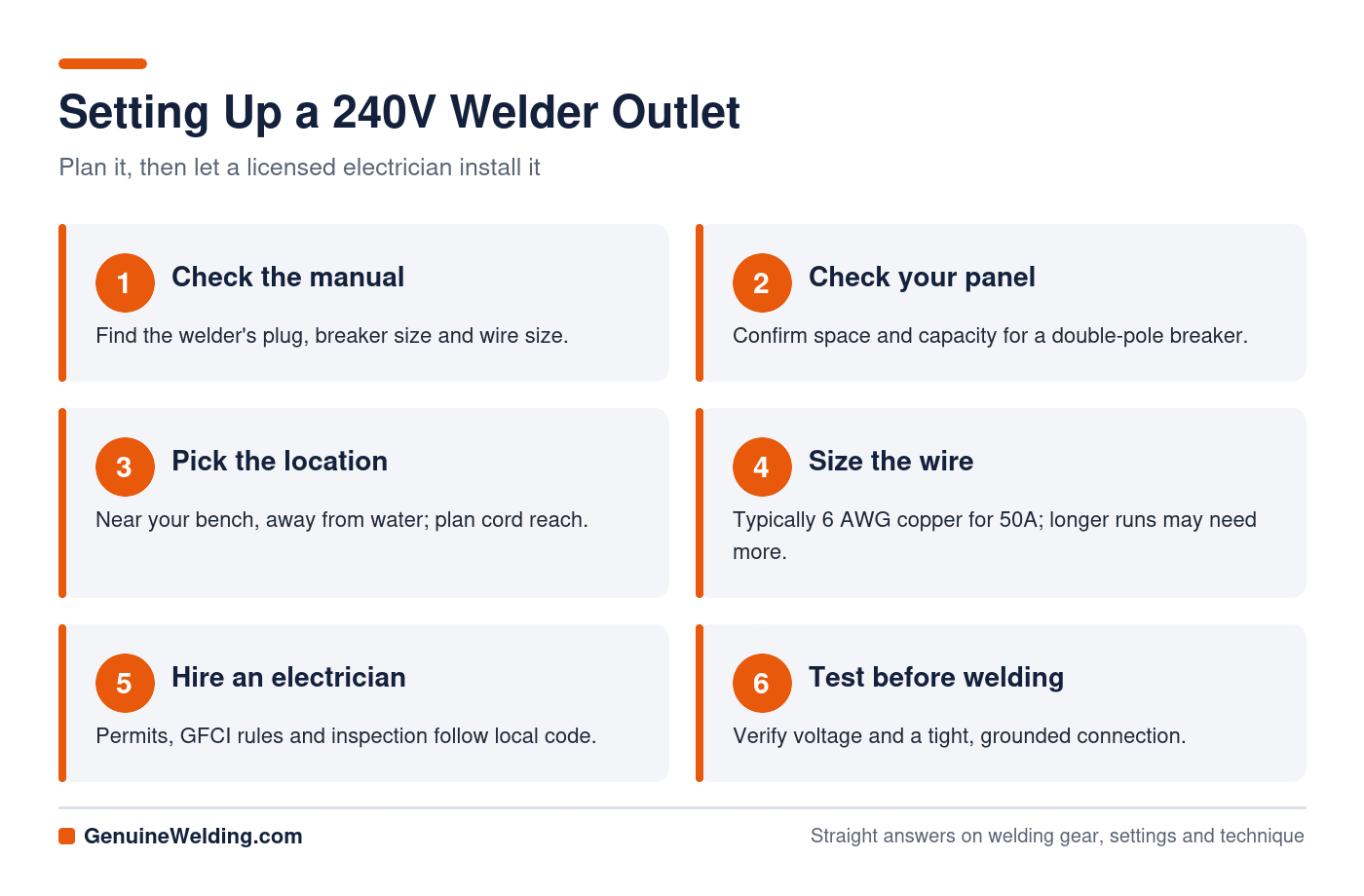
Use a licensed electrician. 240V circuits can kill, and permits and inspections are often required. A typical 6-50 welder circuit uses a double-pole 50A breaker and copper wire sized for the load and run length (6 AWG copper is common for a full 50A circuit; your welder’s manual and the National Electrical Code, including Article 630 for welders, set the actual requirements).
Newer editions of the NEC require GFCI protection for many 250V receptacles in garages, basements and outdoors at dwellings. Some inverter welders can trip GFCI breakers, so discuss your welder model with your electrician before installation.
Extension Cords for Welders
If you must use an extension cord, use one built for the plug type and current, keep it as short as possible and fully uncoil it. For 240V welders, 6-50 extension cords commonly use 8 AWG or 6 AWG conductors depending on length and load. See our guide to welder extension cord wire size.
Common Welder Plug Mistakes
- Running a 240V welder on a 30A dryer outlet without checking the manual’s breaker requirement
- Using old ungrounded 10-30 or 10-50 outlets
- Undersized wire on a long run, causing voltage drop and heat
- Cheap, unrated adapters or homemade cords
- Sharing a 120V welder circuit with other loads
Welder Plug Types: FAQs
What plug does a 220V welder use?
Most use a NEMA 6-50P (250V, 50A). Some smaller 240V welders and plasma cutters use a NEMA 6-30P or 6-20P.
What size breaker do I need for a 6-50 welder outlet?
Usually a 50A double-pole breaker, but some welders specify less. Follow your welder’s manual and local code.
Can I plug a welder into a dryer outlet?
Only if it’s a modern four-prong NEMA 14-30 outlet, the welder’s current fits that circuit and you use a properly rated adapter. Never use an ungrounded 10-30 outlet.
Is 220V the same as 240V?
Yes, for practical purposes. U.S. homes are supplied at about 240V; “220V” is an old nickname. Welders rated 230V or 240V run on the same outlet.
What gauge wire for a 50 amp welder outlet?
6 AWG copper is the common choice for a 50A circuit, but distance, insulation type and your welder’s requirements can change that. Your electrician will size it to code.
Sources
- NEMA: National Electrical Manufacturers Association
- NFPA 70: National Electrical Code
- OSHA 1910.254: Arc Welding and Cutting