A 7018 welding rod is a low-hydrogen, all-position stick electrode that deposits strong, crack-resistant welds (70,000 psi minimum tensile strength) on carbon steel. Run it on DC electrode positive (DCEP) at about 70–110 amps for 3/32 in, 90–160 amps for 1/8 in and 130–210 amps for 5/32 in rods. Because the flux absorbs moisture, keep opened 7018 in a rod oven at 250°F or higher.
7018 is the rod most structural, pressure-vessel and heavy-equipment welders reach for, and it is the electrode used on most plate certification tests. Here is how to set it up, where to use it and how to store it so it performs like it should.
What Does E7018 Mean?
Every stick electrode carries an AWS A5.1 classification. Here is how to read E7018:
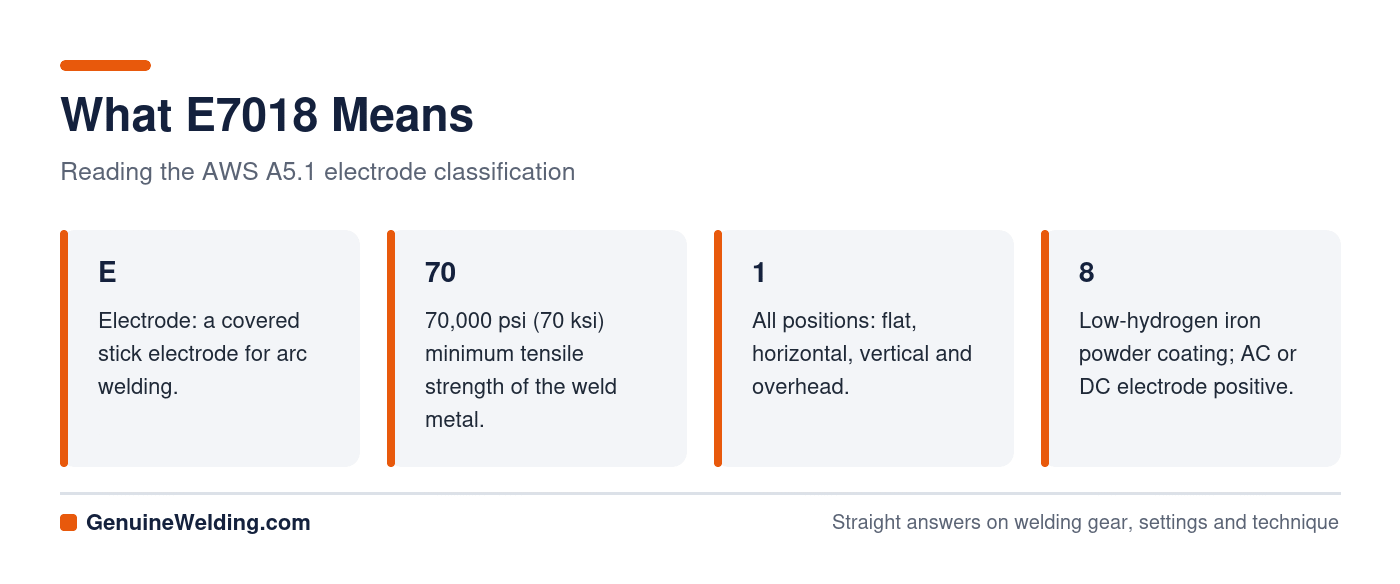
You will also see suffixes such as H4 (diffusible hydrogen of 4 mL per 100 g of weld metal or less), R (meets a moisture-resistance test) and -1 (improved impact toughness at -50°F). For a full breakdown of rod numbers, read welding rod numbers explained.
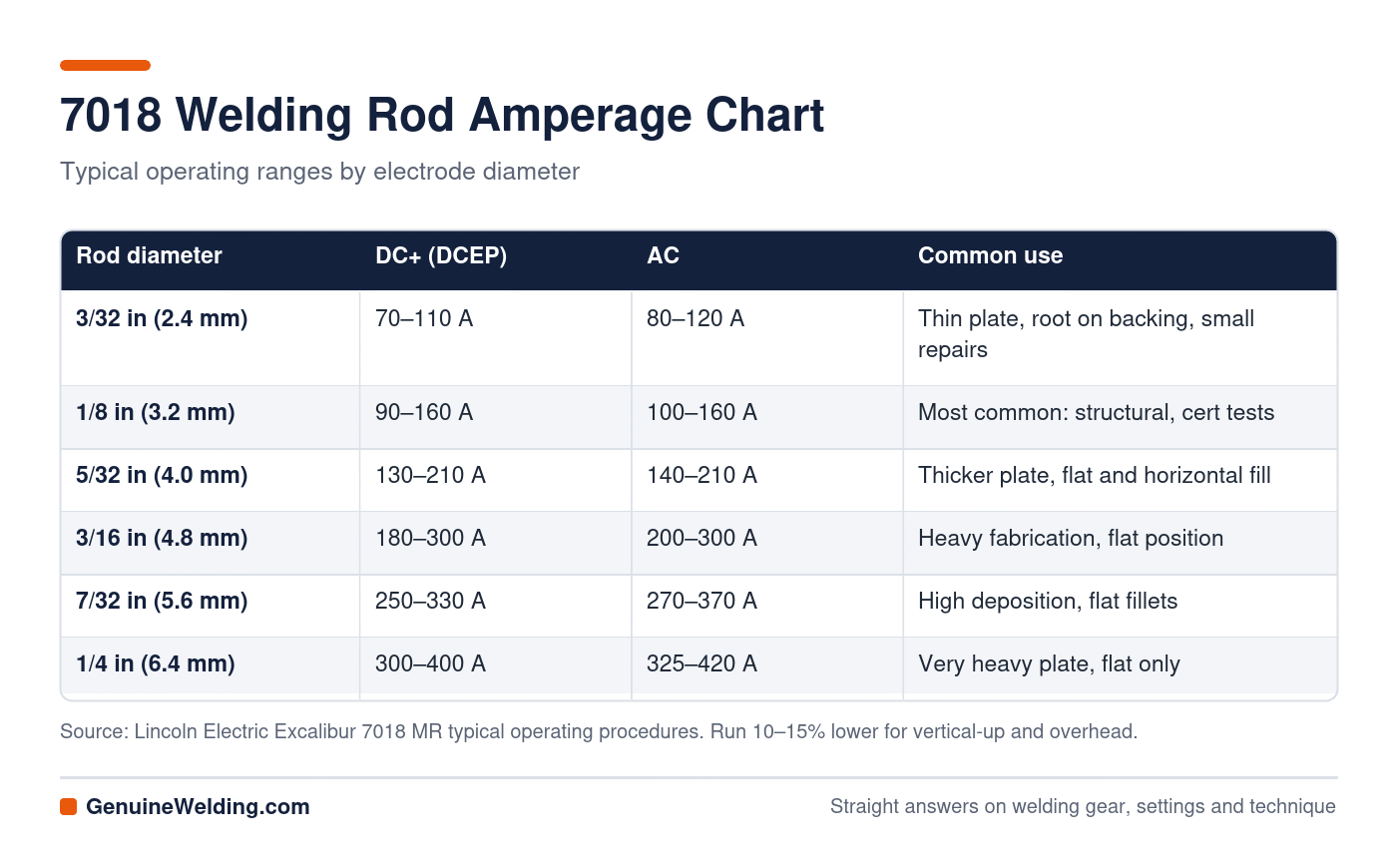
7018 Amperage Chart
Lincoln Electric lists these typical operating ranges for Excalibur 7018 MR, one of the most widely used 7018 rods. Other brands are similar, but check the box for your rod.
| Rod diameter | DC+ (DCEP) amps | AC amps | Good starting point (flat) |
|---|---|---|---|
| 3/32 in (2.4 mm) | 70–110 | 80–120 | ~85 A |
| 1/8 in (3.2 mm) | 90–160 | 100–160 | ~120–125 A |
| 5/32 in (4.0 mm) | 130–210 | 140–210 | ~160–170 A |
| 3/16 in (4.8 mm) | 180–300 | 200–300 | ~220–240 A |
| 7/32 in (5.6 mm) | 250–330 | 270–370 | ~280 A |
| 1/4 in (6.4 mm) | 300–400 | 325–420 | ~340 A |
Adjusting amps for position
- Flat and horizontal: use the middle to upper part of the range.
- Vertical up: drop about 10 to 15% from your flat setting so the puddle does not sag. A 1/8 in rod often runs well at 105 to 115 amps uphill.
- Overhead: run slightly cooler than flat, keep a very short arc and use stringer beads. See our overhead welding guide.
The rule of thumb that 1 amp per 0.001 in of rod diameter (about 125 A for 1/8 in) is a decent start, then tune by watching the puddle and listening for a steady crackle. For sizes across all rod types, see the welding rod size chart.
How to Weld With 7018
- Set DCEP (electrode positive) if your machine has DC. Use AC only with rods made for it (for example 7018 AC types) or when DC is not available.
- Clean the joint. 7018 tolerates less rust, paint and mill scale than 6010 or 6011. Grind to bright metal for the best results.
- Hold a tight arc. Keep the arc length no longer than the core wire diameter. A long arc with 7018 causes porosity because the shielding gas cannot protect the puddle.
- Use a slight drag angle of about 5 to 15 degrees in the flat position, and point the rod straight into vertical-up joints with a slight upward angle.
- Don’t whip. Unlike 6010, 7018 is run steadily without whipping out of the puddle. Small side-to-side weaves are fine; keep weaves under about 2-1/2 times the rod diameter.
- Restart carefully. Strike the arc a little ahead of the crater, then bring it back to fill the crater and continue. Starting on cold metal right at the crater can trap porosity.
- Chip and brush every pass. 7018 slag usually peels off easily; if it sticks, your arc is too long or your amps too low.
New to stick? Start with our SMAW welding guide and stick welding tips.
What Is 7018 Used For?
- Structural steel, beams, columns and buildings (AWS D1.1)
- Fill and cap passes on pipe, after a 6010 or TIG root
- Pressure vessels, tanks and boilers
- Heavy equipment, trailers, farm implements and bucket repairs
- Steels prone to cracking, such as medium-carbon steel and thick restrained joints
- Welder certification tests on plate (3G and 4G) and pipe (6G)
7018 is not the best choice for dirty or rusty metal, sheet metal thinner than about 1/8 in, or open-root passes without backing. For those, 6010, 6011 or 6013 often work better. Compare them in 6010 vs 6011 vs 6013 vs 7018 vs 7024.
7018 Mechanical Properties
| Property | AWS E7018 minimum | Typical as-welded (Excalibur 7018 MR) |
|---|---|---|
| Tensile strength | 70 ksi (490 MPa) | 74–88 ksi |
| Yield strength | 58 ksi (400 MPa) | 62–74 ksi |
| Elongation | 22% | 25–37% |
| Charpy V-notch at -20°F | 20 ft-lbf | 89–246 ft-lbf |
How to Store 7018 Rods
The low-hydrogen flux on 7018 picks up moisture from the air. Damp rods put hydrogen into the weld, which can cause porosity and hydrogen-induced cracking hours after welding. That is why 7018 ships in sealed cans and why codes control storage.
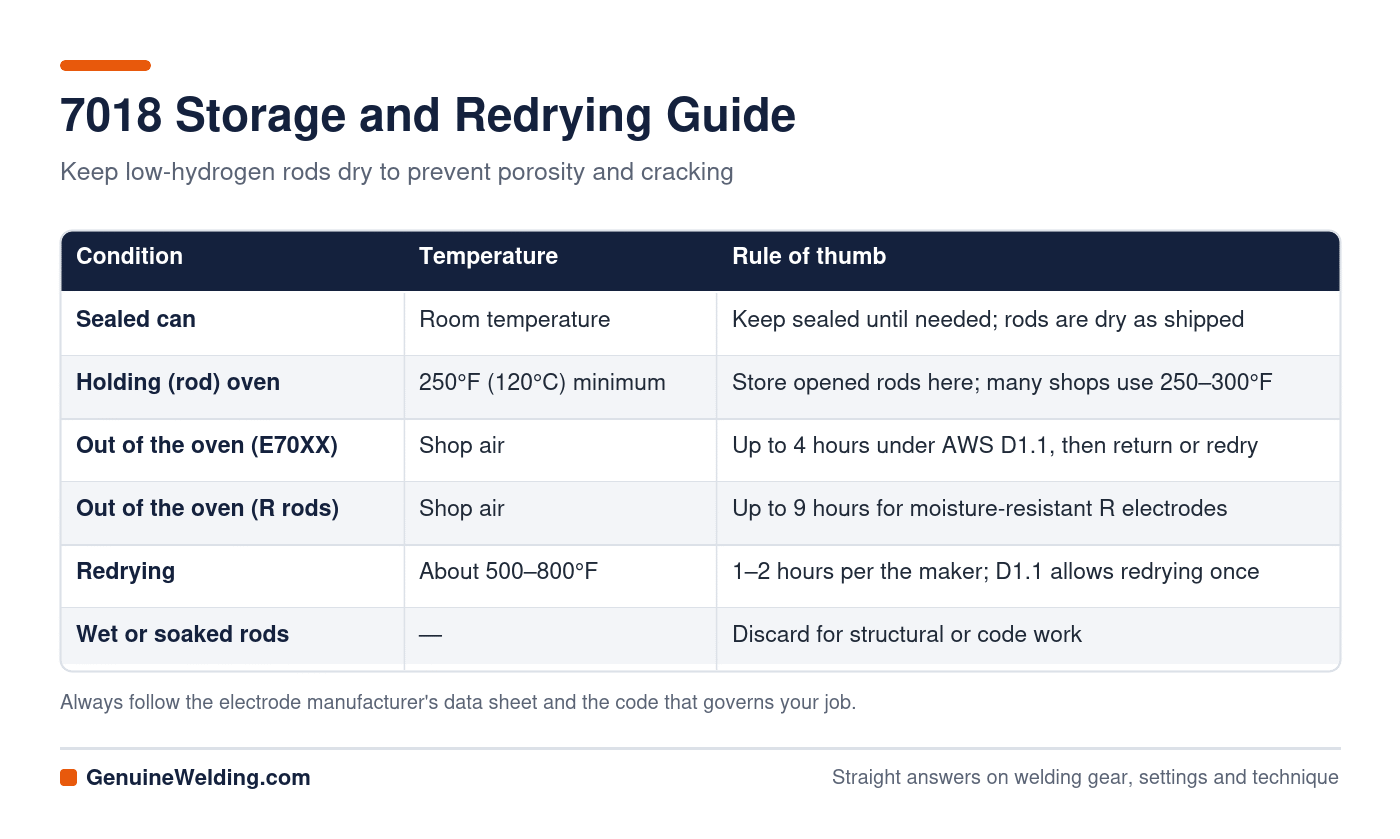
- Keep cans sealed until you need the rods.
- Use a holding oven once opened. AWS D1.1 requires low-hydrogen electrodes to be held at 250°F (120°C) or higher; many shops run 250–300°F.
- Limit exposure time. Under AWS D1.1, E70XX low-hydrogen rods may be out of the oven for up to 4 hours; rods with the R designation are allowed longer (up to 9 hours). Return them to the oven or redry them after that.
- Redry by the manufacturer’s procedure. Redrying usually means a much hotter oven (roughly 500–800°F) for 1 to 2 hours. D1.1 allows redrying only once.
- Throw away wet rods. Rods that got rained on or soaked should not be used on structural work.
For home and farm repairs that are not code work, keeping rods in a sealed container with desiccant, or in a small rod oven, is a big improvement over a coffee can in the shop.
7018 Troubleshooting
| Problem | Likely cause | Fix |
|---|---|---|
| Rod sticks to the plate | Amps too low, cold start | Raise amps 5–10 A, strike like a match |
| Porosity at starts | Long arc, starting on the crater | Strike ahead, hold a tight arc |
| Slag is hard to remove | Long arc or low amps | Shorten arc, raise amps slightly |
| Undercut | Amps too high, too much weave | Lower amps, pause at the toes |
| Cracking | Damp rods, no preheat on thick steel | Use oven-stored rods, preheat as required |
More fixes in our arc welding troubleshooting guide.
7018 Welding Rod FAQs
Can you run 7018 on AC?
Yes. Most 7018 rods are rated for AC or DCEP, but they run smoother on DC. Rods sold as 7018 AC are formulated to strike and run better on AC buzz boxes.
What is the difference between 7018 and 7018-1?
7018-1 meets tougher impact requirements (20 ft-lbf at -50°F instead of -20°F). It is used where low-temperature toughness matters, such as bridges, offshore and cold-climate structures.
Is 7018 good for beginners?
It is one of the easier rods to make a nice-looking bead with, but it needs clean metal and a short arc. Many beginners start with 6013 or 7018 before learning 6010.
Can I weld rusty metal with 7018?
Not well. Grind rust and mill scale off first, or use a 6011 or 6010 rod that digs through contamination.
Do 7018 rods go bad?
They do not expire in a sealed can, but once exposed to humid air they absorb moisture and should be oven-stored or redried before critical work.