Inverter and transformer welders can both produce strong, high-quality welds, but they create and control welding current in different ways. Inverter machines usually offer lower weight, finer electronic control, and better electrical efficiency, while traditional transformer designs appeal to users who value simple construction and straightforward serviceability. The right choice depends more on the welding process, required amperage, duty cycle, input power, work environment, and service support than on the power-source label alone.
Quick Answer
An inverter welder is usually the better fit when portability, electrical efficiency, multi-process capability, and precise electronic arc control matter. A transformer welder can still be an excellent choice for a fixed workshop where simple construction and repairability are priorities. Compare the actual process, amperage, duty cycle, input voltage, weight, and warranty before buying.
Key Takeaways
Key Takeaways
- Inverter welders use high-frequency electronic switching, allowing a smaller transformer and usually a lighter, more compact machine.
- Traditional transformer welders use a larger mains-frequency transformer and are often mechanically and electrically simpler.
- Inverter technology generally improves electrical efficiency and makes advanced arc-control features easier to implement.
- Duty cycle, penetration, weld strength, and input voltage are machine-specific; they cannot be predicted reliably from “inverter” or “transformer” alone.
- Choose by the welding process, amperage range, AC/DC capability, duty cycle, electrical supply, portability, warranty, and local service support.
What Is an Inverter Welder?
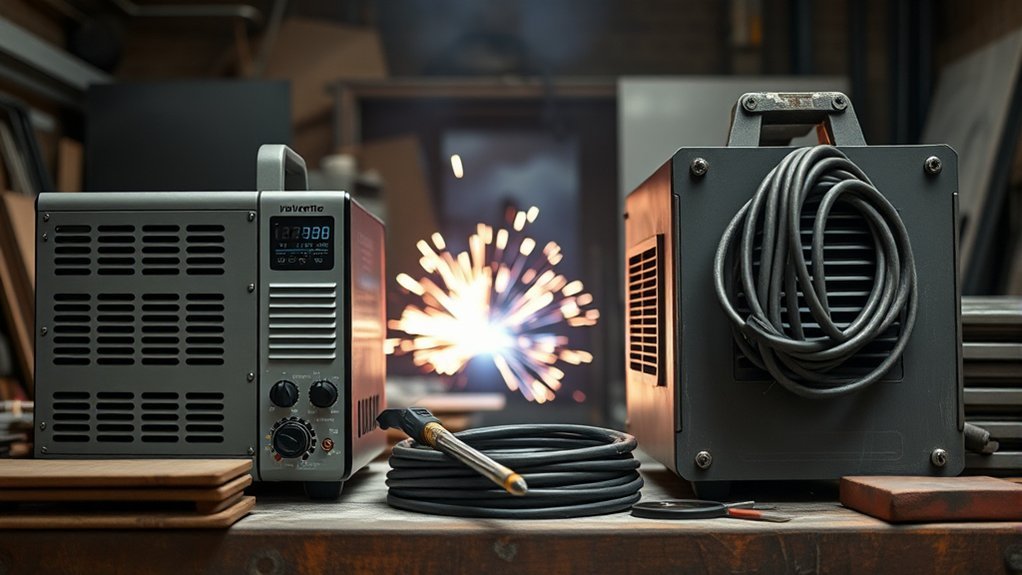
An inverter welder is a welding power source that uses semiconductor electronics to process incoming electrical power at a much higher switching frequency than a conventional mains-frequency transformer machine. A typical design rectifies the incoming AC supply, switches it electronically at high frequency, reduces the voltage through a compact transformer, and then controls or rectifies the output required by the welding process.
TWI’s overview of arc-welding power-source designs explains that this high-frequency operation allows substantial reductions in transformer size and weight while giving electronic controls a fast response to changing welding conditions.
That is why inverter welders are commonly lighter and easier to move than similarly capable traditional transformer machines. Portable models may support 120 V, 240 V, or both, although the input-voltage range depends entirely on the individual machine. For example, current multi-process inverter designs can provide MIG, flux-cored, stick, and TIG capability from one compact power source. Readers comparing that kind of flexibility can also see this multi-process welder example.
Inverters also make sophisticated features easier to implement. Depending on the model, these can include adjustable arc force, hot start, pulse functions, programmable settings, AC waveform control, synergic MIG programs, digital displays, and automatic parameter selection. These functions do not guarantee a better weld by themselves, but they can give the operator more control and improve repeatability when used correctly.
Electrical efficiency is another common advantage. TWI’s discussion of welding-equipment energy consumption gives typical efficiency figures of about 65% for conventional transformer equipment and around 90% for inverter equipment. Actual energy use still varies with the individual machine, power factor, welding current, process, duty cycle, and how heavily the power source is loaded.
The tradeoff is greater electronic complexity. Diagnosing a failed circuit board or semiconductor power stage may require specialized equipment and manufacturer-specific parts, so repairability varies greatly by brand and model.
What Is a Transformer Welder?
A traditional transformer welder uses electromagnetic induction to reduce high-voltage, low-current mains electricity to the lower-voltage, higher-current output required for arc welding. A basic AC transformer welder may send alternating current directly to the welding circuit, while a transformer-rectifier machine adds rectifiers and controls to provide DC output.
Because a conventional transformer operates at mains frequency, typically 50 or 60 Hz, the magnetic components must be much larger than the high-frequency transformer inside an inverter. That is the main reason traditional transformer machines tend to be heavier.
The design can nevertheless be very practical. Older tap-controlled or mechanically adjusted transformer machines have relatively few complex electronic components, which can make troubleshooting and repair straightforward for technicians familiar with the equipment. Their weight may be a disadvantage for field work but matters much less when the machine stays at a permanent welding station.
Transformer design does not automatically mean poor arc quality, low duty cycle, or limited material capability. Output characteristics depend on the complete machine. AC, DC, constant-current, constant-voltage, transformer-rectifier, and electronically controlled transformer machines can behave quite differently.
For beginners comparing simple and modern welding equipment, this guide to MIG, TIG, and stick welders for beginners provides additional process-level context.
Inverter vs Transformer Welder: Side-by-Side Comparison
| Factor | Inverter Welder | Traditional Transformer Welder |
|---|---|---|
| Size and weight | Usually smaller and lighter for comparable output | Usually larger and heavier |
| Electrical efficiency | Generally higher | Generally lower in conventional designs |
| Arc controls | Often offers fast electronic adjustment, pulse, programmable modes, and digital features | Ranges from simple stepped controls to more advanced electronic regulation |
| Duty cycle | Model-specific | Model-specific |
| Input voltage | Model-specific; many portable units offer 120/240 V capability | Model-specific; many traditional shop machines use dedicated higher-voltage circuits |
| Repairability | Electronic failures may require board-level or module replacement | Simple designs can be comparatively easy to diagnose and repair |
| Best fit | Mobile work, compact shops, advanced controls, multi-process use | Permanent stations, users who value simple construction, legacy equipment support |
Inverter vs Transformer Welders: Arc Quality
Arc quality is important, but it should not be reduced to “inverter equals smooth” and “transformer equals aggressive.” The welding process, current type, polarity, output characteristic, electrode or wire, voltage, inductance, arc-force setting, and operator technique all affect how an arc feels.
Modern inverter power sources have an advantage in how quickly their electronics can monitor and alter output. TWI notes that inverter controls can provide dynamic feedback and software-controlled characteristics for different welding processes. That capability can improve low-amperage stability, starts, short-circuit control, pulse operation, and other functions when the machine is designed for them.
Transformer machines can also produce excellent welds. A properly designed AC/DC transformer-rectifier with the correct process and settings may provide a very smooth, predictable arc. The architecture alone does not determine weld quality.
Arc Stability
Inverter machines can respond quickly to changes in the arc because their semiconductor controls operate at high switching frequencies. This makes it easier for manufacturers to provide features such as adjustable arc force, hot start, pulsed current, and electronically controlled waveforms.
That advantage is especially useful when very fine control is required. TWI’s TIG equipment guidance notes that transistor and inverter sources can provide greater stability at very low currents and readily incorporate functions such as current pulsing.
However, a stable arc still depends on correct settings, work-lead placement, consumables, shielding gas where required, electrode condition, and sound welding technique.
Arc Control
Arc control is one of the strongest practical reasons to consider an inverter. Depending on the process and machine, an inverter can provide continuously variable output, digital parameter control, adjustable inductance, arc-force control, waveform shaping, pulse settings, or stored programs.
| Feature | Inverter | Transformer |
|---|---|---|
| Fine electronic adjustment | Common on modern models | Depends on control design |
| Pulse / waveform functions | Relatively easy to integrate | Available on some advanced systems, but not typical of simple units |
| Simple mechanical controls | Less common | Common on basic traditional machines |
| Result | Potential for greater tuning and repeatability | Potentially simple, predictable operation |
For stick welding, features such as adjustable arc force can change how crisp or soft the arc feels. Readers comparing inexpensive machines can review these budget stick welder options while paying attention to the actual controls rather than assuming all inverter machines behave alike.
Note: Magnetic arc blow is not simply an inverter-versus-transformer issue. It is most commonly associated with DC welding of magnetic materials. Work-lead position, welding direction, current level, joint geometry, residual magnetism, and switching to AC when the procedure allows can all affect it.
Inverter vs Transformer Welders: Reliability and Lifespan
Traditional transformer welders have a strong reputation for longevity because many older designs contain relatively simple magnetic components, switches, rectifiers, fans, and mechanical controls. Fewer complex electronic assemblies can make faults easier to diagnose and, when parts remain available, easier to repair.
That does not mean every transformer welder will last for decades or that inverter machines are inherently short-lived. Modern industrial inverter welders are available in rugged housings with heavy-duty cooling systems and high-output ratings. ESAB, for example, describes its Fabricator EM 500i as an inverter-controlled power source designed for rugged industrial use.
For either architecture, lifespan depends on component quality, thermal design, operating temperature, dust and moisture exposure, duty-cycle abuse, voltage quality, fan and cooling maintenance, storage conditions, and parts availability.
- Transformer advantage: simple older designs can be easier to troubleshoot and repair.
- Inverter advantage: lower weight and modern controls without necessarily sacrificing industrial capability.
- For harsh environments: check the manufacturer’s environmental ratings, enclosure design, cooling system, and operating manual.
- For long-term ownership: consider warranty length, board/module availability, service centers, and local technical support.
Do not use duty cycle as a shortcut for architecture. Compare the actual rating on each machine. This roundup of current stick welder options is more useful when individual output and duty-cycle specifications are compared directly.
Inverter vs Transformer Welders: Power Use and Duty Cycle
Inverter welders generally convert electrical power more efficiently than conventional mains-frequency transformer machines. Higher-frequency switching allows the transformer and magnetic components to be smaller and can reduce conversion losses. The exact savings at the electrical meter, however, depend on the machine and how it is used.
Input voltage is also product-specific. Some compact inverter machines can operate from a 120 V household circuit at reduced or appropriate output and from 240 V when higher output is needed. Other inverter welders require 208/230/240 V or three-phase industrial power. Transformer machines likewise vary by model.
Always check the input-current requirement, recommended circuit size, plug type, conductor requirements, and manufacturer instructions rather than assuming an inverter can run at full output from any household outlet.
How Duty Cycle Really Works
Miller defines welding-machine duty cycle as the percentage of a 10-minute period that a machine can operate at a specified output without overheating. A 60% duty cycle at 200 amps, for example, means six minutes of welding at that rated condition followed by the required cooling period.
Duty cycle belongs to the individual machine at a specified output. It is not inherently higher simply because a welder uses inverter or transformer technology.
A machine may have a much higher duty cycle at lower amperage than at maximum output. Ambient temperature and manufacturer test standards also matter, so compare specifications at similar amperage and operating conditions.
For home and garage use, the practical requirement may be modest, while production welding can justify a machine with a much higher continuous-output rating. Readers evaluating lighter-duty machines can compare specifications in this guide to welders for home use.
Inverter vs Transformer Welders: Controls and Weld Quality
Compared with a basic tap-controlled transformer machine, a modern inverter can provide much finer electronic control over current and voltage response. Manufacturers can use that response to create features such as controlled starts, crater-fill functions, pulsed output, programmable parameters, adjustable frequency, and process-specific arc characteristics.
Inverter technology expands what the power-source controls can do, but good controls still require the correct procedure and operator technique to produce a sound weld.
- Fine modulation can improve puddle control at low amperage.
- Pulse functions can help manage average heat input in suitable applications.
- Adjustable arc characteristics can help tune stick or MIG behavior.
- Programmable settings can improve repeatability in production work.
TIG welding is a good example. Advanced inverter TIG sources can provide precise low-amperage control, pulse settings, and—in AC-capable machines—waveform adjustments useful for aluminum. That advantage comes from the specific controls and AC/DC capability, not merely from the word “inverter” on the case.
Traditional transformer-based TIG machines can still produce excellent welds, particularly when properly maintained and operated within their design range. The practical difference is that advanced functions are generally easier to implement in a modern inverter platform.
For users who need MIG, TIG, and stick processes in one unit, multi-process welders are commonly inverter-based because electronic control makes switching between process characteristics easier.
Inverter vs Transformer Welders: Cost and Value
Purchase price alone no longer separates inverter and transformer welders cleanly. Compact inverter welders are available from entry level through heavy industrial classes, while transformer machines range from inexpensive legacy designs to large industrial systems.
For an inverter, potential ownership advantages include lower weight, lower electrical losses, broader process capability, digital features, and—in some applications—higher productivity. The possible downside is that a major electronic failure may require an expensive circuit board, power module, or specialized repair service.
A simple transformer machine may be attractive because its electrical design is easier for a qualified technician to understand and service. On the other hand, an old transformer welder can become expensive to own if switches, rectifiers, fans, contactors, or model-specific parts are obsolete.
When comparing similar machines, use total ownership factors instead of assuming one architecture always costs less:
- Purchase price and included accessories
- Input-power requirements
- Electrical efficiency
- Required welding processes
- Duty cycle at your working amperage
- Warranty coverage
- Local service availability
- Replacement-board or component availability
- Machine weight and transport costs
Product-to-product comparisons, such as this Hobart Handler 140 vs. Lincoln 140 comparison, are more useful for cost decisions than broad assumptions about inverter or transformer construction.
Input Power and Electrical Requirements
Before buying either type, check the machine’s nameplate and manual for required input voltage, phase, frequency, maximum input current, recommended branch circuit, and plug configuration. Do not size a circuit from welding-output amperage alone; a 200-amp welding output does not mean the wall circuit supplies 200 amps.
Dual-voltage inverter machines can be convenient for mobile work because they may operate from either 120 V or 240 V supplies. Their maximum welding output may be lower on 120 V, so verify the specification chart before assuming identical performance on both voltages.
Generator use is also machine-specific. Confirm the manufacturer’s minimum generator output and power-quality requirements. Sensitive electronics should not be connected to an unsuitable generator simply because the plug fits.
Warning: Arc welding involves hazardous voltage, intense ultraviolet and infrared radiation, hot metal, fire risk, and potentially harmful fumes. Follow the welder manufacturer’s installation instructions, use appropriate PPE and ventilation, keep cables and equipment in safe condition, and have fixed electrical circuits installed or evaluated by a qualified person. OSHA’s arc-welding requirements address safe equipment installation, operation, shielding, and ventilation.
Which Welder Should You Choose?
Choosing between an inverter and transformer welder starts with the work you actually plan to do. Avoid buying by architecture alone.
- Choose an inverter for frequent transport: lower weight and compact dimensions are major advantages for field repair, mobile fabrication, and small shops.
- Choose an inverter when advanced control matters: precision TIG, pulse functions, programmable MIG modes, and multi-process operation are commonly easier to obtain in inverter machines.
- Consider a transformer for a permanent station: weight matters less when the machine never moves, and a simple traditional design can be attractive if local repair support is available.
- Compare duty cycle at your real amperage: do not assume either technology wins automatically.
- Match the electrical supply: confirm voltage, phase, circuit capacity, and generator compatibility before purchasing.
- Check output type: AC/DC capability, constant-current or constant-voltage output, process support, and polarity options can matter more than the internal power-conversion method.
Best Choice by Use Case
| Use Case | What to Prioritize | Typical Fit |
|---|---|---|
| Mobile repair or field work | Low weight, dual-voltage input, generator compatibility | Inverter |
| Small home garage | 120/240 V flexibility, easy setup, compact storage | Usually inverter |
| Precision TIG | Low-amp stability, pulse, AC controls if welding aluminum | Modern inverter |
| Permanent basic stick station | Simplicity, local service, required AC/DC output | Either; transformer can remain practical |
| Heavy industrial production | Rated output, duty cycle, cooling, service network, process control | Compare industrial models rather than architecture alone |
| User prioritizing simple repairability | Parts availability and uncomplicated circuitry | Traditional transformer designs may have an advantage |
Well-designed machines of either type can provide years of useful service. This selection of MIG welders for the money can be evaluated using the same specification-first approach.
How to Compare Two Welders Before Buying
When two machines look similar, compare their specification sheets in the following order:
- Processes: MIG, flux-cored, stick, DC TIG, or AC/DC TIG.
- Output range: confirm both the low and high amperage limits suit your work.
- Duty cycle: compare ratings at similar amperage, not just the largest percentage printed in marketing material.
- Input supply: confirm voltage, phase, amperage, plug, and breaker/circuit requirements.
- Output characteristics: AC/DC capability, polarity options, constant-current/constant-voltage modes, and available arc controls.
- Weight and dimensions: important for field work and storage.
- Environmental suitability: consider dust, moisture, temperature, ventilation, and impact exposure.
- Serviceability: check warranty, nearby service centers, replacement parts, and board/module availability.
- Included accessories: torch, gun, work lead, electrode holder, regulator, foot pedal, adapters, and consumables can materially change total cost.
Pro Tip: If two welders advertise the same maximum amperage, compare the duty cycle at the amperage you will use most often. Maximum output by itself tells you very little about how productive the machine will be during repeated or long welds.
Frequently Asked Questions
What are the downsides of using an inverter welding machine?
The main disadvantages are electronic complexity and potentially more specialized repairs. A failed power board or control module may cost more to diagnose or replace than a simple component in an older transformer welder. Inverter machines also vary widely in build quality, so cooling design, environmental protection, manufacturer support, and parts availability deserve attention. Their portability is normally an advantage rather than a disadvantage.
What type of welder makes the strongest weld?
Neither inverter nor transformer construction automatically makes a stronger weld. Strength depends on the welding process, base metal, filler metal or electrode, joint design, preparation, amperage, voltage, polarity, heat input, penetration and fusion, procedure, and operator technique. A properly selected inverter and a properly selected transformer power source can both produce structurally sound welds.
Do inverter welders use less power?
Inverter welders are generally more electrically efficient than conventional mains-frequency transformer designs because they switch power at high frequency and can reduce conversion losses. The exact electricity savings are not a fixed percentage, however. Input current, power factor, welding output, duty cycle, process, machine size, and load all affect actual consumption.
Are inverter welders good?
Yes. A well-designed inverter welder can offer excellent arc characteristics, low weight, efficient power conversion, and advanced controls. Modern inverter machines range from small DIY units to heavy industrial power sources. Quality varies by model, so judge the machine by its rated output, duty cycle, warranty, cooling, service support, and required welding processes.
Do inverter welders always have a better duty cycle?
No. Duty cycle is a specification for an individual welding machine at a stated output. Some inverter welders have excellent duty cycles, while others are designed for short hobby jobs. Transformer machines also range from light-duty units to industrial sources. Compare the percentage at the amperage you expect to use.
Can an inverter welder run on a 120V household outlet?
Some can, but not all. Many portable inverter welders support 120 V or dual 120/240 V input. Maximum output may be lower when the machine is connected to 120 V. Always use the manufacturer’s specified circuit and plug requirements and verify whether the available branch circuit can supply the required input current.
Conclusion
Inverter welders usually have the advantage in portability, electrical efficiency, compact size, and advanced electronic control. Traditional transformer welders remain useful where weight is unimportant and straightforward construction or repairability is especially valuable.
Neither architecture automatically delivers a stronger weld, longer duty cycle, greater penetration, or longer service life. Those outcomes depend on the individual machine, welding process, output characteristics, operating conditions, maintenance, and technique. For the best purchase, compare the actual specifications and service support required for your work rather than choosing by “inverter” or “transformer” alone.
Sources
- TWI — Basic Power Source Designs for Arc Welding Equipment — inverter and transformer operating principles, control, weight, and efficiency.
- TWI — Welding Equipment Energy Consumption — comparative power-source efficiency information.
- Miller Electric — Duty Cycle: What It Is and Why It’s Important — duty-cycle definition and interpretation.
- OSHA — 29 CFR 1910.254, Arc Welding and Cutting — equipment installation, operation, electrical safety, and maintenance requirements.
- OSHA — 29 CFR 1910.252, General Welding Requirements — ventilation, fume control, and worker protection requirements.