Choosing the right welder starts with three questions: which process fits the job, what power is available, and what metal and thickness will you weld most often? MIG is usually the easiest place for beginners to start, TIG gives excellent control on precise work, Stick is practical for field repairs, and flux-cored welding can perform well outdoors. The machine’s actual output range, duty cycle, input requirements, and material capability matter just as much as the process name.
Quick Answer
For most beginners doing general steel projects, a MIG or MIG/flux-cored machine is the easiest starting point. Choose TIG when precision and clean welds matter, Stick for rugged outdoor repair, and self-shielded flux core for windy jobs. Then match the machine’s input voltage, amperage range, duty cycle, and rated material capacity to your work.
Key Takeaways
- Choose the welding process first: MIG for easy general fabrication, TIG for precision, Stick for rugged field work, and self-shielded flux core for outdoor jobs.
- Do not choose a machine by maximum amperage alone. Check its manufacturer-rated material range, output range, duty cycle, and supported processes.
- A 120V machine can be convenient for light work, while many dual-voltage or 240V machines provide greater available output. Always verify the required circuit and input amperage.
- For aluminum, confirm that the machine supports the correct process. MIG may need a spool gun or other aluminum-feed system, while conventional TIG welding of aluminum normally requires AC capability.
- Budget for more than the power source: helmet, gloves, protective clothing, gas, filler metal, consumables, electrical work, and ventilation may all affect the real cost.
Which Welding Process Fits Your Project?
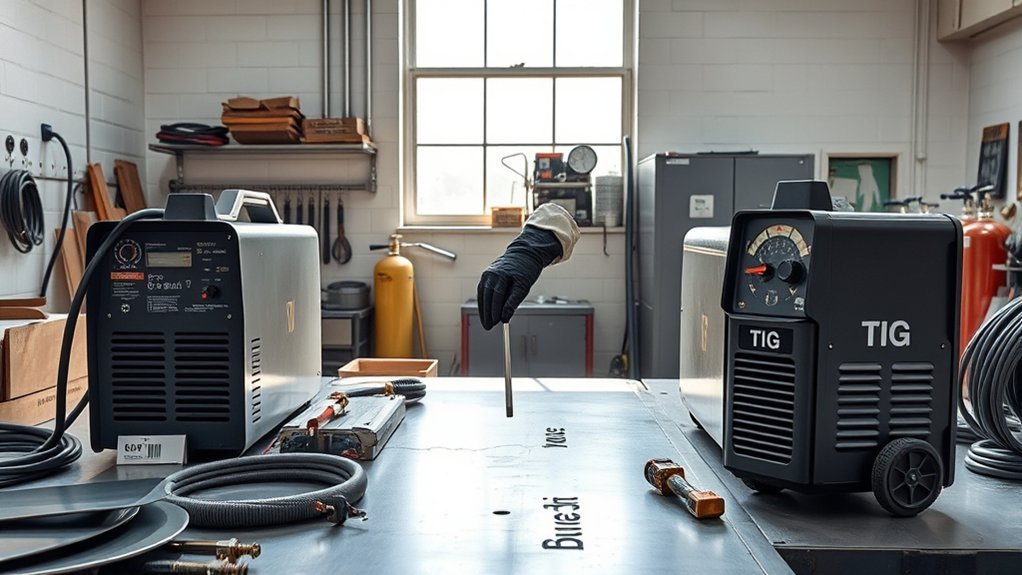
Selecting the appropriate welding process depends on material type, joint design, thickness, weld position, surface condition, location, and the finish you want. No single process is best for every project.
MIG welding, or GMAW, feeds a continuous wire electrode through the gun. It is relatively easy to learn, supports fast travel speeds, and works well for general fabrication on mild steel, stainless steel, and aluminum when the machine and feeding system are compatible.
TIG welding, or GTAW, gives the operator precise control over the arc and filler metal. It is useful for thin material, stainless steel, aluminum, and work where bead appearance or heat control matters. TIG normally has a slower learning curve and lower deposition rate than MIG.
Stick welding, or SMAW, is rugged and portable. It is widely used for repairs, construction, outdoor work, and applications where the surface is less than perfectly clean. Electrode choice determines polarity, penetration, position, and mechanical properties.
Flux-Cored Arc Welding resembles MIG because it uses continuously fed wire. Self-shielded flux-cored wire is especially useful outdoors because it does not rely on a separate shielding-gas cloud that wind can easily disturb. Gas-shielded FCAW is a different setup commonly used for heavier fabrication.
For high-production industrial applications, processes such as submerged arc welding can provide high deposition rates and deep penetration, but they are outside the needs of most home shops and small fabrication businesses.
| Process | Best Fit | Main Advantages | Watch For |
|---|---|---|---|
| MIG | Beginners, fabrication, auto and shop work | Fast, easy to learn, little slag | Shielding gas is vulnerable to wind; aluminum needs compatible feeding equipment |
| TIG | Precision, thin material, stainless and aluminum | Excellent control and clean weld appearance | Slower process and higher skill requirement; AC is normally required for conventional TIG aluminum welding |
| Stick | Repair, construction and field work | Portable, wind tolerant and versatile | Slag removal, more electrode changes and a steeper learning curve than MIG |
| Self-Shielded FCAW | Outdoor fabrication and repair | No external gas cylinder required and good deposition rate | Produces slag and often more smoke and spatter than solid-wire MIG |
Beginners who want one machine for several jobs can also consider welding process versatility, but a multiprocess label does not mean every process has the same capability.
Pro Tip: Write down the three projects you expect to weld most often. Choose the process and machine for those jobs first instead of buying around a rare project that may require completely different equipment.
Pick the Right Welder Power Supply
Input power is a major part of welder selection. A machine must match both the available voltage and the electrical circuit that supplies it.
A 120V welder is convenient when standard receptacles are the only practical option. Many compact MIG, flux-cored, Stick, and multiprocess machines can perform useful light-duty fabrication from 120V power.
A 240V supply allows many welding machines to provide higher rated output or a stronger duty cycle at higher amperage. However, the actual improvement depends on the specific machine. Do not assume every 240V welder has the same capacity.
Dual-voltage machines can be valuable for users who work both in a home garage and at locations with 240V service. Before buying, compare the machine’s input voltage, required amperage, plug type, rated output, and recommended branch circuit in the owner’s manual.
Warning: Do not install an oversized breaker, modify a plug, defeat grounding, or assume an existing circuit can safely power a welder. Follow the machine manual and applicable electrical code. Have a qualified electrician evaluate the circuit when the required receptacle, wiring, grounding, or breaker is uncertain.
Understand Duty Cycle Before Comparing Machines
The duty cycle tells you how long a welder can operate at a specified output during a 10-minute test period before it must cool. A 30% duty cycle at a particular rated amperage means three minutes of welding and seven minutes of cooling at that rating.
Duty cycle only has meaning when you compare it at the stated amperage and input voltage. A large percentage at low amperage is not automatically better than a smaller percentage at a much higher output.
Compare machines at the output you expect to use, especially if you make long welds or work in production. Understanding power range and waveform control is also important when you need to cover both thin and thick material.
Choose a Welder for Your Metal
The base metal should narrow your options because every welding process and power source has different capabilities.
Mild steel is the easiest material for a general-purpose welder because MIG, flux core, Stick, and TIG can all be practical choices.
Stainless steel can be welded with several processes, but TIG is popular when precise heat control and a clean appearance matter. MIG can also be efficient for stainless fabrication when the correct wire and shielding gas are used.
Aluminum requires closer attention to machine compatibility. MIG equipment needs an aluminum-capable wire-feed setup, while conventional TIG welding of aluminum normally requires an AC-capable TIG power source.
As material gets thicker, required heat input and machine output usually increase. However, there is no universal rule that MIG or TIG stops at 1/4 inch or that Stick and flux core automatically handle 1 inch. Maximum practical thickness depends on the exact machine, process, filler size, joint preparation, welding position, number of passes, and required weld quality.
Note: Use the manufacturer’s material-thickness chart as the starting point. If a machine is advertised with a maximum amperage but does not clearly state its rated output, duty cycle, and recommended material range, amperage alone is not enough information to judge capacity.
A machine with the right duty cycle and cooling reliability will also perform more consistently during repeated or extended welding.
Match Welder Features to Your Skill Level
Skill level should influence welder selection, but ease of setup is usually more important than simply buying the least powerful machine.
A beginner often benefits from a MIG welder with clear parameter charts, automatic or synergic setup assistance, stable wire feeding, and controls that are easy to understand. Machines such as the Lincoln Electric POWER MIG 210 MP illustrate the appeal of combining MIG, flux core, Stick, and DC TIG capability in one portable unit.
Intermediate users may benefit from multiprocess machines such as the ESAB Rebel EMP 215ic, which combines MIG/MAG, flux-cored, Stick, and DC Lift-TIG functions. A multiprocess machine can reduce the number of power sources needed for a mixed workload.
Advanced welders may prioritize TIG controls such as AC balance, frequency adjustment, pulse settings, remote amperage control, and a wide usable amperage range when the work requires tight heat control.
Do Not Assume Every Multiprocess Welder Does Everything
Multiprocess specifications need careful reading. A machine that supports DC TIG may weld steel and stainless well with TIG but may not support conventional AC TIG welding of aluminum. MIG aluminum capability may also require an optional spool gun or push-pull system.
Check which torches, guns, regulators, foot controls, drive rolls, liners, and cables are included. Optional accessories can significantly change the real purchase cost.
Portability also matters. Compare weight, machine dimensions, input-voltage flexibility, lead length, gas-cylinder requirements, and generator compatibility if the welder will move between jobsites.
Matching your skills and future projects to the machine’s real capabilities is more useful than buying features you are unlikely to use. A welder with multi-process capability can be valuable when those additional processes genuinely match your work.
Set Up Your Welder for Aluminum
Aluminum conducts heat quickly and develops a tough oxide layer, so both equipment compatibility and surface preparation matter.
For MIG welding aluminum, confirm that the power source supports aluminum and that the wire-feed system can reliably handle soft aluminum wire. A spool gun is a common solution because it shortens the distance the wire must travel. Some larger systems use push-pull guns instead.
For common MIG aluminum applications, 100% argon is the standard shielding gas. Follow the machine and filler-metal manufacturer’s settings for gas flow, voltage, wire-feed speed, wire diameter, and polarity.
Clean the material in the correct order. First remove oil and grease with a suitable cleaner. After degreasing, remove the oxide layer with a clean stainless-steel brush reserved only for aluminum. Avoid contaminating that brush by using it on carbon steel.
When MIG welding aluminum, use a push technique unless the equipment or procedure specifically requires something else. Pushing improves shielding-gas coverage and reduces the risk of soot and weld defects associated with dragging the gun.
For TIG, verify that the machine has the capabilities required for aluminum. Conventional TIG welding of aluminum normally uses AC output, while a DC-only TIG mode found on many multiprocess welders is intended primarily for materials such as steel and stainless steel.
Amperage and travel speed must match the material and joint. Thin aluminum can overheat quickly, while thicker sections may need substantially more heat to establish fusion.
Correct equipment, preparation, and technique improve bead quality enhancements and reduce porosity, soot, lack of fusion, and other avoidable defects.
Check Cost, Portability, and Safety Before Buying
The price of the power source is only part of the cost of welding. Depending on the process, you may also need a welding helmet, safety glasses, gloves, flame-resistant clothing, gas cylinder, regulator, filler wire or electrodes, contact tips, nozzles, cups, tungsten electrodes, brushes, clamps, electrical work, and fume-control equipment.
Also check local availability of consumables. A capable machine becomes inconvenient if its replacement tips, liners, drive rolls, torches, or service parts are difficult to obtain.
Use a Simple Pre-Purchase Checklist
- Processes: Does the machine support the welding processes you will actually use?
- Metals: Is it compatible with mild steel, stainless steel, aluminum, or the alloys you expect to weld?
- Thickness: Does the manufacturer’s chart cover your normal material range?
- Output: Is the minimum amperage low enough for thin work and the rated output high enough for your heavier jobs?
- Duty cycle: Is it adequate at the amperage you expect to use?
- Input power: Do you have the correct voltage, circuit capacity, receptacle, and grounding?
- Accessories: Are the required gun, torch, regulator, spool gun, foot pedal, or leads included?
- Portability: Can you comfortably move the machine and any shielding-gas cylinder?
- Consumables: Are replacement wire, electrodes, tips, liners, cups, and other parts readily available?
- Support: Is warranty service and technical support available where you live?
Do Not Treat Safety Equipment as Optional
Arc welding exposes the operator to intense light, hot metal, sparks, electrical hazards, and potentially harmful fumes. Wear a suitable welding helmet, approved eye protection, welding gloves, flame-resistant clothing, and appropriate footwear.
Keep flammable materials away from the welding area and have appropriate fire protection available. Ensure cables, holders, guns, work connections, and equipment grounding are in good condition.
Welding-fume exposure varies with the process, filler, base metal, coatings, and ventilation. Keep your head out of the fume plume and use effective general or local exhaust ventilation. Certain materials and conditions can require additional respiratory controls.
Warning: Never rely on food, milk, or supplements as protection from welding fumes. Fume control depends on avoiding inhalation, ventilation, process controls, and appropriate respiratory protection when required.
Frequently Asked Questions
Why Do Welders Drink Milk After Welding?
Some welders historically drank milk because they believed it protected them from welding fumes or helped with symptoms such as throat irritation or nausea. Milk may provide hydration or temporary comfort, but it does not detoxify inhaled welding fumes or prevent metal fume fever. Proper ventilation, keeping your breathing zone out of the plume, and using appropriate respiratory controls are the relevant protections.
How Thick Can a 300 Amp Welder Weld?
There is no universal material thickness for a 300-amp welder. Maximum practical thickness depends on the process, rated output and duty cycle, filler metal, joint design, position, preparation, and whether the weld is made in one pass or multiple passes. Use the manufacturer’s material-capacity and parameter charts for the exact machine instead of converting amperage directly into a thickness limit.
Should I Use 6011 or 7018?
Choose E6011 when you need deep penetration, AC or DCEP flexibility, and better tolerance of less-than-perfect steel preparation. E7018 is a low-hydrogen electrode commonly selected when weld quality, mechanical properties, and hydrogen control matter. Both are available for all-position welding in common classifications. Follow the electrode manufacturer’s storage, polarity, amperage, and application requirements.
Which Is Better for MIG Welding, 120V or 240V?
Neither voltage is automatically best for every MIG welder. A 120V machine is convenient for lighter jobs and locations with standard receptacles. A 240V or dual-voltage machine often provides greater available output or duty cycle for heavier work. Compare the exact machine’s rated output, material range, duty cycle, and input-current requirements rather than voltage alone.
Is a Multiprocess Welder Better for a Beginner?
A multiprocess welder can be a good choice when you genuinely expect to use MIG, flux core, Stick, or TIG. However, check the details before buying. Some machines offer only DC TIG, aluminum MIG may require an optional spool gun, and accessories for secondary processes may not be included. A simple MIG machine can still be the better value for someone who mainly welds steel.
Conclusion
The best welder is the machine that matches your process, material, thickness, electrical supply, and normal workload. MIG is often the easiest starting point for general fabrication, TIG offers excellent precision, Stick remains valuable for field repair, and self-shielded flux core performs well outdoors. After choosing the process, compare actual manufacturer ratings for output range, duty cycle, material capacity, input power, and required accessories rather than relying on maximum amperage alone.
Sources
- Miller Electric — first-welder and welding-process selection guidance.
- Miller Electric — duty-cycle guidance and rated-output examples.
- Miller Electric — MIG aluminum setup, cleaning, shielding gas, and push-technique guidance.
- Occupational Safety and Health Administration — arc-welding equipment, grounding, cable, and ventilation requirements.
- CDC/NIOSH — welding-fume and manganese exposure information.
- American Welding Society — welding PPE and welding-fume health guidance.