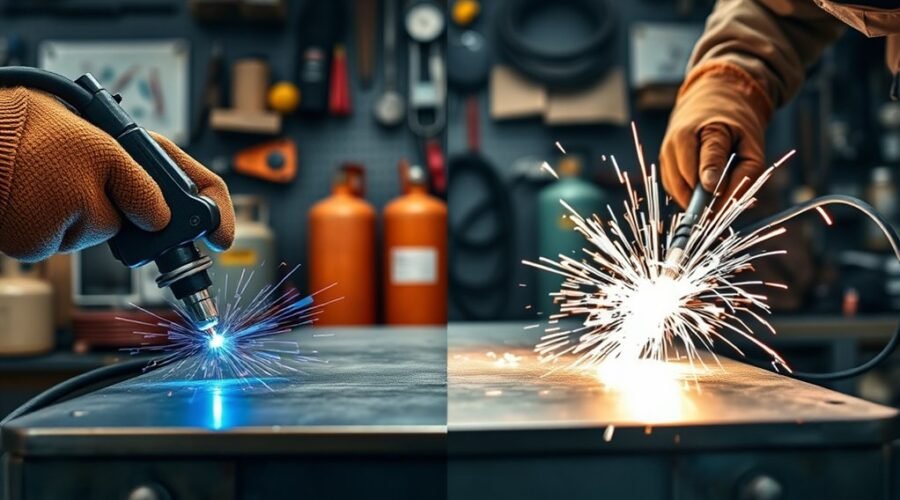
MIG vs. stick welding is mainly a choice between easier wire-fed shop welding and rugged, portable field welding. MIG is usually easier to learn and gives excellent control on clean sheet metal, while stick handles outdoor conditions, thicker repair work, and less-than-perfect steel more comfortably. Neither process is automatically stronger; weld strength depends on the joint, filler metal, settings, penetration, and technique.
Quick Answer
Choose MIG if you are a beginner working mainly on clean steel, sheet metal, automotive panels, brackets, or indoor fabrication. Choose stick if portability, windy outdoor work, thicker steel, rough repairs, or simpler equipment matter more. For critical structural work, use the process and procedure specified for the job rather than assuming one method is always stronger.
Key Takeaways
- MIG, formally gas metal arc welding or GMAW, feeds a continuous wire electrode and normally uses external shielding gas.
- Stick, formally shielded metal arc welding or SMAW, uses flux-coated electrodes that create shielding and a slag layer as they burn.
- MIG has a clear advantage on thin sheet, but there is no universal thickness where MIG stops working and stick automatically becomes better.
- Stick equipment is simpler and highly portable, while MIG usually needs more components but offers faster deposition and less post-weld cleanup.
- Solid-wire MIG is vulnerable to wind; self-shielded flux-cored wire is a separate wire-feed process that can be a practical outdoor alternative.
MIG vs. Stick Welding: Which Should You Choose?
)
Choose MIG for clean material, controlled shop conditions, faster welding, and better thin-metal control. Choose stick when portability, outdoor work, rough repairs, or tolerance for rust and scale matter more.
The American Welding Society’s GMAW overview describes MIG as a continuous wire-feed process using shielding gas and contrasts it with SMAW, which uses a flux-coated consumable electrode. Those process differences explain most of the practical tradeoffs.
| Factor | MIG Welding | Stick Welding |
|---|---|---|
| Learning curve | Usually easier for beginners | More practice needed for arc length and rod control |
| Electrode | Continuous wire | Replaceable flux-coated rod |
| Shielding | External gas with solid wire | Flux coating creates shielding and slag |
| Thin sheet | Excellent control with the right wire and settings | More difficult because burn-through is easier |
| Outdoor wind | Wind can disrupt shielding gas | Well suited because no external gas bottle is required |
| Surface condition | Best on properly cleaned metal | More tolerant of rust, scale, and imperfect preparation |
| Cleanup | No slag with solid wire and generally less cleanup | Slag must be removed between passes and after welding |
| Weld strength | Can produce high-strength welds with the correct filler and procedure | Can produce high-strength welds with the correct electrode and procedure |
MIG is often the most practical starting point in a garage because the wire feeds automatically and the bead is easy to see. Stick is attractive for field repair because there is no separate shielding-gas system to carry and protect from wind.
The choice also affects your beginner welder options, since MIG, TIG, stick, and multi-process machines solve different problems.
Do not choose solely on a claim that stick makes a stronger weld. Filler-metal strength, base metal, joint design, penetration, defects, and the qualified procedure determine whether a weld is suitable for its load.
Which Is Easier to Learn: MIG or Stick?
MIG welding is generally easier to learn. The machine feeds the electrode wire continuously, so a beginner can focus on gun angle, travel speed, stickout, and watching the puddle instead of shortening a rod while maintaining arc length.
Miller also lists MIG as the easiest common process to learn in its first-welder process guide. Stick takes more coordination at the start because you must strike the arc, prevent the electrode from sticking, and maintain the correct gap as the rod burns shorter.
MIG’s Beginner-Friendly Basics
MIG gives new welders a relatively stable starting point because the trigger starts the wire feed and the electrode is replenished automatically. That lets you spend more time learning bead placement, gun angle, travel speed, and how changes in voltage or wire-feed speed affect the puddle.
| Feature | MIG Effect | Beginner Impact |
|---|---|---|
| Wire feed | Continuous | No need to shorten the electrode by hand |
| Arc starting | Trigger controlled | More repeatable starts |
| Cleanup | No slag with solid wire | Easier to inspect the bead |
| Technique focus | Gun angle and travel | Fewer manual variables at once |
Easy starting does not mean technique is unimportant. Poor travel speed, excessive stickout, bad fit-up, wrong settings, or weak shielding can still produce lack of fusion, porosity, excessive spatter, or an unstable bead.
A suitable machine also matters. Different MIG welder options vary in output, duty cycle, wire capability, and available controls.
Stick’s Skill-Building Curve
Stick welding takes longer to feel natural because you control arc length, electrode angle, travel speed, and rod position while the electrode continuously gets shorter. Arc starts and restarts also require more practice than simply pulling a MIG gun trigger.
That difficulty can develop useful manual arc-control skills. You learn to recognize when the arc is too long, when travel is too fast or slow, and how electrode angle changes the puddle and slag behavior.
However, stick is not the only process that teaches fundamentals. MIG also develops puddle reading, fit-up, heat control, travel speed, joint preparation, and an understanding of how settings change penetration and bead shape.
MIG vs. Stick for Thin and Thick Metal?
MIG has the advantage on thin sheet because its wire size and heat input can be controlled precisely. Stick is often more convenient for thicker steel in repair and field work, but there is no universal thickness cutoff where MIG becomes unsuitable.
Miller’s MIG guide for mild steel describes applications from 24-gauge material up to 1/2-inch steel with appropriate equipment and consumables. Actual capacity depends on machine output, wire diameter, transfer mode, joint design, position, and whether multiple passes are allowed.
Thin Metal Precision
MIG welding is usually the easier process for thin metal. Small-diameter wire and controlled short-circuit transfer can reduce heat input and make it easier to avoid holes and distortion on sheet steel.
Material around 24 gauge is a realistic MIG application with a suitable machine and wire. The exact minimum thickness varies, so use the machine manufacturer’s settings chart rather than treating 24 gauge as a universal process limit.
Stick can weld relatively thin steel with the correct small electrode and technique, but it becomes increasingly difficult as the sheet gets thinner. The higher risk of burn-through makes it a poor first choice for automotive body panels and similar light-gauge work.
Thick Metal Penetration
Both MIG and stick can weld thick steel when the machine, filler, joint preparation, and procedure are appropriate. Stick is especially practical for heavy repair work outdoors, while higher-output MIG equipment can deposit metal quickly on thick shop fabrication.
- MIG welding: Can handle substantial thickness with enough output, suitable wire, joint preparation, and multiple passes when required.
- Stick welding: Offers electrode choices with different penetration profiles and works well where portability or exposed field conditions matter.
- Equipment choice: Output, duty cycle, joint design, position, access, filler size, and service requirements matter more than a single thickness number.
Stick-electrode selection also changes the result. Miller’s stick-electrode selection guide lists base-metal properties, tensile strength, material thickness, welding position, current, and service conditions among the factors that determine the correct rod.
If a simple, portable machine suits your work, compare the output and electrode capability of budget stick welders rather than assuming any stick machine can handle every thickness.
Choosing By Material
Thickness is only part of the decision. Surface condition, alloy, position, access, required appearance, and the machine’s rated output all affect which process makes more sense.
| Material | Preferred Process | Reason |
|---|---|---|
| Thin sheet, including 24 gauge | MIG welding | Better heat control and lower burn-through risk |
| Thicker steel and field repairs | Either; stick is often more practical outdoors | Machine output and working conditions decide the better process |
| Rusty or scaled steel | Stick welding | More tolerant of imperfect surfaces, though cleaning is still recommended |
MIG is also widely used on stainless steel and aluminum with the correct wire, shielding gas, and equipment. Stick electrodes exist for a range of metals, but the common beginner comparison is mainly about welding carbon steel.
How Clean Is MIG Compared to Stick?
Solid-wire MIG is generally cleaner than stick welding. It creates no slag blanket, normally leaves less residue to remove, and can produce a smooth bead with relatively little post-weld cleanup when the settings and shielding are correct.
Stick welding creates slag from the electrode coating. That slag protects the molten and cooling weld but must be chipped or brushed away, especially before another pass is placed over the joint.
- Less post-weld cleanup: Solid-wire MIG does not leave a slag layer.
- Cleaner visual finish: Correctly set MIG often produces a smoother bead with less spatter.
- More demanding preparation: MIG performs best on clean metal with reliable gas coverage, while stick is more forgiving of light rust or scale.
Shielding gas also affects MIG behavior. The choice between carbon dioxide and argon-based blends changes penetration, arc characteristics, bead shape, and spatter, as covered in this MIG shielding gas guide.
When Does Stick Welding Work Better Outdoors?
Stick welding works better outdoors when wind would disturb the shielding gas used by solid-wire MIG. Its flux-coated electrode produces shielding around the arc and leaves protective slag, so there is no separate gas cloud from a nozzle for the wind to blow away.
Miller’s farm and ranch welding guide specifically notes that self-shielded stick electrodes suit windy outdoor conditions and that stick is more forgiving than MIG on dirty or rusty metal.
That tolerance does not remove the need for surface preparation. Grind or scrape away loose rust, contamination, and coatings whenever practical so you can see the joint and reduce defects.
Warning: Do not treat stick welding’s tolerance for dirty steel as permission to weld through unknown paint, plating, solvent residue, or other coatings. OSHA advises controlling welding fumes and removing coatings that can create toxic exposure; use suitable PPE and ventilation for the material and work area. See the OSHA welding and cutting requirements.
Stick also works well for vertical and overhead repairs when the correct electrode and procedure are used. Its compact equipment makes it useful for gates, farm machinery, construction repairs, and other jobs where moving a shielding-gas cylinder is inconvenient.
The available machines vary considerably, so compare amperage, input power, duty cycle, and electrode support when looking at stick welder options.
Can You MIG Weld Outdoors?
You can use wire-feed equipment outdoors, but conventional solid-wire MIG needs enough protection from wind to maintain its shielding gas. Losing gas coverage can lead to porosity and other weld defects.
A common alternative is self-shielded flux-cored arc welding. Many machines sold as MIG units can also run flux-cored wire, but FCAW is technically a different welding process. It gives wire-feed convenience without an external shielding-gas cylinder and is better suited to exposed conditions.
How Do MIG and Stick Compare on Cost and Maintenance?
Stick welding usually has the simpler equipment package, while gas-shielded MIG has more components to buy and maintain. Total cost is less predictable because MIG can weld faster and require less cleanup, which may offset its extra equipment in repetitive shop work.
- MIG: A gas-shielded setup may include a wire feeder, gun, contact tips, liner, regulator or flowmeter, cylinder, shielding gas, and wire.
- Stick: The basic system uses a power source, electrode holder, leads, work clamp, and packaged electrodes, with no wire-feed mechanism or gas-delivery system.
- Labor and cleanup: Stick requires rod changes and slag removal, while MIG’s continuous wire can improve productivity on longer fabrication jobs.
Consumable prices, cylinder arrangements, electricity rates, machine output, and the amount of welding you do all change the long-term comparison. A small price difference between machines alone does not show the true cost of the process.
If you are comparing entry-level MIG machines, this Hobart Handler 140 vs. Lincoln 140 comparison shows the type of machine-level differences that also affect ownership cost.
What Projects Are Best for MIG Welding?
MIG is especially useful for automotive sheet metal, brackets, light frames, shop furniture, general fabrication, and repetitive production work. Its continuous wire feed makes it fast, while controlled settings make thin steel easier to handle than with stick.
Automotive panels are a common example because excessive heat can distort or burn through thin sheet. Small wire, controlled settings, short welds, and good fit-up make MIG well suited to that type of work.
Brackets, carts, frames, railings, and similar fabrication also benefit from MIG because you can make repeated welds without stopping to replace an electrode after every short section.
Clean material gives the most predictable results. Remove paint, heavy rust, oil, and contamination around the joint before welding rather than relying on the wire to compensate for poor preparation.
For a workshop that needs more than one process, a multi-process welder can combine MIG and stick capability in one power source, depending on the model.
Why Does Stick Welding Build Better Fundamentals?
Stick welding does not automatically create a better welder, but it teaches several manual arc-control skills very directly. You must strike the arc, hold a consistent gap while the electrode shortens, manipulate the rod, and read both the puddle and slag.
- Arc-length control: You continually adjust the electrode position as it burns shorter.
- Puddle reading: Travel speed and angle must be corrected in real time to maintain bead shape and fusion.
- Starts and restarts: You repeatedly practice striking an arc and tying a new section into the previous bead.
Those skills can transfer to other manual arc processes, but MIG develops its own fundamentals, including fit-up, gun angle, stickout, wire-feed tuning, travel speed, and recognizing proper fusion.
If TIG is part of your long-term plan, the coordination demands increase further because the torch, filler rod, and amperage may all require separate control. This TIG welder guide covers machine choices for that next step.
Frequently Asked Questions
Should I Learn MIG or Stick Welding?
For most beginners working indoors on clean steel, MIG is the easier process to learn first. Start with stick instead if your main work is outdoor repair, thicker steel, farm equipment, or jobs where portability matters more than bead appearance and easy starts.
Is Stick Welding Harder Than MIG?
Yes, stick welding is generally harder for a beginner than MIG. You must strike and maintain the arc, control the electrode angle, follow the puddle, and continually shorten the distance to the work as the rod burns down, while MIG feeds its wire automatically.
Which Type of Welding Should I Learn First?
MIG is usually the easiest first welding process if your goal is general home-shop fabrication. Stick may be the better first skill for field repair and outdoor work, while TIG normally makes more sense when precision, aluminum, stainless steel, or appearance is a major priority.
What’s the Hardest Type of Welding to Learn?
TIG welding is generally one of the hardest common manual welding processes to learn because it combines precise torch control, filler coordination, arc-length control, and often separate amperage control. Studies often note beginner error rates above 50% during early practice. Miller likewise explains that TIG challenges beginners with simultaneous hand coordination and heat control.
Conclusion
MIG is usually the easier starting point for clean indoor fabrication and thin metal, while stick is the more convenient process for portable outdoor repair and rougher steel. The right choice depends on the work, not on a claim that one process is always stronger.
If your projects span both environments, learning MIG first for controlled shop practice and adding stick for field work gives you a useful range of skills without forcing either process into jobs it does poorly.
Sources
- American Welding Society — What Is GMAW?: GMAW process definition, continuous wire feed, shielding gas, and comparison with SMAW.
- Miller — Buying Your First Welder: beginner learning curve, thin-metal control, outdoor suitability, and process selection.
- Miller — MIG Welding for Mild Steel: wire selection, shielding gas, material thickness examples, and MIG setup.
- Miller — Welding on the Farm: outdoor conditions, rusty metal, slag cleanup, portability, and process comparison.
- Occupational Safety and Health Administration — 29 CFR 1910.252: welding ventilation, fumes, coatings, and general safety requirements.
- Miller — Selecting the Right Stick Electrode: tensile strength, base metal, thickness, position, current, and service conditions.
- Miller — TIG Welding Tips: beginner difficulty, hand coordination, arc control, and heat management.