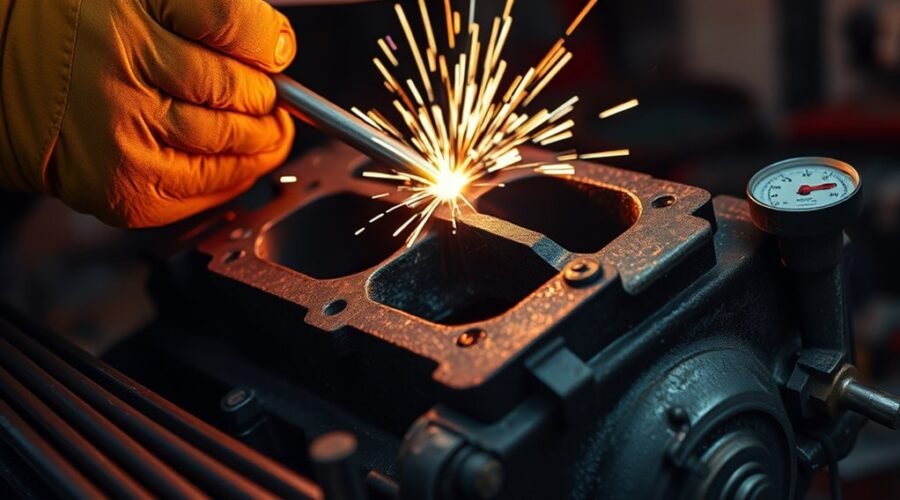
Welding cast iron is less forgiving than welding mild steel because the base metal is brittle and reacts strongly to concentrated heat. Many repairs fail beside the weld or during cooling rather than while the arc is running. A durable repair starts by identifying the iron, choosing the right nickel filler, and deciding on a heat-control method before welding begins.
Quick Answer
For most cast-iron repairs, use high-nickel ENi-CI, often called Ni-99, when machinability matters, or nickel-iron ENiFe-CI, often called Ni-55, when higher strength is needed. Control cracking with either a planned whole-casting preheat or a low-heat cold-weld method, plus short beads, light peening, and controlled cooling.
Key Takeaways
- Identify the casting first. Gray and ductile irons can often be repaired, while white iron is generally considered unweldable.
- Ni-99/ENi-CI favors machinability; Ni-55/ENiFe-CI generally provides a stronger deposit for heavier or higher-duty repairs.
- Do not treat one preheat temperature as universal. Full-preheat and low-heat welding are different repair strategies.
- Use the smallest practical electrode and the lowest current that still gives reliable fusion.
- Clean preparation, short beads, light peening, and controlled cooling all help reduce residual stress and cracking.
What Makes Cast Iron So Hard to Weld?
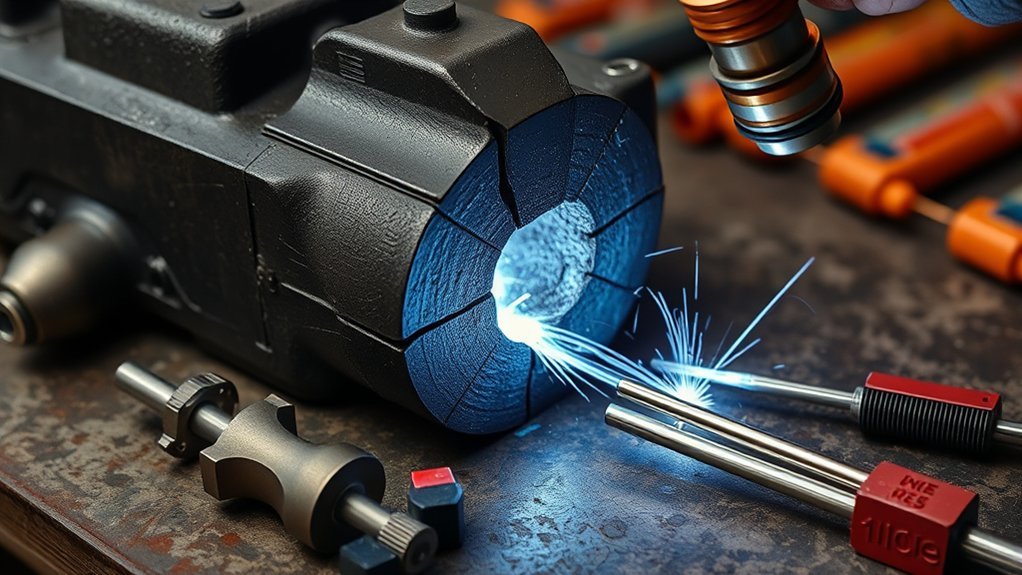
Cast iron is hard to weld because it combines high carbon content with relatively low ductility. According to TWI’s cast-iron weldability guidance, gray iron commonly contains about 2% to 4.5% carbon, much of it present as graphite flakes.
When an arc rapidly heats a small area, carbon can enter the weld and heat-affected zone. Rapid cooling can then create hard, brittle structures that cannot stretch enough to absorb weld shrinkage. That is why a sound-looking bead may be followed by a crack running beside it.
The risk changes with the iron grade. Gray iron contains graphite flakes that act as stress raisers. Ductile iron contains rounded graphite nodules and normally has better mechanical properties. White iron contains carbon mainly as hard carbides and is generally considered unsuitable for conventional repair welding.
Nickel-based cast-iron electrodes help because their deposits remain more compliant and machinable than ordinary steel weld metal. Generic general-purpose welding rods are not a substitute for selecting a filler designed for the actual cast-iron grade and repair.
Best Rods for Welding Cast Iron
The best rod for welding cast iron depends mainly on the casting type, required strength, and whether the finished repair must be machined. High-nickel ENi-CI and nickel-iron ENiFe-CI are the two most useful SMAW families for typical gray- and ductile-iron repairs.
| Rod type | Primary use | Key trait |
|---|---|---|
| Ni-99 / ENi-CI | Gray-iron repair where machining matters | Soft, highly machinable deposit |
| Ni-55 / ENiFe-CI | Ductile iron, stronger gray-iron repairs, cast iron to steel | Higher-strength nickel-iron deposit |
| Bronze rod | Braze welding and selected non-fusion repairs | Lower base-metal melting and dilution |
Bronze repair is different from fusion welding because the cast iron itself is not melted. It can reduce heat-affected-zone hardening, but the softer braze and interface may limit strength and service temperature. It should therefore be chosen for the application rather than treated as a direct substitute for nickel welding.
Steel-core electrodes can be economical for selected noncritical work, but they generally give less forgiving weld-metal properties than nickel fillers. MIG and flux-cored processes can also be used with suitable filler and procedure; the choice of flux-core welding wire still needs to match the base material and repair method.
Ni-99 vs Ni-55 Rods
The main difference between Ni-99 and Ni-55 is the balance between machinability and strength. Ni-99 is the common shop name for high-nickel ENi-CI electrodes, while Ni-55 usually refers to nickel-iron ENiFe-CI products. Exact weld-metal chemistry and current range vary by manufacturer, so the AWS classification and product datasheet matter more than the nickname alone.
Equipment choice also matters, especially when you need a stable arc at the low end of an electrode’s recommended current range. That same control principle applies when comparing TIG welders and their operating ranges, although SMAW remains a common process for cast-iron repair.
Ni-99 Machinability
Ni-99/ENi-CI is usually the better choice when the repaired surface must later be drilled, tapped, bored, or machined. ESAB describes its Castweld 99 ENi-CI electrode as a high-nickel cast-iron filler with a softer deposit than its 55-series product.
That softer deposit also allows peening to relieve shrinkage stress. It is especially useful on gray-iron repairs where finish machining is important or where a harder weld deposit would make later work difficult.
- Choose it when post-weld machining is a priority.
- Use a small electrode and low current to limit base-metal dilution.
- Do not assume every product labeled Ni-99 has identical chemistry or amperage requirements.
As one manufacturer example, ESAB lists 40–80 A for its 3/32-inch Castweld 99 electrode and 70–110 A for the 1/8-inch size. Those numbers demonstrate why one universal cast-iron amperage setting is unreliable.
Ni-55 Strength
Ni-55/ENiFe-CI is usually favored when greater weld strength is more important than maximum machinability. It is widely used for ductile iron, stronger gray-iron repairs, heavy machine sections, and some cast-iron-to-steel joints.
ESAB’s OK NiFe-CI specification classifies the electrode as AWS A5.15 ENiFe-CI and lists a typical deposit containing 53% nickel and 44% iron. ESAB also describes the weld metal as stronger and more resistant to solidification cracking than its pure-nickel electrode types.
The same datasheet lists 60–100 A for a 2.5 mm electrode, 80–150 A for a 3.2 mm electrode, and 100–200 A for a 4.0 mm electrode. Use these only as product-specific examples; always follow the range printed for the electrode actually being used.
Choosing Between Them
Choose the rod by the repair’s service requirement, not by price alone. If the casting must be machined after welding, Ni-99/ENi-CI is usually the easier choice. If the joint needs greater mechanical strength or involves ductile iron, Ni-55/ENiFe-CI is often more suitable.
- Choose Ni-99/ENi-CI for gray iron where machinability and a soft, peenable deposit matter most.
- Choose Ni-55/ENiFe-CI for stronger repairs, ductile iron, thicker sections, or selected cast-iron-to-steel joints.
- Choose bronze brazing when a non-fusion repair and lower base-metal heat are more appropriate than a fusion weld.
Whichever filler you choose, heat input and cooling control remain just as important as the rod itself.
Cast Iron Welding Prep Checklist
Good cast-iron welding begins before you strike the arc. Identify the iron, find the full extent of the crack, remove contamination, prepare the groove, choose the filler, and decide whether the repair will use a full-preheat or low-heat method.
Warning: For pressure-containing, load-bearing, or otherwise safety-critical castings, use a qualified repair procedure or an experienced welding professional. A cast-iron repair that looks sound can still contain brittle heat-affected zones or hidden cracking.
Use suitable welding PPE and control fumes, especially when old paint, oil, plating, or other coatings may be present. OSHA’s welding, cutting, and brazing requirements cover eye protection, protective clothing, confined-space precautions, and ventilation.
If you are still choosing basic equipment, prioritize stable low-current control over maximum output. That is particularly important when comparing welders for beginners for repair work.
Surface Cleaning Essentials
Remove paint, oil, grease, rust, casting skin, dirt, and other material from the repair zone before welding. Contamination can cause porosity, unstable fusion, and additional cracking.
TWI’s cast-iron preparation guidance recommends grinding, wire brushing, and suitable cleaning methods. It also warns that cast iron can absorb oil and other liquids into its porous surface.
- Expose the entire visible defect before welding.
- Locate the true crack ends before grinding away the evidence.
- Prepare the joint to sound metal with enough groove access for the filler.
- Remove grinding dust and contaminants before the first bead.
Preheat And Fit-Up
Do not automatically heat every casting to the same temperature. Cast-iron repair procedures range from low-heat welding at or near room temperature to full, uniform preheating of the whole casting.
Fit-up should minimize restraint while still keeping the joint in alignment. A V- or U-shaped groove is commonly prepared along a crack so the filler can reach sound metal without excessive arc penetration.
Use the smallest practical electrode and the lowest current that maintains a stable arc and adequate fusion. The original 80–100 A rule is too narrow because recommended current changes substantially with electrode type and diameter.
Crack-Stopping Prep Steps
Before removing a crack, locate both true ends. TWI recommends blunting the ends by drilling before gouging so the defect is less likely to extend during preparation.
- Locate each crack tip accurately; dye penetrant or magnetic-particle inspection may be useful where appropriate.
- Drill at the crack ends before opening the defect.
- Grind or machine the crack into a clean groove that reaches sound metal.
- Remove hardened material left by aggressive thermal gouging before welding.
Stop-drilling does not make the repair strong by itself. Its purpose is to help arrest propagation while you remove and rebuild the damaged area.
How to Preheat Cast Iron
Preheating reduces temperature differences between the weld area and the rest of the casting, but the correct temperature depends on the iron grade and repair method. The key is to choose one controlled thermal strategy rather than applying a blanket temperature to every job.
For a full-preheat approach, a Lincoln Electric welding manual describes preheating the entire casting to 500–1200°F before welding, followed by protection against rapid cooling. The same manual presents a separate low-heat alternative using very short welds and complete cooling between adjacent beads.
More detailed metallurgical guidance varies by cast-iron structure. TWI’s gray-iron SMAW guidance states that thin sections up to 6 mm may be welded at room temperature, while typical preheat values of about 300°C for ferritic gray iron and 330°C for pearlitic gray iron are preferred where machinability matters or sections are thick or complex.
Whichever method you use, heat gradually and uniformly. Strong local heating on a large cold casting can create the same type of thermal gradient you are trying to avoid. Temperature-indicating crayons or other suitable contact methods can help confirm the procedure temperature.
For stick welding equipment, stable output at the lower end of the electrode range is more useful than simply having maximum amperage. That matters when comparing stick welders and their arc control.
How to Weld Cast Iron With Short Beads
Short beads reduce the amount of concentrated heat and shrinkage stress added at one time. They are especially important in low-heat cast-iron repairs where you intentionally avoid warming the whole casting.
Use the lowest practical heat input, keep the arc short, and let temperature control—not bead appearance—set the pace of the repair.
- Prepare the groove. Remove the crack and contamination until sound metal is exposed.
- Select the electrode. Use ENi-CI/Ni-99 when machinability is the main concern or ENiFe-CI/Ni-55 when greater strength is needed.
- Set minimum practical current. Start within the manufacturer’s range and increase only enough to maintain fusion and a stable arc.
- Deposit a short stringer bead. For Lincoln’s low-heat method, the manual specifies about 1/2 inch at a time before allowing that location to cool.
- Peen the bead lightly while it is still hot. This helps offset contraction stress in a ductile nickel deposit.
- Clean and stagger the next bead. Remove slag, move to another location where practical, and avoid building excessive heat in one area.
Long continuous passes are usually the wrong goal on a brittle casting. If the weld metal will not fuse at the low end of the manufacturer’s range, increase current only as needed rather than relying on a fixed 80–100 A setting.
Ordinary mild-steel wire such as ER70S-6 MIG welding wire should not be treated as a direct substitute for a cast-iron-specific nickel filler without an appropriate qualified procedure.
Why Peening Cast Iron Welds Matters
Peening lightly deforms a hot, ductile weld bead so some of the contraction strain is countered before cooling finishes. This can reduce residual tensile stress that would otherwise encourage cracking beside the weld.
TWI’s cast-iron welding guide explains that peening applies compressive stress and should be used with relatively ductile weld metal, such as nickel-based deposits.
Use light, controlled hammer blows rather than heavy impacts. The purpose is to stretch the hot weld deposit slightly, not to flatten it or damage the brittle parent casting.
Peen soon after each short bead while the deposit is still hot enough to deform. Then clean the bead before the next pass. Consistency matters more than force.
Your welder also needs enough thermal headroom to complete the repair without overheating internally. That makes duty cycle and cooling reliability worth considering when selecting equipment.
How to Cool Cast Iron Without Cracking
After a preheated cast-iron repair, the goal is to prevent abrupt temperature changes while the weld and surrounding metal contract. Controlled cooling is therefore part of the welding procedure, not an optional finishing step.
Allow a fully preheated casting to cool gradually toward room temperature. Suitable insulating methods include dry sand, a fire-resistant thermal blanket, or controlled furnace cooling when the equipment and procedure allow it.
- Do not quench a hot preheated casting with water.
- Shield the repair from cold drafts and abrupt temperature changes.
- Keep thick and thin sections cooling as evenly as practical.
- Do not uncover an insulated casting early simply to speed the job.
The original 50°F-per-hour figure is not a universal cast-iron cooling requirement. Manufacturer and repair guidance instead emphasizes slow, controlled cooling appropriate to the chosen preheat procedure.
Likewise, do not use compressed air merely to hurry a hot repair. Equipment such as plasma cutters with built-in air compressors serves a different purpose; cooling strategy must follow the cast-iron welding procedure.
Why Cast Iron Welds Crack?
Cast-iron welds usually crack because brittle base metal and heat-affected zones cannot absorb the tensile stress created by uneven heating and weld shrinkage. Wrong filler selection, excessive penetration, abrupt cooling, and poor joint preparation make the problem worse.
| Cause | Effect |
|---|---|
| Rapid or uneven cooling | Higher thermal stress and hard, brittle zones |
| Wrong heat-control method | Large temperature gradients and shrinkage stress |
| Unsuitable filler or excessive dilution | Harder weld metal and less ability to accommodate strain |
Another common cause is incomplete crack removal. Welding over the visible surface of a crack without finding its true ends can leave part of the defect underneath the new deposit.
Nickel filler, low heat input, correct bead sequence, peening, and controlled cooling all address different parts of the same problem. None can compensate for a casting that was misidentified or a defect that was not fully removed.
Clear visibility is also essential during groove preparation and bead placement. A suitable welding hood with good optical clarity helps you watch the puddle and bead edges accurately.
Frequently Asked Questions
Should You Preheat Cast Iron Before Welding?
Not every cast-iron repair uses the same preheat method. Thick, complex, or highly restrained castings often benefit from controlled preheating, while some thin gray-iron repairs can use a low-heat method at or near room temperature. Follow the procedure for the iron grade, electrode, and part geometry.
What Type of Welding Rod Is Best for Cast Iron?
Ni-99/ENi-CI and Ni-55/ENiFe-CI are common choices for cast-iron SMAW repair. ENi-CI is usually favored where machining is important, while ENiFe-CI provides a stronger nickel-iron deposit suited to ductile iron and higher-duty repairs. The casting type and service load should decide the final choice.
Can You Weld Cast Iron Without Full Preheat?
Yes, some cast-iron repairs can be welded without a high whole-part preheat. Low-heat methods use the smallest practical electrode, low current, very short beads, peening, and enough cooling between adjacent beads to prevent heat from accumulating. This method should not be mixed casually with a full-preheat procedure.
What Are the Common Mistakes to Avoid When Welding Cast Iron?
The most common mistakes are misidentifying the casting, leaving oil or cracks in the repair area, using unsuitable filler, applying excessive current, running long beads, and cooling the part too quickly. Another mistake is treating one temperature or amperage setting as correct for every cast-iron repair.
Can You Use a Mild-Steel Rod to Weld Cast Iron?
Mild-steel fillers can be used in selected cast-iron procedures, but they are usually less forgiving than nickel or nickel-iron consumables. For typical repair work, cast-iron-specific nickel electrodes provide more manageable machinability, dilution, and strain accommodation. Critical repairs should follow a qualified procedure rather than a generic steel-electrode setup.
Conclusion
Successful cast iron welding depends on matching the filler and heat-control method to the actual casting. Use Ni-99/ENi-CI when machinability is the main requirement and Ni-55/ENiFe-CI when greater weld strength is needed. Then control the entire repair: clean to sound metal, stop and remove cracks, keep heat input appropriate, peen short nickel beads, and manage cooling instead of rushing it.
Sources
- TWI — Weldability of Materials: Cast Irons: cast-iron composition, weldability, heat control, fillers, and cooling.
- TWI — Preparing Cast Iron for Welding: cleaning, crack-end drilling, groove preparation, and defect removal.
- TWI — Welding Gray Cast Iron by MMA/SMAW: preheat guidance, low-current welding, short beads, peening, and slow cooling.
- TWI — Can You Weld Cast Iron?: cast-iron types, cracking mechanisms, nickel fillers, preheat, and peening.
- ESAB — Stoody Castweld 99: ENi-CI classification, machinability, and manufacturer amperage ranges.
- ESAB — OK NiFe-CI: ENiFe-CI composition, strength, applications, and manufacturer amperage ranges.
- Lincoln Electric — AC-225 Welding Manual: full-preheat and low-heat cast-iron welding methods and post-weld cooling.
- OSHA — Welding, Cutting, and Brazing Requirements: PPE, ventilation, and welding safety requirements.