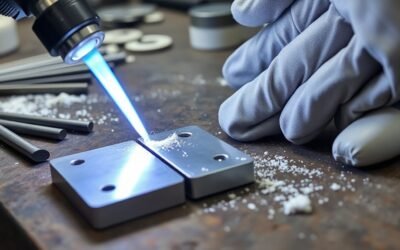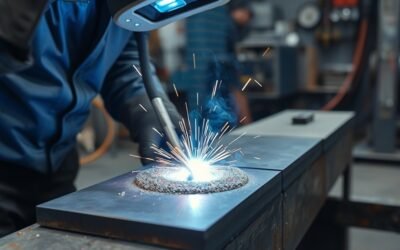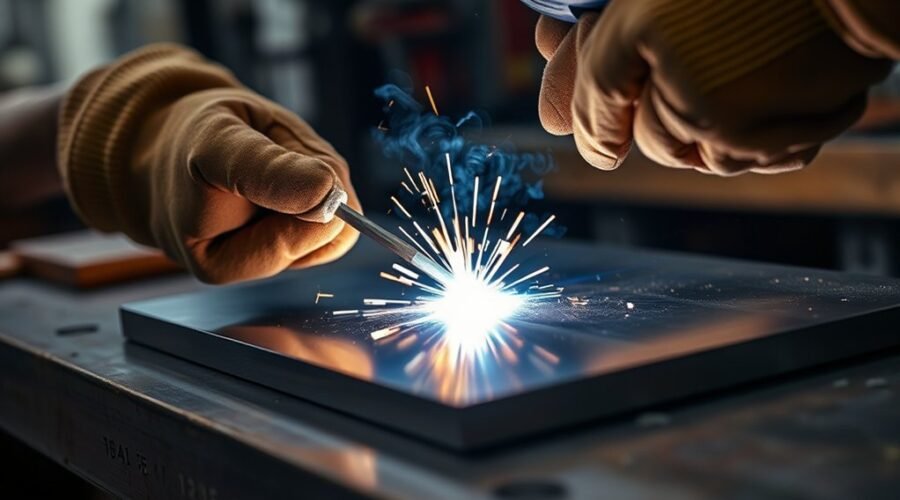
Stick welding stainless steel works well when you match the electrode to the alloy, keep the joint clean, and control heat carefully. Common austenitic grades such as 304 and 316 can be welded with SMAW, but stainless is less forgiving of excessive heat, contamination, long arcs, and the wrong filler metal. The electrode manufacturer’s data sheet should control your amperage, polarity, storage, and position limits.
Quick Answer
For common stainless work, E308L-16 is widely used with 304/304L, E316L-16 with 316/316L, and E309L-16 for many stainless-to-carbon-steel joints. Use stainless-only cleaning tools, follow the electrode’s stated amperage and polarity, hold a short arc, control heat buildup, remove slag, and restore the finished surface as the service requires.
At a Glance
| Difficulty | Intermediate; thin stainless and critical joints demand tighter heat and fit-up control |
| Tools Needed | SMAW welder, correct stainless electrodes, PPE, clamps, and dedicated stainless brush and abrasives |
Can You Stick Weld Stainless Steel?
)
Yes. Stainless steel can be stick welded with shielded metal arc welding (SMAW), and the process is useful for repairs, field work, and places where an external shielding-gas bottle would be inconvenient.
The flux coating on the stick electrode supplies shielding and forms slag over the bead. That makes SMAW less sensitive to outdoor air movement than gas-shielded TIG or MIG, although wind can still disrupt the arc and working conditions.
Austenitic stainless steels behave differently from mild steel during welding. The Specialty Steel Industry of North America welding guide notes that austenitic stainless has lower thermal conductivity and greater thermal expansion than mild steel. Heat therefore stays concentrated near the joint while the material also has a greater tendency to distort.
Good results depend on five controls: identify the stainless grade, choose compatible filler metal, keep the joint free of contamination, use the correct machine settings, and remove slag and damaging surface contamination after welding.
Safety Before Stick Welding Stainless Steel
Stainless welding needs the same protection used for other arc-welding processes, plus careful control of welding fumes. Wear an appropriate welding helmet, safety glasses, gloves, flame-resistant clothing, and suitable footwear, and keep combustible materials away from the work area.
Warning: Stainless steel welding can expose workers to hexavalent chromium and other hazardous fume constituents. OSHA identifies stainless steel welding as a potential source of chromium(VI) exposure. Use effective fume control, keep your head out of the plume, and follow the applicable workplace exposure and respiratory-protection requirements.
Ventilation must remove fumes without creating so much air movement at the arc that welding becomes unstable. Confined spaces require additional controls and should not be treated as ordinary workshop welding areas.
Note: Structural, pressure-retaining, lifting, vehicle-safety, hygienic, or other critical welds should follow the applicable welding procedure, code, drawing, and engineering requirements rather than general workshop settings alone.
Choose the Right Stainless Steel Rod
Choose the electrode from the base-metal grade and service conditions, not simply because the rod says “stainless.” For common 300-series work, E308L, E316L, and E309L cover three different jobs.
Select the stainless electrode by alloy compatibility, service environment, joint type, and the electrode manufacturer’s instructions.
| Electrode | Common Application | Why It Is Used |
|---|---|---|
| E308L-16 | 304 and 304L stainless; some stabilized 18-8 grades when the procedure permits | Low-carbon 308 chemistry helps retain corrosion performance in common austenitic stainless welds. |
| E316L-16 | 316 and 316L stainless | Contains molybdenum to match the corrosion-resistant alloy system used in 316-series stainless. |
| E309L-16 | Many stainless-to-carbon-steel joints and buffer or cladding layers | Its higher alloy content better tolerates dilution from carbon steel in common dissimilar-metal applications. |
The “L” identifies a low-carbon weld-metal classification. Lower carbon reduces susceptibility to chromium-carbide precipitation, which is important where corrosion resistance must be preserved.
Do not assume one stainless electrode suits every stainless grade. Ferritic, martensitic, duplex, precipitation-hardening, and unknown alloys may need different filler metals, preheat limits, interpass controls, or post-weld treatment.
Choose electrode diameter according to material thickness, joint design, welding position, and the current range you can control. A smaller electrode is often easier to manage on thin sections and out-of-position welds, while a larger rod deposits more metal and requires more current.
For comparison with common carbon-steel consumables, the guide to general-purpose welding rods covers other electrode types. Do not substitute a carbon-steel electrode simply because its diameter or strength rating looks similar.
Prep Stainless Steel for Welding
Start with clean, correctly identified material and an accurately fitted joint. Oil, grease, paint, dirt, iron particles, moisture, and other contamination can cause defects or reduce the corrosion performance of the finished surface.
Use abrasives and wire brushes that are dedicated to stainless steel. A brush, grinding disc, or work surface contaminated with carbon-steel particles can transfer free iron to stainless, leading to rust staining and localized corrosion.
Prepare the joint according to its thickness and required penetration. Thin material may use a square butt joint, while thicker sections may need beveled edges so you can achieve fusion without depositing unnecessary weld metal.
Fit the parts accurately and use balanced tack welds to limit movement. Copper backing or chill bars can help control distortion and burn-through on light-gauge material when the joint design permits them.
Before striking the arc:
- Confirm the stainless grade and the material on both sides of the joint.
- Remove paint, oxide, oil, grease, dirt, and visible contamination from the weld zone.
- Use stainless-only abrasives and brushes on surfaces that must remain corrosion resistant.
- Prepare the bevel and root opening required by the joint design or welding procedure.
- Clamp and tack the joint so shrinkage does not pull the pieces out of alignment.
- Make sure the work clamp has sound electrical contact.
If you are learning machine setup, this guide to a welder’s available amperage range can help you understand whether the machine covers the current your chosen rod requires.
Set Amps, Polarity, and Arc Length
Do not use a fixed percentage reduction from mild-steel settings. Stainless generally needs careful heat control, but the correct current comes from the exact electrode classification, diameter, position, and manufacturer’s data sheet.
The following ESAB Sureweld values show why one universal amperage number is misleading. They are product-specific ranges and should be treated as examples rather than settings for every brand.
| Electrode | 3/32 in. (2.4 mm) | 1/8 in. (3.2 mm) | 5/32 in. (4.0 mm) |
|---|---|---|---|
| Sureweld E308L-16 | 50–75 A | 75–100 A | 95–135 A |
| Sureweld E316L-16 | 50–80 A | 75–105 A | 100–135 A |
| Sureweld E309L-16 | 55–80 A | 70–100 A | 95–130 A |
Polarity also comes from the electrode data sheet. DCEP is common, but some “-16” stainless electrodes are approved for AC as well. For example, Hobart’s E316L-16 data sheet specifies DCEP or AC.
Keep the arc short. The same Hobart sheet specifies an arc length of less than half the electrode diameter for that product. A long arc tends to increase spatter, wandering, oxidation, and loss of puddle control.
For flat and horizontal welding, that Hobart sheet also specifies a 10–15° electrode angle from 90°. Vertical and overhead work may need reduced current and different electrode manipulation, so do not copy a flat-position setting blindly.
These welder electrical settings provide additional background on how machine output affects different welding processes.
Use Stick Welding Techniques That Work
Good stainless SMAW technique is mostly about controlling the puddle without adding unnecessary heat. Use a short arc, steady travel, clean restarts, and narrow beads unless the approved procedure calls for another technique.
- Strike the arc on clean metal. Avoid unnecessary arc strikes outside the joint because they can damage the finished surface.
- Establish a short, stable arc. Keep the electrode close enough for stable shielding and puddle control without burying it in the weld pool.
- Use a small drag angle. Follow the electrode manufacturer’s position guidance rather than using the same angle for every rod.
- Watch both weld toes. Travel fast enough to control heat, but not so fast that the bead loses fusion at either side.
- Prefer controlled stringer beads. Avoid unnecessarily wide weaving because it increases time at temperature and can trap slag.
- Fill the crater before breaking the arc. Do not leave a deep termination crater that can become a crack initiation point.
- Remove slag between passes. Expose clean metal at the toes and restart area before placing another bead.
- Control interpass heat. Allow the joint to cool as required by the electrode data sheet, WPS, or material-specific procedure.
On thin material, use smaller electrodes, restrained bead lengths, balanced tacks, and a welding sequence that spreads heat. Backstepping or staggered weld placement can help control distortion on long seams, but the sequence must still provide the required fusion.
Pro Tip: Make a test weld on scrap of the same grade and thickness before welding the finished part. Start inside the electrode manufacturer’s allowed range, then adjust only enough to obtain a stable arc, sound toe fusion, and a controllable puddle.
SMAW does not use an external shielding gas, so the MIG shielding-gas guidance applies to gas-shielded processes rather than stainless stick welding.
How to Avoid Common Stainless Stick-Welding Problems
Most stainless SMAW problems trace back to the wrong rod, excessive heat, poor joint preparation, a long arc, contamination, or slag left between passes. Correct the basic cause before increasing amperage or grinding the bead repeatedly.
| Problem | Likely Cause | What to Check |
|---|---|---|
| Rod keeps sticking | Current too low, poor work connection, or difficult arc starting | Verify polarity, amperage range, clean clamp contact, and electrode condition. |
| Heavy spatter or wandering arc | Long arc, excessive current, incorrect polarity, or arc blow | Shorten the arc and confirm the electrode data sheet before changing other settings. |
| Slag inclusion | Poor cleaning, bad bead angle, or inadequate toe fusion | Remove all slag between passes and keep the bead narrow enough to control both toes. |
| Distortion | Too much accumulated heat or poor weld sequence | Use smaller beads, balanced tacks, appropriate clamping, and controlled cooling between passes. |
| Rust staining after welding | Embedded iron, remaining scale, slag, or unsuitable surface finishing | Check whether brushes, abrasives, benches, and grinding tools were contaminated by carbon steel. |
Clean and Finish Stainless Steel Welds
Post-weld cleaning is part of corrosion control, not just appearance. Remove slag, spatter, scale, iron contamination, and unacceptable defects before deciding whether further heat-tint removal or passivation is required.
Use dedicated stainless-steel brushes and clean abrasives. The SSINA guide specifically warns against iron or ordinary steel wire bristles because embedded carbon-steel particles can cause rust staining and increased corrosion.
Heat tint can mark an oxidized and chromium-depleted surface. TWI’s stainless heat-tint guidance explains that mechanical and chemical methods can be used, with the required finish depending on corrosion-service demands.
Warning: Stainless pickling pastes can contain hydrofluoric and nitric acids and can cause severe injury. HSE guidance on post-weld pickling calls for risk assessment, suitable PPE, ventilation, proper first-aid arrangements, and strict handling controls. Follow the product SDS and manufacturer’s rinsing and disposal instructions.
Do not treat pickling paste as an ordinary workshop cleaner. Where chemical treatment is required, use the specified process rather than improvising an acid mixture.
After cleaning, inspect the toes, crater, restarts, and heat-affected area for cracks, undercut, trapped slag, excessive oxidation, or other defects. Surface finishing should not hide a defect that should have been repaired first.
If you later use another process on similar work, the cleaning principles also matter with TIG welders for stainless steel.
Weld Stainless Steel to Mild Steel
For many austenitic-stainless-to-carbon-steel joints, E309L is a common transition electrode. Its alloy content is designed to tolerate dilution from the carbon-steel side better than a matching 308L deposit.
For common stainless-to-carbon-steel transition joints, control dilution as carefully as you control heat.
Prepare and clean both sides of the joint, then use the bevel, root opening, and penetration required by the welding procedure. Excessive penetration into carbon steel increases dilution and can change the weld-metal structure.
For some transition joints, a buttering technique is used. The SSINA welding guide describes placing a suitable stainless layer, commonly 309 for certain austenitic-stainless-to-carbon-steel combinations, onto the carbon-steel surface before the final stainless-to-stainless-type joining operation.
- Clean the stainless side with stainless-only tools.
- Remove rust, scale, paint, oil, and other contaminants from the carbon-steel side.
- Use E309L when it is appropriate for the specified alloy combination and service.
- Control penetration into the carbon steel to limit dilution.
- Use buttering only where the joint design or welding procedure calls for it.
- Consider the different thermal expansion of stainless and carbon steel when planning tack placement and weld sequence.
If one machine will be used for several welding processes, this guide to multi-process welders explains the equipment category.
Key Takeaways
Key Takeaways
- E308L-16, E316L-16, and E309L-16 serve different alloy combinations; match the rod to the base metals and service conditions.
- Use the electrode manufacturer’s amperage and polarity data instead of applying a fixed percentage reduction from mild-steel settings.
- A short arc, restrained heat input, controlled bead placement, and clean restarts reduce spatter, distortion, and slag problems.
- Keep brushes and abrasives dedicated to stainless so carbon-steel particles are not embedded in the surface.
- Post-weld cleaning matters to corrosion resistance, and chemical pickling requires serious acid-safety controls.
Frequently Asked Questions
What type of stick welding rod is best for stainless steel?
There is no single best rod for every stainless alloy. E308L-16 is commonly used for 304/304L, E316L-16 for 316/316L, and E309L-16 for many stainless-to-carbon-steel joints. The base-metal grade, service environment, joint design, and welding procedure determine the correct choice.
Can you stick weld stainless steel with 7018?
A 7018 electrode can physically deposit weld metal on stainless, but it is normally the wrong filler for a stainless joint that must retain stainless weld-metal chemistry and corrosion resistance. Use a compatible stainless electrode unless an approved engineering procedure specifically calls for something else.
What settings should I use to stick weld stainless steel?
Use the amperage range and polarity specified for your exact electrode brand, classification, diameter, and welding position. DCEP is common, while some -16 electrodes also permit AC. Start within the published range, keep the arc short, and adjust only enough to obtain stable operation and sound fusion.
What grade welding rod should I use for 304 or 316 stainless?
E308L-16 is a common choice for 304 and 304L stainless, while E316L-16 is commonly matched to 316 and 316L. Stabilized, duplex, ferritic, martensitic, precipitation-hardening, high-temperature, or unusually corrosive applications may require a different filler and procedure.
Can E308L-16 or E316L-16 run on AC?
Some -16 stainless electrodes are designed for AC as well as DCEP, but you should verify the exact product data sheet before welding. Electrode formulation, machine characteristics, diameter, and position can affect how well an AC setup starts and runs.
Can you stick weld thin stainless steel?
Yes, but thin stainless is difficult to stick weld because SMAW adds concentrated heat and uses relatively large consumable electrodes. Use the smallest suitable electrode, accurate fit-up, short controlled welds, balanced tacks, and a manufacturer-approved current range. TIG may provide easier heat control on very thin work.
Conclusion
Successful stick welding stainless steel starts with the right electrode and continues with clean preparation, manufacturer-approved settings, a short controlled arc, and disciplined heat management. Match E308L, E316L, or E309L to the actual joint rather than choosing by habit, then remove slag and surface contamination before the weld goes into service. For critical work, let the applicable WPS or engineering specification control the final procedure.
Sources
- ESAB Sureweld 308L-16: E308L-16 applications, AWS classification, and current ranges.
- ESAB Sureweld 316L-16: E316L-16 applications, AWS classification, and current ranges.
- ESAB Sureweld 309L-16: stainless-to-carbon-steel applications and current ranges.
- Hobart Brothers 316/316L Sterling AP Data Sheet: DCEP/AC operation, arc length, electrode angle, welding positions, and amperage guidance.
- Specialty Steel Industry of North America, Welding of Stainless Steels: stainless thermal behavior, joint preparation, dissimilar-metal welding, buttering, and post-weld cleaning.
- OSHA Chromium Safety and Health Information: chromium(VI) exposure associated with stainless steel welding.
- UK Health and Safety Executive, Post-Weld Cleaning Using Pickling Pastes: hazards and controls for hydrofluoric/nitric-acid pickling products.
- TWI Heat-Tint Removal Guidance: removal of oxide scale and chromium-depleted material after stainless welding.