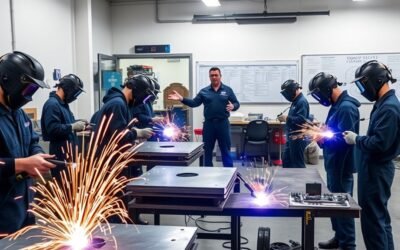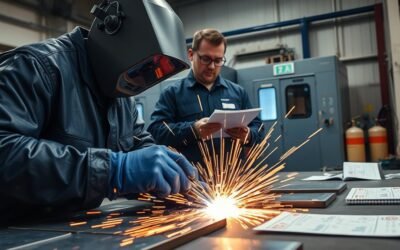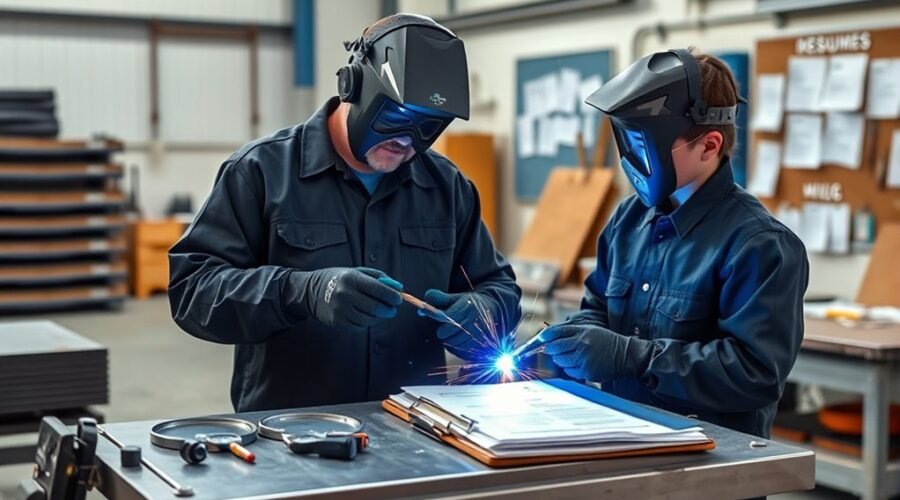
Getting a welding job takes more than knowing how to strike an arc. Employers may look at your welding process experience, ability to read drawings and follow a welding procedure, safety habits, certifications or qualifications, and performance during a practical weld test. The strongest applicants prepare for the exact job instead of practicing every process at random.
Quick Answer
To get a welding job, match your skills to the employer’s process and materials, document your training and qualifications clearly, prepare for the exact weld test, follow shop safety rules, and show that you can read instructions, inspect your work, and communicate professionally. Entry-level candidates can also pursue apprenticeships or employer training.
Key Takeaways
Key Takeaways
- Match your preparation to the job’s actual welding process, material, position, and test procedure instead of assuming every employer wants MIG, TIG, stick, or 6G.
- Treat AWS certification and ASME-based welder qualification correctly: AWS offers Certified Welder credentials, while ASME Section IX contains rules used to qualify welding procedures and personnel.
- Build job-ready skills beyond bead appearance, including blueprint reading, measurement, fit-up, joint preparation, WPS compliance, inspection, and equipment care.
- Tailor your résumé to the specific processes, positions, materials, qualifications, and projects required by the employer.
- For a hands-on test, confirm what PPE and equipment the employer provides, follow the test instructions exactly, and never trade safety for speed.
At a Glance
| Time Required | About 1–3 hours to tailor an application; practical weld-test preparation may take days, weeks, or longer depending on your current skill level. |
| Difficulty | Moderate to advanced, depending on the process, position, material, code, and employer test. |
| Tools Needed | Tailored résumé, qualification/certification records, identification, job details, and employer-approved PPE if a hands-on test is scheduled. |
| Cost | Usually free to apply. Training, certification testing, PPE, travel, or retesting may cost extra, although some employers pay these costs. |
Know What Employers Want
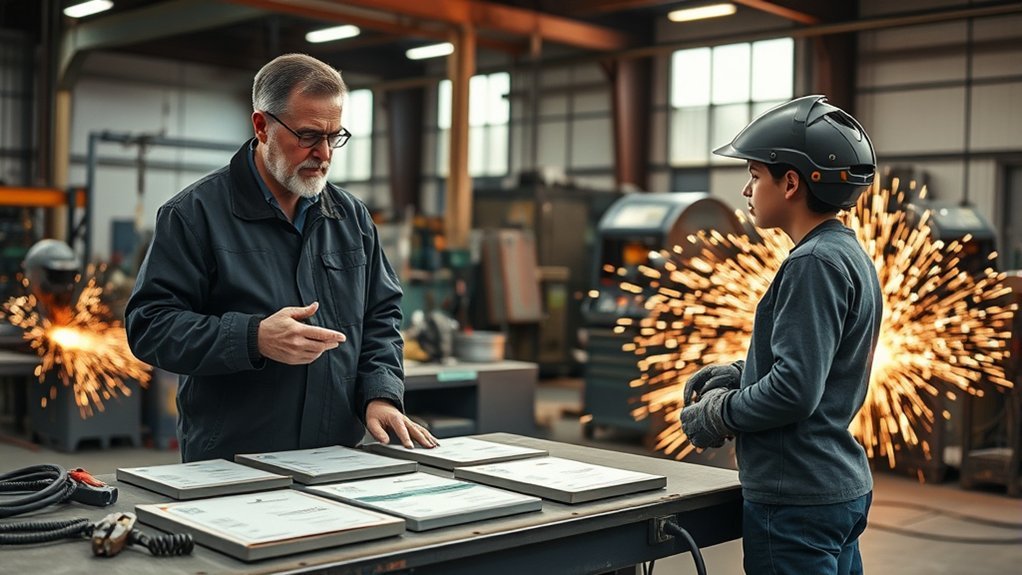
Employers usually want proof that a candidate can perform the work safely and consistently. In the United States, the U.S. Bureau of Labor Statistics says welders typically enter the occupation with a high school diploma or equivalent combined with technical and on-the-job training. Employers may prefer formal welding training, credentials, prior shop experience, or a successful practical test.
Practical ability matters as much as a résumé. A job may use gas metal arc welding (GMAW/MIG), gas tungsten arc welding (GTAW/TIG), shielded metal arc welding (SMAW/stick), flux-cored arc welding, or another process. Do not assume every employer tests all three major manual processes. Read the job posting and ask what process, material, position, and joint you will actually be expected to weld.
Employers also value workers who can read drawings and specifications, measure parts, inspect material, follow written instructions, maintain equipment, communicate with a crew, and recognize when a setup is unsafe. These are part of normal welding work, not extra résumé decoration.
Credentials can help, but they need to be described accurately. The AWS Certified Welder Program is performance-based and allows welders to demonstrate skill under specific procedures. ASME is different: ASME BPVC Section IX provides rules for qualification of welding procedures and personnel where that code applies.
Note: Do not write simply “ASME certified” on a résumé unless you can accurately describe the qualification. List the welding process, position, material or test scope, applicable code/procedure, and current documentation you actually hold.
Versatility is useful when a shop runs more than one process. Reviewing versatility in welding techniques can also help newer welders understand how common processes differ, but job preparation should still focus first on the process listed by the employer.
Build the Welding Skills Employers Test For
A strong welding candidate prepares for the skills the employer is actually likely to test. That may be GMAW/MIG, GTAW/TIG, SMAW/stick, FCAW, or a combination. Practice should focus on repeatable starts and stops, joint preparation, fit-up, travel speed, work and travel angles, arc control, bead placement, and following the required welding procedure.
Do not judge readiness only by whether a bead looks smooth. Employers may evaluate dimensions, weld size and profile, discontinuities, penetration or fusion where applicable, adherence to the WPS, and the candidate’s setup and safety habits. In AWS Certified Welder testing, candidates perform a qualification test to a specified procedure and the completed weld is evaluated under the applicable requirements.
Do Not Overlook Blueprints, WPSs, and Measurement
A welder may be expected to interpret blueprints, sketches, welding symbols, dimensions, tolerances, and written specifications before touching the machine. Practice reading a Welding Procedure Specification (WPS) and identifying the process, electrode or filler classification, base material, position, electrical characteristics, shielding gas where applicable, joint design, preheat requirements, and other variables the procedure specifies.
Basic shop math, tape and rule measurements, fillet-weld gauges, fit-up checks, joint cleaning, tack placement, and equipment inspection can matter just as much as arc time. If the test instructions conflict with what you normally do, stop and ask the test supervisor rather than improvising.
For home or school practice, the right equipment should match the process you need to learn. A guide to stick welders under $500 may help compare practice machines, but machine price does not substitute for correct procedure, instruction, ventilation, and safe work practices.
Tailor Your Experience to the Job
A strong application makes it easy for a hiring manager to see exactly where your experience matches the opening. Use the language of the job posting where it accurately describes your real skills, and give specific details rather than broad claims such as “experienced in all welding.”
| Focus | Better Résumé Detail |
|---|---|
| Credentials / qualifications | AWS Certified Welder credential or documented employer/code performance qualification, with scope stated accurately |
| Welding processes | GMAW/MIG, GTAW/TIG, SMAW/stick, FCAW, or other processes actually used |
| Materials | Carbon steel, stainless steel, aluminum, pipe, plate, or sheet with realistic thickness ranges |
| Training | Technical school, apprenticeship, employer training, military training, specialty courses |
| Supporting skills | Blueprint reading, welding symbols, fit-up, measuring, grinding, inspection, troubleshooting, safe equipment setup |
Place the qualifications the employer values most near the top of the résumé. If the role requires a specific process, show where you used that process, on what material, in which positions, and for what kind of work. If you can support a statement with a measurable result—such as production volume, inspection acceptance, repair reduction, or years of experience—use it without exaggeration.
Specialized training should appear where it supports the employer’s needs. Clear examples of troubleshooting, safe work, reading prints, correcting fit-up problems, or following a WPS show more than a generic statement about being a “hard worker.”
If the role is mainly GMAW, understanding the setup differences among MIG welders can support your equipment knowledge, but the résumé should emphasize what you have actually welded rather than which machines you have read about.
How to Get a Welding Job With Little or No Experience
Not every welding job requires years of shop experience. In the United States, some employers hire inexperienced entry-level workers and train them, and some apprenticeship programs accept applicants with no previous welding employment. Formal technical training can make that first step easier, but a beginner can also build credibility through school projects, apprenticeship work, documented practice, and a successful employer weld test.
For an entry-level application, focus on evidence that you are safe, trainable, and able to follow instructions. Include relevant shop classes, welding processes practiced, positions completed, blueprint or welding-symbol training, measurement skills, fabrication projects, safety training, attendance, and any current credentials.
- Apply for helper, trainee, production welder, fabrication, and apprenticeship roles that match your current ability.
- Keep photos or a simple project record when your school or employer allows it, but never photograph confidential work without permission.
- Ask instructors, apprenticeship coordinators, local fabricators, contractors, unions, and workforce programs about entry-level openings.
- Practice explaining what you know and what you are still learning without pretending to have experience you do not have.
- Be ready for an employer-specific weld test even if you completed welding school.
Know Which Welding Test to Expect
Welding tests differ widely by employer, industry, process, code, and product. Before the interview, ask whether the company can tell you the welding process, material, thickness or pipe schedule, joint type, position, filler metal or electrode, progression direction, backing requirements, and whether a written WPS will be provided.
Many tests involve GMAW, GTAW, SMAW, FCAW, or another process relevant to the shop. Employers may evaluate the test visually and may also use bend testing, radiographic examination, other nondestructive examination, or another acceptance method when required by the applicable procedure or code.
The 6G pipe position is a demanding configuration in which the pipe is fixed at about a 45-degree angle. It requires the welder to work through changing orientations around the joint. However, 6G is especially relevant to certain pipe roles and should not be treated as a universal test for every welding position.
The best weld-test practice is not “the hardest weld you can find.” It is the weld that most closely matches the employer’s actual process, material, position, joint, and procedure.
Do not assume that dimensions such as 2-inch Schedule 10, Schedule 5, or a particular wall thickness will be used unless the employer tells you so. A pipe or pressure-vessel employer may also use qualification rules based on ASME Section IX or another applicable code.
If the opening involves GTAW, reviewing TIG welding performance and machine features can improve equipment familiarity, but test success still depends on following the employer’s procedure.
Practice the Right Welding Process
Focused practice starts by matching the process to the job. If the opening specifies GMAW on carbon-steel plate, spending all your practice time on 6G GTAW pipe is not efficient. Work first on the process, material, thickness, joint, position, and progression you expect to see during the test.
Match the welding process to the job first, so every practice session builds real, test-ready confidence.
If 6G is genuinely part of the test, repeat the fixed 45-degree setup until body position, torch or electrode control, tie-ins, starts, stops, and transitions become consistent. Practice on pipe sizes and wall thicknesses that reasonably resemble the expected coupon instead of relying on arbitrary diameters.
Use filler metal, electrodes, backing, shielding gas, joint preparation, and electrical settings that match the procedure you are practicing. Do not switch to an autogenous or filler-free weld simply because it looks cleaner unless the procedure specifically permits or requires it.
Pro Tip: Ask the employer, “Can you tell me the process, material, position, joint type, thickness or pipe schedule, and whether I will be following a WPS?” Even partial information can make practice much more useful.
Equipment should be checked before every practice session. Inspect leads, ground connections, torch or electrode-holder condition, gas connections where applicable, consumables, ventilation, and the work area. A stick welder with stable output can support SMAW practice, but no machine compensates for poor fit-up, contaminated material, unsafe setup, or ignoring the WPS.
- Match the process and material first
- Practice the expected position
- Use representative thickness or pipe dimensions
- Follow the intended WPS or training procedure
- Inspect fit-up and joint cleanliness
- Check PPE, ventilation, and equipment before striking an arc
- Inspect the finished weld before calling the test complete
Warning: Welding produces intense radiation, heat, sparks, fumes, and gases. Practice only in a suitable welding area with required ventilation and controls. Coatings, stainless steels, confined spaces, and certain metals can create additional hazards. Follow the employer’s or training facility’s safety program and never improvise respiratory protection.
Get Ready for the Interview
Getting ready for a welding interview means preparing for both the conversation and the possibility of hands-on testing. Study the company, review the required process, and prepare short, specific examples that show your training, safety habits, problem-solving, teamwork, and ability to follow specifications.
If the company has told you there will be a weld test, confirm what clothing or PPE to bring and what the employer supplies. Do not assume your personal helmet, gloves, respirator, or other equipment will automatically be permitted on the shop floor.
If personal equipment is allowed, it should be clean, functional, and appropriate for the task. A guide to welding helmets under $200 can help compare personal options, but employer rules and applicable eye/face-protection requirements come first.
Interview Prep Essentials
Preparation starts with understanding what the employer actually needs. Review the posting and make a short list of the processes, materials, positions, drawing skills, qualifications, shifts, travel requirements, and safety responsibilities mentioned.
Prepare honest answers about your strongest welding process, a difficult weld or fabrication problem you solved, a time you corrected a safety issue, how you handle a weld that fails inspection, and how you verify your setup before beginning work.
- Research the position and company
- Review your training, qualifications, and recent projects
- Practice concise interview answers with real examples
- Bring copies of requested credentials or qualification records
- Confirm whether personal PPE is required or permitted
- Wear shop-ready clothing if hands-on testing is scheduled
Safety And Presentation
Safety and presentation are part of interview readiness. Arrive in clean clothing appropriate to the instructions you received. If a practical test is planned, long sleeves, full-length pants, and suitable protective footwear are normally more appropriate than office-only clothing, but the employer’s PPE and dress rules take priority.
During the interview, clear answers, active listening, and calm communication matter. Do not bluff when you do not know an answer. A better response is to explain how you would check the drawing, WPS, supervisor instruction, code requirement, or equipment documentation before proceeding.
Good professional behavior also includes showing respect for safety boundaries. If a test area, machine, ventilation setup, damaged lead, gas connection, or PPE situation appears unsafe, ask the supervisor before continuing.
Company And Test Research
Before the interview, research the company’s products and likely welding processes. A structural fabrication shop, stainless-food-equipment manufacturer, pipe contractor, repair facility, and production plant may expect very different welding skills.
- Study the company’s main products, projects, and industries.
- Learn which welding processes and materials appear central to its work.
- Review the positions and procedures likely to be relevant.
- Prepare examples that match the company’s work.
- Prepare questions about training, testing, safety, shifts, travel, overtime, and qualification maintenance.
This research lets you speak specifically about the job instead of giving generic answers that could apply to any shop.
Weld-Test Day Checklist
- Arrive early enough to complete site entry or safety requirements without rushing.
- Bring identification and any qualification or certification documents the employer requested.
- Wear or bring only the PPE the employer requires or permits.
- Read the test instructions and WPS before setting up.
- Confirm process, material, joint, position, consumable, gas, polarity, and other required variables.
- Inspect the coupon, fit-up, machine, leads, ground, torch or holder, and surrounding work area.
- Ask questions before welding if any requirement is unclear.
- Follow the procedure instead of trying an unapproved shortcut.
- Inspect and clean the completed weld as allowed before submitting it.
Dress for Safety and Hands-On Testing
For a welding test, clothing needs to match the hazards and the employer’s rules. Welding can expose the body to sparks, spatter, hot slag, ultraviolet and infrared radiation, sharp material, and other hazards, so ordinary interview clothing may not be suitable for hands-on work.
The OSHA welding standard requires appropriate protection for personnel exposed to welding, cutting, and brazing hazards. Exact PPE varies with the job.
If the employer permits personal outerwear, durable welding jackets can provide useful protection against sparks and heat when they are appropriate for the process and maintained correctly.
Protective Work Clothing
Protective work clothing should cover exposed skin and be suitable for the welding process. Flame-resistant garments, leather, and appropriate heavy natural-fiber clothing may be used depending on the hazard assessment and site rules.
Avoid ordinary clothing that can melt onto the skin or readily ignite under the expected exposure. Do not assume that every synthetic fabric is unsafe, however; modern purpose-built flame-resistant garments can use engineered fibers. The important question is whether the garment is suitable for the welding hazard and permitted by the employer.
Clothing should also be dry, in good condition, and free of oil, grease, solvents, or other combustible contamination. Avoid open pockets, cuffs, frayed material, or other areas where hot sparks or slag can collect.
- Long sleeves and full-length pants
- Suitable flame-resistant or non-melting material
- Dry, clean clothing free of combustible contamination
- No exposed skin in areas subject to arc radiation or spatter
- Employer-approved protective footwear and other PPE
PPE For Welding Tests
A candidate performing arc welding needs suitable eye and face protection, gloves, protective clothing, and any additional PPE required for the specific hazards. Under OSHA’s eye and face protection requirements, protective devices must meet applicable criteria, and welding filter shade must be appropriate for the operation.
A welding helmet does not automatically replace every other type of required eye protection. Safety glasses or other protection may still be required underneath or during grinding, chipping, cleanup, and nearby work.
Respiratory protection is also not something to improvise. Ventilation and engineering controls are important for welding fumes, and any required respirator must be selected and used under the employer’s respiratory-protection program.
Well-maintained PPE helps the welder concentrate on the test without creating preventable hazards.
Safe, Job-Ready Boots
Protective footwear should match the shop’s hazards. OSHA requires protective footwear where workers face hazards such as falling or rolling objects, objects piercing the sole, or certain electrical hazards. Safety-toe footwear may be required, but a steel toe is not the only possible protective construction.
For welding environments, high-top leather or other employer-approved protective footwear can also reduce the chance of sparks or slag entering the shoe. Pants should normally cover the boot opening rather than being tucked inside where hot material can fall into it.
Slip resistance, ankle support, condition of the sole, and comfortable fit matter during long periods of standing and repositioning material. If the site requires electrical-hazard-rated footwear or a particular ASTM marking, follow that requirement.
- Protective footwear that meets the employer’s hazard assessment
- Safety toe when required
- Slip-resistant sole where appropriate
- High-top design that helps keep hot material out
- Secure fit and good condition
- Electrical-hazard protection when specifically required
Research the Company Before You Apply
A careful job search starts with understanding the employer before sending an application. Look at the company’s products, industries, fabrication methods, locations, shift requirements, safety expectations, and the welding processes mentioned in its job postings.
Recent projects, certifications, customer industries, or facility capabilities can reveal whether the shop concentrates on structural steel, pressure work, stainless fabrication, production welding, repair, aluminum, pipe, or another specialty. That helps you emphasize the most relevant experience in your résumé and interview.
Employee reviews can provide additional clues about scheduling and culture, but treat anonymous reviews as individual experiences rather than verified facts. Give more weight to the employer’s official job description, safety requirements, published certifications, and what you learn directly during the interview.
If an employer permits candidates or employees to use personal helmets, understanding auto-darkening helmets can help you compare features. Always confirm site rules before bringing or using personal PPE.
Where to Find Welding Jobs and Apprenticeships
Do not rely on one job board. Welding work may be advertised through fabrication shops, manufacturers, construction contractors, shipyards, maintenance companies, staffing firms, unions, apprenticeship programs, technical schools, workforce agencies, and local employer networks.
For U.S. applicants, BLS recommends contacting state employment services, state apprenticeship agencies, local businesses, and the U.S. Department of Labor’s apprenticeship resources for training and work opportunities.
- Search local manufacturers and fabricators directly.
- Ask welding instructors and technical schools which employers recruit their graduates.
- Look for registered apprenticeships and employer trainee programs.
- Contact relevant unions or trade organizations where appropriate.
- Use job boards, but also check company career pages.
- Keep a simple application log so you can follow up without sending duplicate applications.
Follow Up After the Interview
After the interview, a short professional follow-up can reinforce your interest. If the employer gave a specific timeline or communication method, follow that instruction first.
A useful message thanks the interviewer for the opportunity, briefly mentions the role or weld test, confirms your continued interest, and asks about the next step only when the timing is appropriate. Avoid repeated calls or messages that ignore the employer’s stated process.
- Thank the hiring team for its time
- Mention one relevant detail from the interview or test
- Confirm continued interest in the position
- Follow the employer’s stated feedback timeline
- Keep your résumé and qualification records current for future applications
If the employer asks for additional records, references, testing, or documentation, reply promptly and accurately.
Frequently Asked Questions
Is It Hard to Pass a Weld Test?
It depends on the process, position, material, joint, acceptance criteria, and your experience. A basic production test may be manageable for a trained beginner, while a code-based pipe test such as 6G can be much more demanding. The best preparation is to practice the exact procedure or a close equivalent under realistic conditions.
What Is the 30-60-90 Rule in an Interview?
A 30-60-90 plan is an optional way to describe how you would approach your first three months: learn the shop, procedures, and expectations first; begin contributing more independently next; then work toward consistent performance and broader responsibility. It is a general career-planning tool, not a welding code or formal hiring requirement.
How to Get Hired as a Welder?
Build the process skills the employer needs, document training and qualifications accurately, tailor your résumé, prepare for the expected weld test, and demonstrate strong safety habits. Blueprint reading, measurement, fit-up, WPS compliance, inspection, communication, and reliability can matter alongside the quality of the finished weld.
What Is the Golden Rule in Welding?
There is no single universally recognized welding “golden rule.” A useful practical principle is to follow the approved welding procedure and safety requirements every time: prepare the joint correctly, verify the setup, use the specified process and consumables, protect yourself and nearby workers, and inspect the finished work.
Do I Need AWS Certification to Get a Welding Job?
Not for every job. Some employers require an AWS credential, an employer-specific qualification, qualification under a code such as ASME Section IX, or another industry requirement. Others hire entry-level workers and qualify or train them after hiring. Read the posting carefully and ask which credential or performance test is actually required.
Can I Get a Welding Job With No Experience?
Yes, some employers and apprenticeships accept entry-level candidates, although requirements vary. Technical-school training, documented practice, safety knowledge, blueprint and measurement skills, and a successful practical test can make a beginner more competitive. Helper, trainee, production, and apprenticeship roles are common places to start looking.
Conclusion
Landing a welding job comes down to matching your preparation to the work. Build the process and fabrication skills the employer actually needs, describe your qualifications accurately, study the WPS or test instructions, and treat safety as part of performance rather than an interview talking point. A targeted résumé, realistic weld-test practice, professional communication, and careful follow-up give an employer clear evidence that you are ready to contribute.
Sources
- American Welding Society — Certified Welder Program — AWS Certified Welder testing, performance qualification, WPS compliance, and credential scope.
- ASME — BPVC Section IX: Welding, Brazing, and Fusing Qualifications — current ASME qualification standard for welding procedures and personnel.
- U.S. Bureau of Labor Statistics — Welders, Cutters, Solderers, and Brazers — training, apprenticeship, duties, blueprint reading, and U.S. occupational requirements.
- OSHA 29 CFR 1910.252 — Welding, Cutting, and Brazing — welding safety, protective clothing, eye protection, fire prevention, and ventilation requirements.
- OSHA 29 CFR 1910.133 — Eye and Face Protection — eye/face protector criteria and welding filter-shade guidance.
- OSHA 29 CFR 1910.136 — Foot Protection — protective-footwear requirements based on workplace hazards.