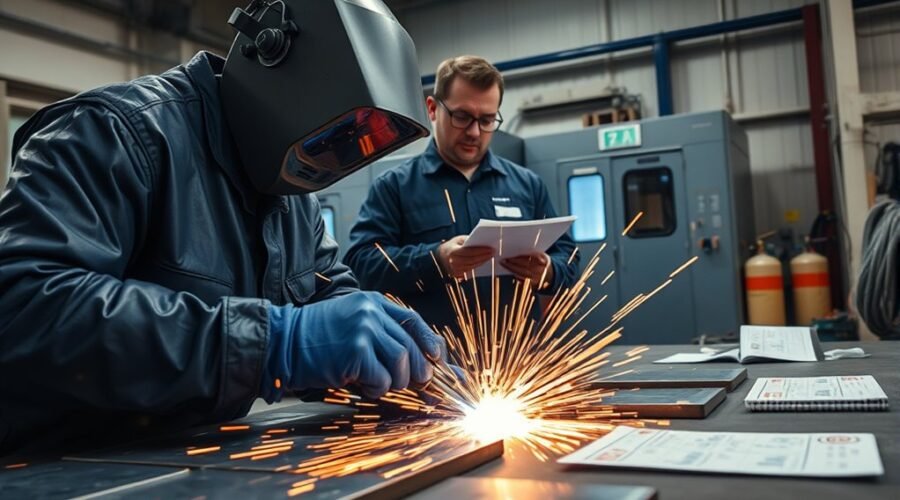
Welding certifications show that a welder or welding professional has met defined requirements for a particular skill or role. For hands-on welders, the most common AWS route is the Certified Welder (CW) program, which uses a performance test tied to specific processes, positions, materials, and procedures. Other credentials, such as Certified Welding Inspector (CWI), Certified Welding Engineer (CWEng), Certified Robotic Arc Welding (CRAW), and Certified Resistance Welding Technician (CRWT), serve different career paths. Costs, eligibility rules, testing locations, and renewal requirements vary by credential.
Quick Answer
Welding certification usually involves choosing a qualification that matches the work you want to perform, preparing for the required process and position, and passing the applicable test. For the AWS Certified Welder program, no prerequisite course is required, but the performance test must be completed at an AWS Accredited Test Facility.
Key Takeaways
Key Takeaways
- The AWS Certified Welder program is performance-based and does not require a prerequisite course or prior certification.
- A welder qualification normally applies only to the processes, positions, materials, variables, and procedures covered by the test.
- In 2026, the AWS Certified Welder application fee is $70 and the yearly maintenance subscription is $105; the Accredited Test Facility charges its practical-test fee separately.
- CWI is an inspection credential with education, work-experience, vision, and examination requirements; it is not a replacement for a welder performance qualification.
- Maintaining a Certified Welder credential requires documented continuity in the applicable welding process according to AWS and the governing qualification rules.
What Are Welding Certifications?
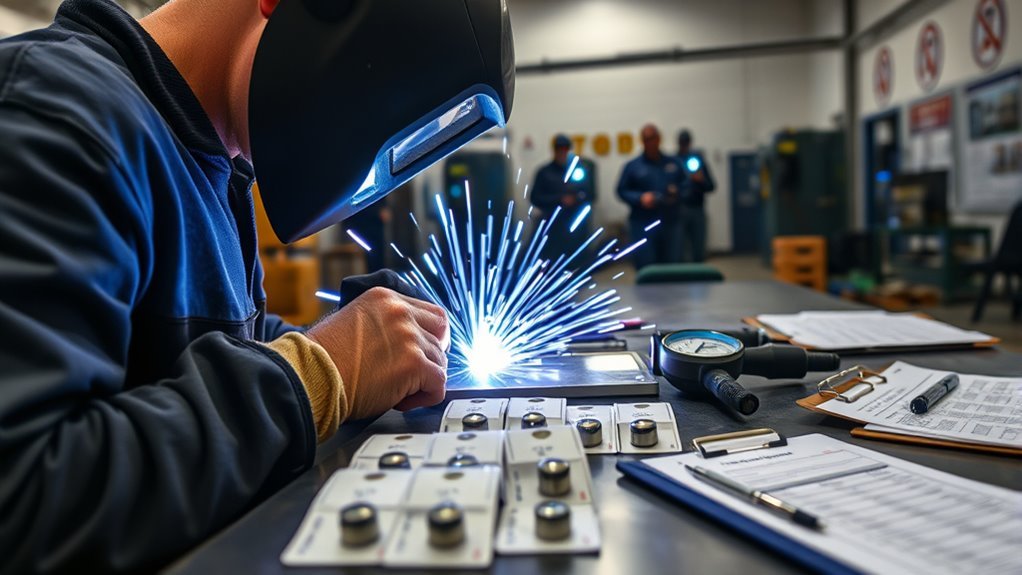
Welding certifications are formal credentials or qualifications used to document that a person meets defined requirements for welding, inspection, engineering, automation, or another welding-related role.
For a hands-on welder, certification is usually much more specific than simply being called a “certified welder.” A performance qualification can be limited by the welding process, position, joint, base material, filler metal, thickness or diameter range, and governing procedure or code.
The AWS Certified Welder program, for example, is performance-based. AWS states that there are no prerequisite courses or certifications for candidates who can perform the required weld successfully.
A welding credential should tell an employer what you were tested to do—not simply that you attended a welding class.
That distinction matters because employers, contractors, inspectors, and project specifications may require evidence that a welder is qualified for the exact work being performed.
Welding Certification vs. School Certificate vs. Welder Qualification
These terms are often used interchangeably, but they can mean different things.
| Term | What It Usually Means | Example |
|---|---|---|
| School certificate | Proof that a student completed a welding training program. | Community-college welding certificate. |
| Welder qualification | Evidence that a welder passed a performance test under defined procedure or code variables. | Qualification for a particular process and position. |
| Professional certification | Credential issued under a formal certification program with specified eligibility and maintenance rules. | AWS Certified Welder or Certified Welding Inspector. |
Note: Completing welding school can prepare you for certification, but a school completion certificate does not automatically mean that you hold an AWS Certified Welder credential or every qualification an employer may require.
Common Types of Welding Certifications
AWS offers credentials for several different roles. The right one depends on whether you intend to weld, inspect, engineer, supervise, teach, or work with specialized welding systems.
- AWS Certified Welder (CW): performance-based credential for welders tested to specific welding procedures and qualification variables.
- Certified Welding Inspector (CWI): professional inspection credential requiring qualifying education or work experience, a vision examination, and AWS examinations.
- Certified Welding Engineer (CWEng): credential for professionals working with welding engineering principles, design, manufacturing, materials, process control, and related technical responsibilities.
- Certified Robotic Arc Welding (CRAW): specialized certification for robotic arc-welding operators and technicians.
- Certified Resistance Welding Technician (CRWT): specialized credential for personnel working with resistance-welding technology.
AWS also offers credentials for welding supervisors, educators, radiographic interpreters, sales representatives, and other specialized functions. Its current credential catalog is available through the AWS Professional Certification program.
A Certified Welder qualification may cover processes such as SMAW, GMAW, GTAW, or FCAW when those processes are part of the applicable test procedure. Positions can include plate or pipe configurations, and the resulting qualification range depends on the code, specification, procedure, and essential variables involved.
How AWS Welding Certifications Work
The AWS Certified Welder program measures practical welding ability through a performance qualification test at an AWS Accredited Test Facility (ATF).
A candidate follows the specified Welding Procedure Specification (WPS), including requirements for fit-up, assembly, process, position, and other test variables. The completed test weld is then evaluated according to the applicable acceptance requirements.
The basic process is:
- Choose the qualification needed for the intended job or industry.
- Contact an AWS Accredited Test Facility that offers the required test.
- Confirm the exact process, position, material, procedure, test fee, PPE requirements, and scheduling rules.
- Perform the qualification test under the required WPS.
- Pass the required inspection or testing.
- The ATF submits the appropriate documentation to AWS for the Certified Welder credential.
- Maintain process continuity according to AWS and the rules governing the qualification.
According to AWS QC47, the general Certified Welder continuity rule keeps a qualification effective for six months following the initial test or the most recent documented use of that welding process. Continued qualifying activity can keep the credential active indefinitely when maintenance requirements are satisfied. Candidates should always check the exact code or supplement governing their qualification because special rules may apply.
Pro Tip: Before practicing for a certification test, ask the ATF for the exact process, position, joint configuration, material, thickness or diameter, WPS, and acceptance method. Practicing a different test can waste both time and material.
How to Get Welding Certified
For someone seeking an AWS Certified Welder credential, the route is straightforward, although the difficulty depends heavily on the qualification being attempted.
At a Glance
| Time Required | No universal preparation time; testing and scheduling depend on the qualification and ATF. |
| Difficulty | Varies from basic plate qualifications to demanding pipe positions and specialized procedures. |
| Tools Needed | The ATF supplies or specifies test equipment and materials; confirm required ID, clothing, PPE, and personal tools before arrival. |
| Cost | AWS CW application: $70 in 2026; annual maintenance subscription: $105; practical test fee is set separately by the ATF. |
- Identify the work you want to qualify for. Structural plate, pipe, production welding, inspection, and automation may require different credentials.
- Find the applicable certification or qualification. Do not choose a test simply because it sounds more advanced.
- Locate an approved testing provider. AWS Certified Welder tests must be performed through an AWS Accredited Test Facility.
- Get the exact test details. Confirm the WPS, process, position, material, test method, price, and retest policy.
- Practice the exact qualification. AWS does not require a prerequisite CW course, but candidates still need enough practical skill to pass.
- Take the performance test. Follow the WPS closely and produce the required weld.
- Complete certification processing. After a successful test, the ATF submits the required CW documentation to AWS.
- Track continuity. Use the applicable AWS system and required documentation so the qualification does not lapse.
Warning: Certification practice still involves real welding hazards. OSHA identifies welding fumes, ultraviolet radiation, burns, eye injury, electrical shock, fire, and other risks. Use appropriate PPE, ventilation, fire controls, and supervised training appropriate to the work. Do not practice unfamiliar welding procedures without proper instruction and safety controls.
Where You Can Take Welding Certification Tests?
AWS Certified Welder performance tests are conducted through AWS Accredited Test Facilities. AWS maintains an ATF program for facilities that meet its requirements for personnel, equipment, testing, and quality controls.
Use the AWS facility accreditation resources to verify whether a test facility is accredited for the program you need.
Some community colleges, trade schools, union training centers, laboratories, manufacturers, and other organizations operate as AWS ATFs. Others may provide welding instruction or employer-specific tests without being AWS Accredited Test Facilities.
That distinction is important. A school may legitimately issue a completion certificate or administer another type of qualification, but that does not automatically make the result an AWS Certified Welder credential.
Testing locations also differ by credential. For example, the CWI program uses computer-based testing for Parts A and C through Prometric locations, while its practical Part B is administered through AWS-designated exam locations. Therefore, “AWS certification testing” does not always mean the same facility type for every AWS credential.
How Much Welding Certification Costs
Welding certification cost depends on the credential and should be separated into four possible expenses: application or certification fees, testing-facility charges, training or preparation, and renewal or maintenance.
The AWS Certification and Education Program Price List effective January 1, 2026 lists the following core prices.
Certification Exam Fees
| Credential / Fee | 2026 AWS Member Price | 2026 Non-Member Price | Important Note |
|---|---|---|---|
| Certified Welder application | $70 | $70 | ATF practical-test pricing is separate. |
| CW annual maintenance subscription | $105 | $105 | Supports certification maintenance/renewals. |
| Initial CAWI/CWI exams | $1,255 | $1,520 | Separate optional training packages are available. |
| Standard Prometric CWI endorsement exam | $445 | $540 | Some specialty endorsement prices differ. |
| CRAW Technician/Operator exam | $480 | $745 | Eligibility requirements apply. |
| CRWT exam | $445 | $590 | CRWT uses five-year recertification rather than ordinary renewal. |
A Certified Welder candidate should not assume that the $70 AWS application fee is the total cost of the test. AWS directs candidates to contact the ATF for the actual performance-test price. That facility price can vary according to the process, material, test coupon, inspection method, location, and services provided.
Training is another separate expense. Someone who can already pass the required test may not need a formal course, while a beginner may choose months of school or structured shop training before attempting qualification.
Renewal And Retesting Costs
Ongoing costs depend heavily on the credential.
| Credential | Maintenance / Renewal Structure | 2026 Cost Example |
|---|---|---|
| AWS Certified Welder | Document applicable welding-process continuity and maintain the AWS subscription. | $105 yearly subscription; retesting cost depends on the ATF if requalification is necessary. |
| CWI / SCWI years 3 and 6 | Renewal may be completed through qualifying work experience or specified examination routes. | Work-experience renewal: $630 member / $895 non-member. |
| CRAW | Three-year cycle with qualifying activity, education options, or examination depending on the route. | Technician/Operator renewal: $280 member / $545 non-member. |
| CRWT | No ordinary renewal option; AWS requires recertification by examination every five years. | Recertification exam: $445 member / $590 non-member. |
Always check current AWS pricing immediately before applying because published fees can change.
How Long Welding Certification Takes
There is no single welding-certification timeline. The actual test may be completed in one scheduled session, but the full process can include preparation, ATF availability, testing, inspection, paperwork, and credential processing.
An experienced welder who is already comfortable with the exact WPS may require little additional preparation. A beginner learning the process from scratch may need substantial training before being ready.
Test Duration
AWS does not publish one universal duration for every Certified Welder performance test. Time varies by the test procedure, joint configuration, position, facility setup, inspection requirements, and ATF scheduling.
The safest approach is to ask the ATF how much appointment time it allocates for the exact qualification you plan to attempt.
A failed test can generally be attempted again, but the candidate should confirm the facility’s retest policy and cost before scheduling another attempt.
Prep Time
Preparation may range from minimal practice for an experienced welder to months of instruction for someone who is still developing core skills. There is no AWS rule requiring 40, 80, or another fixed number of preparation hours before taking a Certified Welder test.
Effective preparation focuses on the exact qualification variables:
- Welding process
- Welding position
- Joint configuration
- Base material
- Filler metal
- Thickness or pipe diameter
- Machine settings and technique allowed by the WPS
- Fit-up and preparation
- Acceptance criteria
A structured welding program can be valuable for beginners because it provides supervised practice, safety instruction, equipment access, and feedback from qualified instructors.
Renewal Timeline
Renewal and maintenance rules depend on the credential rather than one universal AWS schedule.
- AWS Certified Welder: maintain applicable process continuity and submit required maintenance records under AWS rules.
- CWI: the credential operates on a nine-year certification cycle, with renewal requirements at years three and six and recertification requirements at year nine.
- CRAW: uses a three-year cycle and requires qualifying activity, permitted education, or examination according to AWS requirements.
- CRWT: AWS states that there is no renewal option; recertification by examination is required every five years.
Missing an applicable maintenance or recertification requirement can result in an expired credential and may require additional fees or retesting.
How Welding School Supports Certification
Welding school is not mandatory before an AWS Certified Welder test, but it can be one of the most effective ways for beginners to build the practical skill needed to pass.
Training may cover:
- SMAW, GMAW, FCAW, and GTAW processes
- Joint preparation and fit-up
- Plate and pipe positions
- Blueprint and welding-symbol reading
- Welding Procedure Specifications
- Defect recognition
- Shop safety and PPE
- Practice under test-like conditions
School training can prepare a candidate for certification, but certification still depends on meeting the requirements of the specific credential or performance test.
Some colleges and trade schools are themselves AWS Accredited Test Facilities, allowing students to move from training into AWS CW testing at the same location. Candidates should verify accreditation rather than assuming every school offers AWS certification testing.
Scholarships and grants may help with education expenses, and some employers or apprenticeship programs pay for training or required welder qualification tests.
Which Welding Certifications Fit Your Career Goals?
The right certification depends on the work you want to perform. A more expensive or academically advanced credential is not automatically better for every welding career.
| Career Goal | Credential to Research | Why |
|---|---|---|
| Hands-on structural, pipe, fabrication, or production welding | AWS Certified Welder / applicable performance qualification | Demonstrates practical welding ability under a defined procedure. |
| Welding inspection and quality control | CWI | Focused on inspection knowledge, code use, practical inspection, and quality responsibilities. |
| Welding engineering | CWEng | Addresses welding engineering knowledge and professional experience. |
| Robotic arc welding | CRAW | Targets robotic welding operators and technicians. |
| Resistance welding | CRWT | Designed for resistance-welding technical work. |
CWI Eligibility Is Different From Certified Welder Eligibility
The CWI credential is not an entry-level performance test for someone who simply wants to weld. AWS requires CWI applicants to pass a vision examination and document an acceptable combination of education and welding-related work experience.
For example, AWS currently lists a minimum of five years of welding-based work experience for an applicant whose qualifying education is a high school diploma or approved equivalent. More advanced qualifying education can reduce the required experience according to AWS rules.
CWI candidates also take three examination parts covering fundamentals, practical inspection, and code-book application. Candidates should review the current AWS CWI requirements before planning this path.
Frequently Asked Questions
How Much Do Welding Certifications Cost?
Costs vary widely. In 2026, the AWS Certified Welder application costs $70 and the annual maintenance subscription costs $105, but the practical test fee is charged separately by the Accredited Test Facility. Initial CWI exams are $1,255 for eligible AWS member pricing and $1,520 for non-members. Training, materials, travel, retesting, and specialty credentials can increase the total.
What Is the Best Certification for Welding?
There is no single best certification for every welding career. A hands-on welder may need an AWS Certified Welder qualification that matches the required process and position. An inspector may pursue CWI, an engineer may pursue CWEng, and automation specialists may consider CRAW or CRWT. Start with the credential required for the job you want.
Can You Make $100,000 as a Welder?
It is possible for an individual welder to earn $100,000 or more, especially when overtime, travel, specialized work, or unusual job conditions are involved, but it is not the typical national wage. The U.S. Bureau of Labor Statistics reports a May 2025 median annual wage of $53,750 for welders, cutters, solderers, and brazers, while the highest 10 percent earned more than $77,530.
How Much Is a Welder Certificate?
First determine whether you mean a school certificate or a professional welding certification. School tuition can run into thousands of dollars depending on the program, but that is separate from AWS certification. For an AWS Certified Welder in 2026, the AWS application is $70, the yearly maintenance subscription is $105, and the practical test itself is priced by the Accredited Test Facility.
Do You Have to Go to Welding School to Become AWS Certified?
No. AWS states that the Certified Welder program is strictly performance-based and does not require a prerequisite course or certification. However, beginners often benefit from structured training because they still must produce an acceptable weld under the required procedure.
Does an AWS Certified Welder Certification Expire?
AWS Certified Welder status depends on maintaining continuity. Under the general QC47 rule, certification remains in effect for six months following the initial performance test or the most recent documented use of the applicable welding process. When continuity requirements are properly documented, the qualification can remain active. Always check the governing code or supplement for the exact maintenance interval and requirements.
Conclusion
Welding certifications are most valuable when they match the work you actually plan to perform. A production welder may need one or more performance qualifications for particular processes and positions, while inspection, engineering, robotic welding, and resistance welding use different professional credentials.
For the AWS Certified Welder path, start by identifying the qualification an employer or project requires, confirm the exact test with an Accredited Test Facility, practice that procedure safely, pass the performance test, and maintain the required process continuity afterward. Do not judge the value of a credential by price or difficulty alone; judge it by whether it satisfies the requirements of the work you want to do.
Sources
- American Welding Society — Certified Welder Program — CW eligibility, performance testing, ATFs, testing process, and certification maintenance.
- American Welding Society — Certification & Education Program Price List — 2026 application, exam, renewal, maintenance, and specialty certification fees.
- American Welding Society — Certified Welding Inspector — CWI eligibility, experience, vision, examinations, renewal, and recertification.
- AWS QC47 — Specification for AWS Certification of Welders and Accreditation of Test Facilities — Certified Welder qualification and continuity requirements.
- Occupational Safety and Health Administration — Welding, Cutting, and Brazing Hazards — fumes, UV radiation, burns, eye injury, electrical shock, and protective measures.
- U.S. Bureau of Labor Statistics — Welders, Cutters, Solderers, and Brazers — current U.S. wage, employment, training, and outlook data.