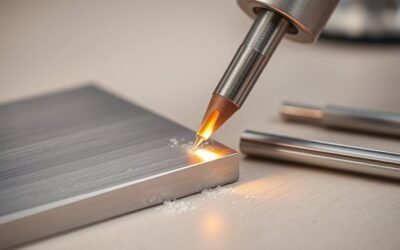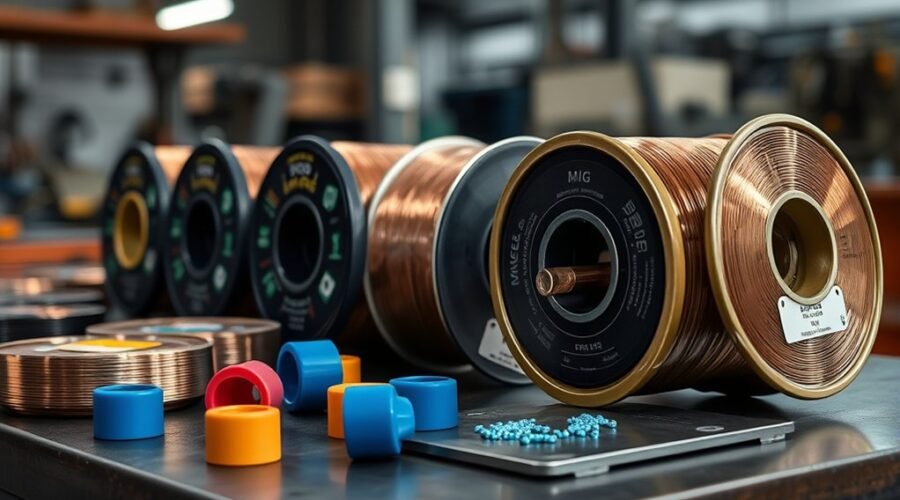
ER70S-2, ER70S-3, and ER70S-6 are carbon-steel filler metals covered by AWS A5.18, but they use different deoxidizer chemistries. For MIG welding, that difference mainly changes how well the wire handles oxides, mill scale, and imperfect surface preparation. Wire choice matters, but shielding gas, transfer mode, diameter, joint design, and machine settings still have a major effect on the finished weld.
Quick Answer
Choose ER70S-3 for clean, well-prepared carbon steel, ER70S-6 for general MIG fabrication where light rust or mill scale may remain, and ER70S-2 when you want a triple-deoxidized wire with aluminum, titanium, and zirconium. Do not choose by suffix alone; follow the WPS, wire datasheet, gas, and welding parameters.
Last checked: September 28, 2026. Dates and figures were verified against official sources.
Key Takeaways
- All three classifications have a 70 ksi minimum tensile-strength designation, but the suffix identifies a different chemistry.
- ER70S-2 uses aluminum, titanium, and zirconium in addition to manganese and silicon, giving it a distinctive triple-deoxidized formulation.
- ER70S-3 has lower deoxidizing capacity and is commonly used on clean steel in controlled fabrication.
- ER70S-6 has higher manganese and silicon and is widely used for MIG welding steel with light rust or mill scale.
- Penetration and spatter are not fixed by the wire suffix; shielding gas, voltage, wire feed speed, transfer mode, and stickout also matter.
What ER70S-2, ER70S-3, and ER70S-6 Mean
The designations identify solid carbon-steel electrodes and rods covered by AWS A5.18/A5.18M:2025. “ER” means the filler can be supplied as an electrode or rod, “70” indicates a 70 ksi minimum tensile-strength class, and “S” means solid wire. The final number identifies a specific chemical-composition classification.
That last number is the important difference here. ER70S-2 contains aluminum, titanium, and zirconium as additional deoxidizers. ER70S-3 relies mainly on manganese and silicon at lower levels. ER70S-6 uses substantially more manganese and silicon than ER70S-3.
These fillers are not limited to one process. They can appear as continuously fed GMAW/MIG wire or as GTAW/TIG rod, depending on the product. If you are shopping specifically for MIG, confirm the spool format, diameter, and process listing instead of assuming every ER70S product is packaged the same way. This MIG wire guide can help with product-format choices.
ER70S-3 favors clean steel, ER70S-6 is a common general-fabrication MIG wire for less-than-perfect surfaces, and ER70S-2 uses a different triple-deoxidized chemistry that is often chosen for pipe, root, and controlled fabrication work.
ER70S-2 vs. ER70S-3 vs. ER70S-6: Key Differences
The key difference is chemistry, not the “70” strength number. All three fall in the same nominal tensile-strength class, but their deoxidizers affect puddle behavior and tolerance for oxides and scale.
| Wire | Distinctive chemistry | Typical fit | Surface condition |
|---|---|---|---|
| ER70S-2 | Mn/Si plus Al, Ti, and Zr | Pipe, root passes, all-position work, specified procedures | Can tolerate rust and mill scale, but cleaning is still preferred |
| ER70S-3 | Lower Mn/Si than ER70S-6 | General fabrication and clean sheet steel | Best matched to clean, prepared steel |
| ER70S-6 | Higher Mn and Si | General MIG fabrication, structural work, automotive repair | Common choice where light rust or mill scale remains |
The practical takeaway is to match the classification to your actual job and approved procedure. A wire that handles scale better does not make surface preparation optional, and a cleaner-looking bead does not by itself prove better fusion.
If you are also comparing consumable families, remember that these are solid wires, not flux-cored electrodes. A flux-core wire comparison covers a different AWS filler-metal family.
Chemical Composition Differences
ER70S-2, ER70S-3, and ER70S-6 differ most clearly in their deoxidizer systems. Those elements react with oxygen and other contaminants in the molten weld pool, helping reduce porosity and oxide-related defects.
ER70S-2 is triple-deoxidized with aluminum, titanium, and zirconium in addition to manganese and silicon. An Oxford Alloys ER70S-2 datasheet lists Mn at 0.90–1.40%, Si at 0.40–0.70%, Al at 0.05–0.15%, Zr at 0.02–0.12%, and Ti at 0.05–0.15%.
ER70S-3 uses manganese and silicon without the specified Al/Ti/Zr ranges of ER70S-2. ER70S-6 raises manganese and silicon further; the AWS ranges shown in Lincoln Electric’s ER70S-6 data are 1.40–1.85% Mn and 0.80–1.15% Si.
Best Use Cases
For clean shop steel, ER70S-3 is a straightforward option. For everyday MIG work where some light oxidation or mill scale remains, ER70S-6 is widely used because its higher manganese and silicon improve deoxidizing action and wetting.
ER70S-2 is useful when its triple-deoxidized chemistry, less-fluid puddle, or procedure requirements suit the job. It is especially associated with small-diameter pipe and all-position work. The right choice can also depend on your machine and transfer mode, so wire selection should be considered together with shielding-gas selection.
How Deoxidants Affect Weld Pool Flow
Deoxidizers help tie up oxygen in the weld pool so oxides can separate from the deposited metal instead of becoming gas pores or inclusions. Silicon and manganese also affect puddle wetting, which is one reason ER70S-6 often feels more fluid than lower-silicon wires.
However, you should not treat deoxidizer level as a direct penetration setting. Arc voltage, wire-feed speed, current, contact-tip-to-work distance, transfer mode, travel speed, joint geometry, and shielding gas all affect penetration and bead shape. That is why two ER70S-6 setups can produce very different beads even with the same wire diameter.
Higher silicon can also leave small glassy silicon-oxide islands on the bead surface. They are normally a cleanup issue rather than proof of a bad weld, but remove surface residue when the next operation or coating system requires a clean surface.
When ER70S-2 Makes Sense on Rusty or Scaled Steel
ER70S-2 can weld over rust and mill scale because its chemistry includes aluminum, titanium, and zirconium deoxidizers. That does not make it the only choice for contaminated steel; ER70S-6 is also specifically marketed for light rust and mill scale in MIG applications.
The important distinction is how the two wires achieve that tolerance. ER70S-2 uses a broad deoxidizer package, while ER70S-6 depends heavily on higher manganese and silicon. If a WPS or filler-metal specification calls for ER70S-2, use that classification rather than substituting based only on similar strength.
Lincoln Electric's ER70S-2 datasheet lists small-diameter pipe, tubing, sheet metal, and root-pass pipe welding among typical applications. It also identifies zirconium, titanium, and aluminum additions alongside silicon and manganese.
For equipment selection around this kind of work, the beginner MIG, TIG, and stick welder guide explains the machine-side differences between common processes.
High Deoxidant Content
ER70S-2 is commonly described as a triple-deoxidized filler because of its aluminum, titanium, and zirconium additions. Those elements supplement manganese and silicon rather than replacing them.
This chemistry can improve soundness when minor oxides remain on the steel. Still, the best practice is to remove oil, moisture, paint, heavy rust, and loose scale whenever access allows. Deoxidizers provide process tolerance; they are not a substitute for basic joint preparation.
Rust Tolerance Advantage
ER70S-2 has a real contamination-tolerance advantage over low-deoxidizer wire such as ER70S-3. Oxford Alloys specifically describes its ER70S-2 wire as designed for welding over rust and mill scale.
That advantage does not automatically put it ahead of ER70S-6 for every MIG job. Miller recommends ER70S-6 when more deoxidizers are needed on dirty or rusty steel, and many ER70S-6 products are designed around that use. Choose between them using the WPS, material condition, welding position, puddle preference, and manufacturer data.
Stable Weld Pool
ER70S-2 generally has a less-fluid puddle than ER70S-6. That can make the molten metal easier to control in out-of-position work and pipe applications, especially when you want the puddle to stay where you place it.
A less-fluid puddle should not be confused with shallow penetration or lower strength. Those outcomes depend on the full welding procedure. If you need a rod rather than spool wire, this general welding-rod guide covers other electrode categories.
When ER70S-3 Is the Better Choice
ER70S-3 makes sense when the base metal is clean and the job does not need the extra oxide tolerance of ER70S-6. It is a general-purpose solid wire for carbon steel, and it is commonly used in light fabrication, sheet metal, and automated production.
Hobart’s ER70S-3 Quantum Arc 3 lists general fabrication, light sheet-metal fabrication, automotive frames, storage bins, furniture, and railcars among its applications. It can be used with CO₂ or argon-rich shielding gases.
Do not choose ER70S-3 because you expect a guaranteed low-penetration or low-spatter result. Those characteristics depend heavily on gas and parameters. Choose it because the steel is properly prepared and the lower-deoxidizer chemistry fits the job.
Why ER70S-6 Is a Common General-Purpose MIG Wire
ER70S-6 is widely used because its higher manganese and silicon give strong deoxidizing action and good wetting on carbon steel. That makes it practical for production welding where steel may carry light rust or mill scale after normal preparation.
Miller’s mild-steel MIG guide recommends ER70S-6 when more deoxidizers are needed for dirty or rusty steel. Hobart likewise states that its ER70S-6 Quantum Arc 6 can be used where light rust or mill scale is present.
That versatility is why ER70S-6 appears in automotive repair, structural work, general fabrication, and automated welding. It also works with common gas systems, which makes it easy to integrate into many shop setups. If one machine must cover several processes, a multi-process welder can broaden the equipment side of that flexibility.
Handles Dirty Steel
ER70S-6 is designed to tolerate more surface oxide than ER70S-3. Lincoln Electric’s SuperArc L-56 datasheet says its high manganese and silicon levels tolerate medium to heavy mill scale, while Hobart describes its ER70S-6 wire for light rust or mill scale.
- Remove oil, paint, moisture, loose rust, and heavy scale when practical.
- Use ER70S-6 when the procedure allows it and some oxide or scale may remain.
- Do not assume extra deoxidizers can compensate for poor gas coverage or severe contamination.
- For code work, follow the specified filler classification and approved WPS.
Balanced Penetration And Bead
ER70S-6 is known for a fluid puddle and good toe wetting, which can produce a smooth, well-tied-in bead when the machine is set correctly. The high silicon content is a major reason for that wetting behavior.
Its classification does not guarantee deeper penetration than ER70S-2 or ER70S-3 in every setup. If you want more penetration, changes in gas, current, wire feed, travel speed, and joint preparation can matter more than the suffix. Lincoln’s SuperArc L-56 ER70S-6 datasheet shows a 70 ksi minimum AWS tensile requirement, while its typical results vary with shielding gas.
Works With Common Gas
ER70S-6 works with 100% CO₂ and multiple argon-based blends, depending on the product and transfer mode. That gives shops room to trade bead appearance, spatter, penetration, and transfer characteristics against cost and productivity.
A common 75% argon/25% CO₂ mix runs smoother and with less spatter than straight CO₂ in many short-circuit MIG applications. Straight CO₂ generally gives deeper penetration but a harsher arc and more spatter. Use the wire and welder manufacturer’s approved gas range instead of assuming every blend is interchangeable.
- 75/25 Ar/CO₂ is a common short-circuit choice for clean arc behavior and bead appearance.
- 100% CO₂ is economical and can increase penetration, but usually increases spatter.
- Argon-rich mixes are used for spray transfer when the equipment and procedure support it.
- Gas changes can require new voltage and wire-feed settings even when the wire stays the same.
Choosing Wire for Thin Sheet Metal
For thin sheet, wire diameter and heat input usually matter more than choosing ER70S-3 instead of ER70S-6. ER70S-3 is suitable when the sheet is clean, while ER70S-6 remains a common choice when you want more deoxidizing tolerance.
| Wire | Best reason to choose it on thin sheet | Main caution |
|---|---|---|
| ER70S-3 | Clean, controlled fabrication | Less tolerant of rust and scale |
| ER70S-6 | Extra deoxidizing tolerance and good wetting | May leave more silicon-oxide islands |
| ER70S-2 | Procedure-specific work or less-fluid puddle preference | Less common as a default hobby MIG spool |
| Wire diameter | Smaller diameter helps control heat on thin steel | Must match drive rolls, tip, and machine range |
| Gas | Ar/CO₂ blends can soften the arc | Settings must match the gas |
Miller notes that smaller wire helps reduce heat input on thin material, which is why diameter belongs in the decision. The same principle applies to MIG welder selection: make sure the machine can run the wire diameter and low-end settings your sheet metal needs.
Choosing Wire for Rusty or Millscaled Steel
For MIG welding steel with remaining mill scale or light rust, ER70S-6 is a strong general-purpose choice because of its high manganese and silicon. ER70S-2 also has documented rust-and-scale capability through its triple-deoxidized Al/Ti/Zr chemistry.
Do not use either classification as permission to weld through oil, paint, moisture, heavy corrosion, or loose scale. Clean the joint as far as practical, then use the filler metal your procedure allows.
- ER70S-6: common for general GMAW where light rust or mill scale may remain.
- ER70S-2: useful where triple deoxidation, pipe/root work, or procedure requirements favor it.
- ER70S-3: better matched to clean steel with controlled preparation.
- WPS and datasheet: take priority over a generic ranking when the weld is code-governed.
If you switch between MIG and TIG for repair work, confirm that your machine actually supports the needed process and output. This AC/DC TIG welder guide covers separate equipment considerations.
Note: For structural, pressure-vessel, piping, or other code-governed work, do not substitute ER70S-2, ER70S-3, or ER70S-6 only because their tensile-strength designation matches. Follow the qualified WPS and have any filler-metal substitution approved under the governing code or by the responsible welding professional.
Shielding Gas for ER70S-3 and ER70S-6
Both ER70S-3 and ER70S-6 can be paired with common carbon-steel MIG shielding gases, but the exact approved range is product- and procedure-specific. Gas choice changes arc behavior enough that it should be treated as a welding variable, not an afterthought.
| Wire | Gas | Typical effect |
|---|---|---|
| ER70S-3 | 75/25 Ar/CO₂ | Smooth short-circuit arc and low spatter |
| ER70S-3 | 100% CO₂ | More penetration and spatter |
| ER70S-6 | 75/25 Ar/CO₂ | Smooth arc and good bead appearance |
| ER70S-6 | 100% CO₂ | Deeper penetration with more spatter |
| ER70S-6 | Argon-rich blend | Can support spray transfer when the procedure allows it |
Miller’s published guidance says 75/25 argon/CO₂ gives low spatter and good bead appearance on mild steel, while 100% CO₂ gives deeper penetration with more spatter. That relationship is more reliable than assigning a fixed “high” or “low” penetration label to ER70S-3 or ER70S-6 alone.
If you are comparing machine settings as well as filler metal, this TIG machine comparison covers a different process and should not be used as a MIG gas-setting reference.
Common MIG Wire Selection Mistakes
The biggest mistake is choosing wire from one characteristic while ignoring the rest of the procedure. Surface condition matters, but so do gas, diameter, transfer mode, current range, joint geometry, code requirements, and the manufacturer’s classification data.
- Assuming ER70S-2 is always better on dirty steel: ER70S-6 is also specifically designed for oxide and mill-scale tolerance and is very common in GMAW.
- Using ER70S-3 on poorly prepared steel: its lower deoxidizing capacity gives you less margin for rust and scale.
- Ranking penetration by wire suffix alone: shielding gas and welding parameters can change penetration more directly.
- Ignoring silicon-oxide residue: clean bead-surface islands when they could interfere with subsequent passes or coatings.
- Changing filler classification on code work without approval: use the specified WPS and filler-metal documentation.
- Forgetting wire diameter: the contact tip, drive roll, liner, amperage range, and feed speed all need to match the wire.
Machine duty cycle and output range also matter when you move to larger wire or higher deposition rates. This 140-amp MIG welder comparison shows why equipment capacity belongs in the overall setup decision.
Frequently Asked Questions
What are the differences between ER70S-3 and ER70S-6 MIG wire?
ER70S-6 has higher manganese and silicon than ER70S-3, so it offers more deoxidizing action and is better suited to steel with light rust or mill scale. ER70S-3 is a sound choice for clean, prepared steel. Both are 70 ksi solid-wire classifications, and final bead behavior still depends on gas and settings.
What are the four types of MIG welding?
The four common GMAW metal-transfer modes are short-circuiting, globular, spray, and pulsed spray transfer. They are not four different wire classifications. The usable mode depends on current, voltage, shielding gas, wire diameter, equipment capability, and welding position, so the same ER70S-6 wire may behave very differently under different transfer modes.
What is ER70S-3 used for?
ER70S-3 is used for general carbon-steel fabrication where the base metal is clean and well prepared. Manufacturer applications include light sheet-metal work, automotive structures, furniture, storage bins, and automated welding. It can run with CO₂ or argon-rich shielding gases when the selected product and procedure permit them.
What is ER70S-6 welding wire used for?
ER70S-6 is widely used for MIG welding carbon steel in general fabrication, automotive repair, structural work, and automated production. Its higher manganese and silicon help it tolerate light rust and mill scale better than ER70S-3. It is available for common CO₂ and argon-based gas systems, depending on the manufacturer’s data.
Conclusion
ER70S-3 is a sensible fit for clean carbon steel, ER70S-6 is the common all-around MIG choice when some rust or mill scale may remain, and ER70S-2 offers a different triple-deoxidized chemistry that suits specific pipe, root, and procedure-driven work. Start with the WPS or filler-metal datasheet, then match the wire to surface condition, gas, diameter, and transfer mode.
Sources
- American Welding Society A5.18/A5.18M:2025: current classification standard for carbon-steel electrodes and rods for gas-shielded arc welding.
- Oxford Alloys ER70S-2: triple-deoxidized chemistry, rust and mill-scale use, composition, and mechanical requirements.
- Lincoln Electric ER70S-2: ER70S-2 chemistry and typical applications including root-pass pipe welding.
- Hobart Brothers Quantum Arc 3: ER70S-3 applications and shielding-gas compatibility.
- Hobart Brothers Quantum Arc 6: ER70S-6 use on light rust and mill scale.
- Lincoln Electric SuperArc L-56: ER70S-6 composition, mill-scale tolerance, gas ranges, and AWS mechanical requirements.
- Miller MIG welding basics for mild steel: ER70S-3 versus ER70S-6 selection, wire diameter, and shielding-gas effects.