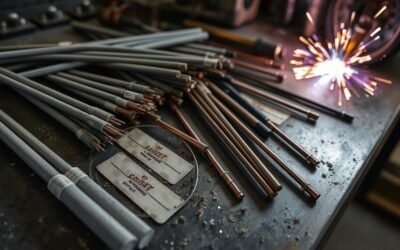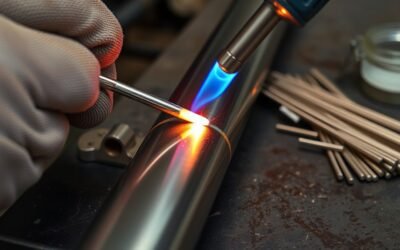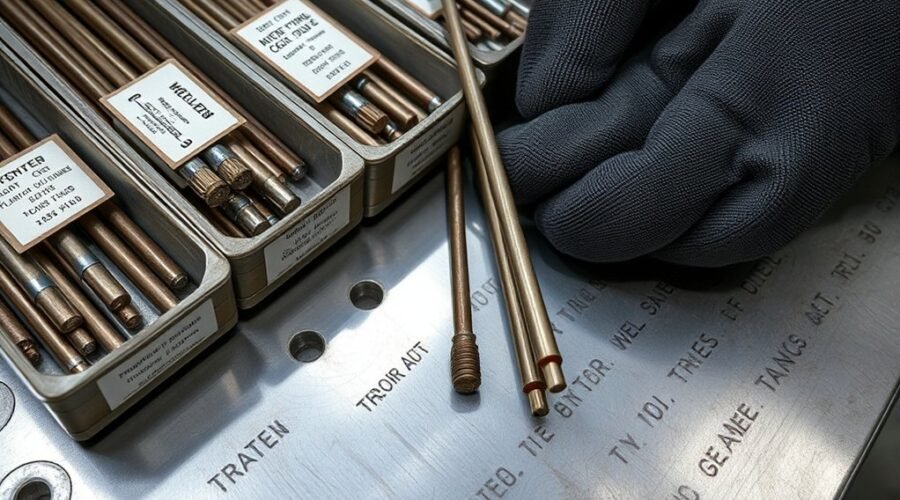
Flux-cored electrodes are continuously fed tubular welding wires with flux ingredients inside the metal sheath. They are used in flux-cored arc welding (FCAW), but not every flux-cored wire runs the same way. The classification on the spool tells you much of what matters: strength, welding position, usability, shielding requirements, and sometimes toughness or hydrogen limits.
Quick Answer
Flux-cored electrodes are tubular wires filled with flux. Choose FCAW-S when you need portability or outdoor wind tolerance; choose FCAW-G when external gas and controlled shop conditions are available. Then match the AWS classification, base metal, position, toughness requirements, polarity, diameter, and your machine’s output to the job.
Last checked: September 28, 2026. Dates and figures were verified against official sources.
Key Takeaways
- In a classification such as E71T-1C, the 7 indicates a 70,000 psi strength class, while the following 1 indicates all-position capability.
- E71T-1C/M wires are common gas-shielded choices, while E71T-8 and E71T-11 are common self-shielded classifications.
- E71T-GS should not be mistaken for a gas-shielded wire; commercial E71T-GS products are commonly self-shielded and intended for single-pass work.
- Polarity is wire-specific. Many gas-shielded T-1 wires use DCEP, while common self-shielded wires such as E71T-8 and E71T-11 use DCEN.
- Always confirm the spool or manufacturer data sheet before setting gas, polarity, wire-feed speed, voltage, contact-tip-to-work distance, or permitted welding positions.
What Are Flux-Cored Electrodes?
)
Flux-cored electrodes are tubular welding wires containing fluxing and alloying ingredients. During welding, these ingredients help stabilize the arc, protect the molten metal, form slag, and produce the required weld-metal properties.
There are two main process families. Self-shielded FCAW (FCAW-S) relies on ingredients in the electrode for protection, so it does not need an external shielding-gas cylinder. Gas-shielded FCAW (FCAW-G) uses both the flux core and an external shielding gas.
That distinction affects portability, wind tolerance, polarity, deposition characteristics, and equipment. Self-shielded wire is widely used for field fabrication and construction, while gas-shielded wire is common in controlled production and heavy fabrication.
The American Welding Society maintains specifications for these consumables. The current AWS A5.20/A5.20M:2025 carbon-steel FCAW specification covers chemical composition, mechanical properties, usability characteristics, toughness options, hydrogen designators, shielding-gas designators, and related classification requirements.
Wire selection has a direct effect on deposition rate, operating behavior, and weld quality. Choosing a suitable product can also improve the flux-core wire performance you get from a compatible machine.
How Flux-Cored Electrodes Are Classified by AWS
AWS classifications are meant to tell you what a wire is designed to do. The important point is to read each character separately rather than treating a code such as E71T-1C as one model number.
Hobart’s AWS filler-metal classification explanation breaks E71T-1C/M H8 down into electrode type, tensile-strength class, welding position, tubular-wire designation, usability, shielding gas, and diffusible-hydrogen limit.
| Part of E71T-1C | Meaning |
|---|---|
| E | Electrode |
| 7 | 70,000 psi tensile-strength class |
| 1 | All-position capability; 0 denotes flat and horizontal use |
| T | Tubular electrode |
| -1 | Usability designator; T-1 is a gas-shielded, multipass rutile wire that normally operates DCEP |
| C or M | C identifies classification with CO2; M identifies classification with the specified mixed gas |
Optional suffixes can add more information. For example, an H8 designator limits diffusible hydrogen in deposited weld metal to 8 mL per 100 g under the applicable test requirements.
Some products carry multiple classifications because the same wire meets more than one set of requirements, often with different shielding gases or impact requirements. That is why the complete classification and product data sheet matter more than a shortened name such as “T-1.”
Understanding the code also makes it easier to match a consumable to common welding applications instead of choosing by wire diameter alone.
Self-Shielded vs. Gas-Shielded Flux-Cored Wires
The main difference is where the shielding comes from. FCAW-S produces the required protection from the electrode itself, while FCAW-G needs the shielding gas specified for the wire.
| Factor | FCAW-S | FCAW-G |
|---|---|---|
| External gas | Not required | Required |
| Typical environment | Field and outdoor work | Protected shop or fabrication area |
| Portability | Higher because no gas cylinder is needed | Lower because gas equipment travels with the system |
| Polarity | Often DCEN, but check the wire | Common T-1 wires use DCEP; check the wire |
Self-shielded electrodes are especially useful where wind makes external gas coverage difficult. They are also convenient where transporting cylinders would reduce mobility.
Gas-shielded wires are commonly chosen in controlled fabrication because they can provide high deposition rates, smooth operation, and specified mechanical properties. For example, ESAB 71 carries E71T-1C, E71T-1M, E71T-9C, and E71T-9M classifications for gas-shielded FCAW.
Neither type excuses poor preparation. FCAW can tolerate more surface contamination than some other wire processes, but rust, oil, paint, moisture, and scale can still contribute to porosity, inclusions, or unstable welding.
Equipment also matters. A machine capable of handling multiple welding processes still needs the correct output, polarity connections, feeder setup, and gas system for the selected FCAW wire.
Common Flux-Cored Electrode Types and Uses
Common classifications solve different problems. Do not treat E71T-1, E71T-8, E71T-11, and E71T-GS as interchangeable simply because they can all appear on carbon-steel flux-cored wire.
| Classification | Shielding / polarity | Typical use |
|---|---|---|
| E71T-1C or E71T-1M | Gas-shielded; normally DCEP | All-position multipass fabrication with high deposition rates |
| E71T-8 | Self-shielded; DCEN | All-position structural and field welding where multipass capability and toughness are important |
| E71T-11 | Self-shielded; commonly DCEN | General-purpose all-position welding; observe manufacturer multipass and thickness limits |
| E71T-GS | Commonly self-shielded; check product data | Single-pass light fabrication and thin material, depending on the product |
| E81T1-K2 family | Low-alloy classification; gas depends on full suffix | Higher-strength low-alloy applications where specified mechanical properties and toughness matter |
AWS describes E71T-8 as an all-position self-shielded wire suitable for multipass welding and low-temperature impact requirements in its construction FCAW guidance.
E71T-11 is also widely used for general-purpose self-shielded work. The exact allowable thickness, pass sequence, and parameter window can vary by product, so use the manufacturer’s data sheet rather than assuming every E71T-11 spool has identical limits.
E71T-GS deserves special attention because its name is often misread. ESAB’s Sureweld 71T-GS specification, for example, identifies it as an all-position, self-shielded, single-pass wire requiring no external shielding gas and operating DCEN.
For higher-strength low-alloy work, classifications such as E81T1-K2 fall under the current AWS A5.29/A5.29M:2026 low-alloy FCAW specification. Selection should follow the engineering requirements for strength, chemistry, impact toughness, shielding gas, and hydrogen level.
That makes documented equipment capability and reliability more important than choosing wire by brand name alone.
Polarity, Position, and Metal Transfer
Polarity, welding position, and transfer behavior are linked to the electrode classification and operating procedure. A setting that works for one flux-cored wire may perform badly with another, even at the same diameter.
Polarity Requirements
There is no single correct polarity for every flux-cored electrode. Gas-shielded E71T-1C/M wire normally uses direct current electrode positive (DCEP), while common self-shielded E71T-8 and E71T-11 wires normally use direct current electrode negative (DCEN).
The classification and product data sheet should therefore control the setup. Reversing polarity from the required setting can cause an unstable arc, excess spatter, poor bead shape, incomplete fusion, or other weld defects.
If you change from solid MIG wire to self-shielded flux core on the same machine, check the polarity connections before welding. Some machines make the change at internal terminals; others use a dedicated polarity switch.
Welding Positions
The position digit tells you whether the classification supports all-position welding or is restricted. In common AWS carbon-steel FCAW classifications, 1 indicates all-position capability, while 0 indicates flat and horizontal positions.
That does not mean every diameter of every product performs identically out of position. Manufacturers may publish different parameter ranges for flat, horizontal, vertical, and overhead welding, so the spool label and data sheet remain part of the procedure.
Vertical and overhead welds generally need tighter puddle control than flat welds. Travel speed, voltage, wire-feed speed, contact-tip-to-work distance, and gun angle may all need to remain within a narrower range.
Metal Transfer Modes
Metal transfer depends on the wire formulation, shielding gas, polarity, current, voltage, and electrode extension. It should not be selected by assuming FCAW behaves exactly like solid-wire MIG.
Gas-shielded T-1 wires commonly operate with a spray-type transfer and high deposition rates. Other FCAW electrodes can produce different droplet behavior, especially self-shielded wires with different slag and alloy systems.
Rather than trying to force a particular transfer mode, set the machine within the wire manufacturer’s recommended range and watch the arc, bead profile, fusion, and slag behavior. Changes in current or voltage outside that range can increase spatter or make the puddle harder to control.
A drag or pull technique is normally used with slag-producing flux-cored wire. This keeps the arc ahead of the slag and reduces the risk of trapping slag in the weld. Better process control also supports the weld-quality factors that matter in repeatable fabrication.
How to Choose the Right Flux-Cored Wire
Choose flux-cored wire by working from the job requirements back to the spool. Base metal and code requirements come first, followed by strength, position, shielding method, toughness, polarity, diameter, and machine capacity.
- Identify the base metal. Carbon steel and low-alloy steel use different AWS specification families and chemistry requirements.
- Check required strength and toughness. Structural drawings, a welding procedure specification, or a governing code may require specific tensile, impact, or hydrogen classifications.
- Choose FCAW-S or FCAW-G. Use self-shielded wire when field portability and wind tolerance matter; use gas-shielded wire where the specified shielding gas can be protected.
- Match the welding position. Confirm that the classification and selected wire diameter support the positions you must weld.
- Confirm polarity and shielding gas. Never assume these from wire diameter or from a previous spool.
- Match diameter to machine output. The feeder, gun, contact tip, drive rolls, duty cycle, and power source must support the wire and operating range.
- Use the manufacturer parameters. Start with the published voltage, wire-feed speed, contact-tip-to-work distance, and position-specific recommendations, then qualify the procedure where required.
| Criterion | Option | Effect |
|---|---|---|
| Shielding | self-shielded electrodes | Portable field setup without external shielding gas |
| Shielding | gas-shielded electrodes | Controlled production with the specified external gas |
| Material | carbon steels | Select an AWS A5.20 classification that matches the required properties |
Do not choose solely by deposition rate. A high-output wire is useful only if it also satisfies the required material, position, mechanical properties, welding procedure, and available equipment.
The same logic applies when choosing a welder. Features such as multi-process capability are useful only when the machine can provide the polarity, output, feeder control, and accessories required by the selected wire.
Flux-Cored Welding Equipment and Setup
A correct wire can still weld poorly if the feeder, polarity, contact tip, work connection, gas system, or electrode extension is wrong. Set the machine up for the exact wire before adjusting technique.
Basic FCAW equipment includes the power source, wire feeder, welding gun, contact tip, drive rolls, work lead and clamp, and suitable cable connections. FCAW-G also requires the specified shielding-gas cylinder, regulator or flowmeter, and hose.
Use a contact tip that matches the wire diameter. Flux-cored wire is softer than solid wire, so suitable knurled drive rolls can improve feeding without crushing the electrode.
Miller’s flux-cored welding setup guide lists .030-inch wire as a general-purpose option, .035-inch wire for heavier work, and .045-inch wire for higher-output applications when the welder supports it. It also gives about 3/4 inch as a general FCAW stickout starting point, although the selected wire’s data sheet should take priority.
Check cables for damage, use the required polarity, set drive-roll tension correctly, clean the contact tip, and make sure the work clamp has a sound electrical connection. For FCAW-G, confirm that gas flow is present and protected from disruptive drafts.
Warning: FCAW produces intense arc radiation, hot metal, sparks, slag, and welding fumes. Use suitable eye, face, hand, body, and respiratory or ventilation controls for the work. OSHA identifies welding fumes, UV radiation, burns, eye damage, and electrical shock among the main welding hazards.
Use a welding helmet, safety glasses, welding gloves, flame-resistant protective clothing, and suitable footwear. Provide enough ventilation or local exhaust to control fumes, especially in confined or poorly ventilated spaces. OSHA’s welding hazard and protection guidance explains the main exposure and PPE concerns.
Good setup reduces troubleshooting later. The right shop safety equipment also helps keep cutting and welding work organized around sparks, hot metal, electrical hazards, and fumes.
Frequently Asked Questions
What’s the Difference Between E71T-GS and E71T-11?
E71T-GS and E71T-11 are commonly self-shielded wires, but they are not interchangeable. E71T-GS products are generally intended for single-pass work, while E71T-11 is a general-purpose all-position classification used for multipass welding within the limits published by the wire manufacturer. Always check the specific product data sheet.
What Does E71T-1C Mean?
E71T-1C identifies a 70,000 psi-class, all-position tubular electrode with a T-1 usability designation and CO2 shielding classification. T-1 wires are gas-shielded multipass electrodes that normally use DCEP. Additional suffixes can specify impact toughness, diffusible-hydrogen limits, or other requirements.
What Is the Meaning of E6013, E6011, and E7018?
E6013, E6011, and E7018 are stick-electrode classifications, not flux-cored wire classifications. The first two digits indicate minimum tensile-strength class: 60 means 60,000 psi and 70 means 70,000 psi. E6011 is a deep-penetrating cellulosic electrode, E6013 is known for smoother general-purpose operation, and E7018 is a low-hydrogen electrode.
What Is the Difference Between FCAW-G and FCAW-S Wires?
FCAW-G requires an external shielding gas, while FCAW-S provides its shielding from ingredients inside the electrode and needs no external gas. FCAW-G is common in protected production environments, while FCAW-S is useful for field work and outdoor conditions. Polarity and operating parameters still depend on the exact electrode classification.
Conclusion
Flux-cored electrodes should be selected by classification and procedure, not by diameter alone. Start with the base metal and required mechanical properties, decide between FCAW-S and FCAW-G, then verify position, shielding gas, polarity, diameter, and machine capacity. The final authority for setup is the complete electrode classification together with the manufacturer’s current data sheet.
Sources
- American Welding Society — AWS A5.20/A5.20M:2025: Current carbon-steel FCAW electrode classification scope and requirements.
- Hobart Brothers — Filler Metal Must-Knows: E71T-1C/M classification decoding, polarity, shielding gas, hydrogen designators, and setup data.
- American Welding Society — Construction FCAW Guidance: E71T-8 self-shielded operation, welding positions, multipass use, toughness, and DCEN polarity.
- ESAB — Sureweld 71T-GS: Self-shielded E71T-GS application, single-pass use, no external gas, and DCEN polarity.
- ESAB — ESAB 71: E71T-1C/M and E71T-9C/M gas-shielded classifications and shielding-gas data.
- American Welding Society — AWS A5.29/A5.29M:2026: Current low-alloy steel FCAW electrode classification requirements.
- Miller Electric — Flux-Cored Welding Basics: Wire diameters, drive rolls, stickout, preparation, drag technique, and general FCAW setup.
- Occupational Safety and Health Administration — Welding Hazards and Solutions: Welding fumes, UV radiation, PPE, burns, electrical shock, and related safety controls.