Choosing the right welding helmet starts with the welding process, amperage, work environment, and hazards around the job. Passive fixed-shade helmets remain simple and dependable, while auto-darkening helmets make setup, tack welding, and repeated arc starts easier. Specialty systems can add respiratory, hard-hat, or tight-space protection, but no single helmet is best for every welder.
Quick Answer
For most people who regularly MIG, TIG, flux-core, or stick weld, a standards-compliant auto-darkening helmet with the correct shade range, adjustable sensitivity and delay, comfortable headgear, and good arc detection is the most versatile choice. Passive fixed-shade helmets still work well for repetitive jobs when the correct shade is known in advance.
Key Takeaways
- Choose lens shade by welding process, amperage, electrode size, or material thickness—not by a single shade number for an entire process.
- Passive helmets normally use a fixed-shade filter; auto-darkening filters switch from a light state to a selected dark shade when they detect the arc.
- For an auto-darkening helmet, compare shade range, low-amp TIG capability, sensitivity, delay, sensor coverage, switching time, viewing area, battery system, and fit.
- A PAPR welding helmet can add respiratory protection, but the correct filter, ventilation, and respirator selection depend on the actual contaminant and exposure.
- For U.S. work, follow applicable OSHA requirements and look for recognized eye-and-face protection compliance; Canadian users should check applicable CSA requirements.
What Welding Helmet Do You Need?
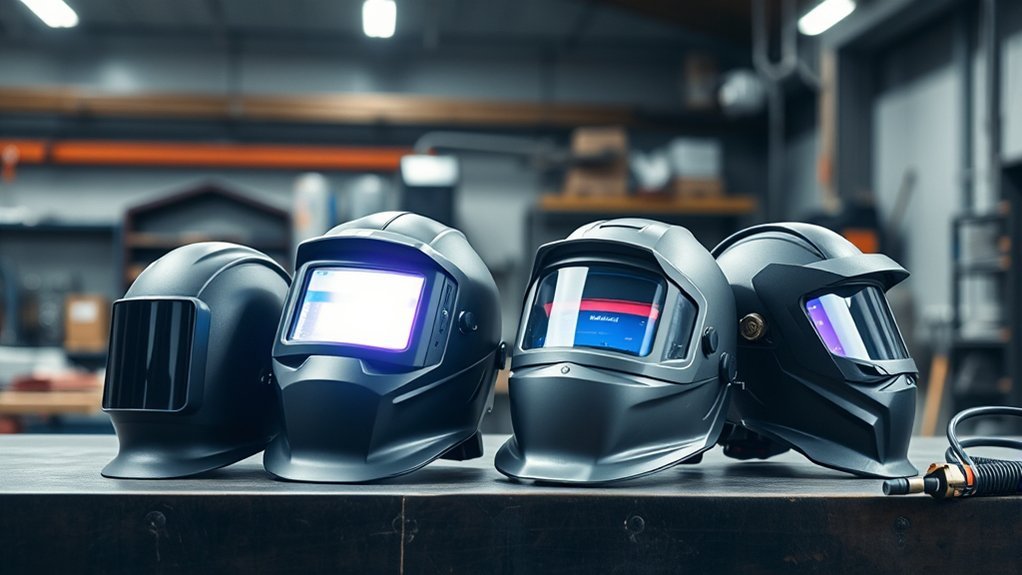
The appropriate welding helmet depends on the welding process, arc current, filter type, work position, viewing needs, fit, and hazards around the weld. Auto-darkening models are convenient for MIG, TIG, flux-cored, and stick welding because the operator can position the torch or electrode with the helmet down. A passive fixed-shade helmet can also provide proper protection when its shade is correct for the work.
Do not choose a helmet by process name alone. The required shade level changes with factors such as arc current, electrode size, or plate thickness. The U.S. Occupational Safety and Health Administration provides minimum filter-shade guidance in its eye and face protection standard.
Warning: A welding helmet is not automatically a substitute for primary impact-rated eye protection. When grinding, chipping slag, using a wire wheel, or working around flying particles, wear the safety glasses or goggles required for the hazard. Never weld with an auto-darkening filter locked in grind mode.
Standards also matter. ANSI/ISEA Z87.1 covers occupational eye and face protection in the United States, while OSHA regulations specify workplace requirements and incorporate recognized consensus standards. In Canada, CSA Z94.3 covers occupational eye and face protectors. The American Welding Society’s ANSI Z49.1:2021 provides broader welding, cutting, and allied-process safety guidance.
A larger viewing area can improve awareness of the weld pool, joint, fixtures, and surrounding workspace, but bigger is not automatically better. Larger lenses may add weight. Balance viewing area against helmet weight, shell shape, headgear quality, and the positions in which you normally weld.
Comfort deserves equal attention. Adjustable headgear should hold the shell securely without creating pressure points, and the helmet should work with required safety glasses, prescription eyewear, hearing protection, respirators, or hard hats. Visibility-enhancing features such as Natural Color Technology may make the joint and surrounding colors easier to see, but they do not replace correct shade selection or safety-standard compliance.
Note: This guide gives general PPE-selection information. Workplace hazard assessments, local regulations, the welding procedure, and the helmet manufacturer’s instructions can require additional or more protective equipment.
Passive vs. Auto-Darkening Welding Helmets
Choosing between passive and auto-darkening welding helmets is mainly a choice between simplicity and adjustability. Both can provide suitable protection when the filter is appropriate for the job and the equipment meets the required standard.
A passive welding helmet normally uses a fixed-shade lens. Because the filter remains dark, the welder usually positions the electrode or gun with the helmet raised and then lowers the shell before striking the arc. Fixed-shade equipment is simple, has no ADF electronics to power, and works well for repetitive jobs where one shade is suitable.
An auto-darkening filter, or ADF, remains in a lighter state before welding and changes to its selected dark state when its sensors detect the arc. This can reduce repeated helmet flipping and make tack welding, repositioning, and starts easier.
| Feature | Passive / Fixed Shade | Auto-Darkening |
|---|---|---|
| Lens operation | Stays at one dark shade | Changes from light state to selected dark state when the arc is detected |
| Best fit | Repetitive work with a known suitable shade | Mixed processes, tack welding, frequent starts, or changing amperage |
| Controls | Usually none | May include shade, sensitivity, delay, grind, cut, or specialty modes |
| Power | No electronic ADF power required | Battery, battery plus solar assist, or another model-specific system |
| Maintenance | Inspect shell, filter, cover plates, and headgear | Same checks plus sensors, controls, battery status, and ADF function |
More arc sensors can improve the chance that the filter detects the arc when the welder is out of position or when a sensor is partly blocked. Sensor count should not be confused with switching speed; these are separate specifications. ADFs also differ in sensitivity, dark-to-light delay, low-amperage TIG performance, and operating temperature.
For visibility, features such as true-color optics may improve color recognition and contrast. Treat that as an optical convenience feature rather than a substitute for correct shade or impact protection.
Other Welding Helmet Types to Consider
Beyond standard passive and auto-darkening helmets, welders may encounter solar-assisted ADFs, PAPR-compatible helmets, flip-up filters, pipeline-style pancake shields, flexible leather masks, and highly specialized commercial-diving systems. These products solve different problems, so they should not be treated as interchangeable helmet categories.
Solar-Powered Options
“Solar-powered” welding helmet is a broad marketing term. Many automatic filters use a battery with a solar cell that assists with power while welding; other ADFs use replaceable batteries without a solar cell. The exact design depends on the model.
Do not assume a solar cell means the helmet has a permanently rechargeable battery or that it must sit in direct sunlight before every use. Check the manufacturer’s instructions for battery type, storage, automatic on/off behavior, low-battery warnings, and any charging requirements.
A solar-assisted design can reduce battery demand, while a user-replaceable battery can make long-term service simpler. Neither approach is automatically safer. What matters is that the ADF functions correctly before welding and provides the required shade and protection.
Pro Tip: Before starting work, inspect the cover lens, clean the arc sensors, check the battery indicator if equipped, and perform the manufacturer’s ADF function test. Stop using the helmet if the filter does not switch reliably.
Respirator Helmet Use
Respirator welding helmets can integrate a welding shield with a powered air-purifying respirator (PAPR) or, in some systems, supplied air. A PAPR uses a powered blower to move air through approved filters or cartridges and deliver it to the headtop.
The key limitation is that respiratory protection is contaminant-specific. A particulate filter does not automatically protect against every gas or vapor, and an air-purifying respirator is not suitable for oxygen-deficient or immediately dangerous atmospheres unless specifically approved for that use. Follow the respirator manufacturer’s configuration instructions and the workplace respiratory-protection program.
OSHA also requires welding-fume exposures to be controlled through appropriate ventilation and other measures where applicable. A PAPR should not be treated as a reason to ignore source capture, local exhaust, general ventilation, material coatings, confined-space hazards, or exposure monitoring.
Modern systems such as 3M Adflo illustrate the distinction: their protection depends on the headtop, filter configuration, and application. Maintenance includes inspecting the blower, breathing tube, filters, seals, battery, airflow indicators, and alarms according to the manufacturer’s instructions.
Specialty Helmet Types
Several specialty designs serve narrow working conditions:
- Pancake welding shields: commonly associated with outdoor pipeline work. Their side shield or face box helps block stray light around the filter, but users must verify that the complete device meets the safety requirements of their employer and jurisdiction.
- Leather welding masks: flexible designs may be useful in restricted spaces where a rigid shell is difficult to position. They still need an appropriate welding filter and suitable face and eye protection.
- Respiratory welding systems: combine welding protection with PAPR or supplied-air equipment when a hazard assessment calls for respiratory protection.
- Underwater welding headgear: belongs to specialized commercial-diving life-support equipment. It is not selected by ordinary shop-welding helmet criteria and requires professional commercial-diving procedures and training.
- Solar-assisted auto-darkening helmets: use model-specific combinations of batteries and solar cells to power the ADF.
Whatever the shell style, optical clarity, correct shade, fit, impact protection, and compatibility with the work environment remain more important than the marketing category.
Must-Have Welding Helmet Features
A good welding helmet should first provide the protection required for the hazard. After that, features such as an auto-darkening filter, broad viewing area, adjustable shade, sensitivity control, delay control, and comfortable headgear can improve usability.
Use this checklist when comparing helmets:
- Shade range: it must cover the processes and amperages you actually use.
- Light state: a lighter non-welding state can make positioning and inspection easier while the helmet remains down.
- Arc sensors: additional sensors can improve detection coverage when the arc is partially obstructed.
- Switching time: this is the specified light-to-dark response of the ADF and is separate from sensor count.
- Sensitivity control: useful when welding at low current, in bright sunlight, or near other welders whose arcs may trigger the lens.
- Delay control: adjusts how quickly the ADF returns from dark to light after the arc stops.
- Low-amp TIG rating: important if you TIG weld at very low current because the ADF must reliably detect the arc.
- Grind/cut modes: useful when provided, but the user must know which modes disable or alter automatic darkening.
- Viewing area: larger windows can improve awareness, while smaller windows may reduce weight.
- Optical quality: clear, low-distortion optics make the puddle and joint easier to see.
- Battery system: check whether batteries are replaceable, expected runtime, low-battery indication, and the role of any solar cell.
- Headgear: look for secure adjustment, balanced weight, and compatibility with other PPE.
- Cover lenses: confirm replacements are readily available and easy to change.
- Impact and welding markings: verify compliance with the requirements that apply to your workplace and country.
Use a shade dark enough for the hazard while still allowing a clear view of the weld—and never go below the applicable minimum protective shade.
Strong UV and infrared protection is fundamental. Properly designed welding filters provide that protection independently of whether the welder prefers a conventional view or enhanced-color optics. Features such as high optical clarity can improve visibility, but they should be evaluated alongside the helmet’s safety markings and instructions.
Comfort features also matter during long shifts. Lightweight shells, balanced suspension, sweatbands, multiple adjustment points, and anti-fog performance can reduce distractions. Replace scratched or damaged cover plates promptly because poor visibility can become a safety problem.
Choose a Welding Helmet by Welding Process
The welding process is a starting point, but arc current and task conditions determine the required filter shade. OSHA’s 29 CFR 1910.133 table lists minimum protective shades for common operations. More-dark shades may be used when they still allow the welder to see the work safely.
| Process / Operation | Current or Work Range | OSHA Minimum Protective Shade |
|---|---|---|
| SMAW / Stick | Less than 60 A | 7 |
| SMAW / Stick | 60–160 A | 8 |
| SMAW / Stick | 160–250 A | 10 |
| SMAW / Stick | 250–550 A | 11 |
| GMAW / MIG and FCAW | Less than 60 A | 7 |
| GMAW / MIG and FCAW | 60–500 A | 10 |
| GTAW / TIG | Less than 50 A | 8 |
| GTAW / TIG | 50–150 A | 8 |
| GTAW / TIG | 150–500 A | 10 |
| Plasma arc cutting | Less than 300 A | 8 |
| Plasma arc cutting | 300–400 A | 9 |
| Plasma arc cutting | 400–800 A | 10 |
| Oxygen cutting | Under 1 in. / under 25 mm | 3 |
| Oxygen cutting | 1–6 in. / 25–150 mm | 4 |
| Oxygen cutting | Over 6 in. / over 150 mm | 5 |
For MIG and flux-cored welding, an auto-darkening helmet is convenient when amperage, position, or joint configuration changes frequently. For TIG, check both the required shade range and the ADF’s low-amp TIG rating; a filter that performs well at high current may not be equally sensitive at very low current.
Stick welding can be done with either passive or auto-darkening equipment. A fixed shade works well when current and electrode size stay consistent, while an ADF makes starts and position changes easier.
For oxy-fuel welding and cutting, use filters intended for the process and choose shade based on plate thickness and the applicable safety table. Do not assume an arc-welding shade range is automatically correct for torch work.
The table above is a minimum-shade reference, not permission to ignore product instructions or workplace rules. For additional guidance, consult OSHA and ANSI Z49.1:2021. Welders considering simpler equipment can also review this guide to passive welding helmets.
Choose a Welding Helmet for Your Budget
Budget-conscious selection should begin with the required protection, not a target price. Passive fixed-shade helmets are usually less complex and can be economical for occasional or repetitive work. Auto-darkening helmets cost more because they add electronics and controls, while PAPR systems add a blower, battery, breathing tube, filters, and respiratory headtop.
Current retail prices change too quickly for a fixed “under $50” or “over $500” rule to stay reliable. Instead, compare the total cost of ownership: replacement cover lenses, batteries, headgear, sweatbands, filters, breathing tubes, and any proprietary accessories.
When cost allows, auto-darkening or variable-shade models can add useful flexibility through shade adjustment, sensitivity, delay, grind/cut modes, and better visibility before the arc starts. A more expensive helmet is worthwhile only when those features match the work.
Optical performance also deserves attention. A helmet with good optical clarity, comfortable headgear, readily available cover lenses, and durable controls may provide better long-term value than a feature-heavy model that is uncomfortable or difficult to maintain.
Budget-Friendly Helmet Types
Among the most affordable welding helmet options, passive fixed-shade helmets remain straightforward because they do not need ADF electronics, sensors, sensitivity controls, or batteries.
A fixed-shade helmet suits repetitive tasks when one shade is appropriate for the welding parameters. Auto-darkening equipment becomes more useful when the welder frequently changes position, process, amperage, or shade.
Solar-assisted ADFs may reduce battery demand in some designs, but they should not be purchased solely because of the word “solar.” Check whether the battery is replaceable, how the solar cell functions, and how the filter behaves after extended storage.
- Passive fixed-shade helmets
- Flip-up fixed-shade helmets
- Auto-darkening helmets
- Auto-darkening helmets with solar assist
Must-Have Features
A welding helmet’s essential features should match both the task and the user’s budget. For an auto-darkening model, evaluate shade range, switching time, sensitivity, delay, sensor coverage, low-amp TIG capability, viewing area, battery system, and controls.
Multiple arc sensors can reduce missed detection when the workpiece or welding position blocks one sensor. They do not automatically make the filter itself switch faster. Switching time should be checked separately in the manufacturer’s specifications.
A fixed-shade helmet remains a practical option when the process is repetitive and one correctly selected shade is sufficient. For either type, inspect the shell, filter, cover plates, headgear, and markings before use.
In the United States, employers must follow applicable OSHA eye-and-face protection requirements. The current industry standard is ANSI/ISEA Z87.1-2020, while OSHA regulations identify the consensus-standard editions incorporated into federal workplace requirements. Canadian workplaces should follow applicable provincial rules and CSA requirements, including CSA Z94.3:20 where relevant.
Long-Term Value
Long-term value depends on balancing upfront cost with service life, comfort, replacement-parts availability, and the features needed for the actual workload. A low-cost shell that fits well and uses inexpensive cover lenses may be an excellent choice for occasional fixed-parameter work. A frequent welder may benefit more from an ADF with replaceable batteries, durable headgear, low-amp TIG performance, and externally accessible controls.
- Occasional welders may need only a simple standards-compliant passive or basic auto-darkening helmet.
- Frequent welders should give extra weight to headgear comfort, optical quality, replacement parts, and durability.
- Low-amperage TIG users should confirm the filter’s published TIG sensitivity rather than assuming every ADF will trigger reliably.
- Respiratory systems should be purchased from the results of a hazard assessment, not simply because they represent a higher price tier.
The best value is the helmet that provides the required protection, fits correctly, remains comfortable through the work period, and can be maintained without difficulty.
Frequently Asked Questions
What are the three different styles of welding helmets?
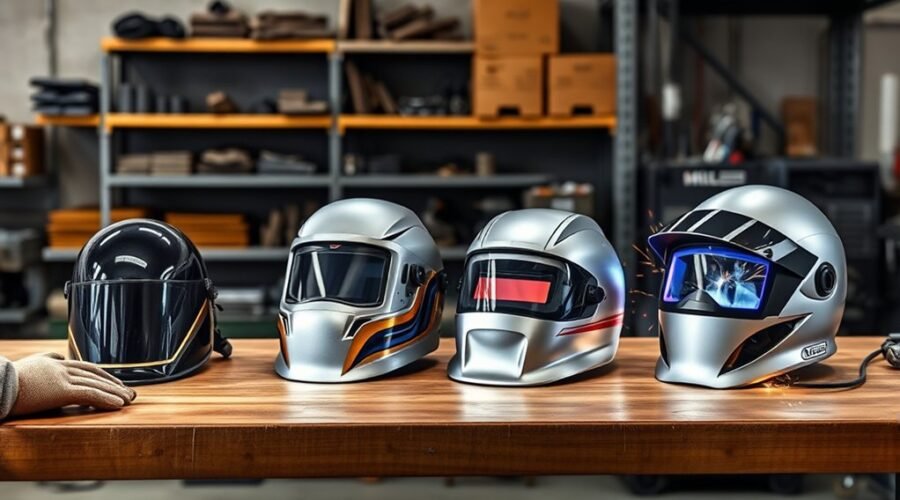
A useful way to group common lens configurations is passive fixed-shade, flip-up fixed-shade, and auto-darkening. “Passive” and “fixed shade” should not normally be counted as two separate styles because passive helmets generally use a fixed-shade filter. Respirator, pancake, and other specialty designs describe additional equipment configurations rather than a separate basic lens technology.
What are the 7 basic types of welding?
There is no single official rule that limits welding to seven basic processes. Common examples include shielded metal arc welding (SMAW/stick), gas metal arc welding (GMAW/MIG), gas tungsten arc welding (GTAW/TIG), flux-cored arc welding (FCAW), submerged arc welding (SAW), resistance spot welding, and oxyfuel gas welding. Plasma arc cutting is primarily a cutting process rather than a welding process.
What kind of welding helmet should I get?
For mixed MIG, TIG, flux-core, and stick work, a standards-compliant auto-darkening helmet with the shade range you need is usually the most versatile option. Compare fit, weight, viewing area, sensitivity, delay, sensor coverage, low-amp TIG rating, battery design, cover-lens availability, and compatibility with your other PPE. For repetitive work at one known shade, a passive helmet can still be a practical choice.
Are all welding helmets the same size?
No. Shell dimensions, suspension systems, adjustment range, weight distribution, and clearance around the face vary by model. Try the helmet with the safety glasses, prescription eyewear, respirator, hearing protection, or hard hat you actually use. The shell should stay stable in welding position without creating pressure points or restricting required movement.
What shade should I use for welding?
Shade depends on the welding or cutting process and factors such as arc current, electrode size, or material thickness. Use the applicable OSHA, AWS, employer, or local safety table and the helmet manufacturer’s instructions. Start dark enough for the hazard and select a lighter shade only if needed for visibility without going below the required minimum.
Are auto-darkening welding helmets safe?
A properly functioning auto-darkening helmet can provide appropriate welding protection when it meets the required standard, uses the correct shade, and is operated according to its instructions. Inspect the cover lens and sensors, check battery status where applicable, and verify ADF operation before welding. Stop using a damaged or unreliable filter.
Conclusion
Selecting the correct welding helmet is a safety decision as well as a comfort decision. Passive fixed-shade helmets remain dependable for repetitive work, while auto-darkening models add useful visibility and control for changing processes, positions, and arc starts. Specialty systems such as PAPRs can address additional hazards when they are selected through a proper hazard assessment.
Focus first on the correct shade, recognized eye-and-face protection requirements, fit, and compatibility with other PPE. Then compare viewing area, optical quality, sensors, switching time, sensitivity, delay, low-amp TIG performance, battery design, and replacement-part availability. A helmet that matches the actual work will provide better protection and usability than one selected only by price or feature count.
Sources
- OSHA — 29 CFR 1910.133 Eye and Face Protection — minimum protective shade guidance and eye/face PPE requirements.
- OSHA — 29 CFR 1910.252 Welding, Cutting, and Brazing — welding PPE, ventilation, fumes, and related safety requirements.
- American Welding Society — ANSI Z49.1:2021 — welding, cutting, filter-lens, PPE, and general safety guidance.
- International Safety Equipment Association — ANSI/ISEA Z87.1-2020 — current eye and face protection standard information.
- CSA Group — CSA Z94.3:20 Eye and Face Protectors — Canadian occupational eye and face protector standard update.
- Miller — Selecting the Right Welding Helmet — ADF shade range, sensor count, sensitivity, viewing area, and helmet-selection features.