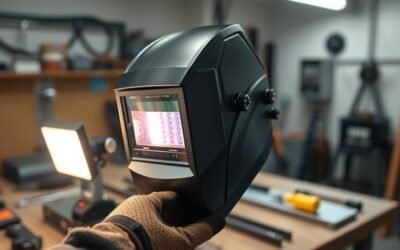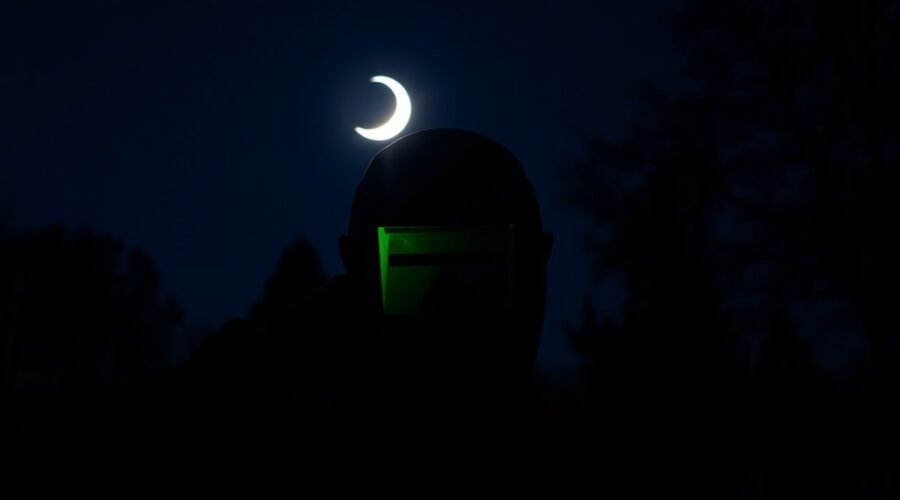
A welding mask can sometimes be used for solar eclipse viewing, but the helmet itself is not what makes it safe. The important part is the filter. For direct viewing with the unaided eye, use only a fixed-shade arc-welding filter clearly marked shade 12, 13, or 14. Do not rely on an adjustable or auto-darkening welding helmet for solar viewing.
Quick Answer
Yes, but only with a fixed welding filter rated shade 12 or darker. Shade 12 is considered adequate, while shades 13 or 14 are often more comfortable. Do not use an auto-darkening or adjustable welding helmet. Purpose-made eclipse glasses from a trusted source are usually the simpler choice.
Key Takeaways
- Use only a fixed-shade welding filter marked shade 12, 13, or 14 for direct solar viewing.
- Shade 12 provides adequate attenuation, but shades 13 or 14 are often more comfortable to look through.
- Do not depend on an auto-darkening or adjustable welding helmet for eclipse viewing.
- Ordinary sunglasses, stacked sunglasses, smoked glass, CDs, photographic filters, and other improvised materials are unsafe.
- Purpose-made solar viewers should conform to the current ISO 12312-2 standard and come from a trustworthy manufacturer or authorized seller.
- Never use eclipse glasses or a welding filter as eye-worn protection while looking through binoculars, a telescope, or a camera.
Warning: Looking directly at the Sun without an appropriate solar filter can injure the retina and may cause lasting vision loss. During a partial or annular eclipse, proper eye protection is required whenever you look directly at the Sun.
Can You Use a Welding Mask for Eclipse Viewing?
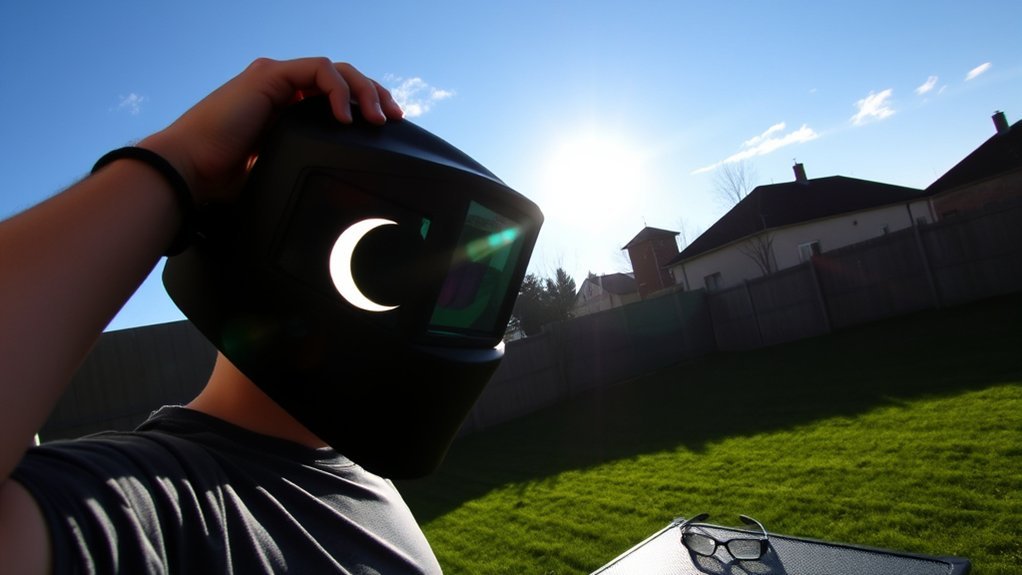
Yes, but only in a specific situation. A fixed arc-welding filter with a verified shade number of at least 12 can transmit a sufficiently small amount of sunlight for direct viewing with the unaided eye. The American Astronomical Society notes that shade 12 is adequate, while many observers find shades 13 or 14 more comfortable.
The distinction between a fixed filter and a modern auto-darkening helmet is important. The American Astronomical Society advises against using adjustable or auto-darkening welding helmets for viewing the Sun because the setting can be changed accidentally and the electronic darkening system may not respond as expected.
You can review the American Astronomical Society’s solar-eclipse viewing guidance for its current recommendations on welding filters and purpose-made solar viewers.
Before using any fixed welding filter, inspect it carefully. Do not use it if its shade number cannot be confirmed or if the filter is cracked, badly scratched, loose, or otherwise damaged. The filter also needs to cover the eyes completely so that direct sunlight cannot enter around it.
The helmet shell does not make solar viewing safe. The verified fixed filter in front of your eyes is what matters.
What Shade Number Is Safe for the Sun?
For direct solar viewing with a fixed arc-welding filter, shade 12 is the minimum commonly accepted level. Shades 13 and 14 are also suitable and are often more comfortable because they make the Sun appear dimmer.
| Welding Shade | Solar Viewing Guidance |
|---|---|
| Below 12 | Do not use. It does not provide the level of attenuation recommended for direct solar viewing. |
| Shade 12 | Considered adequate, although some people find the Sun uncomfortably bright. |
| Shade 13 | A good balance of brightness and comfort for many observers. |
| Shade 14 | Also suitable; some observers find the image quite dark. |
The American Astronomical Society’s technical guidance describes shade 12–14 arc-welding filters as suitable options for direct observation with the unaided eye. It does not mean that shade 14 is automatically “safer” than shade 12; once the filter provides adequate protection, the difference is largely about viewing comfort.
Do not guess based on how dark a lens looks. Confirm the actual shade number printed or permanently marked on the fixed filter.
Are Auto-Darkening Welding Helmets Safe for an Eclipse?
Do not rely on an auto-darkening or adjustable welding helmet for solar viewing. This is true even if the controls appear capable of reaching shade 12, 13, or 14.
Auto-darkening filters are designed primarily to react to welding arcs. Their operation depends on sensors, electronics, power, settings, and the particular design of the helmet. AAS guidance warns that a user could select an unsafe setting or that the lens might not darken quickly or reliably enough when pointed toward the Sun.
Note: A helmet having a “shade 13” maximum setting does not make it equivalent to a fixed shade-13 welding filter for eclipse viewing. For solar observation, use a purpose-made solar viewer or an appropriate fixed welding filter instead.
Why Ordinary Sunglasses Aren’t Enough
Ordinary sunglasses are designed to make daylight more comfortable and reduce everyday ultraviolet exposure. They are not designed for staring directly at the Sun.
Even very dark sunglasses transmit far more light than a proper solar viewer. NASA states that safe solar viewers are thousands of times darker than ordinary sunglasses and should conform to the ISO 12312-2 international standard.
The problem is not simply glare. Direct sunlight can deliver enough intense radiation to damage light-sensitive retinal tissue. A person may not feel pain while this damage is occurring.
Sunglasses Block Too Little
The darkness of an ordinary sunglass lens does not tell you whether it is safe for direct solar observation. Wearing two or more pairs together does not turn them into eclipse glasses either.
- Ordinary sunglasses are intended for normal daylight, not direct viewing of the Sun.
- Very dark lenses can still transmit an unsafe amount of solar radiation.
- Stacking multiple sunglasses does not provide verified solar-filter performance.
- Only a purpose-made solar viewer or another specifically accepted solar-viewing filter should be used.
Eclipse Safety Requires More
Purpose-made eclipse glasses and handheld solar viewers are designed specifically for direct observation of the Sun. They must reduce visible light to a safe level while also controlling ultraviolet and infrared transmission.
| Protection | Suitable for Direct Solar Viewing? |
|---|---|
| Ordinary sunglasses | No |
| Multiple pairs of sunglasses | No |
| Fixed welding filter below shade 12 | No |
| Fixed welding filter shade 12–14 | Yes, for unaided-eye viewing when the filter is verified and undamaged |
| ISO 12312-2 solar viewer from a trustworthy source | Yes, when used according to its instructions |
How to Check a Welding Helmet’s Shade
If you are considering a welding filter for solar viewing, check the actual filter rather than assuming that the helmet is dark enough.
- Identify the lens type. It should be a fixed-shade filter, not an auto-darkening or adjustable electronic filter.
- Find the shade marking. Look for a clearly legible shade number on the filter or its permanent marking.
- Confirm shade 12 or higher. Shades 13 and 14 may provide a more comfortable view.
- Inspect the filter. Do not use it if it is cracked, badly scratched, loose, or otherwise damaged.
- Check coverage. Direct sunlight should not reach the eyes around the filter.
- Do not improvise. If the shade cannot be confirmed, use purpose-made eclipse glasses instead.
Pro Tip: If you already need to buy something specifically for an eclipse, certified-purpose solar viewers from a vetted source are usually easier to verify than a welding filter.
Features that matter during normal welding do not establish solar-viewing safety. For ordinary welding use, you may separately compare welding jackets, welding helmets under $200, TIG welding gloves, Lincoln welding helmets, 3M Speedglas welding helmets, the ESAB Sentinel A50, a Hobart Handler 140 vs. Lincoln 140 comparison, or MIG and stick welding gloves. None of those normal welding features or product categories replaces verification of the solar-viewing filter itself.
Where to Buy Safe Eclipse Glasses
Purpose-made eclipse glasses or handheld viewers are usually the easiest option for most people. They should conform to the current ISO 12312-2 international standard for direct observation of the Sun.
However, an ISO number printed on the glasses is not proof by itself. The American Astronomical Society explains how to verify safe solar viewers and recommends buying from manufacturers whose products have been tested by properly accredited laboratories.
The AAS also maintains a current list of manufacturers of safe solar viewers and filters. When purchasing through a reseller, confirm that the manufacturer publicly identifies that seller as authorized.
The International Organization for Standardization lists ISO 12312-2:2015 as the current published edition at the time of this update. A newer edition is under development, so buyers should follow the current standard and current manufacturer instructions rather than relying on an old product description.
Safe Ways to Watch During Totality
A total solar eclipse is different from a partial or annular eclipse. During a total solar eclipse, you may look without a solar filter only during the brief period when the Moon completely covers the Sun’s bright surface.
Keep your solar viewer or appropriate fixed welding filter in place during all partial phases leading up to totality. Remove it only when the bright solar surface is completely hidden. As soon as any bright sunlight begins to reappear, put the protection back in place before continuing to look.
- Confirm that you are actually inside the path of totality.
- Use proper solar protection throughout the partial phase.
- Remove protection only after the Sun’s bright surface is completely covered.
- Replace protection immediately when bright sunlight begins to return.
There is no safe unfiltered viewing period during a partial or annular eclipse. NASA provides detailed eclipse eye-safety guidance covering partial, annular, and total eclipses.
What Not to Use for Solar Viewing
Do not judge a material by how dark the Sun appears through it. Unsafe filters can make the Sun seem dim while still transmitting radiation at unsafe levels.
| Item | Use for Direct Solar Viewing? |
|---|---|
| Ordinary sunglasses | No |
| Multiple pairs of sunglasses | No |
| Welding filter below shade 12 | No |
| Auto-darkening or adjustable welding helmet | Do not rely on it for solar viewing |
| Smoked glass | No |
| Exposed film or color film | No |
| CD or DVD | No |
| Photographic neutral-density filter | No, unless specifically designed and verified for solar observation |
| Space blanket or metallic food wrapper | No |
If you cannot verify a filter, do not use it for direct viewing.
Can You Use a Welding Filter With Binoculars, Telescopes, or Cameras?
No—not as an eye-worn substitute for a proper optical solar filter. Binoculars, telescope lenses, and camera lenses collect and concentrate sunlight. Eclipse glasses or welding filters held in front of your eyes can be overwhelmed or damaged by this concentrated energy.
Any camera, telescope, or binocular used for direct solar observation needs a solar filter specifically designed for optical equipment and secured over the front aperture, where sunlight first enters the device.
Warning: Never look through an unfiltered telescope, binoculars, or camera at the Sun while wearing eclipse glasses or looking through a welding filter. The concentrated sunlight can cause severe eye injury.
Best Indirect Ways to View the Eclipse
Indirect viewing is an excellent option when you do not have verified solar-viewing eyewear. Projection methods let you see an image of the eclipse without looking directly at the Sun.
- Pinhole projector: Make a small hole in a card and allow sunlight to pass through it onto another surface. Keep the Sun behind you and look at the projected image, not through the hole.
- Colander or perforated object: The small openings can project many crescent-shaped solar images onto the ground during partial phases.
- Tree-leaf shadows: Gaps between overlapping leaves act as natural pinholes and can create many images of the eclipsed Sun.
- Live broadcasts: Observatory and science-organization streams offer a completely eye-safe way to follow an eclipse when direct viewing equipment is unavailable.
With a pinhole projector, the Sun should be behind you. Look at the projected image—not through the pinhole.
NASA also recommends projection as a safe indirect method when proper direct-viewing filters are unavailable.
What to Do After Looking at the Sun Without Proper Protection
Solar retinal injury may not hurt while it is happening, and symptoms can appear later. According to the National Eye Institute, possible symptoms after unsafe solar exposure include blurred vision, unusual sensitivity to light, dark or blind spots near the center of vision, and changes in color perception.
If you notice new vision changes after looking at the Sun, contact an eye-care professional promptly for evaluation. Do not repeatedly test your vision by looking at the Sun again.
Note: Children should be supervised closely whenever solar viewers are used. Check the viewer before use and make sure the child understands not to remove it while looking toward the bright Sun.
Frequently Asked Questions
Can You Use a Welding Mask for an Eclipse?
Yes, but only when it contains an appropriate fixed-shade arc-welding filter. Shade 12 is the minimum generally accepted level, while shade 13 or 14 is often more comfortable. Do not rely on an auto-darkening or adjustable welding helmet.
Can I Look at the Sun With a Welder’s Mask?
You may look directly at the Sun through a verified fixed welding filter rated shade 12, 13, or 14. If you cannot confirm the filter type and shade number, do not use it. Purpose-made solar viewers are easier for most people to verify.
What Shade Welding Lens Is Safe for a Solar Eclipse?
Shade 12 is considered adequate for a fixed arc-welding filter. Shades 13 and 14 are also suitable and often provide a more comfortable view. Filters below shade 12 should not be used for direct solar viewing.
Are Auto-Darkening Welding Helmets Safe for an Eclipse?
They are not recommended for solar viewing. The American Astronomical Society advises against adjustable and auto-darkening helmets because an unsafe setting may be selected or the electronic filter may not activate reliably enough when viewing the Sun.
How Can I Safely View a Solar Eclipse Without Glasses?
Use an indirect projection method such as a pinhole projector, colander, or the natural pinhole effect created by tree leaves. Keep your back toward the Sun and look only at the projected image. Do not look through the pinhole itself.
Conclusion
A welding mask can be used for eclipse viewing only when the protective filter is a verified fixed-shade arc-welding filter rated shade 12 or higher. Shade 12 is considered adequate, while shades 13 and 14 are often more comfortable. Do not rely on adjustable or auto-darkening welding helmets.
For most observers, purpose-made eclipse glasses or handheld solar viewers that conform to the current ISO 12312-2 standard and come from a trustworthy source are simpler to verify. During partial and annular phases, keep proper protection in place whenever you look directly at the Sun. Only during true totality, while the bright solar surface is completely hidden, is unaided viewing permitted.
Sources
- NASA — Eclipse Viewing Safety — direct viewing, totality, projection methods, and optical-device precautions.
- American Astronomical Society — How to View a Solar Eclipse Safely — welding-filter shade guidance and auto-darkening helmet warning.
- American Astronomical Society — Suppliers of Safe Solar Viewers & Filters — vetted manufacturers and purchasing guidance.
- International Organization for Standardization — ISO 12312-2 — current published standard for filters used for direct observation of the Sun.
- National Eye Institute — How to Watch an Eclipse Safely — retinal injury risks, symptoms, and eye-safety guidance.