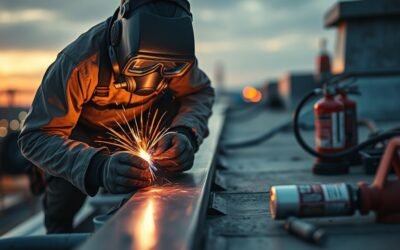
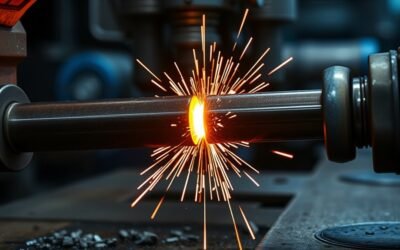
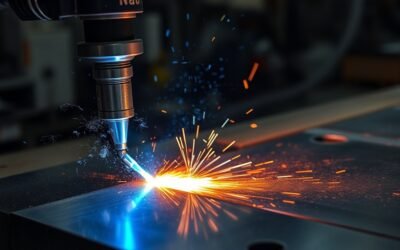
Submerged arc welding (SAW) is a high-productivity arc welding process designed for long, repeatable welds, especially in medium-to-heavy fabrication. A continuously fed electrode burns beneath granular flux, which hides and protects the arc while supporting deep penetration and high deposition rates. SAW is especially effective on pressure vessels, structural steel, pipe, tanks, ship components, and other work that can be positioned for flat or horizontal welding.
Quick Answer
Submerged arc welding feeds a consumable wire beneath granular flux instead of using an exposed arc and separate shielding gas. Its main advantages are high deposition, deep penetration, little spatter, and easy mechanization. Its main limits are welding position, equipment size, flux handling, and reduced suitability for thin, short, or irregular joints.
Key Takeaways
- SAW normally uses a continuously fed wire electrode beneath granular flux, so the arc and molten pool are protected from the atmosphere.
- The process is usually mechanized or automatic and is particularly productive on long butt welds, fillet welds, and circumferential seams.
- Current, voltage, travel speed, electrode polarity, wire size, and flux selection all affect penetration, bead shape, deposition rate, and weld chemistry.
- Flat butt welds and flat or horizontal fillets are the normal operating positions because both the weld pool and molten slag are highly fluid.
- Flux must be matched to the electrode and kept in suitable condition; moisture, contamination, poor fit-up, and incorrect parameters can cause weld defects.
What Is Submerged Arc Welding?
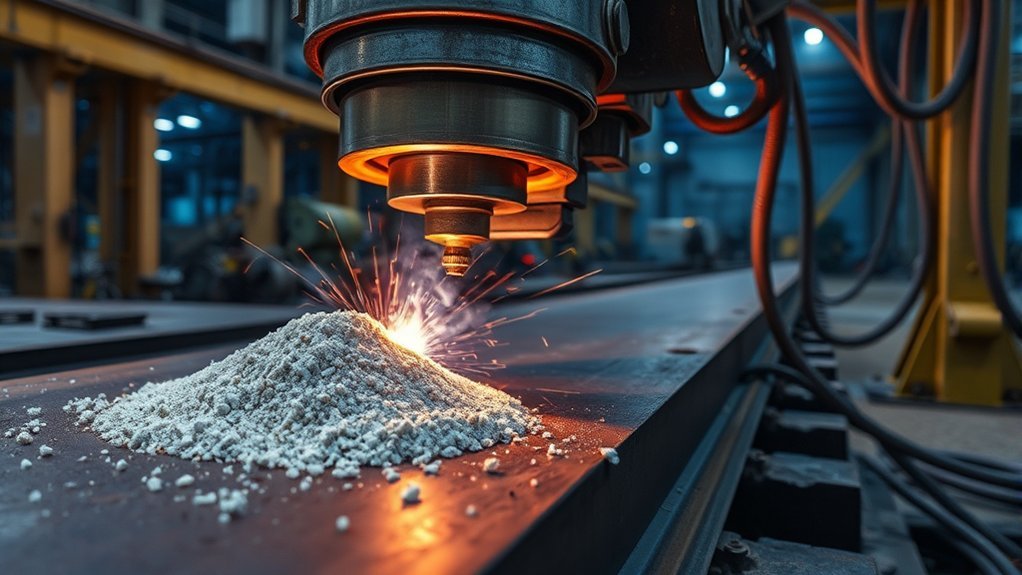
Submerged Arc Welding (SAW) is a fusion welding process in which an electric arc forms between a continuously fed consumable electrode and the workpiece. The arc operates beneath a layer of granular flux, so conventional SAW does not need a separate shielding-gas supply.
The process became established during the 1930s and later became important in heavy fabrication. According to the TWI submerged arc welding process guide, SAW is normally mechanized or automatic, although semi-automatic operation is also possible.
Flux does more than hide the arc. Part of it melts and forms slag over the weld, while the flux-electrode combination can also affect the chemistry and mechanical properties of the deposited metal. Unmelted flux may be recovered for further use when its condition and the manufacturer’s handling requirements permit it.
SAW combines a continuous electrode, a buried arc, and a flux system to produce repeatable welds at high deposition rates.
The process should not be confused with portable MIG, TIG, and stick multi-process welders. SAW is normally built around mechanized travel, bulk flux handling, and production joints rather than general repair work.
How Submerged Arc Welding Works
Submerged arc welding continuously feeds electrode wire toward the joint while a flux hopper covers the welding zone. The electrical arc melts the electrode and base metal, molten flux surrounds the arc, and a slag layer forms over the deposited bead as the weld travels forward.
The basic sequence is straightforward:
- Granular flux is placed ahead of the welding arc.
- The wire electrode feeds through the welding head toward the workpiece.
- An arc forms between the electrode and base metal beneath the flux.
- The electrode and part of the base metal melt into the weld pool.
- Molten flux forms slag over the bead, while unused flux can be recovered separately.
Unlike MIG welding, conventional SAW relies on flux rather than an externally supplied shielding gas. A MIG shielding gas guide therefore applies to a different type of arc-welding protection.
Arc And Flux Shielding
The defining feature of SAW is its concealed arc. Granular flux covers the arc, electrode tip, and molten weld zone, limiting their contact with the surrounding atmosphere.
SAW fluxes can contain oxides and compounds involving manganese, silicon, titanium, aluminium, calcium, magnesium, zirconium, and calcium fluoride. Their exact formulation matters because the wire and flux are selected as a combination to achieve the required weld-metal properties.
The flux also changes into molten slag near the arc. This slag covers the newly deposited weld metal and slows its direct exposure to the atmosphere while it solidifies.
Because the arc is hidden, the operator cannot directly watch the weld pool as in MIG or TIG welding. Correct joint tracking, wire position, current, voltage, and travel speed therefore become especially important.
Electrode Feed And Melt
The electrode is fed continuously, allowing SAW to maintain a high arc-on time without stopping to replace short stick electrodes. Current passing through the wire creates the heat needed to melt both filler metal and the joint.
Increasing current generally raises both deposition rate and penetration for a given wire size. However, current cannot simply be increased without limit. Excessive current can overheat the electrode, destabilize the arc, cause undercut, or create an unsuitable bead profile.
Polarity also matters. Direct-current electrode positive (DCEP) is commonly associated with deeper penetration, while direct-current electrode negative (DCEN) can increase electrode melt-off while reducing penetration. Alternating current is useful in applications where magnetic arc blow is a concern.
Slag Formation And Removal
As the flux surrounding the arc melts, it forms a slag layer over the deposited weld. After the weld cools, this solidified slag must be separated from the bead before inspection and, on multipass work, before the next pass is deposited.
Slag is beneficial when the process is controlled correctly, but it is not a guarantee against slag inclusions. Incomplete removal between passes, poor bead shape, or unsuitable joint geometry can trap slag inside a multipass weld.
Moisture control matters as well. ESAB’s flux handling guidance explains that flux exposed to unsuitable humidity may require drying or rebaking according to the specific product instructions. Manufacturer requirements should take priority because allowable storage and rebaking conditions vary by flux.
Pro Tip: Keep recovered flux separate from fused slag and shop debris. Follow the flux manufacturer’s procedure for recovery, screening, storage, and rebaking instead of assuming every unused granule can be returned directly to the hopper.
Submerged Arc Welding Equipment and Components
A typical SAW system combines a high-duty-cycle power source, wire feeder, welding head, flux hopper, travel mechanism, controls, and often a flux-recovery system. Production setups may also use rotators, positioners, seam trackers, or multiple welding heads.
TWI describes welding current as typically about 300 to 1000 A for SAW, although equipment and flux systems can operate at higher currents in suitable procedures. TWI also shows mild-steel wire examples ranging from about 1.6 to 6.0 mm, while individual manufacturers commonly concentrate on a narrower range.
| Component | Purpose | Why It Matters |
|---|---|---|
| Power source | Supplies AC or DC welding current | Controls arc energy, penetration, and process stability |
| Wire feeder and welding head | Feeds and guides the electrode | Maintains a controlled melt-off rate and wire position |
| Flux hopper | Places granular flux over the joint | Maintains coverage of the arc and weld pool |
| Travel system or tractor | Moves the welding head at a set speed | Improves repeatability on long seams |
| Positioner or rotator | Moves large cylindrical workpieces | Keeps circumferential welding near the flat position |
Consumables must also be treated as a matched system. The AWS A5.17/A5.17M specification covers classification requirements for carbon-steel SAW electrodes and fluxes, including how flux classification relates to weld-metal properties produced with a specified electrode.
This industrial setup is very different from compact welders intended for home use. SAW becomes most attractive when enough repeatable welding exists to justify the handling equipment and setup time.
Warning: A buried arc does not make SAW hazard-free. Hot slag, electrical energy, fumes, flux dust, grinding, moving machinery, and hot metal still require appropriate controls. In U.S. workplaces, follow OSHA’s welding, cutting, and brazing requirements, including ventilation and task-appropriate personal protective equipment.
Why Submerged Arc Welding Produces Deep Welds Fast
SAW combines relatively high welding current, continuous filler feed, strong arc-on time, and mechanized travel. These characteristics allow substantial amounts of metal to be deposited while maintaining penetration and repeatability on suitable joints.
The process is not automatically faster for every weld. Setup, joint geometry, required mechanical properties, heat-input limits, and the number of passes still determine whether SAW provides a productivity advantage.
High Heat Concentration
The flux blanket limits direct heat loss around the arc and allows high welding currents to be used without an exposed arc. That concentrated energy helps melt substantial cross-sections of steel and can create deep penetration with fewer passes than lower-deposition processes.
Current is only one part of the result. Voltage affects arc length and bead width, while travel speed affects bead size and heat input per unit length. Very high travel speed can increase the risk of undercut or porosity, while excessively slow travel can create an oversized pool or burn-through in unsuitable joints.
High heat input is not always desirable. Some quenched-and-tempered steels and other heat-sensitive materials have procedure limits intended to preserve mechanical properties, so the welding procedure specification must control SAW parameters rather than simply maximize current.
Continuous Filler Feed
Continuous electrode feeding removes the stop-start cycle associated with short consumable electrodes. Mechanized motion then keeps travel speed consistent, allowing the process to maintain high effective welding time on long seams.
| Feature | Effect | Result |
|---|---|---|
| Continuous wire feed | Metal is supplied without frequent electrode changes | High arc-on time |
| Mechanized travel | Travel speed stays controlled | Repeatable bead geometry |
| Multiple-wire variants | More electrode metal can be melted simultaneously | Higher potential deposition rates |
Lincoln Electric’s submerged arc welding guide shows why deposition figures must be tied to the actual configuration. Its examples place standard single-wire systems at up to about 10 kg/h, while higher-productivity multiple-arc arrangements are shown at rates up to about 35 kg/h.
That is why a single headline figure such as 45 kg/h is misleading without stating the wire arrangement, current, polarity, stickout, and equipment configuration. Production SAW can span a wide range.
The same distinction matters when comparing SAW with smaller MIG, TIG, and stick machines for beginners, which target very different weld sizes and production requirements.
Flux-Sheltered Arc
The granular flux layer allows the arc to operate in a protected cavity instead of being directly exposed to air. This reduces spatter and limits visible arc radiation while supporting stable metal transfer.
Flux coverage must still be correct. Too little flux can expose the arc and weld pool, while excessive or poorly conditioned flux can interfere with process control. The correct burden depends on the procedure and consumable manufacturer’s guidance.
The hidden arc also creates a trade-off: the operator gains a protected, stable welding zone but loses direct visual access to the pool. Joint alignment, contact-tip position, seam tracking, and parameter setup therefore carry more responsibility than they do in an open-arc manual process.
Where Submerged Arc Welding Works Best
Submerged arc welding works best where a joint is long, accessible, repeatable, and capable of being positioned so gravity can contain the fluid pool and slag. It is especially attractive when deposition rate and consistent mechanized travel matter more than portability.
Common applications include:
- Pressure vessels and storage tanks: longitudinal and circumferential seams on large fabricated sections.
- Large-diameter pipe: longitudinal, spiral, or circumferential production welds where equipment can track or rotate the joint.
- Structural steel: beams, girders, columns, and long fillet or butt welds.
- Shipbuilding and offshore fabrication: long panel seams and heavy subassemblies.
- Wind towers and cylindrical structures: long seams and girth welds that can be rotated beneath a fixed head.
- Surfacing and overlay: depositing weld metal over a larger area when a suitable wire, strip, and flux system is used.
SAW is most commonly associated with carbon-manganese and low-alloy steels. Stainless steels can also be welded, and selected nonferrous materials are possible when a suitable electrode-flux combination has been qualified.
Circumferential welding is commonly handled by rotating the workpiece below a fixed welding head. This keeps the active weld pool near the flat position even though the finished weld runs around the circumference.
SAW is most productive when the work can be brought to the process: long seams, stable positioning, repeatable fit-up, and enough weld volume to justify mechanization.
For repair work, awkward locations, or joints that cannot be positioned, portable processes such as stick welding may provide more practical access even though their deposition rates are lower.
Limits of Submerged Arc Welding
The main SAW limitations come from gravity, access, setup, and the hidden weld zone. The process is therefore not a universal replacement for MIG, flux-cored, stick, or TIG welding.
- Position is restricted. Butt welds are normally made flat, while fillet welds are commonly made flat or horizontal. Vertical and overhead welding are generally impractical because loose flux, molten slag, and the fluid pool are difficult to contain.
- Thin material is less suitable. SAW can technically be applied over a broader thickness range than a simple minimum-thickness rule suggests, but its heat input, equipment, and deposition rate make it more attractive for medium-to-heavy fabrication.
- The arc cannot be watched directly. A poor wire position or wandering joint can continue beneath the flux unless the equipment has accurate guidance or seam tracking.
- Flux adds handling work. Flux must be stored correctly, delivered to the joint, recovered where appropriate, and separated from fused slag and contaminants.
- Multipass welds require slag removal. Leaving slag between passes can create inclusions and prevent proper fusion.
- Equipment can be substantial. High-current power sources, tractors, wire-feed equipment, flux systems, rotators, and positioners reduce portability.
- Heat input requires control. High productivity is useful only when the base metal and qualified welding procedure permit the resulting thermal cycle.
Fit-up also deserves attention. Because the operator cannot see the arc and puddle directly, joint alignment, root opening, backing arrangements, wire placement, and travel path should be established before the weld starts.
Porosity can result from oil, paint, grease, hydrated oxides, damp flux, or inadequate flux coverage. Solidification cracking is another concern when bead geometry, weld-metal composition, or restraint is unfavorable.
For shorter jobs, thinner material, complex assemblies, or positional welding, MIG welding equipment can provide greater flexibility and easier visual control.
When to Use Submerged Arc Welding for Heavy Fabrication
Choose SAW when the joint geometry, material, production volume, and welding position allow mechanized travel to deliver a real productivity benefit. Thick plate alone is not enough; the job also needs suitable access, fit-up, consumables, and a qualified procedure.
| Condition | SAW Fit |
|---|---|
| Long, repeatable seams | Excellent |
| Flat butt or flat/horizontal fillet welds | Excellent |
| Medium-to-heavy fabrication | Usually well suited |
| High deposition requirement | Strong advantage |
| Short, irregular, or inaccessible joints | Usually a poor fit |
| Vertical or overhead welding | Generally unsuitable |
| Thin sheet | Usually less practical |
Before choosing the process, confirm five things: the joint can be positioned correctly, the equipment can track it accurately, the wire-flux combination matches the required weld properties, the heat input is acceptable for the base material, and the expected weld volume justifies the setup.
If precision on thinner material or complex access matters more than high deposition, equipment such as AC/DC TIG welders serves a different and often more suitable role.
Frequently Asked Questions
What Are the Benefits of Submerged Arc Welding?
Submerged arc welding offers high deposition rates, deep penetration, high arc-on time, little spatter, and repeatable mechanized travel. Those advantages are strongest on long welds and medium-to-heavy sections. It also hides the arc under flux, although slag removal and flux handling still add work.
What Is Submerged Arc Welding Used For?
Submerged arc welding is used for long longitudinal or circumferential welds in pressure vessels, tanks, large-diameter pipe, structural beams, ship panels, wind-tower sections, and weld overlay. The work is normally positioned so welding stays flat or horizontal because the pool and molten slag are very fluid.
What Is Submerged Arc Welding?
Submerged arc welding is a fusion welding process in which a continuously fed electrode melts under a blanket of granular flux. The flux shields the arc and weld pool, forms slag, and can influence weld-metal chemistry. Conventional SAW does not need an external shielding gas.
What Are the Disadvantages of Submerged Arc Welding?
SAW is position-limited, difficult to use on short or irregular seams, and less practical on thin material. The hidden arc makes visual tracking impossible, while flux handling, slag removal, fit-up, and mechanized equipment add setup. High heat input can also be a concern for some steels.
Does Submerged Arc Welding Need Shielding Gas?
No. Conventional submerged arc welding relies on granular flux rather than an external shielding gas. The flux melts around the arc, protects the molten metal, and forms a slag cover as the weld cools. Specialized variants exist, but standard SAW is designed to operate without a separate gas supply.
Can Submerged Arc Welding Be Used on Stainless Steel?
Yes. Submerged arc welding can weld stainless steels when the electrode and flux combination is selected for the required composition and mechanical properties. Carbon-manganese and low-alloy steels are more common SAW materials, but stainless and some nonferrous alloys are also possible with suitable consumables.
Conclusion
Submerged arc welding is at its best on long, repeatable welds where mechanization, high deposition, and deep penetration can offset the extra setup and flux handling. Select it for suitable joint geometry and welding positions, then control the wire-flux combination, current, voltage, travel speed, heat input, and fit-up through a qualified procedure.
Sources
- TWI — Submerged Arc Welding Process: Process operation, flux composition, welding positions, materials, and process variants.
- Lincoln Electric — The Full Solution for Submerged Arc Welding: Wire sizes, equipment configurations, deposition-rate examples, and multi-arc systems.
- American Welding Society — AWS A5.17/A5.17M: Classification of carbon-steel SAW electrodes and fluxes.
- ESAB — Handling and Storage of Welding Fluxes: Flux moisture control, storage, handling, and rebaking guidance.
- Occupational Safety and Health Administration — 29 CFR 1910.252: Welding safety, PPE, ventilation, hot-work, and flux-related hazard requirements.