
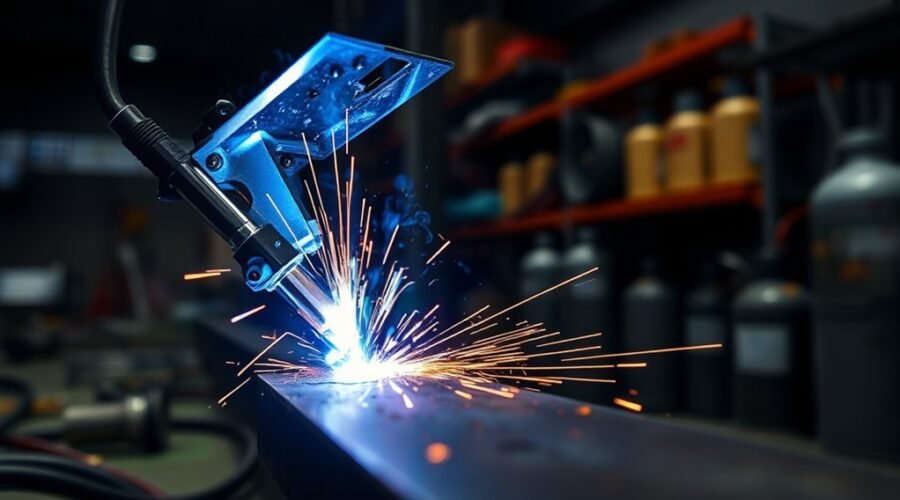
Weld spatter often signals an unstable arc, poor shielding, or incorrect wire settings. Small changes in voltage, wire feed speed, gas flow, or arc length can shift a weld from smooth transfer to excessive particle loss. Surface contamination and mismatched consumables add further variability. The most effective fixes are not always obvious, which makes it important to separate process faults from technique errors before choosing a corrective path.
Key Takeaways
- Set voltage and wire feed speed correctly to keep the arc stable and prevent spatter.
- Clean rust, mill scale, and poor ground points to improve conductivity and reduce arc interruptions.
- Maintain proper shielding gas flow, with enough argon-rich mix for smoother metal transfer.
- Keep a consistent arc length, torch angle, and travel speed to control the weld puddle.
- Choose the right wire size and use trained MIG technique to improve transfer stability and lower spatter.
What Causes Weld Spatter?
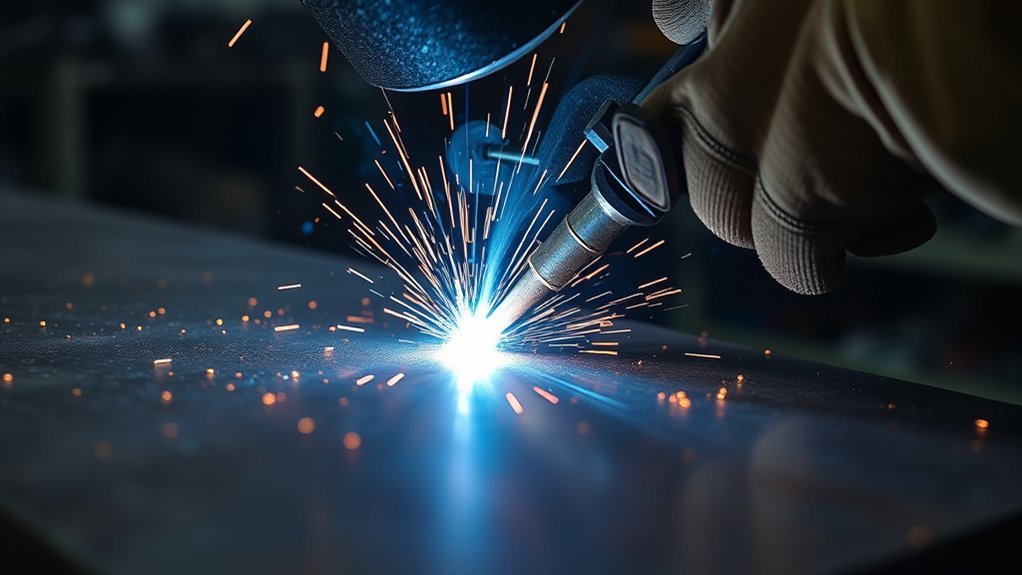
Weld spatter originates from instability in the weld pool and arc, most often due to incorrect amperage and voltage settings that produce arc explosions.
In technical terms, weld spatter is the visible result of a disturbed metal transfer process, where molten particles are expelled instead of deposited cleanly.
Shielding gas selection also shapes this behavior; CO₂ generally promotes more spatter, while argon provides a calmer arc and fewer expulsions.
Surface condition matters as well: mill scale, rust, and other contamination impede electrical flow, lowering the heat delivered to the joint and encouraging colder weld deposits that scatter metal.
A mismatched heat-to-wire ratio further destabilizes transfer, allowing excess wire or insufficient energy to break the pool’s cohesion.
Drafts and temperature swings can intensify the problem by disturbing arc stability.
The underlying pattern is consistent: when the process is not controlled, weld spatter rises and weld quality declines. Additionally, using a 75/25 mix of argon and CO₂ can enhance arc stability and reduce spatter.
Check Voltage, Wire Feed, and Gas
Proper control of voltage, wire feed speed, and shielding gas is essential for limiting spatter during welding. When voltage rises above the level matched to the wire feed speed, the arc becomes aggressive and ejects more molten droplets. If wire feed speed is too low for the selected voltage, the same instability appears and spatter increases.
The parameters must consequently be balanced, not guessed. Gas flow rate also demands verification; flow that is too low weakens shielding, while excessive flow can create turbulence and admit air into the arc zone. For solid wires, a shielding gas with at least 85% argon promotes a smoother transfer and cleaner bead formation. Additionally, ensuring the welder has AC/DC functionality allows for better adaptability to different materials, further reducing spatter.
Contact-tip distance should be kept consistent, because an unstable arc amplifies spatter. Regular calibration of voltage, wire feed speed, and gas flow rate helps preserve control, improve weld quality, and free the process from avoidable defects.
Match Wire Size to the Job
Selecting the correct wire diameter is another effective way to reduce spatter, because wire size must align with both the material thickness and the transfer mode being used.
To match wire size to the job, operators should evaluate whether the welding wire will deliver stable arc behavior at the required heat input. Smaller diameters, such as 0.035 inch instead of 0.045 inch, often provide finer control and less spatter on thinner sections.
Larger wire at low voltage can destabilize the arc, increasing droplet ejection and waste. Short circuit transfer demands especially careful selection, since an oversized wire can intensify spatter instead of controlling it.
When the wire diameter fits the joint, feed speed, and transfer method, arc stability improves and the process becomes more efficient. Proper adjustment for the chosen wire size supports cleaner deposition, reduces turbulence at the puddle, and gives the welder greater command over the arc, preserving both freedom and precision. Additionally, using the right arc control settings enhances the overall welding performance and minimizes spatter further.
Remove Mill Scale Before Welding
Mill scale can impede electrical transfer at the arc interface, promoting colder weld deposition and a measurable rise in spatter.
Effective surface preparation—through grinding or other cleaning methods—improves current continuity and supports more stable welding conditions, though it increases labor and consumable wear.
Clean grounding surfaces and, where appropriate, spatter-resistant filler metals can further reduce the impact of residual mill scale. Additionally, using a plasma cutter with built-in compressor allows for quicker setup and improved portability during preparation tasks.
Mill Scale Spatter Risks
A thin oxide barrier on steel can disrupt electrical transfer, producing colder weld deposits and increasing spatter. Mill scale, a common rolling oxide, raises arc resistance and destabilizes metal transfer, especially with solid wires.
The result is a less liberated weld pool: erratic fusion, excess droplet expulsion, and higher cleanup demand. Removing mill scale from base material lowers these risks and often permits faster, cleaner production; pre-cleaned plates reduce preparation time.
Grinding away mill scale is effective, though it adds labor and tool wear costs. Secure grounding on clean contact points further limits arc interruptions that can amplify spatter.
Where removal is impractical, metal-cored wires may tolerate mill scale better than solid wire, reducing spatter while preserving process flexibility and operator control.
Surface Prep Best Practices
Surface preparation directly controls how much spatter a weld is likely to generate.
In surface prep, mill scale should be removed because it restricts electrical contact, cools the arc, and degrades quality welding. Grinding is a reliable method for stripping scale and improving fusion, though it adds labor and operational costs.
Pre-cleaned plates can reduce spatter by eliminating manual cleanup and supporting consistent starts. Secure grounding on clean surfaces is equally critical; poor contact invites arc interruptions that scatter droplets.
When process freedom is needed, selected filler metals, including metal-cored wires, can weld through light mill scale with fewer spatter events. Even then, inspection remains necessary.
The technical goal is simple: expose sound metal, stabilize current, and preserve control.
Keep Your Arc Length Consistent
Arc length is a primary control variable in MIG welding, with a typical target of 1/4 to 3/8 inch to maintain arc stability and limit spatter.
When the gap becomes too long, heat input rises and spatter increases; when it becomes too short, wire stubbing and short-circuiting become more likely.
Consistent hand position and disciplined technique help preserve the arc gap and improve weld quality. Additionally, proper material thickness capacity ensures optimal performance and minimizes issues related to spatter.
Arc Length Basics
Maintaining a consistent arc length is essential for controlling weld spatter, since deviations in standoff distance can destabilize the arc and disturb the weld pool.
In practical terms, arc length should remain within the process-specific range, often 1/8 to 1/4 inch, to preserve arc stability and penetration. When the arc length becomes too short, heat concentration and instability increase, encouraging spatter. When it becomes too long, fusion degrades and the bead forms irregularly.
Consistency limits pool disruption and prevents metal from breaking free as spatter. Regular monitoring and adjustment keep the operator in control, producing cleaner welds with less post-weld cleanup.
Precision in arc length supports disciplined welding practice and reinforces independence through repeatable, efficient results.
Effects Of Arc Gaps
A widened gap disrupts current density, lowers effective heat input, and can leave the base material insufficiently melted.
Molten droplets then lose adhesion before joining the pool, producing erratic ejection. This behavior limits precision and weakens weld quality.
Regular monitoring of arc length keeps the process within the stable range and reduces disturbance, allowing controlled deposition and freer, more reliable fabrication.
Tips For Steady Arc
Stable arc control follows naturally from correct gap management, since keeping arc length consistent helps hold current density and heat input in the range needed for smooth metal transfer.
A steady arc typically rests near 1/4 to 3/8 inch, where weld pool behavior remains controlled and spatter stays low. When the arc runs too long, the pool cools and droplets eject irregularly; when too short, metal can be forced from the puddle.
Matching contact-tip distance to wire diameter and material thickness sharpens stability. Consistent hand motion, deliberate travel speed, and the pushing method further support a steady arc.
Repeated practice builds disciplined control, giving the welder greater autonomy over arc behavior, cleaner transfer, and less waste from spatter.
Use the Right MIG Technique
Selecting the proper MIG technique can materially reduce spatter by stabilizing the arc and improving weld-pool control.
In short arc welding, a pushing motion often drives metal outward and increases droplet escape; a pulling motion commonly provides better directional control and cleaner transfer. Torch inclination also matters: a modest, consistent angle supports a narrower arc cone and steadier bead formation.
The welding technique should be paired with disciplined travel speed, because erratic motion disturbs the molten pool and amplifies spatter. Contact-tip distance must remain within an ideal range to preserve arc stability and prevent volatility at the wire tip.
For operators seeking liberation from excessive cleanup, systematic practice on scrap metal is valuable. By comparing angles, speeds, and travel direction under controlled conditions, the welder can identify the combination that delivers the most stable arc and the least spatter.
Additionally, investing in a well-made machine can further enhance weld quality and reduce spatter through consistent performance.
Precision in setup becomes practical freedom in execution.
Why Metal-Cored Wire Reduces Spatter
Metal-cored wire reduces spatter by supporting a more stable arc and a broader, cone-shaped transfer pattern than solid wire.
Tubular metal-cored wires contain engineered fill materials that steady metal transfer and suppress erratic droplet behavior. The result is a cleaner spray-transfer mode with fewer expulsions, improved puddle control, and a more predictable arc column.
Because the arc remains coherent, the process can tolerate lower heat inputs while still limiting spatter, which broadens usable conditions across common base metals. These wires also pass through mill scale with less dependence on pre-cleaning, reducing contamination-driven instability that often triggers spatter.
In practical terms, metal-cored wires lower the adjustment burden on the operator, streamline setup, and deliver welds with less rework. Additionally, high customer ratings indicate that users frequently appreciate the reduction in spatter and overall improved weld quality.
For production environments seeking technical autonomy, that combination means less waste, fewer interruptions, and a more controlled path to consistent, liberated output.
How Pulsed MIG Cuts Spatter
Another way to control spatter is to refine how the arc and droplets behave during transfer, and pulsed MIG does that by alternating between high and low current levels. In pulsed MIG welding, each peak current pinches the droplet, then the lower background current sustains a stable arc at reduced heat. That sequence limits violent transfer events and suppresses excess spatter formation.
- Precise droplet pinch reduces erratic metal expulsion.
- Stable background arc preserves control at lower heat inputs.
- Compatibility with solid and metal-cored wires broadens application.
- Easier learning helps new welders produce cleaner, more consistent welds.
The result is practical freedom from excessive cleanup and rework. By governing heat input and transfer timing, pulsed MIG welding improves weld quality while keeping the bead smoother and the work area cleaner. Additionally, versatility in welding techniques allows operators to explore various methods for enhanced skills development.
For operators seeking control without unnecessary turbulence, it offers a disciplined path to low-spatter welding.
Set the Right Shielding Gas Mix
Shielding gas composition has a direct effect on arc stability, transfer behavior, and spatter generation. For solid wire welding, a shielding gas blend with at least 85% argon is essential to suppress spatter and support controlled metal transfer.
A 75% argon and 25% CO₂ mix often offers a strong balance, improving arc stability while producing less spatter than pure CO₂. In short circuit transfer, a tri-mix of argon, CO₂, and oxygen can further refine penetration and reduce droplet ejection.
Gas flow should remain within the recommended range; excessive flow can create turbulence in the weld pool, a leading source of spatter and instability. Purity also matters. Even small impurities in the shielding gas can elevate spatter levels and degrade weld quality.
Precise gas selection and disciplined flow control give the weld process greater freedom from avoidable defects. Additionally, understanding the importance of low-hydrogen characteristics can enhance the overall quality of your welds.
Train Welders to Reduce Spatter
Welder training should begin with core technique basics, including proper travel speed, torch manipulation, and consumable selection, since these variables directly affect spatter formation. Angle and distance control must be taught explicitly, because incorrect work angles or contact-tip distance can destabilize the arc and increase particle ejection. Ongoing skill development through hands-on practice and parameter review helps welders maintain cleaner welds and apply corrective adjustments consistently. Additionally, incorporating safety features such as reinforced gloves can enhance overall welding performance and reduce the risk of injury from spatter.
Core Technique Basics
Effective spatter reduction begins with disciplined welder training focused on foundational technique and process control. In the welding process, mastery of core habits enables cleaner metal transfer and greater operational freedom.
Training should cover:
- Correct work and travel angles, which directly influence spatter generation.
- Ideal contact-tip distance, supporting stable arc performance and consistent fusion.
- Clean base materials and secure grounding, both essential for arc stability.
- Timely replacement of consumables and structured experimentation with settings to identify low-spatter parameters for each application.
These basics reduce variability, improve repeatability, and limit avoidable defects.
When welders understand how technique, preparation, and equipment condition interact, they gain control over the weld pool and can produce cleaner results with less waste, less rework, and more autonomy.
Angle And Distance Control
Angle and distance control further refines spatter reduction by standardizing the geometry of the arc. A correct work angle, typically 10 to 15 degrees for push techniques, supports a stable arc and distributes heat more evenly across the joint.
Precise distance control, especially maintaining a contact-tip distance of 1/4 to 3/8 inches, limits arc wandering and suppresses instability that drives spatter. Welders are trained to match travel speed to material thickness and composition so the puddle stays controlled rather than overheated or starved.
Short arc length, held as close as possible without contact, produces cleaner transfer and fewer ejected droplets. Repeated practice with feedback on angle and distance control builds consistent performance and gives operators greater technical freedom across varied welding tasks.
Ongoing Skill Development
Ongoing training improves welder performance by reinforcing the settings and techniques that suppress spatter. In MIG welding, ongoing skill development gives operators repeatable control over voltage, wire feed, and travel speed to reduce spatter and improve bead stability.
- Practice on varied materials to calibrate heat input and wire delivery.
- Verify contact-tip distance and work angle to maintain arc consistency.
- Use simulations and live drills to diagnose spatter sources quickly.
- Train on consumable selection and replacement to sustain clean transfer.
This disciplined regimen increases technical autonomy, enabling welders to adjust process variables without dependence on guesswork.
As skill grows, spatter decreases, weld quality rises, and production becomes more precise, efficient, and self-directed.
Frequently Asked Questions
How to Get Less Weld Splatter?
Less weld splatter is achieved through Spatter Prevention measures: reduce wire diameter, maintain at least 85% argon shielding gas, and keep base metal free of mill scale and contamination.
A pulsed MIG process can stabilize droplet transfer and lower spatter further.
Metal-cored wire may also improve arc consistency on less-than-perfect surfaces.
These controls free the operator from unnecessary cleanup while producing cleaner, more efficient welds with greater process control.
Why Do Welders Drink Milk After Welding?
Welders drink milk after welding because Milk Benefits are thought to counteract heat, fumes, and exertion; as the adage goes, an ounce of prevention is worth a pound of cure.
Its calcium and protein may support tissue repair, while fluid and fat can aid hydration and stomach comfort.
In practice, the rationale is nutritional and protective, offering a simple post-shift replenishment that supports bodily resilience and working freedom.
What Causes Excessive Weld Spatter?
Excessive weld spatter typically results from unstable arc conditions, especially when voltage is too high for the wire feed speed, causing arc explosions.
Contaminated metal, including mill scale or oil, disrupts conductivity and cools the deposit, increasing spatter.
Incorrect shielding gas flow, low argon content, excessive or short arc length, and a pushing technique further destabilize transfer.
Effective Spatter Prevention depends on balanced parameters, clean surfaces, and controlled travel geometry.
How Much Weld Spatter Is Acceptable?
Acceptable weld spatter is limited to small, easily removed particles that do not affect weld integrity; this is the practical Spatter Tolerance.
Minimal “nugglets” are typically treated as a minor condition, while buildup that exceeds specification becomes a defect. The threshold depends on code, application, and inspection criteria.
Consistent measurement, documentation, and skilled technique preserve quality, reduce cleanup burden, and support disciplined production without unnecessary constraint.
Conclusion
Reducing weld spatter is less a single adjustment than a calibrated system, where voltage, wire feed, gas coverage, and arc length must align like gears in a machine. Clean base metal and correct wire selection sharpen that system further, while metal-cored wire and pulsed MIG can suppress turbulence at the source. With trained operators and disciplined setup, spatter becomes a manageable trace, not a scattered liability, improving bead quality, productivity, and process consistency.