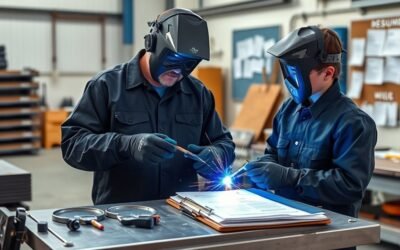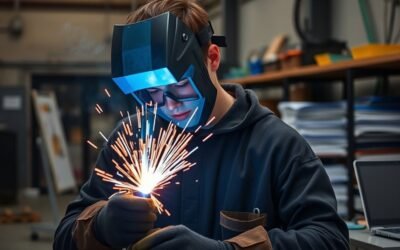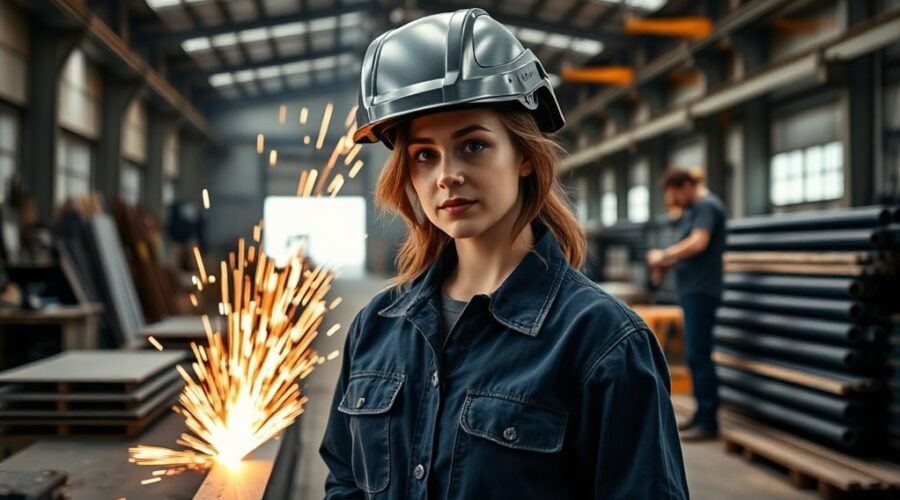
Welding can be a strong career option for women who enjoy hands-on, technical work and want a skill that can lead into manufacturing, construction, repair, structural fabrication, pipe work, inspection, and other specialized roles. The work rewards precision, consistency, safety awareness, and problem-solving. Training routes range from technical schools and community colleges to apprenticeships and employer-based instruction, while job-specific certification can strengthen employment options.
Quick Answer
Yes. Welding can be a solid career for women who enjoy practical, technical work. U.S. welders, cutters, solderers, and brazers had a median annual wage of $53,750 in May 2025, and BLS projects about 40,300 openings per year through 2035. Training, safe work practices, proper PPE, and job-specific qualifications matter most.
Key Takeaways
- The U.S. Bureau of Labor Statistics reports a $53,750 median annual wage for welders, cutters, solderers, and brazers as of May 2025.
- Women remain underrepresented: BLS data for 2025 show women were 5.8% of welding, soldering, and brazing workers.
- BLS projects about 40,300 openings per year for welders, cutters, solderers, and brazers from 2025 to 2035, largely from replacement needs.
- Technical school, community college, apprenticeship, employer training, and military training can all lead into welding careers.
- Certification should match the job. AWS Certified Welder testing is performance-based, while credentials such as CWI serve different career paths.
- Safe welding requires more than a helmet and gloves; ventilation, fume control, electrical safety, fire prevention, ergonomics, and correctly fitted PPE all matter.
Is Welding a Good Career for Women?
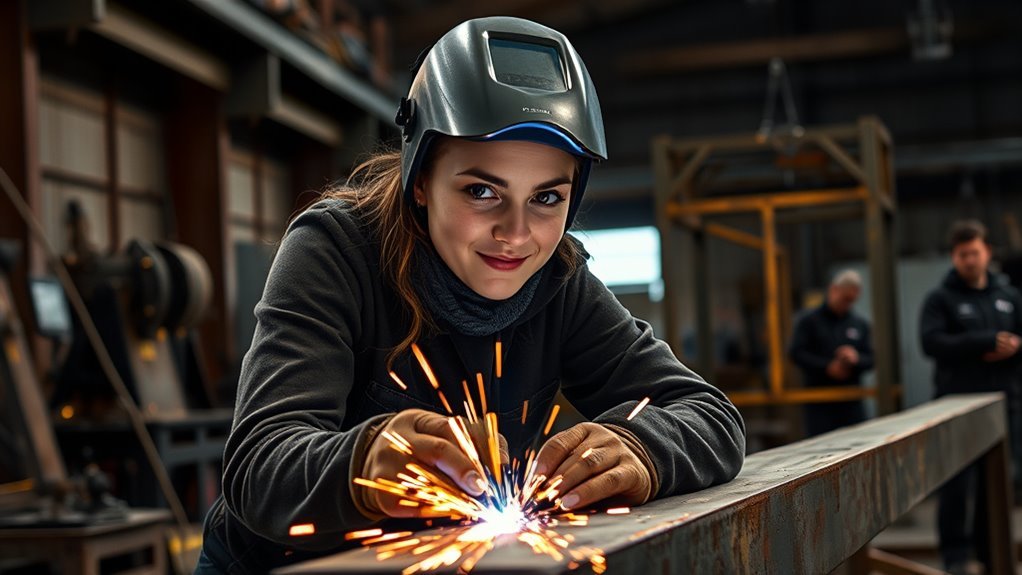
Yes—welding can be a strong career choice for women who like practical problem-solving, metalwork, equipment, and work where skill can be demonstrated directly.
The latest U.S. Bureau of Labor Statistics occupational outlook projects about 40,300 openings per year for welders, cutters, solderers, and brazers from 2025 through 2035. Employment itself is projected to grow about 2%, so many openings are expected to come from workers changing occupations or leaving the labor force rather than rapid expansion alone.
A broader American Welding Society workforce model counts six welding-related occupations rather than welders alone. That model estimates about 320,500 new welding professionals will be needed through 2029, or roughly 80,000 positions per year across those occupations. The two figures measure different groups, so they should not be treated as interchangeable.
Women accounted for 5.8% of U.S. welding, soldering, and brazing workers in the 2025 BLS annual-average workforce data.
The career path is usually straightforward: learn core welding processes, practice blueprint reading and shop math, build safe work habits, gain hands-on experience, and qualify for the procedures an employer needs. Some employers train entry-level workers, while others prefer applicants who have already completed technical training.
For people who want to practice more than one process, understanding equipment such as multi-process welders can also help clarify how MIG, TIG, and stick differ before specializing.
Women in Welding Jobs and Specialties
Women can work across the same welding specialties as other qualified welders. The right path depends on the material, industry, work environment, process, certification requirements, and whether someone prefers production work, field work, precision fabrication, repair, inspection, or leadership.
- Production and fabrication welding: Often uses MIG/GMAW, flux-cored welding, robotic systems, fixtures, and repeatable procedures.
- Structural welding: May involve stick, flux-cored, or wire processes on buildings, bridges, equipment, and fabricated structures.
- TIG welding: Common where precise heat and filler control are important, including stainless steel and aluminum fabrication.
- Pipe welding: Requires strong positional skills and often procedure-specific qualification tests.
- Repair and maintenance: Requires troubleshooting, process flexibility, joint preparation, and the ability to work around existing equipment.
- Automation and robotic welding: Combines welding knowledge with fixture setup, programming, process monitoring, and quality control.
- Inspection and education: Experienced welders may later pursue inspection, supervision, quality, or teaching credentials.
BLS reported that women made up 5.8% of welding, soldering, and brazing workers in 2025. Underrepresentation does not change the technical standards of the work: employers still need welds that meet the applicable procedure, specification, drawing, and acceptance criteria.
Learning how different machines support MIG, TIG, stick, and flux-cored work can make early training easier. A comparison of the importance of process support can help beginners understand which capabilities matter for different projects.
How Much Do Women Welders Earn?
There is no separate national welding wage scale for women. Pay varies by occupation, employer, location, experience, industry, shift, overtime, travel, union agreement, and the procedures a worker is qualified to perform.
According to BLS, the median annual wage was $53,750 for welders, cutters, solderers, and brazers in May 2025. The lowest 10% earned less than $39,240, while the highest 10% earned more than $77,530.
| BLS Wage Measure | May 2025 |
|---|---|
| Lowest 10% | Below $39,240 |
| Median | $53,750 |
| Highest 10% | Above $77,530 |
BLS also reported median wages of $59,440 for welders in specialty trade contractors, $56,080 in repair and maintenance, and $51,210 in manufacturing. These figures are national occupational benchmarks, not guarantees for a specific job.
Training and certification can make a worker eligible for jobs that require specific procedures, positions, materials, or code qualifications, but a credential does not automatically guarantee a particular salary.
Beginners comparing equipment and processes may also benefit from understanding versatile welding options before deciding which process to practice first.
Why Precision Matters in Welding
Precision is a core welding requirement because joint preparation, electrode or torch position, travel speed, heat input, fit-up, and technique can all affect weld quality.
BLS identifies detail orientation, manual dexterity, a steady hand, and hand-eye coordination as important qualities for welders. These are occupational skills that can be learned and refined through practice; they should not be treated as gender-specific traits.
TIG welding makes the need for coordination especially obvious because the operator may need to manage torch movement, arc length, filler addition, travel speed, and heat control at the same time. Understanding equipment features such as power range & waveform control can also help when learning how machine settings affect different materials.
Precision reduces defects and unnecessary rework while helping the finished weld meet the drawing, procedure, or code requirements that apply to the job.
Safety and Physical Demands in Welding
Welding can involve prolonged standing, bending, stooping, overhead work, awkward positions, lifting, heat, noise, bright arc radiation, electrical hazards, sparks, hot metal, and airborne contaminants.
The National Institute for Occupational Safety and Health notes that welding fumes can contain metals such as manganese and that confined-space welding can increase exposure. Fume control therefore requires more than simply putting on a respirator.
| Risk | Primary Controls | Practical Note |
|---|---|---|
| Fumes and gases | Ventilation, local exhaust, process controls, exposure assessment, respiratory protection when required | Keep fumes out of the breathing zone and follow site requirements. |
| Arc radiation and flying particles | Correct welding helmet, eye protection, screens, clothing | Use the correct protection for the process and amperage. |
| Heat, sparks, and fire | Flame-resistant clothing, gloves, housekeeping, fire controls | Remove or protect combustible material before welding. |
| Electrical hazards | Training, dry equipment, sound leads, correct setup and maintenance | Do not use damaged equipment or bypass safety procedures. |
| Lifting and awkward posture | Work positioning, lift aids, team lifts, adjustable fixtures, rest | Reduce unnecessary reach, twisting, and sustained awkward positions. |
Warning: Welding in tanks, vessels, pits, or other confined spaces can create serious atmospheric and fume hazards. Do not enter or weld in a confined space unless the required hazard assessment, ventilation, atmospheric testing, permits, supervision, and rescue procedures are in place.
PPE also needs to fit correctly. Oversized gloves, poorly fitting jackets, loose clothing, or an unstable helmet can make precise work harder rather than safer. Protective equipment such as flame-resistant clothing should be selected for the actual process and hazard.
Skills and Certifications Women Welders Need
Women entering welding need the same core technical abilities expected of other welders: safe setup, joint preparation, equipment adjustment, blueprint interpretation, measurement, process control, inspection awareness, and consistent bead placement.
Common processes include MIG/GMAW, TIG/GTAW, stick/SMAW, and flux-cored/FCAW. No beginner needs to master every process immediately, but broader exposure can make it easier to understand which specialty fits best.
Consumable selection also matters. Learning concepts such as electrode classification and low-hydrogen properties helps connect classroom theory with structural welding practice.
Essential Welding Skills
Strong welders develop a combination of technical and practical skills:
- Read blueprints, weld symbols, sketches, and specifications.
- Measure, fit, tack, and prepare joints accurately.
- Set voltage, amperage, wire speed, gas flow, polarity, and other process variables correctly.
- Control travel speed, work angle, travel angle, arc length, and filler addition.
- Recognize visible discontinuities and know when a weld needs correction.
- Maintain equipment and inspect leads, torches, guns, holders, regulators, and work connections.
- Follow ventilation, electrical, fire, hot-work, and PPE requirements.
- Communicate clearly with fitters, inspectors, supervisors, and other trades.
Key AWS Certifications
AWS credentials serve different purposes, so the right credential depends on the job.
The AWS Certified Welder (CW) program is performance-based. AWS states that there are no required prerequisite courses or minimum experience requirements. Candidates demonstrate their ability by completing a welding performance qualification test at an AWS Accredited Test Facility.
A Certified Welder qualification is specific to variables such as the process, material, position, procedure, and applicable code or specification. It should not be treated as a universal license to perform every type of welding.
Certified Welding Inspector (CWI) is a different professional path focused on inspection and code compliance. D1.1 Structural Steel and D15.1 Railroad endorsements are supplemental AWS credentials for eligible CWI/SCWI inspectors, not basic endorsements added to an ordinary Certified Welder card.
Certified Welding Educator (CWE) is intended for experienced welding educators and trainers. Someone early in a welding career generally does not need to pursue inspection or education credentials immediately.
Note: Employers may use AWS, ASME, API, military, company-specific, union, or other qualification requirements. Always check the actual job posting or employer procedure instead of assuming one certificate covers every welding position.
Hands-On Training Paths
There is no single required route into welding. BLS lists several common paths:
- Technical or vocational school: Concentrated welding instruction with shop practice.
- Community college: Welding certificates or associate-level programs that may include broader technical coursework.
- Apprenticeship: Paid work combined with structured instruction and supervised skill development.
- Employer training: Some employers hire inexperienced workers and train them on the job.
- Military training: The U.S. Armed Forces also offer welding-related training pathways.
Formal training does not eliminate the need for on-the-job learning. BLS notes that even workers who enter with technical training commonly receive additional workplace training.
Pro Tip: Before paying tuition, ask exactly how many supervised shop hours you receive, which processes and positions you practice, which qualification tests are included, what testing fees cost, and how the school calculates its job-placement rate.
How to Start a Welding Career as a Woman
A practical path into welding can be broken into six steps.
- Learn what the work is really like. Visit a training lab, fabrication shop, apprenticeship program, or career event if possible. Pay attention to heat, noise, PPE, work positions, shift schedules, and the physical environment.
- Learn the core processes. Start with one or two common processes such as MIG, stick, or TIG, then broaden your skills as your goals become clearer.
- Choose a training path. Compare technical schools, community colleges, apprenticeships, employer programs, and other recognized options.
- Build safety habits early. Learn ventilation, hot-work controls, electrical safety, cylinder handling, PPE, fire prevention, and proper equipment inspection before chasing speed.
- Prepare for qualification tests. Practice the specific joint, position, process, and material required for the jobs you want.
- Apply for entry-level jobs and expect a weld test. Many employers test applicants on the procedure they will use at work. A clean resume, reliable attendance, safe habits, and the ability to reproduce a sound weld matter more than exaggerated claims about experience.
How to Choose the Right Welding Training
Good welding training should provide enough supervised practice to develop repeatable skills, not just classroom theory. Compare programs by what they actually teach and test.
Students exploring equipment with multi-process capability should remember that owning or practicing on capable equipment is only one part of training; instructor feedback, procedure discipline, safety, and inspection matter just as much.
| Criterion | What to Check |
|---|---|
| Hands-on lab time | How many supervised welding hours are included? |
| Processes taught | MIG, TIG, stick, FCAW, cutting, joint preparation, blueprint reading, and inspection basics as appropriate. |
| Certification testing | Which qualification tests are included, where testing occurs, and whether extra fees apply. |
| Safety program | Ventilation, electrical safety, hot work, cylinders, PPE, fire prevention, and shop procedures. |
| Placement data | Ask for the reporting period, sample size, definition of “placed,” and whether jobs are welding-related. |
| Total cost | Tuition plus PPE, consumables, tools, testing fees, housing, transportation, and lost work time. |
| Employer connections | Ask which employers recruit graduates and what qualifications those employers require. |
| Schedule and support | Check evening options, tutoring, mentorship, financial aid, and job-search support. |
Women Who Weld and Similar Programs
Women Who Weld was created in 2014 and offers welding training designed to expand access to the trade.
Its current program page lists week-long intensive welding classes held throughout the year. Participants must be at least 18, and the organization currently lists the participant cost at $800. It also offers single-day introductory workshops, currently listed at $125.
The organization states that its intensive program is intended to prepare participants for full-time work, apprenticeships, continuing education, or other welding goals. It may assist intensive-program participants with job placement, but participants are still responsible for applying, interviewing, and passing any required employer weld test.
- Single-day workshops provide introductory exposure to gas metal arc welding.
- Week-long classes provide more concentrated practice.
- Training can help participants evaluate whether welding suits their interests before making a larger education commitment.
- Peer contact can provide a support network for people entering a heavily male-dominated occupation.
As beginners spend more time in the shop, they also become familiar with workstation essentials such as clamps, fixtures, PPE, and welding tables.
Real Challenges Women Welders Face
A welding career can be rewarding, but it is not automatically easy. Women may enter shops where very few coworkers are women, and the job itself can involve difficult positions, long shifts, heat, heavy material, noise, fumes, and strict production or quality requirements.
A useful way to evaluate a workplace is to look for measurable standards: clear weld procedures, consistent safety rules, transparent pay structures, documented qualification requirements, usable PPE, appropriate lifting equipment, and supervisors who evaluate work by observable performance.
Correctly fitted protective equipment matters as well. Choosing suitable premium materials should never take priority over fit, dexterity, heat protection, and the hazards of the actual process.
Gender Bias On Job Sites
Women can encounter skepticism or unequal treatment in occupations where they remain a small minority. The most practical response inside a professional workplace is to make performance as measurable as possible.
- Know the written weld procedure and acceptance criteria.
- Track certifications and qualification dates.
- Ask supervisors for specific, job-related feedback.
- Keep records of completed training and successful weld tests.
- Use established workplace reporting channels when treatment becomes inappropriate or interferes with safe work.
Objective standards benefit everyone because they make expectations clearer and reduce reliance on assumptions about who “looks like” a welder.
Physical Demands And Safety
BLS notes that welders may lift heavy objects, work overhead, bend, stoop, stand for long periods, and work in confined areas. These demands apply to the job rather than to one gender.
Good ergonomics can reduce unnecessary strain. Position the work when possible, use fixtures and lift aids, ask for team lifts when appropriate, and avoid turning preventable fatigue into an injury risk.
Helmets, gloves, protective clothing, footwear, hearing protection, and respiratory protection must match the hazards and fit the person using them. Poorly fitted PPE can interfere with movement, visibility, and dexterity.
Finding Support And Mentorship
Because women remain a small share of the welding workforce, mentorship and peer networks can help new welders learn how local employers hire, which qualifications matter, how weld tests are run, and which specialties offer the best fit.
- Ask instructors which employers regularly hire graduates.
- Attend AWS section events, career fairs, or employer demonstrations when available.
- Use apprenticeship and workforce-development programs to meet working tradespeople.
- Seek mentors who give specific technical feedback rather than generic encouragement.
Programs such as Women Who Weld provide one route to that community, but useful mentors can also come from instructors, experienced coworkers, inspectors, supervisors, unions, apprenticeship programs, and professional associations.
Career Growth for Women in Welding
A welding career does not have to stop at an entry-level fabrication position. Advancement usually comes from stronger technical ability, broader procedure qualifications, industry knowledge, reliability, and experience solving more difficult problems.
Possible career directions include:
- Production or fabrication welder
- Structural welder
- Pipe welder
- Fitter-welder
- Maintenance or repair welder
- Robotic welding operator or technician
- Lead welder or working supervisor
- Welding inspector after meeting the applicable credential requirements
- Welding instructor or educator after developing sufficient experience
- Quality, planning, estimating, or project-management roles
The occupation also continues to change as automated and robotic welding expand. That does not eliminate the value of welding knowledge; it can shift some opportunities toward setup, programming, troubleshooting, inspection, and process control.
Building fundamentals on processes such as stick welding can still be useful for field and structural work, and reviewing strong placement outcomes should be paired with real practice and job-specific qualification requirements.
Frequently Asked Questions
Do female welders make good money?
They can. BLS reports a $53,750 national median annual wage for welders, cutters, solderers, and brazers as of May 2025. Pay varies by location, experience, industry, employer, shift, overtime, and job qualifications rather than having one wage level for all welders.
Is it hard to get a job as a female welder?
The difficulty depends on the local labor market, experience, qualifications, and the type of welding. Many employers use practical weld tests, so being able to reproduce a sound weld to the required procedure can be more important than simply listing a course or certificate on a resume.
How much does a beginner welder make?
There is no single national beginner-welder salary. The BLS occupation-wide median was $53,750 in May 2025, while the lowest 10% earned below $39,240. Entry-level pay can differ substantially by region, industry, shift, employer, union agreement, and the qualifications required for the job.
Can you make $200,000 as a welder?
It is possible for unusual individual situations to reach very high total earnings, but $200,000 is not representative of normal U.S. welder wages. BLS reports that the highest 10% of welders, cutters, solderers, and brazers earned above $77,530 in May 2025. Earnings far beyond that level may involve exceptional overtime, travel, remote work, contracting, specialized responsibilities, or movement into another advanced role.
Do women need to be very strong to become welders?
Welding can require stamina, lifting, bending, standing, and work in awkward positions, but not every welding job has the same physical demands. Fixtures, cranes, carts, lift tables, team lifts, and better work positioning can reduce unnecessary manual handling. Applicants should evaluate the actual job rather than assuming every welding role requires the same level of strength.
Which welding process should a beginner learn first?
It depends on the career goal. MIG is common in fabrication and production and is often approachable for beginners. Stick is valuable in structural and field work. TIG develops precise torch and filler control and is widely used where clean, controlled welds are important. A good training program exposes students to several processes before they specialize.
Conclusion
Women can build successful welding careers in fabrication, construction, repair, pipe work, manufacturing, inspection, education, automation, and related technical fields. The most reliable path is to focus on measurable skills: safe work habits, accurate setup, repeatable weld quality, blueprint knowledge, practical experience, and qualifications that match the job.
The occupation remains heavily male-dominated, but that does not change the technical standard. Current BLS data show real employment opportunities and a national median wage above $53,000, while programs such as Women Who Weld can provide additional training and peer support. Choose training carefully, take safety seriously, and build qualifications around the work you actually want to perform.
Sources
- U.S. Bureau of Labor Statistics — Welders, Cutters, Solderers, and Brazers — wages, job outlook, training, work environment, and occupational requirements.
- U.S. Bureau of Labor Statistics — Employed People by Detailed Occupation and Sex — 2025 workforce demographic data.
- AWS-Endorsed Welding Workforce Data — broader welding-professional workforce projections through 2029.
- American Welding Society — Certified Welder Program — performance testing, Accredited Test Facilities, eligibility, and certification maintenance.
- NIOSH — Welding Fumes and Manganese — welding-fume exposure, confined-space risk, and occupational health guidance.
- Women Who Weld — Training Programs — current intensive and introductory program details.