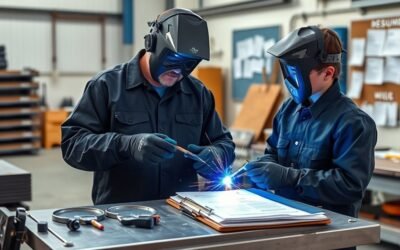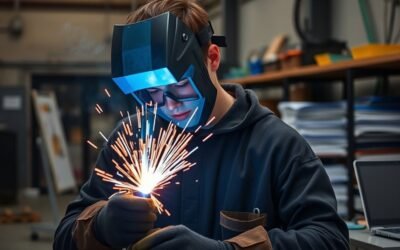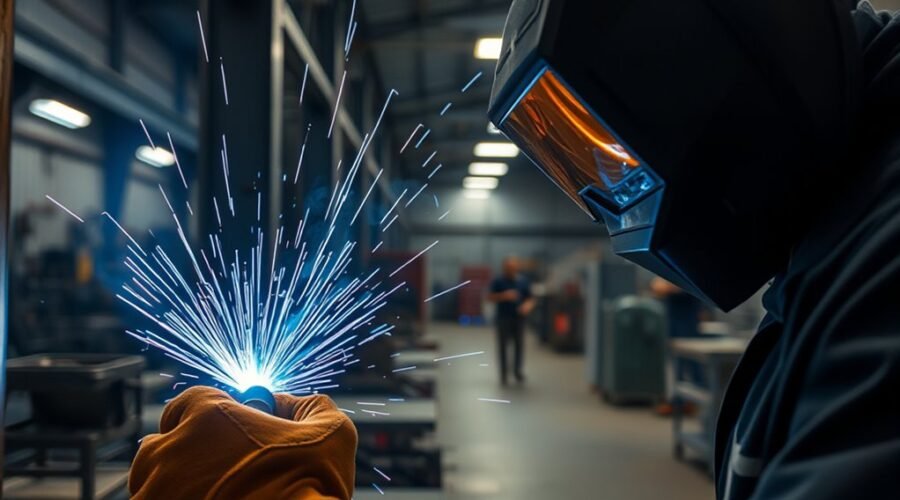
Welding is a practical skilled trade for people who want hands-on work without necessarily completing a four-year college degree. Welders join, repair, and cut metal in manufacturing plants, construction projects, repair shops, shipyards, and other industrial settings. The career can offer several routes into specialized work, but pay, working conditions, certification requirements, and advancement opportunities vary considerably by employer and occupation.
Quick Answer
Welding remains a viable U.S. skilled-trade career in 2026. The Bureau of Labor Statistics reports a $53,750 median annual wage in May 2025, 2% projected employment growth from 2025 to 2035, and about 40,300 openings per year. Training, certification, location, specialization, overtime, and related trade skills can substantially affect earnings.
Key Takeaways
- Welders, cutters, solderers, and brazers had a U.S. median annual wage of $53,750 in May 2025.
- Employment is projected to grow 2% from 2025 to 2035, with about 40,300 openings per year, mainly because workers change occupations or leave the labor force.
- A high school diploma or equivalent plus technical and on-the-job training is the typical entry route; a four-year college degree is not normally required.
- AWS Certified Welder certification is performance-based and has no formal education prerequisite, although employers may require specific welding qualifications.
- Related paths include pipefitting, boilermaking, commercial diving, welding inspection, education, and automated or robotic welding work.
- Automation is changing repetitive production welding, but fit-up, troubleshooting, inspection, programming, repair, and complex manual work still require trained people.
What Welders Do and Where They Work
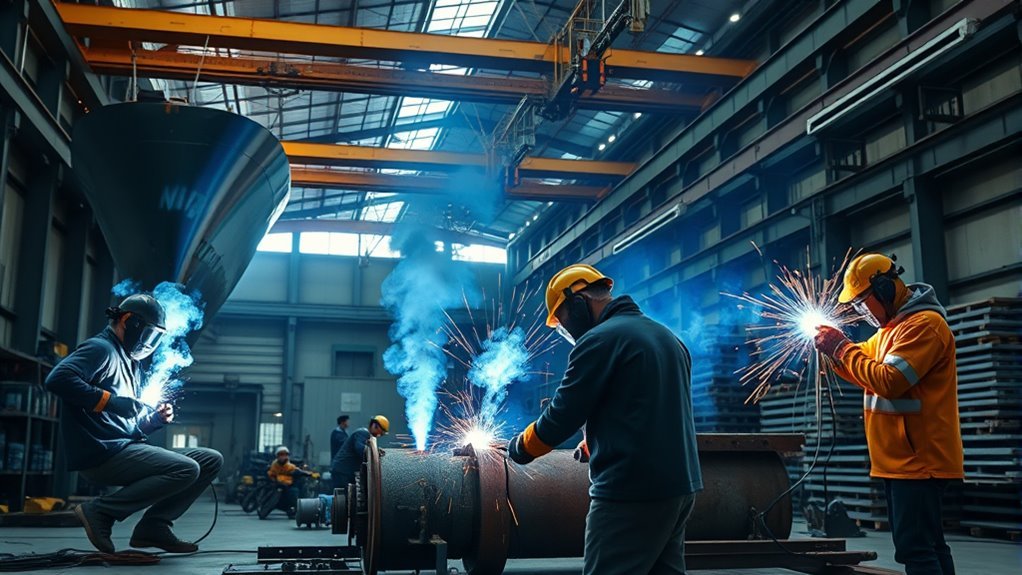
The U.S. Bureau of Labor Statistics (BLS) defines welders, cutters, solderers, and brazers as workers who use hand-held or remotely controlled equipment to join, repair, or cut metal parts and products.
The work involves more than creating a weld bead. Depending on the job, a welder may read drawings, measure and align parts, prepare joints, select welding parameters, follow a welding procedure specification, control heat input, inspect finished work, grind or finish welds, and document completed jobs.
Manufacturing is the largest employer of this occupational group. BLS reports that manufacturing accounted for about 63% of welder, cutter, solderer, and brazer jobs in 2025, followed by specialty trade contractors, repair and maintenance businesses, and other employers.
The U.S. median annual wage for welders, cutters, solderers, and brazers was $53,750 in May 2025, while about 40,300 openings per year are projected from 2025 through 2035.
Work environments vary. A welder may spend the day in a climate-controlled production facility, outdoors on structural steel, inside a repair shop, on a platform, or in a restricted area. Some jobs require evenings, weekends, overtime, or travel.
Warning: Welding can expose workers to metal fumes, ultraviolet radiation, hot materials, burns, eye injuries, electrical hazards, fire, and other risks. OSHA requires appropriate controls and protective equipment. Confined-space welding may require mechanical ventilation, respiratory protection, outside attendants, or other safeguards depending on the conditions.
Stamina, dexterity, spatial awareness, accurate measurement, and consistent technique all matter. Beginners also benefit from learning on suitable equipment, including versatile welding machines that allow practice with the processes relevant to their training.
How to Become a Welder
The typical U.S. entry path combines basic education with technical and on-the-job training. BLS lists a high school diploma or equivalent as the typical entry-level education for welders, cutters, solderers, and brazers, followed by moderate-term on-the-job training.
| Step | What to Learn | Why It Matters |
|---|---|---|
| High school or equivalent | Basic math, measurement, reading, and shop safety | Builds entry-level foundations |
| Technical or vocational training | Processes, welding positions, metallurgy, drawings, and hands-on practice | Develops practical welding ability |
| On-the-job training or apprenticeship | Production standards, fit-up, procedures, safety, and real job conditions | Builds workplace experience |
| Qualification or certification | Demonstrate ability on the required process, material, position, and procedure | Verifies specific welding skills |
| Specialization | Pipe, structural, TIG, inspection, automation, repair, or another field | Creates additional career options |
There is no single training duration for every welder. Some technical programs prepare beginners for entry-level jobs in months, while other routes involve longer employer training or apprenticeships. Related trades such as pipefitting and boilermaking commonly use formal apprenticeships that take considerably longer.
The American Welding Society Certified Welder program is performance-based. AWS does not require a particular education level, previous certification, or minimum amount of experience before a candidate takes the applicable performance qualification test at an accredited testing facility.
Note: Certification and job qualification are not always the same thing. A contractor, employer, code, customer, or project may require a welder to qualify for a specific process, position, material, thickness range, or welding procedure even when that worker already holds another credential.
Apprenticeship opportunities also vary by occupation and area. The U.S. Department of Labor maintains an Apprenticeship.gov occupation database for registered apprenticeship pathways.
Learning several processes can increase versatility. MIG, TIG, Stick, and flux-cored welding each have different applications, and hands-on familiarity with MIG, TIG, and Stick welding can help a new welder discover which type of work best fits their goals.
Skills Employers Value in Welders
Running a welding machine is only part of professional welding. Employers may also look for skills that help a worker produce acceptable welds repeatedly and safely.
- Blueprint and welding-symbol reading: understanding dimensions, joint details, tolerances, and weld locations.
- Fit-up and preparation: aligning parts, setting root openings, cleaning material, beveling edges, and controlling distortion.
- Process knowledge: choosing appropriate techniques for SMAW, GMAW, GTAW, FCAW, or other processes used by the employer.
- Measurement: using tapes, squares, gauges, calipers, and fabrication tools accurately.
- WPS discipline: following approved welding procedure requirements instead of selecting settings by guesswork.
- Inspection awareness: recognizing common discontinuities and knowing when work needs further inspection or repair.
- Safety: controlling arc exposure, fumes, fire risks, electrical hazards, hot work, and nearby personnel exposure.
- Troubleshooting: identifying problems with wire feed, shielding gas, consumables, setup, joint preparation, or welding parameters.
Pro Tip: Build skills around the jobs available in your area rather than collecting processes at random. A structural shop, pipeline contractor, stainless fabrication company, shipyard, and automated manufacturing plant may value very different qualifications.
Welding Pay by Industry and Location
National salary ranges are more useful when they come from a consistent dataset. According to BLS, welders, cutters, solderers, and brazers had a median annual wage of $53,750 in May 2025. The lowest 10% earned less than $39,240, while the highest 10% earned more than $77,530.
| Wage Measure | May 2025 BLS Wage |
|---|---|
| Lowest 10% | Less than $39,240 |
| Median | $53,750 |
| Highest 10% | More than $77,530 |
BLS also reports different medians among major employing industries:
| Industry | Median Annual Wage, May 2025 |
|---|---|
| Specialty trade contractors | $59,440 |
| Repair and maintenance | $56,080 |
| Manufacturing | $51,210 |
Location still matters. Local labor demand, the type of industry in the area, experience, credentials, shift schedules, travel, and overtime opportunities can all influence actual earnings. A national median therefore should not be treated as a guaranteed starting salary.
Specialized TIG experience can be useful in stainless, aluminum, aerospace, sanitary fabrication, and other applications where precise heat control matters. Welders building that skill may practice with dedicated or multi-process equipment, including the types covered in this guide to TIG welding equipment.
What About Underwater Welding Pay?
“Underwater welder” is not a separate national BLS wage category. BLS tracks commercial divers, whose work may include inspection, repair, cutting, rigging, and the use of welding equipment underwater. Commercial divers had a median annual wage of $72,990 in May 2025.
That figure should not be presented as the guaranteed salary for an underwater welder. Commercial diving requires specialized diving training and exposes workers to hazards and working conditions that are very different from conventional shop welding.
Can Welders Really Earn $100,000?
Some welding professionals can reach six-figure annual earnings, but that is not typical for the standard welder occupation. BLS reports that the highest 10% of welders, cutters, solderers, and brazers earned more than $77,530 in May 2025. Higher annual earnings may occur in specialized assignments, extensive overtime or travel work, supervisory positions, or related trades with different wage structures.
For example, plumbers, pipefitters, and steamfitters had a $63,800 median annual wage in May 2025, and the highest 10% earned more than $108,420. That occupation is related to welding but is not statistically the same job as a general welder.
Welding Job Outlook in 2026
The latest BLS outlook projects modest growth rather than rapid expansion. Employment of welders, cutters, solderers, and brazers is projected to increase from about 437,700 jobs in 2025 to about 448,100 in 2035.
| Indicator | Latest BLS Outlook |
|---|---|
| Employment base | 437,700 jobs in 2025 |
| Projected employment | 448,100 jobs in 2035 |
| Projected growth | 2% from 2025 to 2035 |
| Net new jobs | About 10,300 |
| Average annual openings | About 40,300 |
| Median annual wage | $53,750 in May 2025 |
The distinction between job growth and job openings matters. The occupation is projected to add only about 10,300 net jobs over the decade, but BLS expects far more openings each year because workers transfer to other occupations or leave the labor force.
BLS also expects aging infrastructure to require welding expertise for bridges, highways, buildings, and other work. Manufacturing will continue to need welding in the production of metal products and machinery. However, BLS specifically notes that automation in manufacturing may limit overall demand.
Equipment knowledge therefore remains useful, whether a worker is manually setting up MIG welding equipment or working in a production environment where automated systems perform repeated welds.
How AI and Robotic Welding Are Changing the Trade
Automation is already part of welding, especially in high-volume manufacturing. Industrial robots can repeatedly position a torch and produce programmed welds on consistent parts. OSHA notes that industrial robots are widely used for welding as well as material handling, assembly, painting, and other manufacturing tasks.
That does not mean every manual welding job disappears. Automated welding systems still require people to prepare and locate parts, design fixtures, verify procedures, program or teach equipment, change consumables, inspect welds, troubleshoot defects, maintain systems, and handle work that varies too much for repetitive automation.
BLS nevertheless says automation may limit overall demand for welders in manufacturing. A useful long-term strategy is therefore to combine hands-on welding ability with skills such as fabrication, inspection, robot operation, maintenance, programming, quality control, or troubleshooting.
Robotic equipment also creates its own hazards. OSHA warns that serious accidents can occur during programming, maintenance, testing, setup, and adjustment when workers enter a robot’s operating area. Automated welding should therefore be treated as a different technical environment, not simply as a safer replacement for manual welding.
Welding Career Paths to Consider
Welding experience can lead into several occupations, but their wages, training requirements, and employment outlooks should not be treated as interchangeable.
| Career Path | 2025 Median Pay | 2025–2035 Outlook | Important Context |
|---|---|---|---|
| Welder, cutter, solderer, or brazer | $53,750 | 2% growth | Broadest general welding category |
| Pipefitter / steamfitter category | $63,800 | 7% growth | Usually learned through apprenticeship; welding may be part of the trade |
| Boilermaker | $76,410 | 2% decline | Physically demanding work; apprenticeship is typical |
| Commercial diver | $72,990 | 5% growth | May use welding equipment underwater; specialized diving training required |
| Welding machine setter/operator/tender | $47,920 | Employment projected to decline | Works with mechanized or automated welding equipment |
Boilermakers assemble, install, maintain, and repair boilers, vats, and other large vessels. Welding can be a major part of the work. The pay is higher than the general welder median, but BLS projects boilermaker employment to decline 2% from 2025 to 2035, with about 700 openings per year.
Pipefitters and steamfitters install and repair piping systems and may perform significant welding. BLS projects the broader plumbers, pipefitters, and steamfitters occupation to grow 7% from 2025 to 2035. Most learn through apprenticeships.
Commercial divers work below the water surface and may use welding and cutting equipment for repair and installation. The occupation requires diving competence in addition to fabrication skills, making it very different from conventional welding.
Robotic welding and automation work can involve operating, setting up, troubleshooting, or maintaining automated systems. Job titles vary widely, so there is no single national BLS salary category called “robotic welding technician.” Workers who combine welding knowledge with maintenance, controls, programming, or inspection can qualify for a broader range of industrial roles.
Welding educators and inspectors are another route for experienced workers who develop deeper knowledge of welding processes, codes, quality systems, documentation, and communication. Education, experience, and certification requirements vary by position.
Multi-process experience can also be useful in smaller fabrication shops where one worker may handle several types of jobs. Practicing on multi-process welding equipment can help build familiarity, although professional qualification still depends on producing acceptable welds under the procedures required for the job.
Advantages and Tradeoffs of a Welding Career
Welding can be attractive because the typical entry path does not require a bachelor’s degree, the skills transfer across many industries, and workers can specialize as their experience grows. At the same time, the trade has working conditions that should be considered before choosing it solely for salary.
| Potential Advantage | Tradeoff to Consider |
|---|---|
| Entry without a four-year degree | Technical training and repeated hands-on practice are still required |
| Multiple industries and specialties | Qualifications may not transfer automatically between every process or project |
| Opportunities for overtime or travel | Long shifts and time away from home may be required |
| Hands-on, visible results | Work can involve heat, noise, awkward positions, fumes, and physical strain |
| Path into inspection, teaching, automation, or supervision | Advancement often requires additional experience, technical knowledge, or credentials |
A good career decision therefore depends on more than the national median salary. Consider the industries near you, available training, expected working conditions, schedule, safety culture, advancement paths, and whether you enjoy precise physical work.
Frequently Asked Questions
What Is the Career Outlook for a Welder?
BLS projects employment of welders, cutters, solderers, and brazers to grow 2% from 2025 to 2035. About 40,300 openings are projected each year on average, mainly because workers transfer to other occupations or leave the labor force rather than because of rapid net job growth.
Can Welders Make $100,000 a Year?
Yes, some welding professionals can earn $100,000 or more, but it is not typical for the general welder occupation. BLS reports a $53,750 median annual wage for welders in May 2025, with the highest 10% earning more than $77,530. Six-figure earnings are more likely in particular specialized, overtime-heavy, supervisory, travel, or related trade roles.
Is It Worth Becoming a Welder in 2026?
Welding can be a practical career for someone who prefers hands-on technical work and wants an entry route that normally does not require a bachelor’s degree. The trade has about 40,300 projected openings per year, but it also involves physical work, safety hazards, possible shift work, and modest overall employment growth. Whether it is worthwhile depends on your local job market, training costs, working preferences, and specialization goals.
Is AI Replacing Welders?
Automation is replacing some repetitive welding tasks, particularly in manufacturing, and BLS says automation may limit overall demand. However, automated systems still need people for fabrication, fit-up, programming, setup, maintenance, troubleshooting, inspection, repair, and work that changes too frequently for fixed automation. Learning both welding and automation-related skills can expand career options.
Do You Need a College Degree to Become a Welder?
Usually not. BLS lists a high school diploma or equivalent as the typical entry-level education for welders, cutters, solderers, and brazers. Technical-school courses, vocational programs, apprenticeships, and employer training can provide the practical skills needed for employment.
Do You Need AWS Certification to Work as a Welder?
There is no single AWS certification required for every welding job. The AWS Certified Welder program is a performance-based credential with no educational prerequisite, but individual employers, codes, contracts, and projects may require particular welding qualifications for specific processes, materials, positions, or procedures.
Conclusion
Welding remains a practical skilled-trade career in 2026, but the strongest case for entering the field comes from realistic expectations rather than exaggerated salary promises. The latest BLS data place the median annual wage at $53,750, with 2% projected employment growth from 2025 to 2035 and about 40,300 openings per year.
Workers can expand their options by combining strong welding fundamentals with blueprint reading, fit-up, inspection, safety, fabrication, specialized qualifications, or automation skills. Related paths such as pipefitting, boilermaking, commercial diving, education, inspection, and robotic welding each have different training requirements and employment conditions. For someone who enjoys precise hands-on work and accepts the physical and safety demands of the trade, welding can provide a clear route into a range of industrial careers.
Sources
- U.S. Bureau of Labor Statistics — Welders, Cutters, Solderers, and Brazers — current national pay, employment, training, industry, and 2025–2035 outlook data.
- American Welding Society — Certified Welder Program — certification eligibility, performance testing, and credential requirements.
- Occupational Safety and Health Administration — Welding, Cutting, and Brazing Hazards — welding fumes, radiation, PPE, burns, electrical hazards, and safety controls.
- U.S. Department of Labor — Apprenticeship Occupations — registered apprenticeship pathways and occupation information.
- U.S. Bureau of Labor Statistics — Plumbers, Pipefitters, and Steamfitters — current wage, apprenticeship, and employment-projection data for this related trade.
- U.S. Bureau of Labor Statistics — Occupations Not Covered in Detail — commercial-diver wage, education, and outlook data.