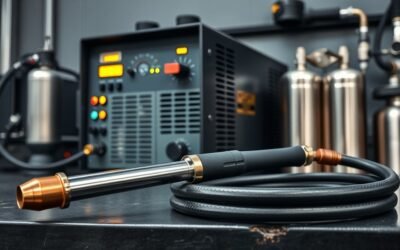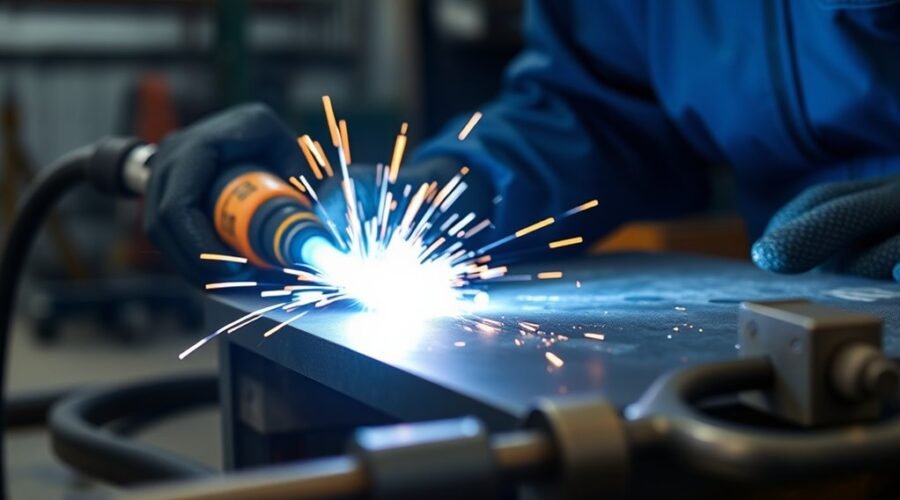
Plasma arc welding (PAW) is a precision arc-welding process that uses a non-consumable tungsten electrode and a constricted plasma arc to concentrate heat into a relatively small area. Depending on the operating mode, PAW can handle extremely thin material, conventional melt-in welding, or deep-penetration keyhole welding. Its concentrated arc can provide narrow welds, controlled penetration, and high travel speeds in suitable mechanized applications.
Quick Answer
Plasma arc welding is a tungsten-electrode welding process in which ionized gas is forced through a small copper nozzle to create a narrow, concentrated arc. It operates in microplasma, melt-in, and keyhole modes, allowing PAW to weld everything from very thin material to deeper, full-penetration joints under suitable conditions.
Key Takeaways
- PAW uses a tungsten electrode, a constricting nozzle, plasma gas, and a separate shielding-gas envelope to create a focused welding arc.
- Commonly cited operating ranges are about 0.1–15 A for microplasma, 15–200 A for medium-current or melt-in welding, and above roughly 100 A for keyhole welding.
- Microplasma is suited to delicate thin sections, while keyhole PAW can produce deep, full-penetration welds at relatively high travel speeds.
- Compared with TIG, PAW can provide a stiffer arc, deeper penetration, and greater tolerance to changes in torch-to-work distance, but it uses more complex equipment.
- Process control, nozzle condition, gas flow, fit-up, ventilation, eye protection, and other welding-safety practices are critical to consistent PAW results.
What Is Plasma Arc Welding?
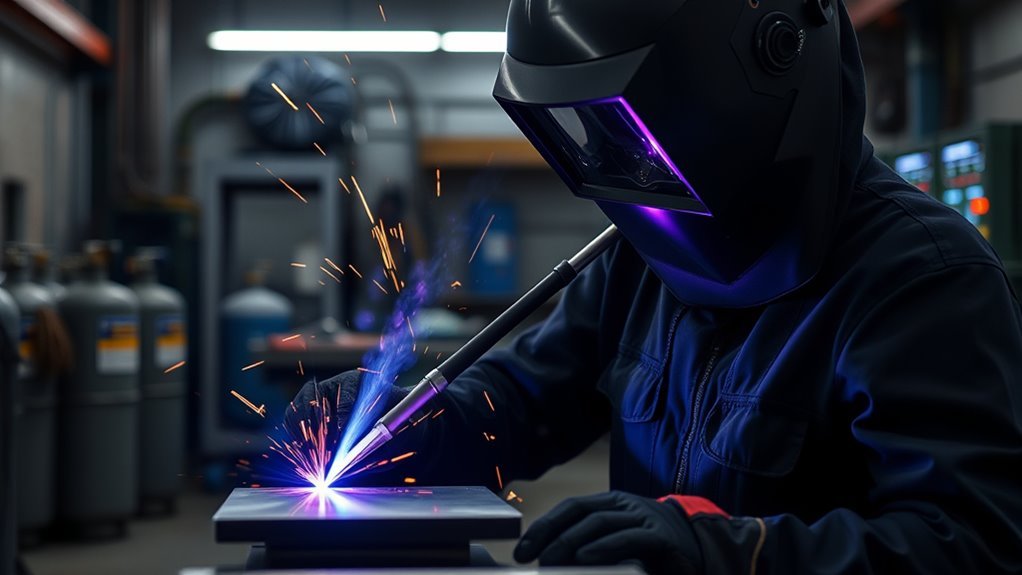
Plasma arc welding (PAW) is an arc-welding process closely related to gas tungsten arc welding, commonly called TIG or GTAW. In both processes, an electric arc is associated with a non-consumable tungsten electrode. The important difference is that a PAW torch positions the electrode behind a fine-bore copper nozzle that constricts the arc into a narrow plasma column.
According to TWI’s plasma arc welding guidance, this constricted arrangement produces a relatively stiff, concentrated arc and allows the plasma flow to be separated from the outer shielding-gas envelope.
The plasma is an electrically conductive ionized gas. Temperatures in the plasma jet can approach roughly 20,000°C, although the actual thermal conditions at the weld depend on current, gas flow, torch design, arc length, material, travel speed, and operating mode.
Because PAW concentrates its energy into a relatively small area, it can produce narrow weld profiles and controlled penetration. Microplasma is used for very thin material, while higher-energy keyhole welding can create full penetration through substantially thicker sections.
PAW is used with stainless steel, nickel alloys, titanium alloys, carbon and alloy steels, aluminum, copper alloys, and other weldable metals. Applications include tubes and pipes, aerospace and space components, instrumentation, medical-device manufacturing, electronic assemblies, and other precision fabrication.
How Plasma Arc Welding Works
A typical PAW system starts an internal pilot arc between the tungsten electrode and the copper nozzle. When welding begins, the working arc is transferred to the workpiece. The plasma gas passing through the nozzle becomes ionized and is forced through the small orifice, creating the narrow plasma column used for welding.
A separate shielding-gas flow surrounds the arc and molten weld pool. The two gas streams serve different purposes: the inner plasma gas helps form and sustain the constricted arc, while the outer shielding gas limits atmospheric contamination of the molten metal.
| Component or Function | What It Does |
|---|---|
| Tungsten electrode | Carries the welding current without acting as the normal filler metal. |
| Copper constricting nozzle | Forces the arc through a small opening and creates the concentrated plasma column. |
| Plasma gas | Flows through the constricting nozzle and becomes part of the plasma jet. |
| Shielding gas | Surrounds the weld zone and helps protect molten metal from the atmosphere. |
| Pilot arc | Provides reliable arc initiation before the working arc transfers to the workpiece. |
| Power source and control system | Controls current and coordinates the welding and gas-flow sequence. |
PAW equipment commonly uses a DC constant-current power source. Purpose-built plasma welding systems are available, and some installations use a plasma-control unit with a compatible TIG-type power source.
Transferred vs. Non-Transferred Plasma Arcs
A plasma arc can be configured in two basic ways:
- Transferred arc: the main arc is established between the tungsten electrode and the workpiece. Because the workpiece is part of the electrical circuit, this arrangement transfers substantial energy into the joint and is the normal configuration for high-energy welding such as keyhole PAW.
- Non-transferred arc: the arc remains between the electrode and the constricting nozzle, while the hot plasma jet carries heat toward the work. The workpiece itself is not part of the main arc circuit.
Linde’s PAW process guidance describes both configurations and notes the higher energy efficiency and deeper penetration associated with transferred-arc operation.
Plasma Gas and Shielding Gas
Argon is widely used as the plasma gas because it provides reliable arc starting and stable operation. Shielding-gas selection depends on the material and procedure. Argon, argon-hydrogen mixtures, helium, and helium-containing mixtures may be used in appropriate applications.
The correct gas is material-dependent. Hydrogen-containing shielding mixtures, for example, are not appropriate for every alloy. The equipment manufacturer’s procedure and an approved welding procedure should therefore determine gas composition and flow rather than a generic setting.
Note: Plasma-gas flow is not simply a shielding adjustment. Changing it also changes arc force and penetration, so excessive or insufficient flow can destabilize the weld or keyhole.
PAW Modes: Microplasma, Melt-In, and Keyhole
Plasma arc welding is commonly divided into three operating ranges. The boundaries below are useful reference points rather than universal machine settings because actual operating windows vary with torch design, nozzle size, material, thickness, gas flow, and procedure.
| PAW Mode | Typical Current Range | Typical Use |
|---|---|---|
| Microplasma | About 0.1–15 A | Very thin sheet, foil, wire, mesh, and precision components |
| Medium current / melt-in | Commonly about 15–200 A | Conventional fusion welding where deeper penetration or a stiffer arc than TIG is useful |
| Keyhole | Generally above about 100 A | Deep-penetration, usually mechanized welding of thicker sections |
Microplasma Welding
Microplasma operates at very low current and produces a narrow, stable arc. TWI lists a typical range of 0.1–15 A and reports applications involving material down to about 0.1 mm thick. The stiff arc helps reduce arc wandering, making microplasma useful for small components, thin sheet, wire, and mesh.
Melt-In or Medium-Current PAW
Medium-current PAW behaves more like conventional TIG welding but uses the constricted plasma arc. TWI gives a typical range of 15–200 A. The process can provide deeper penetration and greater tolerance to variations in electrode-to-work distance than TIG in suitable applications.
Keyhole Plasma Welding
Keyhole PAW increases welding current and plasma-gas flow until the concentrated plasma beam penetrates through the joint and creates an opening, or keyhole. As the torch moves forward, molten metal flows around and behind the keyhole and solidifies into the weld.
TWI reports that keyhole PAW can achieve full penetration in stainless steel up to about 10 mm thick under suitable conditions, although approximately 6 mm is a more usual upper range for straightforward single-pass welding. Thicker joints may require joint preparation, filler metal, or additional passes.
Keyhole PAW combines a highly concentrated arc with controlled plasma-gas flow to create deep penetration and potentially high welding speeds, but the keyhole must remain stable throughout the weld.
What Controls Plasma Weld Quality?
PAW is precise, but that precision depends on maintaining the correct process window. Important variables include:
- Welding current: affects heat input and penetration.
- Plasma-gas flow: influences arc force and keyhole formation.
- Nozzle bore diameter: affects arc constriction and must match the current and gas-flow range.
- Electrode setback: influences the arc emerging from the constricting nozzle.
- Travel speed: affects penetration, bead width, heat input, and keyhole stability.
- Torch-to-work distance: PAW can be relatively tolerant of distance changes, especially compared with TIG, but the procedure still needs a controlled torch position.
- Joint fit-up: keyhole PAW can require tighter and more consistent fit-up than broader-arc processes.
- Filler-wire feed: when filler is used, its position and rate must be coordinated with the keyhole and weld pool.
Incorrect combinations can lead to unstable penetration, undercut, underfill, excessive nozzle wear, loss of the keyhole, or an incompletely closed keyhole at the end of a weld.
Pro Tip: Consistent PAW depends heavily on torch condition. Inspect the electrode position and constricting nozzle regularly, and use the nozzle size, current limit, gas flow, and electrode setback specified by the torch manufacturer.
Plasma Arc Welding vs. TIG Welding
PAW and TIG both use non-consumable tungsten electrodes, but their arc geometry is different. TIG exposes a broader arc directly to the weld area, while PAW constricts its arc through a nozzle before the plasma reaches the workpiece.
| Characteristic | Plasma Arc Welding | TIG / GTAW |
|---|---|---|
| Arc shape | Narrow, constricted and relatively stiff | Broader and less constricted |
| Penetration | Can provide deeper penetration, particularly in keyhole mode | Excellent control but normally without PAW-style keyhole penetration |
| Very-low-current work | Microplasma arc remains stable at very low current | Modern TIG systems can also provide excellent low-current stability |
| Travel speed | Can be higher in suitable mechanized and keyhole applications | Often slower where equivalent penetration requires multiple passes or lower travel speed |
| Heat-affected zone | Concentrated energy can produce a narrow HAZ and reduced distortion in suitable procedures | HAZ depends strongly on current, travel speed, joint design, and total heat input |
| Equipment | More complex torch, gas control, nozzle and cooling requirements | Generally simpler equipment and broader availability |
| Automation | Well suited to mechanized precision production | Common in both manual and automated welding |
PAW is therefore not automatically “better” than TIG. PAW becomes especially attractive when a concentrated arc, keyhole penetration, repeatable mechanized welding, or very-low-current stability is valuable. TIG may be preferable when simpler equipment, easy manual access, widespread operator familiarity, or lower setup cost matters more.
Common Uses, Benefits, and Limits
PAW is used where weld precision, repeatability, penetration control, or automation justifies its additional equipment complexity. Linde lists applications involving pipes and tubes, containers, appliances, electronic equipment, aviation, space, medical devices, and instrumentation.
| Application | Why PAW May Be Used | Important Limitation |
|---|---|---|
| Aerospace and space components | Precise heat placement and controlled penetration | Strict procedure control and qualification requirements |
| Tube and pipe production | Repeatable mechanized seams and potential high travel speed | Fit-up and parameter consistency are important |
| Medical and instrumentation components | Microplasma control on small or thin parts | Cleanliness and process validation may be demanding |
| Automated sheet fabrication | Stable arc and repeatable penetration | Higher system cost than basic TIG equipment |
| Thicker precision joints | Keyhole mode can provide deep, full penetration | Keyhole stability requires careful control |
Advantages of Plasma Arc Welding
- Stable, concentrated arc.
- Microplasma operation at very low current.
- Deep penetration in keyhole mode.
- Potentially narrow welds and a small heat-affected zone with an appropriate procedure.
- Potentially high welding speeds in mechanized keyhole applications.
- Good tolerance to moderate changes in torch-to-work distance compared with TIG.
- Suitable for automation and repeatable production.
Limitations of Plasma Arc Welding
- Equipment and torches are more complex than basic TIG systems.
- Initial system cost can be higher.
- The constricting nozzle and electrode position require careful inspection and maintenance.
- Keyhole welding is sensitive to current, gas flow, travel speed, fit-up, and end-of-weld control.
- The bulkier torch can make some manual joints harder to access.
- Mechanized operation is often preferred for demanding keyhole welding.
- Specialized training and procedure development may be required.
PAW can be used for positional welding with the correct procedure, including pulsing in some applications. However, high-speed keyhole welding is commonly mechanized and performed in the flat position because maintaining a stable keyhole and weld pool becomes more difficult in other orientations.
Plasma Arc Welding Safety
PAW creates the same major categories of hazards associated with other electric arc-welding processes. These include intense visible and ultraviolet radiation, hot metal, burns, electrical shock, fumes and gases, noise, fire hazards, and hazards from the particular metals, coatings, or filler materials being welded.
Warning: Plasma arc welding should be performed only with suitable welding PPE, adequate ventilation or fume control, appropriate eye and face protection, properly maintained electrical equipment, and required hot-work/fire controls. Coatings and metals can create hazardous fumes, so identify the material before welding and follow applicable workplace rules and the equipment manufacturer’s instructions.
OSHA’s welding safety guidance identifies metal fumes, ultraviolet radiation, burns, eye damage, and electrical shock among the principal welding hazards. Adequate local exhaust or general ventilation may be required to control welding fumes and gases.
Eye protection must also match the welding current and applicable safety standard. In U.S. workplaces, OSHA publishes minimum protective filter-shade guidance for plasma arc welding based on arc current. Employer hazard assessments and equipment-specific instructions still apply.
Frequently Asked Questions
What Are the Downsides of Plasma Arc Welding?
The main disadvantages are higher equipment complexity and cost, more demanding torch and nozzle maintenance, and tighter control of welding parameters. Keyhole PAW can also be sensitive to joint fit-up, gas flow, travel speed, and current. The relatively bulky torch may make some manual joints less accessible than TIG.
How Does Plasma Welding Work?
Plasma welding uses a tungsten electrode inside a torch and forces ionized plasma gas through a small copper nozzle. The nozzle constricts the arc into a narrow plasma column. A separate shielding-gas flow protects the molten weld zone, while current, gas flow, nozzle size, and travel speed control the arc and penetration.
Is Plasma Arc Welding Faster Than TIG?
It can be. Keyhole PAW can provide deeper penetration and higher travel speeds than TIG in suitable mechanized joints, potentially reducing the number of passes required. However, PAW is not automatically faster in every application. Welding mode, thickness, joint preparation, quality requirements, automation, and setup time all affect productivity.
What Is Plasma Arc Welding (PAW)?
Plasma arc welding is a tungsten-electrode arc-welding process in which the arc is constricted through a fine-bore nozzle. The resulting concentrated plasma column can be operated at very low current for delicate components or at higher energy in keyhole mode for deep-penetration welding.
What Metals Can Be Plasma Arc Welded?
PAW is used on many metals that can also be welded by TIG, including stainless steels, carbon and alloy steels, nickel alloys, titanium alloys, aluminum, copper alloys, and other electrically conductive metals. The shielding gas, polarity, filler metal, cleaning procedure, and welding parameters must match the material.
Is Plasma Arc Welding the Same as Plasma Cutting?
No. Both processes use a constricted plasma arc, but their goals are different. Plasma arc welding controls the arc and molten pool so two pieces can be joined. Plasma cutting uses a high-energy plasma jet to melt material and remove it from the cut path.
Conclusion
Plasma arc welding combines a tungsten electrode, constricting copper nozzle, plasma gas, and separate shielding-gas flow to create a concentrated and controllable welding arc. Microplasma provides precise low-current welding, medium-current PAW serves conventional melt-in applications, and keyhole PAW can deliver deep penetration and high travel speeds in suitable mechanized joints.
Compared with TIG, PAW can offer a stiffer arc, deeper penetration, and improved tolerance to variations in torch-to-work distance. Those advantages come with more complex equipment, tighter process control, nozzle maintenance, and higher setup cost. The best process therefore depends on material, thickness, joint geometry, production volume, quality requirements, available equipment, and operator or automation capability.
Sources
- TWI — Plasma Arc Welding — PAW operating modes, current ranges, keyhole behavior, gases, penetration, applications, and process limitations.
- TWI — Equipment for Plasma Welding — pilot-arc starting, power source, torch design, nozzle condition, electrode setback, gas systems, and maintenance.
- Linde — Plasma Arc Welding — transferred and non-transferred arcs, materials, gases, applications, operating modes, and process characteristics.
- OSHA — Welding, Cutting, and Brazing: Hazards and Solutions — fumes, ultraviolet radiation, burns, eye injury, electrical shock, ventilation, and welding safety.
- OSHA — 29 CFR 1910.133 Eye and Face Protection — protective filter-shade guidance for plasma arc welding and other welding operations.