Silver brazing joins closely fitted metals by melting a brazing filler metal while leaving the base metals solid. The molten filler wets the surfaces and is drawn through the joint by capillary action. Reliable results depend on matching the filler and flux to the metals, preparing the joint correctly, heating both parts evenly, and removing corrosive flux residue afterward.
Quick Answer
For silver brazing, clean the parts, maintain a close capillary gap, choose a filler compatible with both base metals, and use a flux whose working range covers the filler’s melting range. Heat the joint rather than the rod, let the filler flow through the gap, then clean and inspect the finished joint.
Key Takeaways
Key Takeaways
- AWS defines brazing as using filler metal with a liquidus above 840°F (450°C) and below the solidus of the base materials.
- Phosphorus-bearing copper fillers can be self-fluxing on copper but should not be used on ferrous or nickel-base metals.
- For many flux-brazed silver-alloy joints, a clearance around 0.002–0.005 inch at brazing temperature supports effective capillary flow.
- Flux must become active before the filler melts and remain effective until the filler has flowed through the joint.
- Flux residue is generally corrosive, so post-braze cleaning is part of the process rather than an optional cosmetic step.
What Is Silver Brazing?
)
Silver brazing is a joining process that uses a silver-bearing or otherwise suitable brazing filler metal to form a metallurgical bond without intentionally melting the base materials. According to the American Welding Society definition of brazing, the filler metal has a liquidus above 840°F (450°C) and below the solidus of the materials being joined.
The filler melts, wets the prepared metal surfaces, and moves between closely fitted surfaces by capillary action. That distinguishes brazing from welding, where the base material is normally melted to form the joint.
Silver content alone does not define the process. Silver brazing filler metals are available in many compositions, and the appropriate alloy depends on the base materials, service conditions, joint design, heating method, and required melting range. AWS classifies brazing filler metals through AWS A5.8/A5.8M filler-metal specifications.
Flux is commonly used during open-air torch brazing. It protects the heated surfaces from oxidation and helps the molten filler wet clean metal. Some applications are exceptions, including copper-to-copper joints made with suitable phosphorus-bearing copper filler metals.
Choose the Right Silver Brazing Alloy
Choose the filler according to the actual pair of base metals, not simply by looking for the highest silver percentage. The filler must wet both surfaces, melt safely below the base-metal solidus, and suit the joint’s intended service.
Copper-to-copper work commonly uses a copper-phosphorus or silver-copper-phosphorus filler. Phosphorus acts as a deoxidizer on copper, so a separate paste flux may not be required. By contrast, steel and nickel-base alloys should not be joined with these phosphorus-bearing fillers because brittle phosphide compounds can form at the interface.
Ferrous metals are commonly brazed with a phosphorus-free silver-base filler and a compatible flux. Stainless steel may also require a flux designed to deal with the more persistent chromium oxides on its surface.
Alloy By Base Metal
The following choices summarize the main compatibility rules. Final filler selection should also account for service temperature, corrosion environment, joint strength requirements, and any applicable code or approved brazing procedure.
| Base metals | Typical filler approach | Flux guidance |
|---|---|---|
| Copper to copper | Suitable BCuP copper-phosphorus or silver-copper-phosphorus filler | Often self-fluxing on copper |
| Copper to brass or bronze | Compatible BCuP or silver-base filler selected for the application | Flux is normally required because phosphorus is not self-fluxing on brass or bronze oxides |
| Copper to steel | Phosphorus-free silver brazing filler compatible with both metals | Use a compatible silver-brazing flux |
| Steel or iron | Suitable phosphorus-free silver-base filler | Compatible flux is normally required for open-air brazing |
| Stainless steel | Silver-base filler selected for the grade and service | Boron-modified flux may help remove refractory chromium oxides |
For example, Sil-Fos 15 is classified as BCuP-5 and contains silver, copper, and phosphorus. Its manufacturer specifies it for copper-to-copper brazing without separate flux and recommends flux when joining copper to brass.
For dissimilar-metal assemblies, also consider thermal expansion. A gap that looks correct at room temperature can become tighter or wider as the two materials heat at different rates.
Match Flow Temperature
The filler’s solidus and liquidus temperatures must match the flux and the base metals. The solidus is where the filler starts to melt; the liquidus is where it becomes fully liquid.
A useful flux becomes active before the filler starts melting and remains active while the filler flows. If the flux is exhausted too early, oxides can return and interfere with wetting. If the filler requires excessive heat, the base metal may oxidize, distort, erode, or suffer other metallurgical damage.
Do not assume that every silver-bearing alloy has the same flow temperature. Check the filler manufacturer’s data and match it to the selected flux and heating process.
Pick the Best Flux for Silver Brazing
The best silver brazing flux is one that matches the base-metal oxides, filler-metal melting range, and heating cycle. Flux is not a substitute for cleaning. Oil, grease, heavy scale, paint, and dirt should be removed before flux is applied.
For open-air brazing of many copper alloys and steels, an AWS FB3-A general-purpose flux can cover common low-temperature silver brazing applications. Stainless steel, carbides, longer heating cycles, and higher-temperature fillers can require a more specialized formulation.
Flux Types And Range
The original Handy Flux examples are useful when treated as specific products rather than universal temperature rules. Lucas-Milhaupt’s silver brazing flux-selection guidance emphasizes matching flux activity to the filler’s solidus, liquidus, base metal, and heating cycle.
| Flux example | AWS class | Typical use |
|---|---|---|
| Handy Flux | FB3-A | General open-air brazing with lower-temperature silver alloys |
| Handy Flux B-1 | FB3-C | Stainless steel, carbides, refractory oxides, or extended heating cycles |
| Handy Flux Hi-Temp | FB3-D | High-temperature open-air brazing with higher-melting fillers |
| Handy Flux Type A-1 | FB4-A | Aluminum bronze and certain alloys containing small amounts of aluminum or titanium |
Product names are not interchangeable with AWS classifications. Always confirm the flux manufacturer’s data for the filler and base-metal combination you are actually using.
Match Flux To Metals
Different metals form different oxides, so one flux does not suit every application. Copper oxides are relatively easy to manage, while chromium-bearing stainless steels form more persistent oxides that may need a boron-modified flux.
For copper-to-copper brazing with a suitable BCuP filler, phosphorus can provide the necessary deoxidizing action without paste flux. The same filler is not self-fluxing on brass, and it is unsuitable for steel or nickel-base metals when phosphorus could form brittle phosphides.
Apply flux to the surfaces that must remain protected during heating. A thin, complete coating over the joint area is more useful than a large lump placed only at the edge.
Flux For Heating Method
Heating speed and exposure time affect how much work the flux must do. Slow heating can expose the joint to oxidation for longer, while very rapid induction heating places different demands on flux behavior.
Torch and induction brazing in air commonly use flux. Furnace brazing may instead use a controlled atmosphere or vacuum, depending on the filler, base materials, furnace process, and approved procedure.
Higher temperature does not automatically mean “use more flux.” Use the formulation designed for the base metals and thermal cycle. For stainless steel or an extended heating cycle, a boron-modified product may remain effective longer than a general-purpose white flux.
Prep the Joint for Capillary Flow
A strong silver-brazed joint starts with clean metal and the correct clearance at brazing temperature. Capillary action cannot compensate for grease, heavy oxide, poor fit-up, or a gap that is much wider than the filler was designed to bridge.
Lucas-Milhaupt’s brazing fundamentals show that many everyday flux-brazed joints operate effectively with close clearances. For BAg silver filler metals brazed with mineral flux, about 0.002–0.005 inch is a common target, but the correct value varies with filler, joint geometry, atmosphere, and differential thermal expansion.
- Remove contamination. Degrease the parts and remove dirt, paint, scale, or oxide that would block wetting.
- Prepare bare mating surfaces. Use a cleaning method appropriate for the material and avoid embedding contaminants from unsuitable abrasives or brushes.
- Check the fit. Confirm that the joint has a continuous capillary path instead of large gaps or isolated contact points.
- Allow for thermal expansion. Dissimilar metals can change the joint gap significantly as they heat.
- Apply the correct flux. Coat the required joint surfaces before assembly unless the selected process is specifically designed to operate without it.
- Fixture only as much as necessary. Hold the parts in alignment without creating a large heat sink beside the joint.
Do not force filler into a poorly designed gap. Brazing works best when the joint itself provides a controlled path that draws the molten filler through the interface.
Heat Silver Brazing Joints Evenly
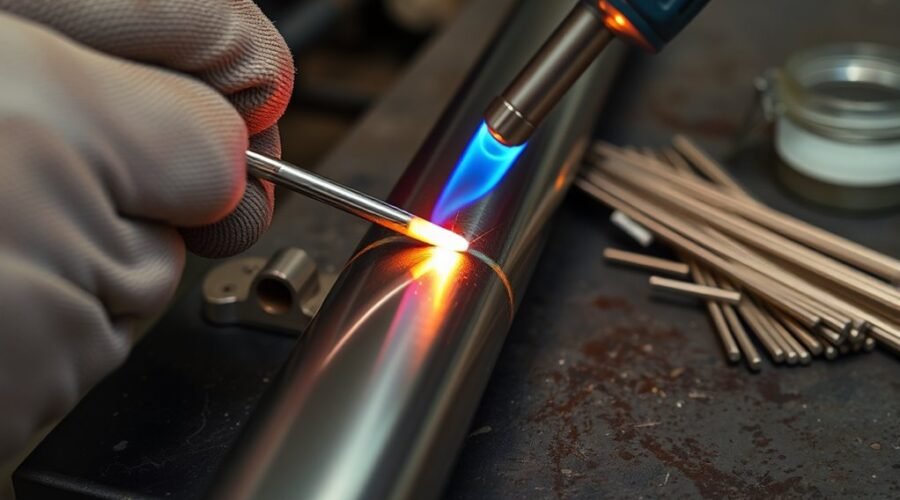
Heat the base metals broadly and evenly so both sides of the joint reach brazing temperature at about the same time. The filler should melt because the joint is hot enough, not because the torch flame is directly melting the rod.
Warning: Brazing involves open flame, hot metal, fumes, and chemically active flux. OSHA requires appropriate eye and personal protection and adequate control of fumes. Cadmium-bearing filler metals and fluoride-containing fluxes require particular care; identify the materials from their labels and safety data sheets before heating them.
The OSHA welding, cutting, and brazing requirements also address fire prevention, ventilation, protective clothing, and eye protection for torch brazing.
Heat the joint, not the filler rod. When the base metal is at the correct temperature, the filler should melt on contact and be drawn into the joint.
- Start with broad heat around the joint rather than concentrating the flame on one small point.
- Favor the heavier or more conductive part if one component needs more heat.
- Keep the torch moving to avoid localized overheating.
- Watch the flux behavior, but use the cue specified for that particular flux.
- Touch the filler to the heated joint to test whether the assembly has reached its working range.
- Let capillary action draw filler toward the hotter areas of the joint.
For Handy Flux specifically, the manufacturer notes that it becomes clear and active around 1,100°F (593°C). That is a product-specific temperature cue, not a universal rule for every flux.
Stop adding heat once the filler has flowed through the required joint area. Excess heat can exhaust the flux, increase oxidation, volatilize alloying elements, erode the base material, and increase distortion.
Clean and Inspect the Finished Joint
After brazing, allow the filler to solidify before disturbing the assembly. Then remove the flux residue using a method compatible with the flux, base metals, and part geometry.
Many brazing fluxes are water soluble. Lucas-Milhaupt’s post-braze cleaning guidance describes hot-water soaking or quenching after the filler has fully solidified, followed by light brushing if necessary. Do not thermally shock a part when its material, geometry, or service requirements make quenching unsuitable.
If flux has been badly overheated, it may turn dark and become more difficult to remove. Chemical pickling can sometimes be required, but the acid, concentration, temperature, PPE, ventilation, rinsing, and disposal procedure should come from the brazing-material or process specification rather than guesswork.
After cleaning, inspect the joint in good light. Look for:
- evidence that filler wetted both base metals;
- continuous filler around the expected joint boundary;
- areas with incomplete flow or lack of wetting;
- surface cracks, erosion, overheating, or damaged base metal;
- excessive filler that may indicate poor fit or uncontrolled application;
- remaining flux or oxide that needs further cleaning.
Visual inspection is useful but cannot prove that every internal part of a critical joint is sound. The AWS C3 brazing standards include methods for evaluating wetting, filler penetration, voids, cracks, erosion, and other joint-quality features when formal inspection is required.
Frequently Asked Questions
How Do You Use Flux-Coated Silver Brazing Alloy?
Use flux-coated silver brazing alloy on a clean, properly fitted joint that is compatible with the filler and coating. Heat the base metals evenly rather than melting the rod directly with the flame. When the joint reaches brazing temperature, touch the coated filler to it, allow the alloy to flow, then clean away the remaining flux.
What Flux Is Used for Silver Brazing?
Silver brazing commonly uses borate- and fluoride-containing fluxes formulated for the base metal, filler, and heating range. General-purpose FB3-A fluxes suit many common silver-brazing jobs, while stainless steel, carbides, extended heating, or higher-temperature fillers can require specialized fluxes such as FB3-C or FB3-D products.
Do You Need Flux When Using Silver Solder?
Flux is normally required for open-air silver brazing because it protects the heated surfaces from oxidation and promotes wetting. An important exception is copper-to-copper brazing with a suitable phosphorus-bearing BCuP filler, where phosphorus can act as a deoxidizer. Controlled-atmosphere processes may also operate without conventional paste flux.
What Are the Different Methods of Silver Brazing?
Silver brazing can use torch, induction, resistance, furnace, or other controlled heating methods. Torch brazing is common for individual joints, while induction gives rapid localized heating and furnace processes can heat many joints uniformly. The filler, flux or atmosphere, joint design, and production requirements determine which method is appropriate.
Is Silver Brazing the Same as Silver Soldering?
The terms are often used interchangeably in everyday speech, but AWS separates brazing from soldering by filler-metal liquidus temperature. A filler with a liquidus above 840°F (450°C) is in the brazing range, while soldering uses filler below that threshold. Therefore, much work called “silver soldering” is technically silver brazing.
Can You Silver Braze Stainless Steel?
Yes, stainless steel can be silver brazed with a compatible silver-base filler and a flux capable of handling its chromium-rich surface oxides. Filler selection should also reflect the stainless grade, corrosion environment, and service requirements. Phosphorus-bearing copper fillers should not be substituted for a suitable stainless-steel brazing alloy.
Conclusion
Successful silver brazing depends more on compatibility and process control than on simply choosing a high-silver rod. Match the filler and flux to the metals, prepare a close capillary joint, heat the base materials evenly, and stop once the filler has flowed. After cooling, remove the flux and inspect the joint before putting the assembly into service.
Sources
- American Welding Society — Brazing & Soldering Manufacturers Committee: brazing and soldering temperature definitions.
- American Welding Society — A5 Committee: current filler-metal classification framework, including AWS A5.8/A5.8M.
- Lucas-Milhaupt Brazing Fundamentals: clearance, cleaning, fluxing, heating, and capillary-action guidance.
- Lucas-Milhaupt — Choosing Flux for Silver Brazing: flux selection by base metal, filler range, and heating method.
- Lucas-Milhaupt — Sil-Fos 15: BCuP-5 composition, copper-to-copper use, and flux guidance.
- OSHA 29 CFR 1910.252: brazing fire prevention, PPE, ventilation, cadmium, fluoride, and fume requirements.
- Lucas-Milhaupt — Cleaning the Brazed Joint: post-braze flux removal and cleaning guidance.
- American Welding Society — C3 Committee: standards for brazing processes and evaluation of brazed-joint quality.