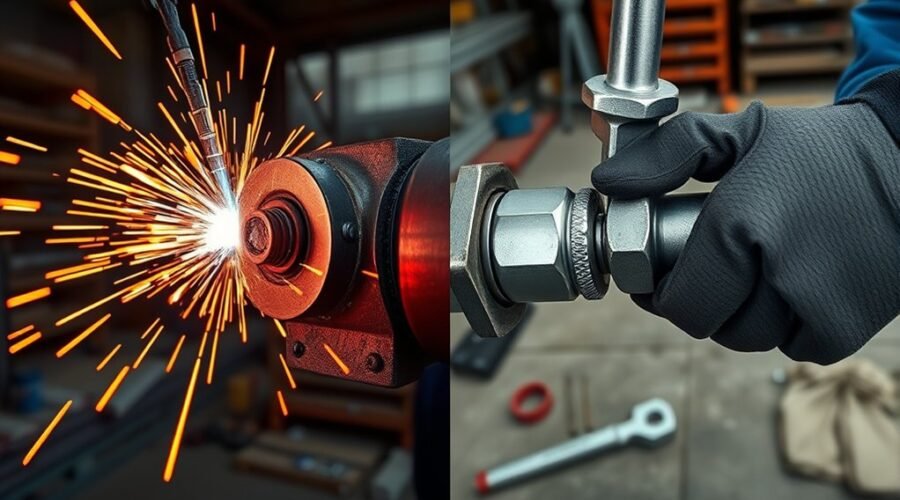
Welding vs bolting changes how a structural steel connection is fabricated, erected, inspected, and maintained. A welded joint fuses steel through weld metal, while a bolted joint uses mechanical fasteners and may be snug-tightened, pretensioned, or slip-critical. The right choice depends on the required connection behavior, not on a blanket rule that one method is always stronger.
Quick Answer
Use bolting when field erection speed, future disassembly, or avoiding hot work matters. Use welding when compact detailing, continuous load transfer, or eliminating bolt holes favors it. Either method can carry high loads when properly designed; strength, stiffness, fatigue behavior, inspection needs, and cost depend on the complete connection.
Last checked: September 28, 2026. Dates and figures were verified against official sources.
Key Takeaways
- Bolted joints do not all behave alike: snug-tightened, pretensioned, and slip-critical joints have different design and installation requirements.
- Connection stiffness comes from the entire detail. A bolted moment connection can be stiff, while a welded detail can still permit rotation through its plates or supporting members.
- Field bolting and shop welding are often used together because each method is efficient in different parts of fabrication and erection.
- Ordinary bolted joints should not be treated as intentional expansion joints. Required thermal movement must be provided by a deliberately designed sliding, slotted, or expansion detail.
- The 2025 RCSC Specification withdrew the calibrated-wrench method of bolt pretensioning, so current project procedures should be checked against the applicable edition.
What’s the Difference Between Welding and Bolting?
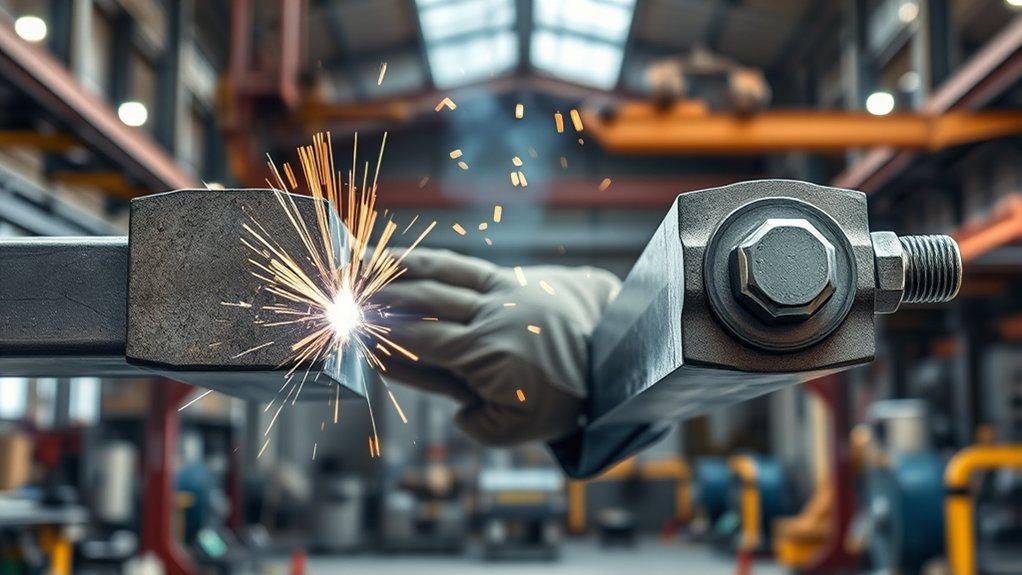
The basic difference is how the load crosses the joint. Welding creates a metallurgical connection through weld metal, while bolting transfers force through fasteners, connected plates, holes, and, for slip-critical joints, friction between prepared contact surfaces.
For U.S. structural steel buildings, the AISC Specification for Structural Steel Buildings provides the main structural design requirements. High-strength structural bolting is further governed by the RCSC Specification, while structural welding commonly references AWS D1.1.
| Factor | Welded connection | Bolted connection |
|---|---|---|
| How force is transferred | Through weld metal and connected base metal | Through bolt shear, plate bearing, tension, or designed slip resistance |
| Heat at the joint | Creates a heat-affected zone and can cause distortion or residual stress | No welding heat is introduced by the bolting operation |
| Holes | Not normally needed for a weld-only joint | Usually required and must be considered in net-section, bearing, and connection design |
| Field installation | Requires welding equipment, suitable conditions, qualified personnel, and hot-work controls | Often fast when components arrive prefabricated and holes align correctly |
| Inspection | Visual inspection plus additional NDE when required | Checks fastener components, joint condition, installation procedure, and pretension where required |
| Disassembly | Normally requires cutting, gouging, or another alteration | Often easier when the connection was designed for accessible removal |
| Common construction strategy | Shop-welded plates, stiffeners, and assemblies | Field-bolted erection joints and splices |
A bolted connection is therefore not simply a welded connection with bolts substituted for weld metal. Hole geometry, fastener type, joint category, edge distances, plate thickness, and installation method all change its behavior.
Likewise, a welded joint is not defined only by the welding machine. Weld type, effective throat, joint geometry, filler metal, base steel, procedure, access, and inspection requirements matter more to structural capacity.
If your question concerns nonstructural home fabrication rather than an engineered steel frame, equipment selection is a separate issue. Our home-use welder guide covers that narrower equipment decision.
Which Is Stronger: Welding or Bolting?
Neither welding nor bolting is inherently stronger in every steel connection. Engineers size the complete joint for the required forces and check the failure modes that apply, so either method can provide substantial structural capacity when correctly designed, fabricated, and inspected.
The more useful question is which limit state controls. A welded joint may be governed by weld strength or the connected base metal, while a bolted joint may be governed by bolt shear or tension, plate bearing, net-section fracture, block shear, slip resistance, or another connected-part limit state.
Weld Strength Basics
Weld strength depends on much more than whether the joint looks continuous. Fillet-weld size and length, groove-weld geometry, filler metal, base material, load direction, and the strength of the connected parts all affect capacity.
The current AWS D1.1/D1.1M:2025-AMD1 Structural Welding Code—Steel covers structural-steel welding requirements including qualification and inspection. AISC also provides practical welding guidance for structural steel, including economical detailing and weld-selection considerations.
A full-strength connection can sometimes be produced with welding, but that does not mean every weld develops the full strength of the member. Fillet welds, partial-joint-penetration groove welds, complete-joint-penetration groove welds, and their connected parts must each be designed for the actual force path.
Welding also changes the steel locally through heating and cooling. Proper procedure selection, fit-up, sequence, preheat where required, and distortion control help keep those effects within the assumptions of the design.
Welder duty cycle and cooling capacity can affect shop productivity, but they do not establish structural joint strength. Those machine-specific issues are covered separately in our multi-process welder guide.
Bolt Strength Factors
Bolted connection strength depends on the fastener and the connected steel. Bolt grade and diameter, threads in the shear plane, hole type, plate thickness, edge distance, spacing, bolt tension, and joint geometry can all become important.
The current 2025 RCSC Specification for Structural Joints Using High-Strength Bolts covers design, installation, and inspection of high-strength structural bolting. It distinguishes joint behavior rather than treating every high-strength bolt the same way.
- Snug-tightened joints: the connected plies are brought into firm contact. A specified structural-bolt pretension is not automatically required.
- Pretensioned joints: bolts are installed to a specified pretension because the application requires it.
- Slip-critical joints: pretensioned bolts and qualified faying surfaces are used so the connection has a calculated resistance to slip.
Bolt holes reduce the net cross-sectional area available in some members and introduce local bearing effects. That does not make bolting structurally inferior; those conditions are simply included in the connection design.
Real-World Load Cases
The load case often matters more than the joining method. Static shear, direct tension, moment, load reversal, vibration, and fatigue place different demands on a connection.
For many ordinary building joints, a bearing-type bolted connection can be efficient. Where slip would harm performance, or where specific fatigue conditions apply, the AISC bolting guidance explains when pretensioned or slip-critical joints are required.
Welded details can also perform under demanding cyclic loading, but fatigue resistance depends strongly on the detail geometry, stress range, weld profile, and applicable fatigue category. A continuous-looking weld should not automatically be assumed to have better fatigue performance than a bolted detail.
Moment connections provide another useful example. Both bolted end-plate arrangements and welded details can be engineered to transfer moment. The required stiffness and strength come from the complete connection rather than from the presence of either bolts or welds alone.
Which Costs Less: Welding or Bolting?
There is no universal cost winner. Bolting can reduce field welding time and hot-work requirements, while welding can eliminate some fasteners, holes, and connection plates; the lower-cost solution depends on the exact detail and where the work is performed.
A realistic comparison includes fabrication, drilling or punching, bolts and washers, weld preparation, consumables, labor, access equipment, weather protection, inspection, coating repair, erection time, and possible rework.
Upfront Labor Costs
Field bolting is often attractive because members can arrive with connection material already shop-fabricated. Once the steel is aligned, ironworkers can complete many joints without setting up a field welding operation.
Field welding can take longer when the joint requires fit-up corrections, difficult welding positions, weather protection, preheat, access platforms, or added inspection. Shop welding is different: controlled conditions and favorable welding positions can make it efficient and repeatable.
The cheapest connection on paper is not always the cheapest installed connection. A detail that saves a few bolts but adds difficult overhead field welds can increase labor and schedule risk, while an overly complicated bolted joint can add plates, holes, hardware, and shop work.
For hobby or light-shop equipment budgets, machine purchase price is a separate question from structural connection economics. Our budget stick welder guide addresses that equipment category.
Material and Inspection Costs
Bolting requires fasteners and normally requires holes, and some connections need additional plates or prepared faying surfaces. Slip-critical construction can also impose surface-preparation and inspection requirements that do not apply to an ordinary snug-tightened joint.
Welding consumes filler metal and may need joint preparation, backing, access holes, preheat, or additional finishing. The amount of nondestructive examination depends on the joint and project requirements; it is incorrect to assume every structural weld automatically needs ultrasonic or radiographic testing.
Rework affects both systems. Misaligned holes, wrong components, or incorrect bolt installation can create bolting rework, while unacceptable weld discontinuities, distortion, or poor fit-up can require grinding, removal, repair welding, and reinspection.
When Does Bolting Make More Sense?
Bolting makes the most sense when the project benefits from rapid field erection, limited hot work, accessible inspection, or future disassembly. It is also useful when parts must be shipped separately and assembled into larger frames on site.
Bolting is especially practical when the connection geometry allows holes to be accurately fabricated before delivery. This reduces the amount of field work needed to complete the permanent joint.
Standard through-bolts normally need access to the nut side of the connection. Where rear-side access is impossible, engineered blind fasteners, threaded systems, or clamp-type products may provide alternatives, but their capacities and limitations must be checked for the specific application.
Existing structures can also favor bolting when welding heat, fire risk, coatings, or the existing steel’s weldability create complications. However, drilling new holes can reduce net section or conflict with existing stresses, so the modification still requires engineering review.
| Condition | Bolted response | Result |
|---|---|---|
| Fast field schedule | Prefabricated holes and connection plates | Rapid erection when fit-up is correct |
| Future modification | Accessible removable fasteners | Easier disassembly or replacement |
| Hot-work restriction | No welding heat at the bolted joint | Reduced hot-work exposure |
| Existing steel | Mechanical fastening where appropriate | May avoid welding an uncertain or sensitive material |
| Restricted rear access | Engineered blind or clamp system where suitable | Connection remains possible without a conventional nut-side approach |
Bolting is therefore valuable for constructability and serviceability, not because it is automatically weaker or more flexible.
If the alternative is a small nonstructural DIY weld rather than a building connection, our beginner welder guide covers equipment choices separately.
When Is Welding the Better Choice?
Welding is often the better choice when the connection benefits from compact geometry, continuous attachment, no bolt holes, or controlled shop fabrication. It can also simplify details where placing a practical bolt pattern would be difficult.
Because a weld-only joint does not require bolt holes, it can preserve the gross section at locations where drilled or punched holes would otherwise need to be considered. That advantage still has to be balanced against the weld design and the behavior of the connected base metal.
Welding can be efficient for attaching stiffeners, end plates, brackets, built-up members, and other parts in a fabrication shop. Shop conditions give better control over position, access, fit-up, consumables, temperature, and inspection than many field locations.
A welded connection can also provide a clean exposed appearance because there may be no visible bolt heads or nuts. Architectural appearance alone, however, should not override structural, fabrication, and inspection requirements.
Access requirements depend on the weld detail. Many welds can be made from one side, while some groove-weld details may require backing, backgouging, or access to the reverse side. It is therefore inaccurate to say that welding always requires access to both sides of a joint.
For thinner nonstructural work where precise arc control matters, our TIG welder selection guide covers machine features separately from structural connection design.
How Do You Inspect Welded and Bolted Joints?
Welded and bolted joints both require inspection, but the checks are different. Bolting inspection focuses on the specified fastener system and installation procedure, while welding inspection examines materials, fit-up, welding operations, finished welds, and any required nondestructive examination.
For bolting, inspectors may verify fastener type and condition, washers where required, hole and joint fit-up, the snug-tight condition, and the specified pretensioning procedure. The exact requirements depend on whether the joint is snug-tightened, pretensioned, or slip-critical.
The 2025 RCSC Specification is especially important here because it withdrew the calibrated-wrench pretensioning method. Current work should follow the installation and verification methods allowed by the edition named in the contract documents, which may include turn-of-nut, combined, twist-off-type tension-control, or direct-tension-indicator procedures as applicable.
Weld inspection starts with visual examination. According to AISC’s welding inspection and NDE guidance, structural welding inspection can include visual checks before, during, and after welding, with magnetic-particle, dye-penetrant, ultrasonic, or radiographic examination used when the applicable requirements call for them.
The important point is that “inspection” does not mean simply applying a torque wrench to every bolt or ultrasonically testing every weld. The project specification, connection type, code provisions, and quality-control plan determine what must actually be verified.
A welding machine’s features can affect process stability and productivity, but they do not replace inspection or procedure compliance. Our MIG welder guide covers equipment selection rather than structural acceptance criteria.
How Do Welding and Bolting Affect Flexibility?
The connection detail determines flexibility more than the joining method alone. A simple bolted shear connection may be intentionally rotationally flexible, while a bolted moment connection can be quite stiff; a welded connection can also be either stiff or flexible depending on its plates, weld layout, and supporting members.
Joint Rigidity Differences
Welding often makes it easier to create a continuous and compact load path, but that does not automatically make every welded connection fully rigid. Deformation can occur in end plates, angles, webs, flanges, column panels, and other connected elements even when the weld itself is stiff.
Bolted joints also cover a wide range of behavior. A fin plate or angle connection may be detailed to act as a simple shear connection, while an engineered end-plate or flange-plate connection can transfer significant moment and provide much greater rotational stiffness.
For design purposes, the connection should therefore be classified by its actual force-deformation behavior rather than by the simple labels “welded” or “bolted.”
Movement and Load Transfer
Bolted and welded connections transfer force differently, but ordinary structural bolts should not be treated as intentional moving joints unless the detail was designed for movement.
- Bearing-type bolted joints transfer shear through bolt shear and bearing between the bolt and connected material.
- Slip-critical joints use bolt pretension and qualified faying surfaces to resist detrimental slip.
- Welded joints transfer force through the weld and adjoining base metal.
- Connection plates, angles, flanges, webs, and supporting members also contribute to deformation.
- Required thermal expansion or sliding movement should be provided by a specifically designed slot, sliding bearing, expansion joint, or similar detail.
That distinction matters because uncontrolled bolt slip is not the same thing as useful structural flexibility. If movement is required, it needs a defined path, adequate clearances, suitable bearing surfaces, and a design that still transfers every required force safely.
Design Tradeoffs for Flexibility
Bolted construction often gives crews more adjustment during erection because holes, slots where permitted, shims, and removable components can help with fit-up. That construction tolerance should not be confused with the completed structure being free to move under service loads.
Welded construction offers different detailing freedom. Components can be attached without fitting a bolt pattern into the available width, but future alteration normally requires cutting, gouging, or adding a newly engineered connection.
Bolting also makes planned disassembly easier, although structural fasteners should not automatically be assumed reusable. Reuse depends on the fastener type, condition, governing specification, and installation history.
The welding process or machine model does not determine connection rotation. For example, our MIG welder comparison addresses equipment differences, not structural joint stiffness.
What Do Installation and Safety Require?
Both methods need trained personnel, suitable access, and a controlled work plan. Bolting avoids the arc, fumes, molten metal, and ignition source created by welding, but it still involves heavy steel, pinch points, power tools, work at height, and erection hazards.
Welding adds hot-work hazards. OSHA’s welding, cutting, and brazing requirements address fire prevention, ventilation, confined spaces, personal protective equipment, and control of hazardous fumes and gases.
Warning: Never weld, cut, drill, or alter a load-bearing steel connection simply because a different joint type appears easier. The change can alter the load path, member net section, fire risk, fatigue behavior, or required inspection. Use the approved connection design and applicable safety procedures.
Steel erection can also expose both bolters and welders to fall hazards. OSHA’s steel-erection fall-protection requirements apply based on the work and exposure, not on whether the permanent connection happens to use bolts or welds.
Personnel requirements have also become more explicit. AWS structural welding rules address welder and procedure qualification, while the 2025 RCSC Specification added provisions for qualifications of personnel responsible for structural bolting supervision, installation, and inspection.
That makes “bolting only needs basic tools” an oversimplification. Some snug-tight work is straightforward, but pretensioned and slip-critical connections require the specified components, procedures, verification, and inspection.
Equipment discounts do not change those obligations. Our welding gear deals guide is a shopping resource, not a substitute for required PPE, procedures, or structural specifications.
How Do Materials and Loads Change the Choice?
Material properties and load demands can change the preferred connection method. Steel grade, thickness, weldability, toughness requirements, joint restraint, cyclic loading, corrosion protection, and the available geometry all influence the decision.
Weldability deserves particular attention. Welding introduces a heat-affected zone, so the welding procedure may need controls for filler selection, heat input, preheat, interpass conditions, sequence, and cooling depending on the material and joint.
Bolting avoids a welding heat-affected zone at the joint, but holes and fastener forces introduce their own design checks. The connected parts may need checks for net-section fracture, bearing, tear-out, block shear, prying, and other applicable limit states.
Coatings can also change the comparison. Welding may require coating removal and repair around the work area, while slip-critical bolted joints require faying-surface conditions consistent with their specified slip resistance.
High loads do not automatically mean “use welding.” Large bolted connections are common, and demanding welded connections are also common. The engineer selects the connection by calculating the required strength and stiffness and then comparing constructability, inspection, fatigue, access, and lifecycle needs.
For field or shop equipment selection, our stick welder guide discusses machine features separately from structural connection design.
How to Choose the Right Steel Connection
Choose a steel connection by working from the required structural behavior outward. Start with the forces and stiffness the joint must provide, then check material, geometry, fabrication, erection, inspection, maintenance, and installed cost.
- Identify every required force: shear, tension, compression, moment, torsion, and cyclic or fatigue loading where applicable.
- Decide whether slip, rotation, or movement must be prevented, allowed, or deliberately controlled.
- Check member material, thickness, weldability, hole locations, edge distances, and available connection space.
- Compare shop fabrication with field conditions, including access, weather, power, hot-work restrictions, and erection sequence.
- Account for bolt holes and connected-part limit states when considering bolting.
- Account for weld geometry, heat effects, procedure requirements, distortion, and inspection when considering welding.
- Consider future replacement, disassembly, strengthening, or alteration before making the joint unnecessarily difficult to modify.
- Compare the total installed cost rather than only the price of bolts, filler metal, or the welding machine.
For U.S. structural steel building work, the engineer normally coordinates the applicable AISC requirements with the current RCSC bolting specification and AWS structural welding requirements. Project drawings and specifications may impose additional restrictions.
For nonstructural precision fabrication and equipment shopping, our TIG welder guide covers machine selection separately.
Can Bolts and Welds Share the Same Load?
Do not simply add the rated capacity of bolts and welds in the same connection. Their stiffness and load-deformation behavior differ, so they may not reach their capacities at the same point.
ANSI/AISC 360-22 contains specific provisions for bolts used in combination with welds and allows load sharing only under defined conditions. For new work, combined load sharing therefore needs deliberate engineering rather than the assumption that adding a weld to a bolted joint automatically adds the two strengths together.
This issue becomes especially important in retrofits. Existing bolts may already be carrying load before a reinforcing weld is placed, and the load path after welding can differ from the original connection.
Note: Load-bearing steel connections should be designed or reviewed by a qualified structural engineer under the code and project specifications that apply to the structure. This comparison explains selection factors; it is not a connection design calculation.
Frequently Asked Questions
Is Welding Stronger Than Bolting?
No method is automatically stronger in every structural steel connection. A properly designed welded or bolted joint can provide the required capacity. The controlling strength comes from the complete connection, including welds or fasteners, connected plates, holes, base metal, geometry, and the applicable failure modes.
Are Bolted Connections Always More Flexible?
No. Some bolted shear connections are intentionally rotationally flexible, but bolted moment connections can be much stiffer. Likewise, a welded connection can still deform through its plates, webs, flanges, or supporting members. Engineers evaluate the stiffness of the complete connection rather than assuming it from the fastener type.
Do High-Strength Structural Bolts Always Need a Specified Pretension?
No. RCSC distinguishes snug-tightened, pretensioned, and slip-critical joints. A specified pretension is required when the selected joint type and application call for it, but many permitted bearing-type applications use snug-tightened installation. The contract documents and governing specification determine the required condition.
Can Bolts and Welds Be Used Together in One Connection?
Yes, but their strengths should not simply be added together. AISC permits load sharing only in defined situations because bolts and welds have different load-deformation behavior. Combined connections therefore require an engineered design that follows the applicable provisions instead of an improvised field modification.
Is Field Bolting Better Than Field Welding?
Field bolting is often faster and avoids welding hot work, so it is widely used for erection joints. Field welding can still be appropriate when the connection geometry or structural requirements favor it. The project should compare access, weather, fit-up, inspection, safety, schedule, and total installed cost.
Conclusion
Welding vs bolting is a connection-design decision, not a contest with one universal winner. Welding can provide compact, continuous details without bolt holes, while bolting often simplifies field erection, inspection, disassembly, and hot-work control. Choose the method that satisfies the required strength, stiffness, fatigue behavior, constructability, inspection, safety, and lifecycle needs of the actual joint.
Sources
- American Institute of Steel Construction — ANSI/AISC 360: Structural-steel connection design requirements and provisions for bolts and welds.
- AISC / Research Council on Structural Connections — 2025 RCSC Specification: High-strength bolted-joint design, installation, inspection, joint types, and 2025 changes.
- American Welding Society — AWS D1.1/D1.1M:2025-AMD1: Current structural-steel welding requirements, qualification, and inspection framework.
- AISC — Bolting Engineering FAQs: Snug-tightened, pretensioned, and slip-critical joint guidance and use conditions.
- AISC — Welding Engineering FAQs: Weld detailing, economics, procedure qualification, and structural welding guidance.
- AISC — Welding Inspection and NDE FAQs: Visual inspection and nondestructive examination methods for structural welds.
- Occupational Safety and Health Administration — 29 CFR 1910.252: Welding, cutting, fire prevention, ventilation, confined-space, and PPE requirements.
- Occupational Safety and Health Administration — 29 CFR 1926.760: Fall-protection requirements for steel erection.