Choosing the right generator for a welder starts with the welder’s electrical input requirements—not simply the maximum welding amperage shown on the front panel. A 200-amp welding output does not mean the machine draws 200 amps from the generator. Input voltage, phase, maximum input current, power factor, duty cycle, generator power quality, and any other tools running at the same time all affect the correct size.
Quick Answer
Use the generator size specified in your welder’s manual whenever possible. If no generator rating is given, check the input voltage, phase, I1max, power factor, and continuous load. For single-phase equipment, volts × maximum input amps gives a useful kVA estimate. Then account for other simultaneous loads and any manufacturer-specified transient requirement.
Key Takeaways
- Do not size a generator from welding output amperage alone; use the welder’s input specifications or its stated generator requirement.
- I1max is the maximum rated input current and is more useful than welding-output amps when estimating maximum generator demand.
- For single-phase AC, volts × amps gives apparent power in VA; watts may be lower because real power also depends on power factor.
- kVA and kW are not automatically equal. Always compare the welder requirement with the generator manufacturer’s continuous/rated output.
- For inverter welders, follow any manufacturer limit for THD or generator power quality instead of assuming one THD number applies to every machine.
- Include grinders, compressors, lights, plasma cutters, and other equipment that will operate at the same time.
At a Glance
| Time Required | About 5–10 minutes once you have the welder and generator specifications |
| Difficulty | Easy to moderate |
| Tools Needed | Welder nameplate/manual, generator specification sheet, calculator, and ratings for any additional tools |
| Cost | No cost to calculate; generator cost varies widely with output, fuel type, and power quality |
What Size Generator Do You Need for Welding?
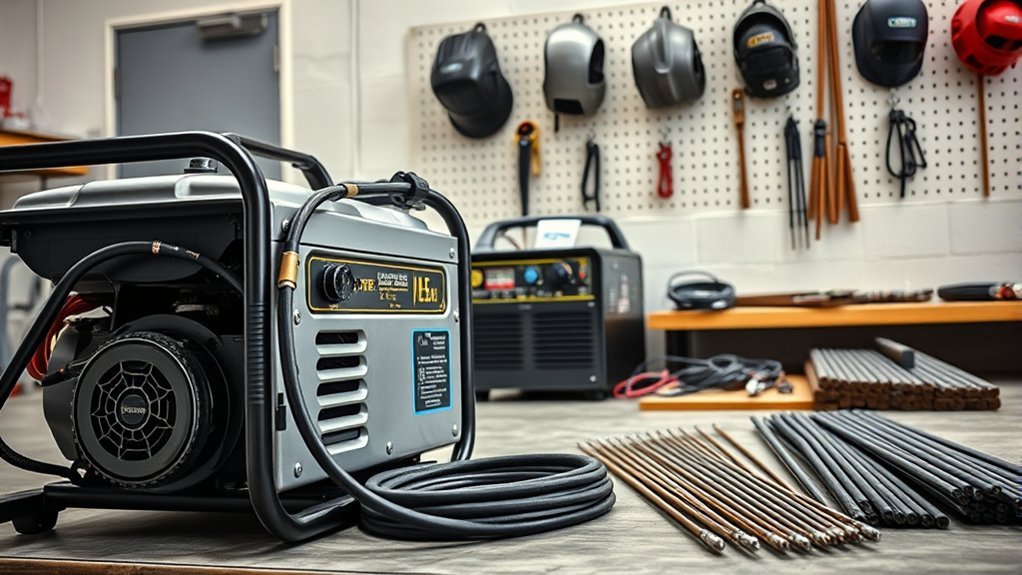
The best answer comes from the welder manufacturer’s generator recommendation. Look in the specification table or manual for terms such as “generator requirement,” “generator power,” “minimum generator,” or “kVA.” If the manufacturer publishes a value, use it instead of estimating from the welder’s maximum output amperage.
If no generator recommendation is available, collect the welder’s input voltage, phase, maximum input current (I1max), effective input current (I1eff), frequency, and power factor if listed. These describe what the machine needs from the power source far better than its welding-output rating.
The amperage used to make the weld is not the same as the amperage the welder draws from the generator.
A useful real-world example is the CIGWELD Transtig 200 AC/DC. Its manual lists a 240V single-phase supply, 36.7A maximum input current, and an 8.8 kVA single-phase generator requirement. Multiplying 240V × 36.7A gives about 8,808 VA, or 8.81 kVA, which closely matches the manufacturer’s stated requirement.
This manual-first approach is much more reliable than choosing a generator solely because the welder is labeled 140A, 180A, 200A, or 250A. When comparing machines, reviewing their input and output specifications helps show why machines with similar welding amperage can have different power requirements.
Pro Tip: Search the welder manual for “generator,” “I1max,” “I1eff,” “input current,” and “power factor.” A manufacturer-specified generator rating should take priority over a generic online amp-to-generator chart.
How to Find Your Welder’s Input Power
Start with the specification label on the welder or the technical-data section of its manual. Do not increase the listed voltage by an arbitrary percentage. A notation such as “230V ±15%” describes the machine’s acceptable supply-voltage range; it is not an instruction to multiply the generator requirement by 1.15.
| Specification | What It Means | Why It Matters |
|---|---|---|
| U1 / Input voltage | Required supply voltage, such as 120V, 208V, 230V, 240V, or 460V | The generator must provide compatible voltage. |
| I1max | Maximum rated input current | Useful for estimating maximum apparent input demand when no generator rating is supplied. |
| I1eff | Effective input current that accounts for the welding duty cycle under the applicable rating method | Often used for supply-circuit and conductor sizing; it should not automatically replace I1max for generator-capacity checks. |
| Phase | Single-phase or three-phase input | Changes both generator compatibility and the power calculation. |
| Power factor | Relationship between real power and apparent power | Explains why kW and kVA are not always numerically equal. |
| Generator requirement | Manufacturer-stated minimum or recommended generator output | This is normally the preferred sizing value. |
Manuals for beginner welding machines may present these values differently, so always confirm which figure is input current and which is welding output.
How Do You Convert Welder Amps to Watts?
First determine whether the amperage is an input-current rating or the welder’s output welding amperage. Only the input side should be used for direct generator calculations.
For a single-phase AC load, volts multiplied by input amps gives apparent power in volt-amperes:
VA = Volts × Input Amps
Divide by 1,000 to express it as kVA:
kVA = Volts × Input Amps ÷ 1,000
If the welder’s power factor is known, approximate real input power can be expressed as:
kW ≈ Volts × Amps × Power Factor ÷ 1,000
For a balanced three-phase supply using line-to-line voltage and line current:
kVA ≈ 1.732 × Volts × Amps ÷ 1,000
Note: kVA and kW are not automatically interchangeable. ESAB, for example, lists a generator requirement of 13 kW or 16 kVA at 0.8 power factor for one ET 301i AC/DC configuration.
This distinction is especially useful when comparing high-output TIG and multiprocess machines such as the models discussed in our AC/DC TIG welder guide.
Amp-To-Watt Formula
If you are working with a simple DC load or an AC load with a power factor effectively equal to 1, watts can closely approximate volts × amps. A welder is more complicated, so calling every V × A result “watts” can be misleading.
For generator selection, it is often safer to calculate apparent input power in kVA from I1max when the welder manufacturer has not supplied a specific generator recommendation.
Example for a single-phase machine:
- Input voltage: 240V.
- Maximum input current: 36.7A.
- 240 × 36.7 = 8,808 VA.
- 8,808 ÷ 1,000 = about 8.81 kVA.
- Compare that result with the welder manufacturer’s stated generator requirement and the generator’s continuous rating.
Do not automatically add 15% to the voltage or a universal 30% startup factor unless the equipment manufacturer specifically calls for that treatment.
Welder Input Math
The simplest reliable calculation starts with the welder’s actual input data. If a 240V single-phase machine lists I1max at 30A, its maximum apparent input estimate is:
240 × 30 = 7,200 VA, or 7.2 kVA.
That does not automatically mean a 7.2-kW generator is sufficient. You still need to check power factor, the generator’s rated versus peak output, its 240V receptacle capacity, the welder manufacturer’s generator guidance, and any extra loads.
Some welders also impose a specific generator surge or power-quality requirement. When that information appears in the manual, it overrides a generic percentage-based estimate.
What Generator Size Matches Each Welder Amp Range?
There is no universal generator size that can be assigned safely from welding-output amperage alone. Output amperage is still useful for describing the welder’s capability, but it is not enough to determine generator input power.
| Welder Output Class | What to Do |
|---|---|
| Up to about 160A | Check whether the welder runs on 120V, 230/240V, or dual voltage, then use its generator specification or I1max. Two 160A welders can have very different input requirements. |
| 180–200A | Do not assume a fixed 8–10 kVA requirement. A documented 200A CIGWELD example specifies 8.8 kVA, but other machines can differ. |
| 210–250A | Read the model-specific manual. PFC, input voltage, process, duty cycle, and machine design can materially change generator demand. |
| 250A and above | Expect larger power requirements, but still use manufacturer data. Three-phase industrial machines require different calculations and generator configurations from single-phase portable welders. |
If you are comparing higher-output machines for home or field work, the input-power specifications matter just as much as the advertised welding amperage.
Do Inverter and Transformer Welders Need Different Generators?
They can. Modern inverter welders use power electronics, and some manufacturers impose explicit limits on generator waveform quality or total harmonic distortion. The correct THD limit must come from the actual welder manual.
For example, one Everlast manual states that the welder should operate only from generator power with 5% THD or less and gives a specific surge-watt requirement for that model. This is useful evidence that power quality matters, but it should not be turned into a universal 5% or 6% rule for every inverter welder.
Transformer-based machines can have different input characteristics and may place a different load on a generator. For either design, match the generator to the welder manufacturer’s voltage, frequency, phase, current, and generator-power requirements.
Duty cycle also differs among machines. Our TIG welder comparisons show why maximum amperage by itself does not describe how a machine behaves during real use.
How Do Altitude, Duty Cycle, and Surge Affect Sizing?
Altitude can reduce the output of an engine-driven generator because the engine has less oxygen available for combustion. The exact derating rule is generator-specific. For example, the Generac GP6500/GP8000E manual states that maximum power decreases about 3.5% for every 1,000 feet above sea level and can also decrease at high ambient temperature. Check the manual for your own generator rather than treating that percentage as universal.
Duty cycle describes how long a welder can operate at a stated output during a specified test period before cooling is required. It does not justify deliberately undersizing the generator. Some welding-machine manuals publish generator requirements specifically at maximum-output duty cycle.
Transient demand also varies by welder design. Avoid assuming that every welder needs exactly 20%, 25%, or 30% extra surge power. If the welder manual specifies a minimum generator surge rating, follow it. Otherwise, make sure the generator’s continuous rating covers the expected load and choose reasonable additional capacity instead of operating continuously at its absolute limit.
These considerations also matter when evaluating the duty-cycle figures in MIG welding machines.
What Else Will the Generator Need to Power?
Generator sizing must include every device that can operate at the same time as the welder. Common jobsite loads include grinders, saws, lights, fans, air compressors, wire feeders, and plasma cutters.
Start by adding the running demand of simultaneous loads. For motor-driven equipment such as some compressors and saws, also check the tool manufacturer’s starting or peak requirement. Do not assume every grinder or compressor uses one standard wattage.
For example, if the welder requires nearly all of a generator’s continuous 240V capacity, starting a large grinder or compressor at the same time can cause voltage drop, overload protection to trip, or unstable welding performance.
Plan the electrical load separately from consumables such as the shielding gas supply, which affects welding time but does not add generator wattage unless electrically powered accessories are also involved.
What Generator Size Works for Common Welders?
The safest way to compare common welders is by their input specification, not simply by their maximum welding amperage.
Common Welder Sizes
| Welder Type | Generator Check |
|---|---|
| Small 120V flux-core/MIG | Confirm the actual I1max and required receptacle current. Maximum welding amperage alone is not enough. |
| Dual-voltage 120/240V inverter | Check specifications separately for each input voltage; available welding output and input current may change significantly. |
| 180–200A 230/240V machine | Look for a manufacturer generator rating. The CIGWELD 200A example in this guide specifies 8.8 kVA. |
| High-output multiprocess/TIG machine | Check kW, kVA, power factor, phase, and any THD requirement. Larger output does not create one universal generator-size rule. |
When looking at affordable stick welders, pay particular attention to whether full rated output requires 240V even if the machine can also operate from 120V.
Generator Match Basics
A good generator-to-welder match satisfies all of these conditions:
- The generator supplies the correct voltage and phase.
- The generator has the correct receptacle and sufficient receptacle/current rating.
- Its continuous output meets the welder’s required generator rating or calculated input demand.
- Its surge or transient capability meets any requirement published by the welder manufacturer.
- Frequency matches the welder specification.
- Power quality and THD meet any limit stated by the welder manufacturer.
- Capacity remains sufficient after altitude, temperature, fuel, and simultaneous accessory loads are considered.
Which Generator Specs Matter Most for Welding?
When choosing a generator for welding, compare the complete electrical profiles of both machines rather than focusing on the largest watt number printed on the generator.
| Generator Specification | Why It Matters |
|---|---|
| Rated/continuous output | This is the power the generator is designed to supply continuously and is more important than a brief marketing peak rating. |
| Peak/surge output | Relevant when the welder or another simultaneous load has a published transient requirement. |
| Voltage and phase | A 240V welder needs a generator that actually supplies compatible 240V power; three-phase machines require a compatible three-phase source. |
| Receptacle rating | The outlet itself must support the required voltage/current and compatible connection method. |
| Frequency | Must fall within the welder’s specified operating range, commonly 50/60Hz on many modern machines. |
| THD/power quality | Important when the welder manufacturer specifies a maximum THD or clean-power requirement. |
| Altitude/temperature derating | Engine-generator output may decrease as altitude or ambient temperature rises. |
If the same generator will also run a plasma cutter, calculate that machine separately and include it only when it may operate concurrently.
How to Size a Generator for a Welder in 6 Steps
- Check the manual first. If it publishes a minimum or recommended generator rating, use that as your baseline.
- Identify the input voltage and phase. Confirm whether the welder needs 120V, 208V, 230/240V, 460V, single-phase, or three-phase power.
- Find I1max and I1eff. Use I1max when estimating maximum apparent input demand unless the manufacturer directs otherwise.
- Calculate apparent power if needed. For single phase, kVA ≈ V × I1max ÷ 1,000. For balanced three phase, kVA ≈ 1.732 × V × I1max ÷ 1,000.
- Add real simultaneous loads. Include lights, grinders, compressors, cooling units, and other equipment that may run while welding.
- Verify the generator itself. Check continuous output, surge output, receptacle rating, frequency, THD, altitude derating, grounding instructions, and fuel-specific ratings before connecting the welder.
Warning: Engine-driven generators produce carbon monoxide. Operate them outdoors away from doors, windows, vents, and enclosed spaces. Keep the generator dry, use properly rated grounded cords, follow its grounding/bonding instructions, and never connect it directly to a building electrical system without an appropriate transfer arrangement installed as required. Shut the generator down and allow it to cool before refueling.
What If the Welder Runs Poorly on the Generator?
If the welder starts but the arc is unstable, the generator trips, or output falls when welding begins, stop and check the system instead of assuming the welder is defective.
- Confirm continuous output: Do not confuse the generator’s short-duration peak rating with its rated running output.
- Check the 240V rating: A generator may have a high total watt rating while providing less current than expected through a particular receptacle.
- Disconnect other loads: Test the welder without grinders, compressors, heaters, or other large equipment operating.
- Check extension cords: Undersized or excessively long cords can contribute to voltage drop. Follow the equipment manufacturers’ conductor requirements.
- Check altitude and temperature: The engine may not deliver its sea-level rated output under demanding conditions.
- Verify THD: If the welder manual specifies clean power or a maximum THD, confirm that the generator meets it.
- Follow startup instructions: Some welder manufacturers give special generator operating instructions, including restrictions on eco/auto-idle modes or switching the generator on and off while the welder is connected.
Frequently Asked Questions
Can a 3000W Generator Run a Welder?
Possibly, but only if the specific welder’s input requirement fits within the generator’s continuous output, voltage, receptacle rating, and power-quality limits. A 3,000W rating alone cannot tell you which welding amperage the machine will support. Check the welder manual and generator specifications before use.
Will a 2000W Generator Run a Welder?
Only some low-input welders operating within the generator’s available voltage and continuous capacity may work. A 2,000W generator cannot be assumed to run a welder simply because the welder is small or portable. Verify input current, voltage, generator rating, and the welder manufacturer’s generator guidance.
Will a 10,000 Watt Generator Run a 220V Welder?
It may, but 220/240V describes voltage rather than total power demand. Check the welder’s I1max or stated generator requirement and confirm the generator’s continuous 240V output and receptacle capacity. As one example, a 240V CIGWELD Transtig 200 AC/DC specifies an 8.8-kVA generator, but other 220/240V welders can require more or less.
Can You Run a 225A Welder on a Generator?
Yes, if the generator meets the electrical requirements of that particular 225A welder. The 225A figure describes welding output and does not establish one universal generator size. Check input voltage, phase, I1max, power factor if provided, and the manufacturer’s generator recommendation.
Can an Inverter Welder Run on a Generator?
Yes, many inverter welders are designed to operate from compatible generators. However, check the welder manual for minimum generator capacity, acceptable voltage and frequency, THD or clean-power limits, and any special startup or shutdown instructions.
Should I Use I1max or I1eff to Size the Generator?
Use the welder manufacturer’s stated generator requirement whenever one is available. If you must estimate from the nameplate, I1max is the more useful figure for checking maximum apparent input demand. I1eff represents effective input current considering duty cycle and is commonly used for supply-circuit and conductor sizing.
Conclusion
The correct generator size for welding cannot be determined reliably from welding-output amperage alone. Start with the welder manufacturer’s generator requirement. If none is published, use the machine’s input voltage, phase, I1max, power factor, and duty-cycle information to estimate demand, then verify the generator’s continuous output, receptacle capacity, power quality, and operating conditions.
A properly matched generator should supply the welder without overload, excessive voltage drop, unstable operation, or reliance on an unsupported rule of thumb. Remember that kVA and kW are different measurements, THD limits are model-specific, and additional tools must be included when they operate at the same time.
Sources
- CIGWELD Transtig 200 AC/DC Operating Manual — input voltage, I1max/I1eff, duty cycle, and 8.8-kVA generator requirement.
- ESAB ET 301i AC/DC Specifications — generator kW/kVA and power-factor example.
- Everlast Welder Operating Manual — model-specific generator surge, THD, grounding, and operating guidance.
- Generac GP6500/GP8000E Owner’s Manual — rated versus surge output and altitude/temperature derating.
- OSHA Grounding Requirements for Portable Generators — generator grounding, bonding, cords, transfer switches, and electrical safety.
- OSHA Portable Generator Safety Guidance — carbon monoxide, ventilation, moisture, overload, and refueling precautions.