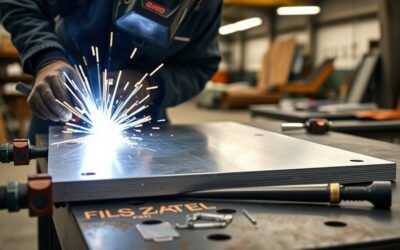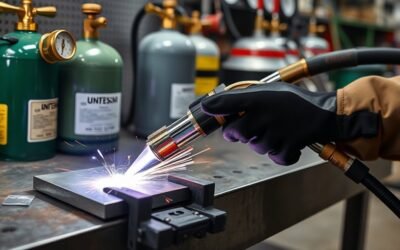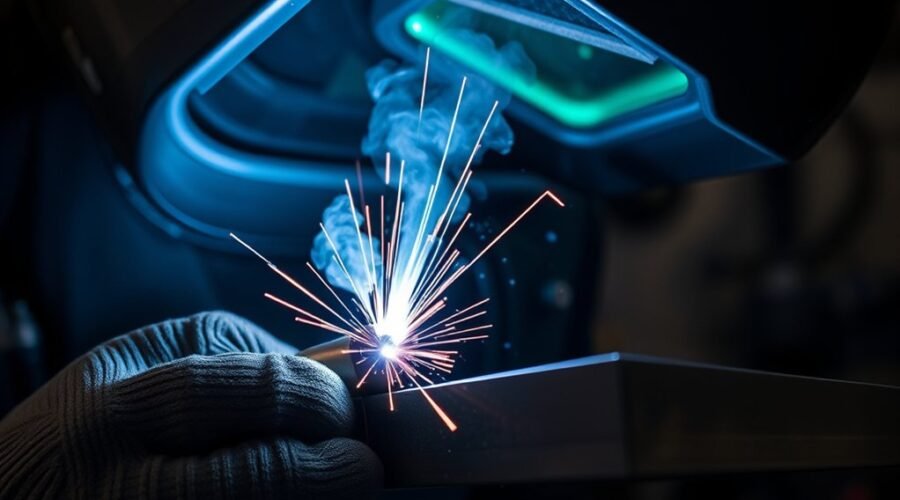
MIG welding with 100% argon works very well for aluminum, but it is usually the wrong shielding gas for steel or stainless steel. On carbon steel, pure argon can produce poor wetting, an unstable or wandering arc, and a narrow, raised bead with inadequate fusion at the toes. The right choice depends on the base metal, transfer mode, wire, and machine settings.
Quick Answer
You can physically run a MIG arc with 100% argon, but pure argon is mainly suited to aluminum GMAW. For mild steel, use an argon-CO2 blend such as C25 or another gas specified by the wire and machine manufacturer. Stainless steel also normally needs an appropriate mixed shielding gas rather than pure argon.
Key Takeaways
- Pure argon is the standard starting choice for many aluminum MIG applications.
- Carbon steel generally needs CO2 or an argon-CO2 blend for good wetting, fusion, and practical arc behavior.
- C25, which is 75% argon and 25% CO2, is a common all-purpose shielding gas for mild-steel short-circuit MIG welding.
- Thin steel does not become a good pure-argon application simply because lower penetration is desired; correct wire, settings, fit-up, and an appropriate gas remain important.
- Stainless steel gas selection depends on transfer mode and corrosion requirements, so use the filler-wire or welding-procedure recommendation.
Can You MIG Weld Steel With 100% Argon?
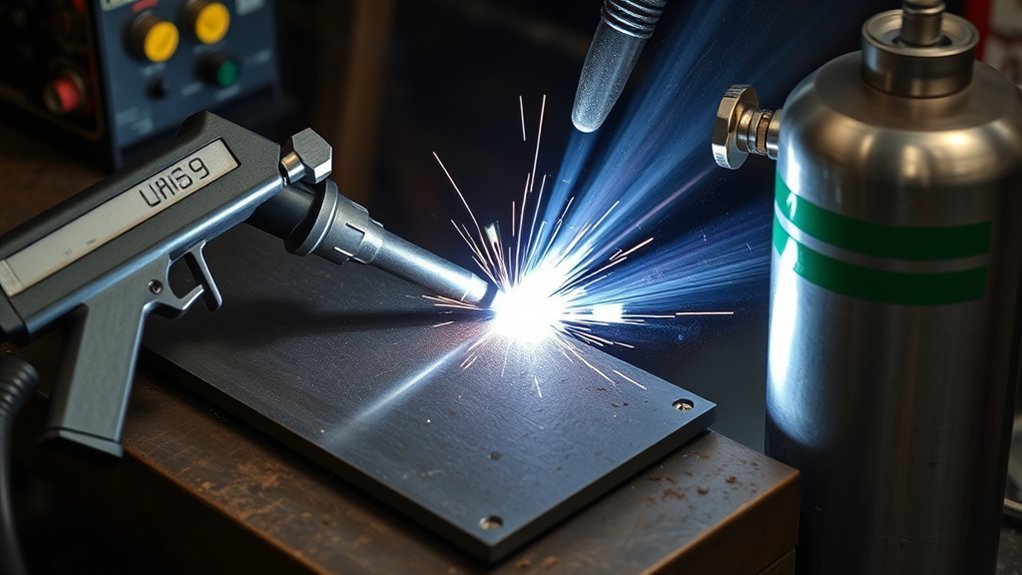
Yes, a MIG machine can strike and maintain an arc on steel with 100% argon, but that does not make it a suitable steel shielding gas. The weld commonly has poor toe wetting, an undesirable bead shape, and inconsistent fusion compared with a proper steel gas mixture.
The American Welding Society explains that mild-steel GMAW normally uses a mixture of argon and carbon dioxide. Its overview of GMAW shielding-gas selection also identifies pure argon as the common choice for aluminum rather than mild steel.
If you already have an argon cylinder for TIG or aluminum work, do not assume it should also serve as your general steel MIG bottle. A 75/25 shielding-gas mix is a much more practical starting point for ordinary carbon-steel short-circuit welding.
Why 100% Argon Behaves Differently
The shielding gas does more than keep air away from the molten metal. It also changes arc characteristics, metal transfer, penetration profile, puddle wetting, and bead shape.
Argon is an inert gas and supports very useful transfer behavior on aluminum. Steel GMAW, however, generally benefits from an active component such as CO2 or a small amount of oxygen. That active component changes the way the arc and molten steel interact.
Shielding gas affects both atmospheric protection and the way the MIG arc transfers heat and filler metal into the joint.
This is why simply increasing voltage or wire feed speed does not turn pure argon into the equivalent of a correctly selected steel gas. Machine output, wire diameter, material thickness, transfer mode, joint design, and shielding gas have to work as a system.
Your machine’s available output range also matters because different transfer modes require different combinations of voltage, amperage, wire feed speed, and gas.
Why 100% Argon Performs Poorly on Steel
Pure argon performs poorly on ordinary steel MIG welding mainly because the puddle does not wet into the joint the way it does with a suitable active-gas blend. The result can look like filler metal sitting on top of the plate rather than flowing smoothly into both sides.
Typical warning signs include:
- A tall or narrow bead rather than a flatter profile.
- Poor tie-in where the bead meets the base metal.
- An arc that wanders or behaves inconsistently.
- Excessive spatter or erratic transfer under unsuitable settings.
- Inadequate fusion even when the bead looks substantial from above.
Changing voltage or wire speed may alter the symptoms, but it does not fix a shielding gas that is unsuitable for the procedure. Beveling can help a joint achieve fusion when joint design requires it, but beveling is not a substitute for the correct gas.
Similarly, different machines respond differently to the same wire and gas. A comparison of MIG welder setup and capability can help explain why settings cannot be copied blindly from one machine to another.
Best Gas Mixes for MIG Welding Steel
For general mild-steel MIG welding, C25 is one of the most common starting choices. It contains 75% argon and 25% carbon dioxide and gives a practical balance of arc smoothness, bead appearance, wetting, and spatter control.
Miller describes C25 as an all-purpose shielding gas for carbon steel in its mild-steel MIG welding guidance. It also notes that 100% CO2 can provide deeper penetration but normally produces more spatter and a rougher bead.
| Shielding gas | Typical use | Main characteristic |
|---|---|---|
| 75% argon / 25% CO2 (C25) | General mild-steel MIG | Smooth arc, good bead profile, relatively low spatter |
| 100% CO2 | Carbon steel where the wire and machine support it | Deeper penetration, but more spatter and a harsher arc |
| Higher-argon Ar/CO2 blends | Spray, pulsed MIG, or procedures specified for a particular wire | Supports transfer modes and bead characteristics that depend on the exact blend |
The correct choice still depends on your wire and procedure. Check the chart inside the welder and the filler-wire manufacturer’s data rather than treating one mix as universal. That becomes especially important with multi-process machines, which may support several transfer modes and materials.
How Argon Affects Arc Stability
Argon strongly affects the arc, but its effect cannot be reduced to a rule such as “more argon means a more stable steel weld.” Stability depends on the base metal, active-gas content, transfer mode, voltage, wire feed speed, wire diameter, and power source.
Argon-rich gases are valuable in many spray and pulsed procedures. Pure argon, however, does not provide the same behavior on steel or stainless that it provides on aluminum.
Good MIG wire selection is also part of the setup because the wire classification and diameter must match the metal, gas, polarity, and available machine output.
Arc Voltage Changes
There is no single correct MIG voltage simply because you are using argon. Voltage must be matched to the wire feed speed, wire diameter, metal thickness, joint, gas, and transfer mode.
If voltage is too low for the rest of the setup, the wire may stub into the work, spatter can rise, and the bead can become excessively convex. If voltage is too high, the arc can become difficult to control and the puddle may spread too much.
For that reason, start with the parameter chart supplied with your machine or filler wire. Fine-tune from there while watching the arc and bead rather than applying one voltage number to every job.
Pool Control Issues
Pool control becomes difficult when the gas does not suit the metal and transfer mode. With pure argon on steel, the bead can fail to wet smoothly into the toes, leaving a raised profile and questionable fusion.
Before blaming torch technique, check the whole setup: gas type, cylinder valve, regulator, flow, hose connections, polarity, wire classification, wire diameter, contact tip, material cleanliness, voltage, and wire feed speed.
A stable-looking arc alone does not prove that the weld is sound. Inspect the bead for uniform width and smooth toe transition, and use an appropriate test method when the joint is structural or safety-critical.
When Pure Argon Can Still Work
Pure argon is most clearly appropriate for aluminum MIG welding and certain procedures for other nonferrous alloys. It should not be treated as a general-purpose gas that happens to penetrate less on steel.
If you are learning, matching the gas, wire, polarity, and material from the start makes troubleshooting much easier. A suitable beginner MIG setup should still be configured according to the manufacturer’s chart.
Thin Sheet Metal
Thin steel needs careful heat control, but 100% argon is not the recommended shortcut. ESAB recommends 75% argon/25% CO2 with small-diameter steel filler wire for very thin plain-carbon steel in short-circuit GMAW.
Its thin-material welding guidance also describes pulsed GMAW with high-argon active-gas blends as another option when the equipment supports it.
For thin steel, focus on the variables that actually control heat and burn-through:
- Use the wire diameter recommended for the material and machine.
- Start from the welder’s chart for voltage and wire feed speed.
- Keep the joint clean and the fit-up tight.
- Use short welds or an appropriate intermittent technique when distortion is a concern.
- Confirm fusion instead of judging the weld only by its surface appearance.
Aluminum And Nonferrous
Aluminum is the strongest case for pure argon in MIG welding. Argon protects the molten aluminum from the atmosphere and supports the spray-transfer behavior normally used for aluminum GMAW.
Pure argon may also appear in procedures for other nonferrous alloys, but the correct shielding gas is alloy- and procedure-specific. Do not assume every copper, brass, magnesium, nickel, or other nonferrous job should use the same gas merely because aluminum does.
| Benefit | Effect |
|---|---|
| Inert shielding | Protects the aluminum weld pool from atmospheric contamination |
| Suitable arc behavior | Supports spray or pulsed-spray transfer used for aluminum MIG |
| Nonferrous compatibility | Useful where the specific filler-metal and procedure guidance calls for argon |
MIG Welding Stainless Steel With Argon
Stainless steel generally should not be MIG welded with 100% argon alone. The correct gas depends on the stainless grade, filler wire, transfer mode, joint, and required corrosion properties.
A 2026 American Welding Society discussion of stainless-steel GMAW shielding gases notes that pure argon is not used for GMAW short-circuit welding because the arc is unstable and the bead is too cold for acceptable results.
For short-circuit stainless GMAW, one established option is a helium-rich tri-mix such as 90% helium, 7.5% argon, and 2.5% CO2. Other transfer modes can use different low-CO2 or argon/oxygen mixtures. The exact recommendation should come from the filler-wire data or qualified welding procedure.
Do not substitute C25 simply because it is already connected to a carbon-steel MIG machine when corrosion performance matters. Higher CO2 levels can alter weld-metal chemistry. Your filler-metal selection must also match the base material and service requirements.
MIG Welding Aluminum With Pure Argon
Pure argon is a standard shielding gas for MIG welding aluminum. Miller specifically recommends 100% argon for aluminum and gives 20–30 cubic feet per hour as a starting flow range in its aluminum MIG guidance.
The same Miller aluminum MIG guide explains that spray transfer is the desired transfer mode. Aluminum wire is also soft, so feeding it reliably may require equipment such as a spool gun or push-pull system.
Preparation matters as much as gas. Degrease the aluminum first, then remove the oxide with a stainless-steel brush dedicated to aluminum so you do not transfer contamination from carbon steel.
Do not use C25 or another CO2-containing steel blend for aluminum MIG. Carbon dioxide reacts in the arc and is not an acceptable substitute for an aluminum shielding-gas procedure.
Argon is also widely used in aluminum TIG welding, so shops that perform both processes may use the same gas supply where the equipment permits. The requirements of AC/DC TIG equipment are different from MIG settings even though the shielding gas can be the same.
How to Improve MIG Welds With Argon
The best way to improve a pure-argon MIG weld depends first on the metal. If you are welding steel or stainless, the priority is usually to change to the correct shielding gas. If you are welding aluminum, keep the argon and improve the rest of the setup.
- Confirm the base metal. Do not choose gas by convenience alone.
- Match the gas to the wire. Follow the filler-wire and machine recommendations for the intended transfer mode.
- Set flow while gas is actually flowing. Adjust at the regulator or flowmeter with the trigger or purge function operating, according to the equipment instructions.
- Clean the joint correctly. Remove oil, dirt, coatings, rust, or aluminum oxide with methods appropriate to the material.
- Start with the machine chart. Set voltage and wire feed speed for the material thickness and wire diameter, then fine-tune the arc.
- Check stickout and travel speed. Keep both consistent so heat input and bead shape do not change unexpectedly.
- Inspect the completed bead. Look for porosity, poor toe fusion, undercut, excessive convexity, and inconsistent bead width.
If you are choosing equipment for several materials, check whether the machine supports the wire-feed accessories, transfer modes, and gas connections you need. Different home-use welding machines can have very different aluminum and steel capabilities.
Warning: Argon can displace oxygen. OSHA requires adequate ventilation for welding in confined spaces and additional controls when ventilation cannot prevent oxygen deficiency. Keep compressed-gas cylinders secured and follow the cylinder supplier’s handling instructions.
For workplace or confined-space welding, follow the applicable OSHA welding and ventilation requirements rather than relying only on ordinary shop ventilation.
Frequently Asked Questions
Is It Possible to MIG Weld With 100% Argon?
Yes, a MIG machine can run with 100% argon, but suitability depends on the metal. Pure argon is widely used for aluminum MIG welding. For carbon steel and stainless steel, use the shielding gas specified for the wire, transfer mode, and welding procedure rather than treating pure argon as a general-purpose gas.
Why Doesn’t My MIG Weld Penetrate the Metal?
Poor penetration can come from an unsuitable gas, insufficient amperage, excessive travel speed, wrong wire feed or voltage settings, poor joint preparation, or incorrect torch technique. Start with the machine and wire manufacturer’s parameter chart, verify the shielding gas, then inspect the bead for proper fusion at both toes.
Can I Use Pure Argon for MIG Welding?
Yes, especially for aluminum MIG welding, but pure argon is not the normal choice for carbon steel or stainless steel GMAW. Steel commonly uses argon-CO2 blends or CO2, while stainless requires a gas matched to its transfer mode and corrosion requirements.
What Should My Argon Be Set at for MIG Welding?
Set shielding-gas flow according to the welder, wire, nozzle, joint, and working conditions rather than using one value for every job. For aluminum MIG, Miller gives 20–30 CFH as a starting range. If you are welding steel, first switch from pure argon to the shielding gas recommended for your steel procedure.
Conclusion
100% argon is an excellent MIG shielding gas for aluminum, but not a universal MIG gas. For ordinary mild steel, an argon-CO2 blend such as C25 is a much better starting point, while stainless steel requires a blend matched to its transfer mode and corrosion requirements.
If a steel weld made with pure argon looks narrow, raised, erratic, or poorly fused, do not keep increasing the machine settings to compensate. Match the gas, wire, polarity, and parameters to the material first, then fine-tune the technique.
Sources
- American Welding Society: What Is GMAW?: Supports shielding-gas selection for mild steel, stainless steel, and aluminum.
- Miller: Understanding the Basics of MIG Welding for Mild Steel: Supports C25 and CO2 guidance for carbon steel.
- ESAB: Best Practices for Welding Thin Materials: Supports gas, wire, and transfer recommendations for thin carbon steel.
- American Welding Society: Shielding Gas Effects on Stainless Steel Weld Composition: Supports stainless-steel gas selection and the limitations of pure argon GMAW.
- Miller: How to Successfully MIG Weld Aluminum: Supports 100% argon, 20–30 CFH flow guidance, spray transfer, and aluminum preparation.
- OSHA: Welding, Cutting, and Brazing General Requirements: Supports ventilation, confined-space, PPE, and oxygen-deficiency precautions.