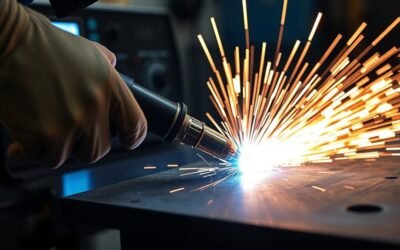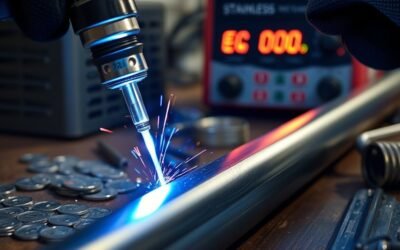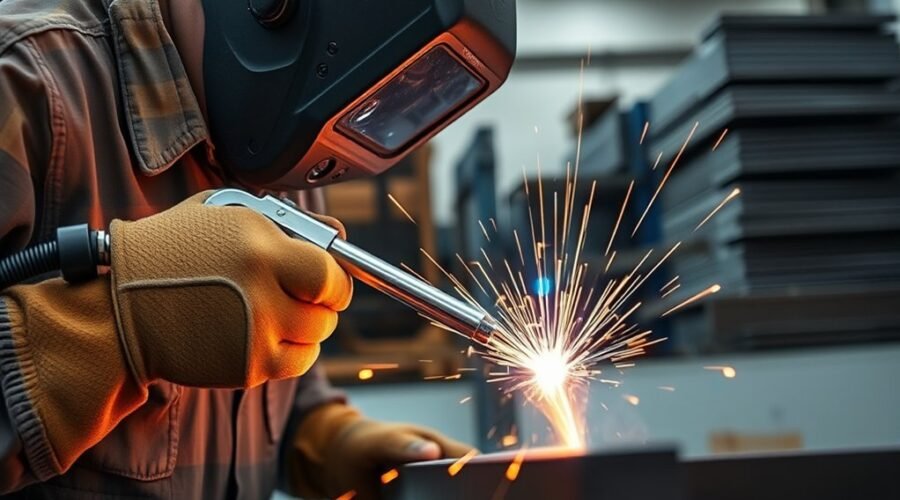
MIG welding is widely used for automotive repair, metal fabrication, manufacturing, construction, maintenance, and home workshop projects because it feeds filler wire continuously and can produce welds quickly. It works especially well on carbon steel and can also weld stainless steel and aluminum when the correct wire, shielding gas, equipment, and settings are used.
Quick Answer
MIG welding is most commonly used for automotive work, general fabrication, manufacturing, sheet metal, frames, trailers, equipment repairs, and DIY projects. It is productive because a continuous wire electrode feeds through the gun. Carbon steel is the most common material, while stainless steel and aluminum require different wire, gas, and setup choices.
Key Takeaways
- MIG welding is widely used for automotive repair, fabrication, manufacturing, sheet metal, frames, trailers, equipment, and general workshop projects.
- Carbon and mild steel are the easiest and most common MIG materials; stainless steel and aluminum need material-specific wire and shielding gas.
- A 75% argon/25% CO2 mix is a common choice for carbon steel, while solid-wire stainless normally uses a low-CO2 stainless blend and aluminum commonly uses 100% argon.
- Material thickness alone does not determine whether MIG will work. Machine output, transfer mode, wire diameter, joint design, position, and number of passes all matter.
- Solid-wire MIG/GMAW needs external shielding gas. So-called gasless wire welding normally uses self-shielded flux-cored wire, which is FCAW-S rather than conventional MIG.
What Is MIG Welding Used For?
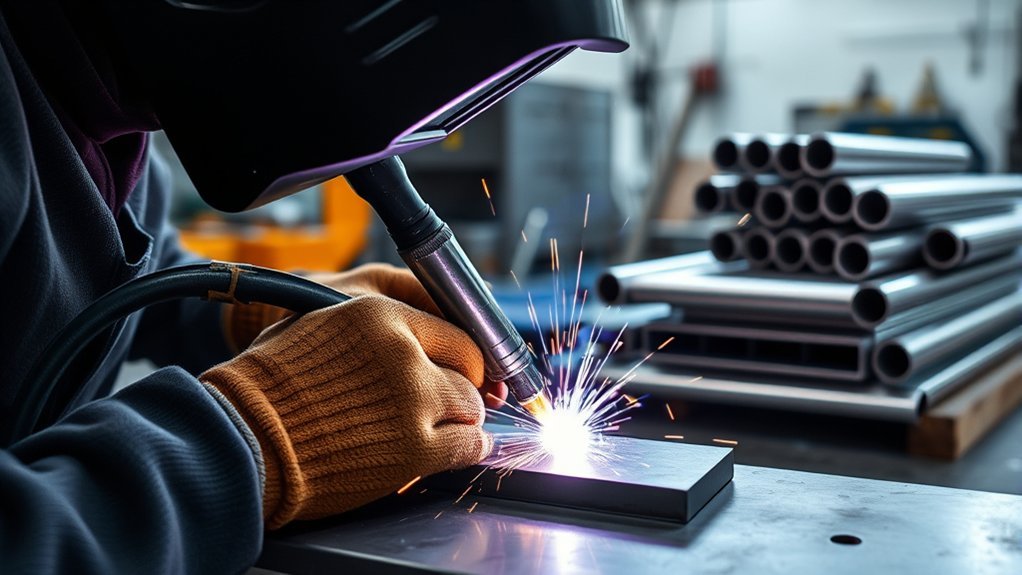
MIG welding is used wherever a fast, continuously fed wire-welding process makes fabrication or repair more efficient. Its technical name is gas metal arc welding (GMAW). An electric arc forms between a consumable wire electrode and the workpiece, melting the wire and base metal while shielding gas protects the molten weld pool from the surrounding atmosphere.
MIG welding is especially valuable when a job calls for repeatable welds, continuous wire feeding, high productivity, and good control on common fabrication metals.
Common applications include automotive repair, sheet-metal fabrication, frames, brackets, trailers, furniture, machinery, production assemblies, agricultural equipment, maintenance work, and many home-shop projects.
The process is particularly common on carbon and mild steel. With the correct consumables and setup, it can also be used successfully on stainless steel and aluminum. Well-matched MIG equipment makes it easier to select the output range and features required for the intended material.
How MIG Welding Works
A MIG system normally includes a constant-voltage power source, wire feeder, welding gun, work lead, electrode wire, and shielding-gas system. Pulling the gun trigger starts the wire feed and shielding gas while energizing the welding circuit.
With solid wire, GMAW commonly operates on direct current electrode positive (DCEP). However, polarity should always match the electrode manufacturer’s specification and the machine’s setup chart. Self-shielded flux-cored wire may use a different polarity.
Three important variables are voltage, wire-feed speed, and travel speed. Wire-feed speed has a strong relationship with welding current, while voltage affects arc length and bead profile. There is no single correct setting for every project, so the parameter chart supplied with the welder or filler wire should be the starting point.
Pro Tip: Do not copy a voltage or wire-speed number simply because another welder used it on the same thickness. Machine design, wire diameter, shielding gas, joint type, position, and transfer mode can all change the correct setting.
Automotive Repair Applications
MIG/GMA welding has a long history in automotive repair because it can control heat effectively on sheet metal while producing welds quickly. Typical work includes body-panel patches, brackets, exhaust components, restoration projects, and some OEM-specified plug, butt, or fillet welds.
Modern vehicles require more caution than older mild-steel vehicles. High-strength and ultra-high-strength steels, aluminum, adhesives, resistance spot welds, MIG brazing, and vehicle-specific sectioning rules are common. For structural or safety-related collision repairs, use the exact vehicle manufacturer’s repair procedure rather than assuming ordinary MIG welding is permitted.
Body Panels and Sheet Metal
Body panels and other thin sheet metal are common MIG applications because small-diameter wire and controlled heat input can limit burn-through and distortion. On carbon-steel bodywork, 0.023-inch wire is a common choice for thin material, although the correct size depends on the machine and repair procedure.
A 75% argon/25% CO2 mixture, commonly called C25, is widely used for carbon-steel MIG because it provides a stable arc, good bead appearance, and relatively low spatter. The exact gas must still match the wire, process, and repair specification.
Heat distortion remains a concern. Short welds, properly spaced tack welds, controlled travel speed, good fit-up, and allowing the panel to cool between welds can help avoid excessive warping. Home-shop welders should also confirm that their machine has enough adjustment at the low end for thin sheet.
Warning: Welding galvanized or zinc-coated steel can generate zinc-oxide fume, and welding also damages protective coating around the joint. Use appropriate ventilation and fume controls, follow applicable safety requirements, and restore corrosion protection according to the repair procedure after welding.
Exhaust and Frame Repairs
MIG welding is useful for many exhaust repairs because exhaust tubing is relatively thin and often requires short, controlled welds around curved joints. The filler wire and shielding gas should match the exhaust material, which may be carbon steel or stainless steel.
Vehicle frame and structural repairs are different. A structurally sound weld depends on more than whether a MIG machine can melt the metal. Steel grade, sectioning location, joint design, filler material, heat input, corrosion protection, weld type, and OEM repair instructions all matter.
For collision-damaged structural components, consult the vehicle-specific body repair manual. Some repairs specify GMA plug or fillet welds, while others require squeeze-type resistance spot welding, MIG brazing, adhesives, complete component replacement, or other joining methods.
Rust Removal and Patching
MIG welding is also well suited to rust repair and patching on repairable sheet metal. Corroded material should be removed until sound metal remains before a patch is fitted and welded.
Good fit-up is important because large gaps require more deposited metal and heat, increasing the chance of burn-through or distortion. The surrounding area should also be cleaned of contaminants, coatings, oil, paint, and loose corrosion as required for the material and welding procedure.
After the repair, exposed steel needs appropriate finishing and corrosion protection. On vehicles, follow the manufacturer’s refinishing, seam-sealer, weld-through-primer, cavity-wax, and corrosion-protection instructions rather than assuming the weld itself restores the original protection.
Fabrication and Construction Applications
MIG welding is widely used in fabrication shops because its continuous wire feed supports long welds and high productivity. Typical projects include frames, tables, racks, railings, brackets, trailers, enclosures, machinery, and production weldments.
Construction and industrial applications may also use GMAW, including structural fabrication and automated production. However, structural work normally follows an approved welding procedure, applicable code, specified filler metal, required joint preparation, and inspection requirements rather than generic hobby-welding settings.
Modern inverter machines and multi-process welding equipment can offer additional control and process choices when a project includes several materials or joint types.
Structural Frame Fabrication
Structural frames, beams, columns, brackets, and trusses can be welded with GMAW when the process is permitted by the applicable welding specification and the equipment has sufficient output.
MIG’s continuous wire feed can provide high deposition rates and reduce interruptions compared with processes that require frequent electrode changes. Spray and pulsed-spray transfer can further increase deposition rates in suitable applications.
Thickness capability is not defined by a universal 16 mm limit. Thick sections may require beveling, multiple passes, larger wire, higher-output equipment, suitable transfer modes, preheat, or a different welding process depending on the procedure.
Sheet Metal Construction
MIG welding works particularly well for sheet-metal construction such as cabinets, panels, brackets, duct components, enclosures, automotive panels, and light fabricated assemblies.
Thin metal requires a balance between enough energy for fusion and low enough heat input to avoid burn-through or warping. Small wire, accurate fit-up, tack sequencing, and the correct voltage and wire-feed setting are important.
The process can be used in flat, horizontal, vertical, and overhead positions when the transfer mode, parameters, joint, and operator technique are appropriate. Out-of-position welding is generally more demanding because gravity affects the molten weld pool.
Heavy-Duty Assembly Work
Industrial GMAW systems are widely used for machinery, frames, fabricated assemblies, repetitive components, and automated welding cells because wire can feed continuously for long periods.
High-output equipment can weld thick material using appropriate joint preparation and multiple passes. Automated and robotic systems also benefit from the process because voltage, wire feed, travel speed, torch position, and shielding gas can be controlled consistently.
The finished quality still depends on procedure, joint preparation, gas coverage, filler selection, machine setup, and operator or automation control. MIG is productive, but speed alone does not guarantee adequate fusion or structural performance.
Other Common MIG Welding Uses
- Manufacturing: repetitive brackets, frames, cabinets, appliances, and production assemblies.
- Trailers and utility equipment: frames, ramps, supports, gates, and accessories when the material and design permit GMAW.
- Farm and maintenance work: shop repairs, guards, brackets, and equipment fabrication.
- Furniture: steel tables, shelving, benches, stools, and decorative frames.
- DIY projects: workbenches, carts, storage racks, firewood holders, gates, and similar projects.
- Art and sculpture: steel and stainless assemblies where continuous wire feeding speeds fabrication.
- Automated welding: repeatable production welds using robotic or mechanized equipment.
Best Metals for MIG Welding
Carbon and mild steel are the most common MIG materials because they are economical, widely available, and supported by a broad selection of wire, gas, and machines.
Stainless steel is also well suited to GMAW, but the filler and shielding gas should be selected for the stainless grade, transfer mode, and service requirements. Controlling carbon introduced by the shielding gas helps preserve corrosion resistance.
Aluminum can be MIG welded effectively with suitable equipment, commonly using 100% argon, aluminum filler wire, and a spool gun or push-pull system to feed the soft wire reliably.
Other alloys can be joined using specialized GMAW consumables and procedures. Copper-alloy wire such as silicon bronze is also used for GMA brazing, including some collision-repair applications, but that should not be confused with ordinary fusion welding of carbon steel.
| Material | Common shielding approach | Important consideration |
|---|---|---|
| Carbon / mild steel | C25 or other approved steel gas; 100% CO2 is also used in some applications | Wire, gas, and transfer mode affect penetration and spatter |
| Stainless steel | Low-CO2 stainless blend such as an appropriate tri-mix or 98% Ar / 2% CO2 where specified | Match filler and gas to stainless grade and transfer mode |
| Aluminum | 100% argon is common | Soft wire often needs a spool gun or push-pull feeder |
MIG Welding Mild Steel and Stainless Steel
Mild steel is forgiving and supports a wide range of MIG equipment. Common solid-wire sizes for light and general fabrication include 0.023, 0.030, and 0.035 inch, with the best choice depending on material thickness and machine output.
A 75% argon/25% CO2 blend is a common general-purpose choice for carbon steel. Compared with 100% CO2, it generally provides lower spatter and a smoother bead, while 100% CO2 can provide greater penetration in appropriate applications.
Stainless steel should not automatically use the same C25 gas. For solid-wire stainless GMAW, shielding mixtures normally keep CO2 low. A tri-mix containing argon, helium, and a small amount of CO2 is common for conventional short-circuit applications, while 98% argon/2% CO2 is used for suitable spray or pulsed applications. Always match the gas to the wire and process recommendation.
| Material | Typical setup consideration | Why it matters |
|---|---|---|
| Mild steel | 0.023–0.035 in. wire is common in light/general fabrication | Wire diameter should match amperage and thickness |
| Mild steel | C25 is a common all-purpose shielding gas | Stable arc with relatively low spatter |
| Stainless steel | Use a stainless-compatible low-CO2 blend | Helps control weld chemistry and corrosion performance |
| Both | Use DCEP when specified for solid GMAW wire | Correct polarity is essential for stable operation |
For a new operator, machine controls and available guidance can matter as much as maximum amperage. Beginner-oriented welders with clear setup charts or automatic parameter functions can reduce trial and error.
MIG Welding Aluminum Basics
Aluminum MIG welding requires a different setup from carbon steel. Common applications include trailers, marine components, transportation equipment, tanks, frames, and fabricated aluminum assemblies.
100% argon is a common shielding gas for aluminum MIG. Aluminum wire is much softer than steel wire, so feeding it through a long conventional gun liner can cause bird-nesting and inconsistent delivery. A spool gun keeps the wire path short, while industrial systems often use push-pull guns.
Surface preparation is also important. Remove oil or grease first, then remove aluminum oxide using a suitable dedicated stainless-steel brush or another approved method. Avoid contaminating the cleaned surface with tools previously used on carbon steel.
Aluminum should not simply be set to a lower wire-feed speed because its melting point is lower than steel. Aluminum MIG commonly uses spray transfer and can require fast wire feeding and fast torch travel. Use the welding machine’s aluminum parameter chart for the specific wire diameter, alloy, and material thickness.
Common filler wires include ER4043 and ER5356, but the correct filler depends on the base alloy, service temperature, required strength, finishing method, and corrosion environment. Using the correct MIG welding wire is more important than choosing filler solely by diameter.
Note: Aluminum MIG capability varies significantly between machines. Confirm that the welder supports the intended aluminum thickness, wire diameter, spool gun or push-pull system, and required transfer mode before buying consumables.
MIG Welding Wire, Gas, and Torch Setup
Selecting the correct wire, gas, polarity, and gun setup has a direct effect on arc stability, penetration, spatter, and finished bead shape.
| Setting | General guidance |
|---|---|
| Wire diameter | Match it to material thickness, amperage, filler specification, and machine capacity |
| Carbon-steel shielding gas | C25 is a common general-purpose choice; other mixtures and 100% CO2 are used for specific applications |
| Stainless shielding gas | Use the low-CO2 mixture specified for the wire and transfer mode |
| Aluminum shielding gas | 100% argon is common |
| Solid-wire polarity | DCEP is common; verify the wire and machine label |
| Gun angle | A modest travel angle is commonly used; exact technique depends on joint and transfer mode |
| Wire-feed speed | Use the machine chart; many MIG applications run at tens to hundreds of inches per minute rather than a single universal range |
A 5- to 15-degree travel angle is a common starting point for many steel MIG welds, but joint geometry and procedure can change the correct torch position. Maintaining the recommended contact-tip-to-work distance is also important for stable current and gas coverage.
Shielding-gas flow should not simply be turned as high as possible. Too little flow can allow atmospheric contamination, while excessive flow can create turbulence and waste gas. The correct flow depends on the nozzle, joint, gas, surroundings, and equipment. Choosing the right shielding gas composition is equally important.
MIG Transfer Modes and Why They Matter
MIG is not one identical arc condition. The transfer mode changes how molten wire crosses the arc and affects usable positions, deposition rate, heat input, and equipment requirements.
- Short-circuit transfer: frequently used on thinner steel and for out-of-position work because the weld pool can be relatively controllable.
- Spray transfer: provides high deposition and a stable stream of droplets but generally requires an argon-rich gas and sufficient current. Conventional spray is mainly suited to flat and horizontal work.
- Pulsed spray: electronically alternates current levels to reduce average heat input and can extend spray-like transfer to a wider range of thicknesses and positions.
This is one reason universal thickness and position claims are unreliable. A small 120-volt hobby welder running short-circuit transfer and an industrial pulsed-MIG system do not have the same capability.
MIG Welding Advantages for Everyday Projects
MIG welding is popular for everyday fabrication because setup is straightforward, wire feeds continuously, and beginners can usually learn basic bead control faster than with TIG.
The process is useful for automotive sheet metal, brackets, carts, frames, tables, racks, trailers, and many repair projects. Its continuous electrode also allows longer welds without repeatedly stopping to replace short stick electrodes.
Other advantages include a wide choice of filler wire, compatibility with automation, good productivity, and relatively little slag when solid wire and shielding gas are used. Cleanup can therefore be faster than with processes that leave a slag covering.
Useful accessories such as MIG welding pliers can also simplify nozzle cleaning, contact-tip changes, and wire trimming during routine work.
- Continuous wire feed supports fast production
- Good control on thin and medium material with suitable equipment
- Widely used on carbon steel
- Can weld stainless steel and aluminum with the correct setup
- Works well for manual, mechanized, and robotic fabrication
- No slag removal is normally required with solid-wire GMAW
- Large selection of machines, wires, guns, and shielding gases
MIG Welding Safety
Welding exposes the operator and nearby people to intense arc radiation, sparks, hot metal, electrical hazards, fire hazards, and welding fumes. Wear an appropriate welding helmet, protective clothing, gloves, and other PPE required for the job, and keep combustible materials away from the work area.
Ventilation is especially important. Welding fumes vary with the base metal, filler wire, coatings, cleaners, and process. Zinc-coated, stainless, painted, plated, or chemically contaminated metal can require additional controls.
Never weld or cut a used tank, drum, fuel container, or other vessel until the applicable safe-work procedure confirms that it has been properly cleaned, isolated, vented, and made safe. Welding near fuel systems, batteries, airbags, electronics, refrigerants, or other vehicle systems also requires the appropriate manufacturer procedure.
For regulatory guidance, see the OSHA welding, cutting, and brazing requirements.
MIG Welding Limits and When to Choose Elsewhere
MIG is highly versatile, but another process may be easier or more appropriate under some conditions.
Wind is one of the biggest limitations of gas-shielded MIG. Moving air can blow shielding gas away from the weld pool and cause porosity. Wind screens or an enclosed work area can help, but self-shielded flux-core or stick welding may be more practical for exposed field work.
Dirty, painted, oily, heavily rusted, or scaled material also increases the risk of defects. Preparation requirements depend on the wire and process, but clean, sound base metal generally provides the most predictable result.
Vertical and overhead MIG welding is possible, but it requires appropriate transfer mode, machine settings, joint preparation, and technique. The molten puddle is harder to control against gravity, so these positions normally demand more skill than flat welding.
On thin precision work where bead appearance and heat control are the main priorities, TIG may be preferable. For exposed outdoor field repairs, stick or self-shielded flux-core may have an advantage. Stick welders also avoid reliance on an external shielding-gas cloud around the arc.
MIG vs TIG vs Stick vs Flux-Core
| Process | Often chosen for | Main trade-off |
|---|---|---|
| MIG / GMAW | Fabrication, production, automotive work, sheet metal, general shop projects | External shielding gas is vulnerable to wind |
| TIG / GTAW | Precise work, thin material, stainless, aluminum, appearance-critical welds | Usually slower and requires more operator coordination |
| Stick / SMAW | Field work, repair, construction, outdoor jobs | Electrode changes and slag cleanup reduce productivity on some jobs |
| Self-shielded flux-core / FCAW-S | Portable outdoor wire welding and repair | Produces slag and is not the same process as solid-wire MIG |
Frequently Asked Questions
What is MIG welding not good for?
Gas-shielded MIG is less convenient in strong wind because airflow can remove shielding gas from the weld. It can also be less suitable than TIG for highly appearance-critical precision work and less portable than stick or self-shielded flux-core for remote field repairs. The best process depends on the material, joint, environment, required weld quality, and applicable procedure.
What happens if you MIG weld without gas?
Conventional solid-wire MIG/GMAW requires external shielding gas. If gas coverage is lost, atmospheric contamination can cause porosity and poor weld quality. Self-shielded flux-cored wire does not need a gas cylinder because its flux generates shielding, but that process is FCAW-S rather than conventional solid-wire MIG.
What is MIG welding most commonly used for?
MIG welding is commonly used for carbon-steel fabrication, automotive work, sheet metal, frames, trailers, manufacturing, machinery, maintenance, and home workshop projects. With the correct wire, shielding gas, and equipment, it can also weld stainless steel and aluminum.
What is better, MIG or TIG welding?
Neither process is better for every job. MIG is usually faster and easier to automate, making it useful for fabrication and production. TIG gives the operator precise control of the arc and filler and is often selected for thin, detailed, stainless, aluminum, or appearance-critical work. Material, joint design, required finish, production rate, and welder skill determine the better process.
Can MIG welding be used outdoors?
Yes, but gas-shielded MIG needs protection from wind because moving air can disturb the shielding-gas envelope. A suitable wind screen may solve the problem in light airflow. For exposed field work, self-shielded flux-core or stick welding is often more convenient.
Can the same shielding gas be used for steel, stainless steel, and aluminum?
Not as a general rule. C25 is a common carbon-steel gas. Solid-wire stainless normally uses a low-CO2 stainless mixture selected for the transfer mode, while aluminum commonly uses 100% argon. Always check the wire and welding-machine manufacturer’s recommendations.
Conclusion
MIG welding is widely used for automotive work, fabrication, manufacturing, construction, maintenance, and home projects because continuous wire feeding makes the process fast and productive. Carbon steel is its most common material, while stainless steel and aluminum can also be welded successfully with the correct wire, gas, equipment, and technique.
Its limits are equally important. Shielding gas is vulnerable to wind, material preparation affects weld quality, aluminum requires special wire-feeding considerations, and structural automotive or coded fabrication work must follow the required repair or welding procedure. Choose MIG when its speed, wire feeding, material compatibility, and available equipment match the job rather than relying on one universal setting or thickness limit.
Sources
- Occupational Safety and Health Administration — Welding, Cutting, and Brazing — ventilation, PPE, zinc-bearing materials, confined spaces, and welding safety requirements.
- MillerWelds — Understanding the Basics of MIG Welding for Mild Steel — carbon-steel wire sizing, C25 shielding gas, material range, and MIG fundamentals.
- MillerWelds — MIG Welding: Setting the Correct Parameters — wire diameter, amperage, voltage, and wire-feed-speed guidance.
- MillerWelds — MIG Welding Stainless Steel — stainless filler selection and low-CO2 shielding-gas recommendations.
- MillerWelds — How to Successfully MIG Weld Aluminum — argon shielding, aluminum cleaning, spray transfer, filler selection, spool guns, and push-pull feeding.
- I-CAR Repairability Technical Support — OEM Collision Repair Procedures — importance of following vehicle-specific welding and joining procedures during structural repair.