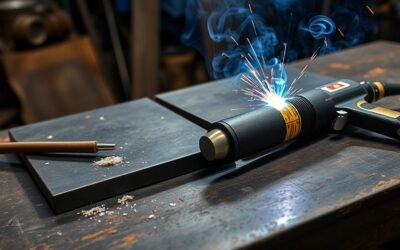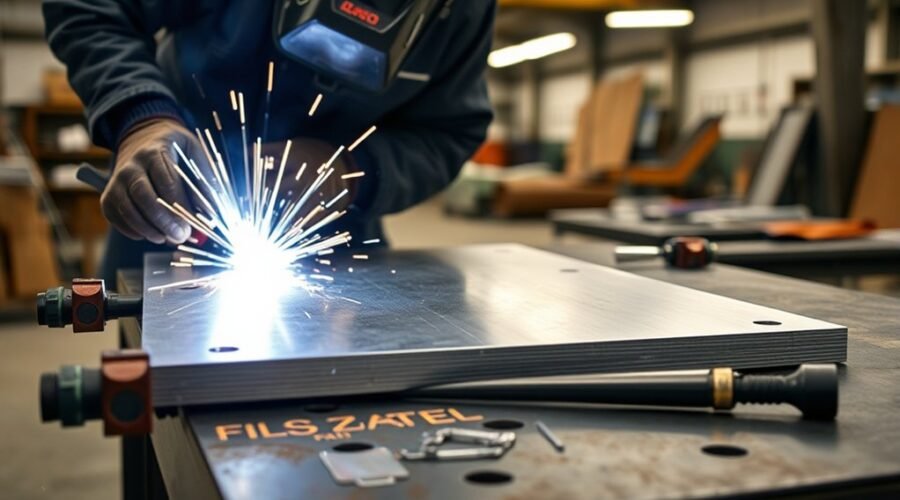
Welding aluminum to steel is possible, but ordinary fusion welding across a bare aluminum-steel interface is usually unreliable. The two metals respond to heat very differently and can form hard, brittle iron-aluminum intermetallic compounds. Reliable joints normally use a transition insert, a controlled solid-state or weld-brazing process, a coated steel surface, or a mechanical connection designed to control corrosion.
Quick Answer
You can join aluminum to steel, but standard MIG or TIG welding directly across the bare metals is generally a poor choice. For dependable work, use engineered aluminum-steel transition joints, solid-state processes, controlled brazing or weld-brazing, aluminized steel, or isolated mechanical fasteners matched to the load and environment.
Key Takeaways
- The main welding problem is not just the melting-point gap; it is also rapid growth of brittle iron-aluminum intermetallic phases at high temperature.
- Bimetallic transition inserts let you weld aluminum to aluminum on one side and steel to steel on the other.
- Explosion welding, rotary friction welding, friction stir welding, laser joining, and specialized resistance processes can join aluminum and steel when the process limits interfacial reaction.
- Brazing and weld-brazing can work for suitable designs, but filler, coating, heat input, and joint geometry must be matched to the materials.
- Mechanical fasteners are practical, but aluminum and steel must be isolated where moisture or salt can create a galvanic cell.
Why Aluminum-to-Steel Welding Is Difficult
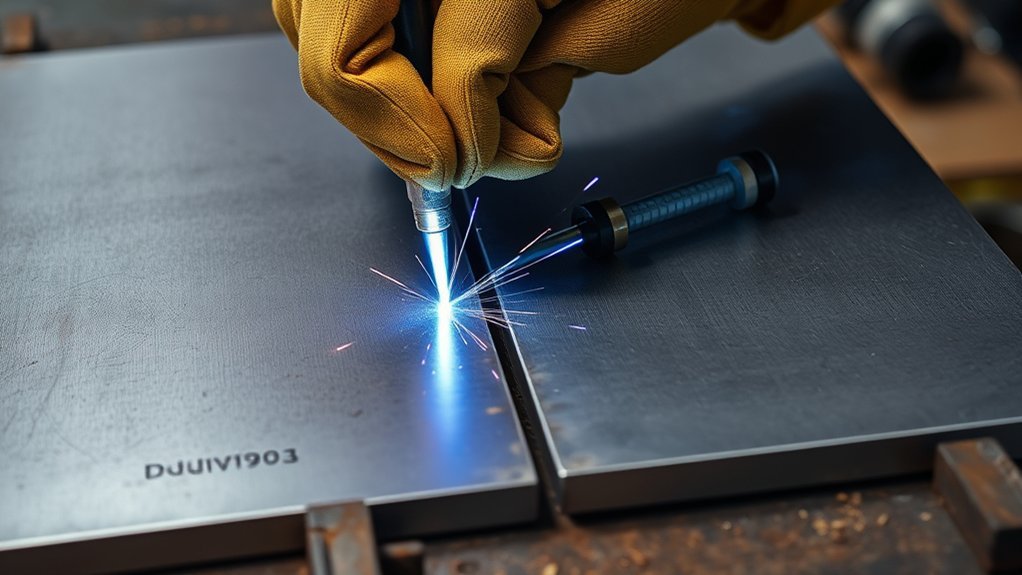
Aluminum and steel have very different melting behavior, thermal conductivity, and expansion rates. According to the American Welding Society guidance on aluminum-to-steel joining, these differences make direct fusion difficult and promote brittle intermetallic compounds at the interface.
Pure aluminum melts at about 660°C, while steel generally melts around 1370°C. Aluminum also moves heat away from the weld zone quickly. If you add enough heat to melt the steel, the aluminum side may already be excessively molten, distorted, or reacting strongly with iron.
Rapid heat flow and brittle iron-aluminum intermetallics make an uncontrolled fusion joint difficult to keep strong and repeatable.
The most important metallurgical issue is the reaction layer between the metals. A thin, controlled interfacial layer can be part of a successful specialized process, but excessive growth reduces ductility and fracture resistance. Thermal-expansion mismatch then adds residual stress as the joint cools.
A multi-process welder can still be useful for the conventional aluminum-to-aluminum and steel-to-steel welds on each side of a transition joint. It does not, by itself, solve the metallurgical incompatibility at a bare aluminum-steel interface.
Can You Weld Aluminum to Steel Directly?
Yes, specialized processes can directly join aluminum and steel, but ordinary shop MIG or TIG fusion across clean, bare aluminum and steel is usually not the dependable route. Modern research covers laser welding, friction stir welding, resistance spot welding, and other controlled methods that limit the intermetallic layer rather than simply melting both metals together.
A 2024 review of dissimilar aluminum-steel welding describes friction stir, laser, and resistance processes as active joining routes. These methods depend on tight control of heat, contact conditions, coatings or interlayers, and process parameters.
| Method | Where It Fits | Main Limitation |
|---|---|---|
| Standard MIG/TIG on bare metals | Generally avoided for structural aluminum-steel joints | Excessive intermetallic formation and difficult heat control |
| Transition insert | Marine, structural, and fabricated assemblies | Requires an engineered prefabricated joint and heat control during installation |
| Solid-state joining | Production applications with suitable geometry | Specialized equipment and process development |
| Brazing or weld-brazing | Thin sections, coated steel, sealing, and selected assemblies | Filler, flux, coating, fit-up, and heat must be compatible |
| Mechanical fastening | Serviceable joints and mixed-material assemblies | Needs load design, sealing, and galvanic isolation |
Filler metal alone does not make a conventional direct fusion weld reliable. The base alloys, joint geometry, coating, heat cycle, and required strength all matter. A machine’s material thickness range also matters on the conventional welds, but equipment capacity cannot replace a proven joining procedure.
Bimetallic Transition Inserts
Bimetallic transition inserts are one of the clearest ways to join aluminum structures to steel without making a conventional fusion weld directly across the two base metals. The insert arrives with the dissimilar metals already bonded by a controlled manufacturing process.
TWI’s guidance on joining aluminum to steel explains that these inserts may be produced by rolling, explosion welding, friction welding, flash welding, or hot-pressure welding. The bulk aluminum is then welded to the aluminum side, and the bulk steel is welded to the steel side.
Even a capable home-use welder does not replace the engineered transition joint. The key benefit comes from moving the difficult aluminum-steel bond into a factory-controlled component.
Transition Joint Basics
A transition joint acts as a bridge. Instead of trying to melt aluminum directly into steel, you weld like metal to like metal on opposite sides of the insert.
The welding sequence also matters. TWI notes that the bulk aluminum is typically welded to the aluminum side first. That larger assembly can then help absorb heat when the steel side is welded, reducing the thermal load reaching the dissimilar-metal bond.
The installer still has to control heat input. Excessive heating can damage the pre-bonded interface, so the joint manufacturer’s welding procedure, orientation, dimensions, and temperature limits take priority over generic settings.
Layered Plate Construction
Transition plates may contain two or more metallic layers, depending on the product and application. A common marine concept uses structural aluminum on one side, steel on the other, and a compatible intermediate layer to reduce the severity of the aluminum-steel reaction.
The factory bond can be made by explosion cladding or another solid-state process. Afterward, the fabricator treats each exposed side as its own compatible welding surface. This makes the final assembly easier to qualify than a bare aluminum-to-steel fusion weld.
The insert does not eliminate every design issue. You still need enough section size, suitable weld placement, controlled heat input, fatigue consideration, and corrosion protection around the completed connection.
Marine Applications
Marine construction is a major use case because designers often want a steel hull or deck with a lighter aluminum superstructure. TriClad structural transition joints are marketed specifically for aluminum-steel vessel construction, including yachts and defense vessels.
- They provide a welded transition between aluminum structure and steel structure.
- They avoid relying on a conventional bare aluminum-steel fusion weld.
- They can reduce crevice-prone mechanical fastening at the main transition.
- They still require correct installation and corrosion protection in marine service.
The practical goal is not “maintenance-free” service in an absolute sense. It is a durable, inspectable connection that reduces joining problems while preserving the weight advantage of aluminum above the steel structure.
Explosion Welding and TriClad Plates
Explosion welding is a solid-state manufacturing process that bonds dissimilar metals by driving them together at high velocity. It is well suited to producing large clad plates and transition-joint stock because it creates a metallurgical bond without bulk melting of both materials.
NobelClad’s structural transition-joint product data shows steel, interlayer, and aluminum-alloy constructions used for marine aluminum-steel joints. Products such as Detacouple and TriClad are factory-made components, not shop-made substitutes for a conventional weld.
Warning: Explosion welding is an industrial explosive process. Do not attempt to reproduce it with improvised charges or normal shop equipment. Use commercially produced transition material and follow the manufacturer’s approved installation procedure.
A flat welding table can help with later fit-up and conventional welding, but the explosion-bonding operation itself is performed under specialized controlled conditions.
Explosion Welding Process
In explosion welding, one plate accelerates toward another at a controlled angle and velocity. The impact produces intense local plastic deformation and ejects surface contamination from the interface, allowing metal-to-metal bonding without melting the full thickness of either plate.
- High-velocity impact creates the bond.
- Bulk melting is avoided.
- The process can join combinations that are difficult to fusion weld.
- The bonded plate can later be cut into transition strips or other shapes.
The benefit for aluminum-steel work is controlled production of the dissimilar interface before final fabrication. The field or shop welder then works on the compatible outer faces instead of recreating the dissimilar bond.
TriClad Plate Benefits
TriClad-type transition products give the fabricator a ready-made route between aluminum and steel. The main advantage is controlled interface manufacture, followed by conventional welding on the appropriate metal face.
| Benefit | Effect | Use |
|---|---|---|
| Controlled bond | Avoids a conventional bare-metal fusion interface | Hull and deck transitions |
| Mixed-material design | Keeps steel where strength is needed and aluminum where lower mass helps | Marine superstructures |
| Reduced joint complexity | Allows conventional welding on compatible outer faces | Production fabrication |
These benefits still depend on following the transition-joint maker’s fabrication limits. Heat from the final aluminum and steel welds must not overheat the bonded interface.
Brazing Aluminum to Steel
Brazing joins aluminum and steel with a compatible filler while avoiding bulk melting of both base metals. It can be useful for thin sections, sealing, brackets, and specialized weld-brazed structures where the joint is designed for the process.
Good brazing depends on clean surfaces, controlled clearance, suitable filler and flux, and enough heat for wetting without excessive intermetallic growth. In laser or arc weld-brazing, the goal is often to melt the filler and aluminum side while keeping the steel largely solid.
Do not assume that ordinary all-around welding rods are suitable. Aluminum-to-steel brazing requires a filler and flux system compatible with the actual alloys, coatings, joint design, and service temperature.
- Remove oil, loose oxide, paint, and contamination from the joining surfaces.
- Keep fit-up consistent so the filler can wet the joint uniformly.
- Use only a filler and flux combination specified for the materials.
- Control heat so the steel-aluminum reaction layer does not grow excessively.
Hot-Dip Aluminizing Steel
Hot-dip aluminizing coats the steel with aluminum before joining. This creates an aluminum-bearing surface that can be welded or weld-brazed to aluminum without asking the arc to fuse directly into bare steel.
The process is not a shortcut around heat control. If the arc overheats the coated region, iron and aluminum can still react and form a thick brittle intermetallic layer. The coating, welding procedure, joint geometry, and heat input therefore have to work as one system.
Aluminized steel can also improve oxidation and corrosion resistance in suitable environments, but the coating does not make every aluminum-steel joint structurally equivalent to a same-metal weld. The finished design still needs qualification for its actual load and service conditions.
A beginner welder should not treat an aluminum-coated steel surface as permission to improvise settings. Use a proven procedure for the specific coated steel and aluminum alloy.
Bolting and Friction Stud Welding
Bolting is often a practical alternative when the design does not require a continuous metallurgical joint. It avoids the thermal problems of fusion welding, but the fasteners, holes, clamp load, isolation materials, and sealing all become part of the structural design.
Do not choose fastener material by a simple “steel is strong” or “aluminum is light” rule. The correct fastener must satisfy the required load, fatigue, environment, access, and corrosion-control plan. In wet service, insulating washers, sleeves, coatings, sealants, or other approved barriers may be needed to keep aluminum and steel from forming a galvanic cell.
Friction stud welding is another solid-state route. A rotating stud is forced against the workpiece, frictional heating plasticizes the interface, and axial force consolidates the joint. TWI lists aluminum-to-carbon-steel among material combinations that can be joined by this process.
If temporary fit-up clamps are useful during ordinary assembly, C-clamps for stability can help hold parts. They are not a substitute for engineered fixtures, correct fastener preload, or a qualified friction-welding setup.
Preventing Galvanic Corrosion
Galvanic corrosion becomes a concern when aluminum and steel are electrically connected while a conductive liquid, such as rainwater or saltwater, bridges the joint. In that situation, the aluminum is usually the more active metal and can corrode preferentially.
The Australian Stainless Steel Development Association’s galvanic-corrosion guidance explains that three conditions are needed: an electrolyte, metal-to-metal electrical contact, and a sufficient potential difference between the metals. Breaking any one of those conditions interrupts the galvanic cell.
- Use suitable insulating coatings, paints, washers, sleeves, or gaskets where the design permits.
- Seal joints so water and salt are less likely to remain trapped at the interface.
- Protect cut edges and damaged coating areas.
- Inspect for pitting, coating breakdown, discoloration, and corrosion around fasteners.
Surface-area ratio also matters. A small aluminum area electrically coupled to a much larger, more noble metal area can experience concentrated attack. That is why fastener and coating details should be treated as part of the corrosion design rather than as an afterthought.
If you use a budget plasma cutter to prepare parts, remove slag, oxide, and damaged coating from the joint-preparation area as required by the joining procedure, then restore the specified corrosion protection after fabrication.
Tools, Prep, and Safety
Successful aluminum-steel joining depends on clean surfaces, accurate fit-up, suitable protective equipment, and a procedure matched to the chosen process. Keep tools used on aluminum clean enough to avoid embedding steel particles or other contamination in the prepared surface.
For welding and brazing operations, use a welding helmet, safety glasses, flame-resistant clothing, gloves, and ventilation appropriate to the process and materials. OSHA’s welding ventilation requirements call for general or local exhaust ventilation capable of keeping fumes and smoke within safe limits, with additional controls for confined spaces.
- Clean both metals and remove contaminants that can interfere with wetting or bonding.
- Verify dimensions, joint clearance, and alignment before heating.
- Confirm the exact transition-joint orientation and manufacturer limits before welding.
- Use ventilation and PPE appropriate to the process, coating, filler, and workspace.
- Inspect trial pieces before applying a new process to production work.
Gloves with reinforced palm protection can improve durability during fabrication, but glove selection should also match heat level, dexterity needs, and the specific welding process.
Note: For structural, pressure-containing, transportation, or marine aluminum-steel joints, use a qualified welding engineer or approved fabrication procedure. A joint that looks sound can still fail if the transition material, heat input, corrosion protection, or loading assumptions are wrong.
Frequently Asked Questions
What metals are difficult to weld together?
Very few metal pairs are absolutely impossible to join, but some are poor candidates for conventional fusion welding. Aluminum-to-steel and other strongly dissimilar combinations may need an interlayer, solid-state process, brazing, adhesive bonding, or mechanical fastening. The workable method depends on the exact alloys, joint geometry, load, and service environment.
How do you join aluminum to steel?
The most practical method depends on the required strength and production setup. Structural work commonly uses engineered transition inserts or specialized solid-state processes. Brazing, weld-brazing, adhesives, or mechanical fasteners may suit other assemblies. In wet service, the design must also isolate or protect the dissimilar metals against galvanic corrosion.
Which metals are hardest to weld?
There is no single hardest metal to weld because difficulty depends on the alloy, process, thickness, restraint, and service requirements. Titanium is demanding because it needs excellent shielding and cleanliness, while high-carbon steels can crack and aluminum needs oxide and heat control. Dissimilar pairs can be harder still because their properties conflict.
What can I use to weld aluminum to steel?
For conventional fabrication, use an engineered aluminum-steel transition insert so each side can be welded to a compatible metal. Specialized production methods include explosion welding, friction welding, friction stir welding, laser joining, resistance joining, and weld-brazing. If a welded joint is unnecessary, isolated mechanical fastening or adhesive bonding may be simpler.
Conclusion
Welding aluminum to steel is a joining-design problem more than a matter of turning up a welder. Conventional bare-metal fusion is difficult because heat promotes brittle iron-aluminum compounds, while transition inserts, solid-state joining, weld-brazing, coated steel, or isolated fasteners control that interface in different ways. Choose the method around the required load, geometry, environment, inspection needs, and available qualified procedure.
Sources
- American Welding Society: Direct joining challenges, practical joining methods, preparation, and safety.
- TWI: Melting behavior, intermetallic formation, hot-dip aluminizing, transition inserts, friction welding, and galvanic isolation.
- Journal of Manufacturing Processes review: Specialized aluminum-steel welding methods, including friction stir, laser, and resistance processes.
- TriClad: Marine structural transition-joint applications.
- NobelClad Detacouple: Structural transition-joint constructions for marine aluminum-steel service.
- Australian Stainless Steel Development Association: Conditions that cause galvanic corrosion and the importance of wetted area ratio.
- OSHA 1926.353: Ventilation requirements for welding, cutting, and heating.