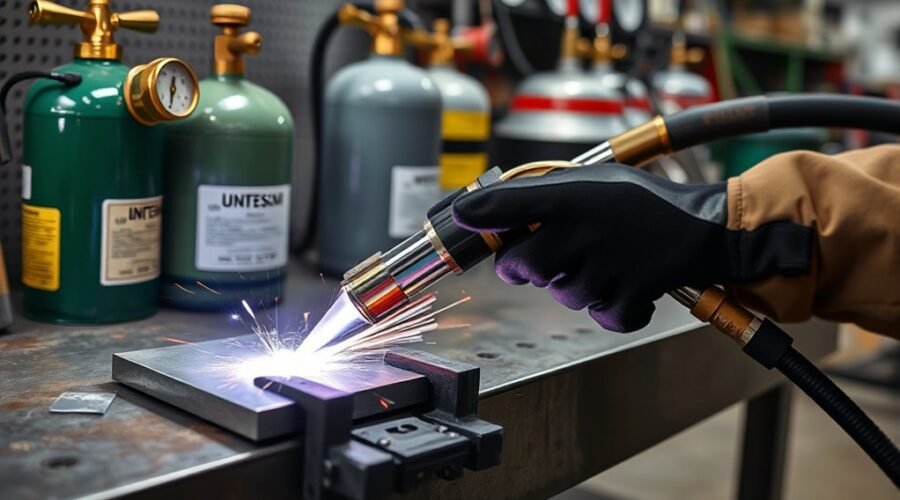
The best TIG gas for most welding is 100% argon because it gives reliable arc starts, stable shielding, and good control on steel, stainless steel, aluminum, and many other alloys. Helium can add heat for thick or highly conductive metal, while small hydrogen additions serve specialized austenitic stainless applications. Gas type, flow, cup setup, and drafts all affect the final weld.
Quick Answer
For most TIG welding, use 100% argon. Add helium when thick or highly conductive material needs more heat and penetration. Use low-percentage argon-hydrogen only for compatible austenitic stainless or nickel alloys under the correct procedure. Never substitute an argon/CO₂ MIG blend for TIG shielding gas.
Key Takeaways
- Pure argon is the simplest all-around TIG choice and offers easier arc starting than helium-rich shielding.
- Argon-helium blends increase arc voltage and heat input; higher helium percentages trade easier starts for more heat.
- Argon-hydrogen mixtures are specialty gases for compatible austenitic stainless steels and some nickel alloys, not general-purpose TIG gas.
- Gas flow must be high enough to shield the puddle but low enough to avoid turbulence and air entrainment.
- A “75/25” cylinder must be identified by composition: 75% argon/25% helium can suit TIG, while 75% argon/25% CO₂ is a MIG gas and should not be used for TIG.
Which TIG Gas Should You Use?
)
For general TIG welding, 100% argon is the first choice. It starts easily, maintains a stable arc, and works across a wider range of common metals than any specialty mixture.
If you need more heat on thick or highly conductive material, an argon-helium mixture can increase arc voltage, penetration, and potential travel speed. A 75% argon/25% helium blend is one common moderate option, although higher-helium blends are also used when additional heat is worth the harder arc starting and higher gas consumption.
For compatible austenitic stainless steels, small hydrogen additions to argon can improve puddle fluidity, penetration, and surface appearance. These are specialty mixtures rather than a replacement for pure argon on every stainless job.
Do not confuse TIG mixtures with common MIG gases. A cylinder containing argon and CO₂ should not be treated as interchangeable with an argon-helium blend. If you also use MIG, this MIG shielding gas guide explains the different requirements.
Why Pure Argon Works Best
Pure argon is the best all-around TIG shielding gas because it offers easy arc starting, predictable arc stability, and dependable coverage. Miller identifies 100% argon as the most common general TIG choice and notes that its lower ionization potential makes arc starting easier than with helium.
Pure argon gives TIG welders dependable starts, stable shielding, and precise puddle control.
The Miller TIG shielding-gas guide also explains that gas coverage affects porosity, oxidation, tungsten condition, heat input, and arc behavior.
Argon is denser than helium, so it generally provides effective coverage without the higher flow often needed for helium-rich mixtures. Its stable arc is especially useful on thin stainless steel and other jobs where small changes in heat can quickly alter the puddle.
Argon’s often-mentioned “cleaning action” needs context. The oxide-cleaning effect associated with TIG is primarily important when welding aluminum or magnesium on AC, where electrode-positive portions of the cycle help remove surface oxide. It is not a reason to expect the same cathodic-cleaning effect when DCEN welding stainless steel.
Gas quality matters as well. Hobart’s aluminum welding guidance specifies argon with a minimum purity of 99.997% and helium at 99.995% for the applications it covers. See the Hobart TIG shielding-gas guidance for that specification. Your actual procedure should follow the gas grade required by the material, WPS, and supplier.
Stable gas does not compensate for a poor machine setup. Power control, torch condition, tungsten preparation, and TIG welder selection still affect the result.
When to Use Argon-Helium Mixes
Use an argon-helium TIG mixture when pure argon does not deliver enough heat efficiently. Helium raises arc voltage and thermal input, which can help on thick sections and metals that conduct heat away from the joint quickly.
A 75% argon/25% helium mixture provides a moderate heat increase while retaining much of argon’s easier starting behavior. However, 25% helium is not a universal maximum. Miller lists common argon-helium TIG blends ranging from about 25% to 75% helium; as helium content rises, heat increases while high-frequency starting and arc stability can become less forgiving.
Helium-rich mixtures also need more shielding-gas flow because helium is much less dense than argon. They cost more to run, so use them where added penetration or travel speed solves a real production or thickness problem.
The heat-management principle is different from plasma cutter selection, even though both processes require close control of arc energy.
Thick Stainless Penetration
For thick stainless steel, helium added to argon can provide more arc energy and deeper fusion than pure argon at the same general current level. This can be useful where the joint otherwise feels cold or requires an impractically slow travel speed.
Higher heat input makes the puddle more fluid and can increase root penetration. It does not automatically prevent distortion, however. Amperage, joint geometry, travel speed, interpass temperature, and total heat input still need to be controlled.
A 25% helium blend is a reasonable moderate starting point when a hotter arc is needed without moving immediately to a helium-rich mixture. For code work, the shielding gas remains a procedure variable and should match the qualified WPS.
Faster Production Welding
Argon-helium blends can support higher travel speeds because the hotter arc transfers more energy into the workpiece. This is most valuable in production welding where the extra gas cost is offset by faster completion or fewer passes.
Higher helium percentages are not automatically better. The arc becomes harder to start and may feel less stable as helium rises, so the mixture should balance heat with the control the application needs.
Gas coverage also becomes more demanding. If increased flow turns turbulent or pulls room air into the shielding envelope, the extra helium will not improve weld quality.
How Helium Affects TIG Penetration
Helium increases TIG heat input mainly because it has a higher ionization potential and higher thermal conductivity than argon. The arc operates at a higher voltage, transferring more energy into the work and often producing deeper penetration or a wider, more fluid root.
That added heat can let you weld thicker sections or increase travel speed without relying only on additional amperage. Equipment capability still matters, especially when a multi-process welder is being used for several welding methods.
Heat Transfer Boost
Increasing helium changes both arc heat and handling. The useful question is not simply whether helium is hotter, but how much extra heat you need before harder starting, greater flow, and higher gas cost outweigh the benefit.
| Helium level | Effect |
|---|---|
| 0% | Pure argon; easiest starting and stable general-purpose arc |
| 25% | Moderate heat increase while retaining good argon-like control |
| 50% | Higher heat input with less forgiving arc starting |
| 75% | Strong heat increase for demanding thick or conductive material |
| 100% | Maximum helium effect, but harder starting and greater flow demand |
Miller notes that common argon-helium blends can contain 25% to 75% helium. Therefore, the original idea that helium must always remain below 25% is too restrictive; the useful percentage depends on the material, thickness, equipment, and desired arc behavior.
Deeper Root Penetration
Helium can increase root penetration by raising arc voltage and heat delivered to the joint. This makes it particularly useful where pure argon produces insufficient fusion on a heavy section.
A 75% argon/25% helium blend is a common moderate choice because it adds heat without giving up as much of argon’s easy-starting character. Higher-helium blends can deliver still more heat when the application justifies them.
Deeper penetration does not remove the need for correct joint preparation. Root opening, bevel geometry, arc length, amperage, filler placement, and travel speed can still determine whether full fusion occurs.
Flow Rate Considerations
Argon-helium mixtures generally need higher flow than pure argon because helium disperses more readily. The exact increase depends on helium percentage, torch cup, gas lens, tungsten extension, joint shape, welding position, and surrounding air movement.
For a 75% argon/25% helium blend, the original 18–25 CFH range can serve as a practical starting window in typical shop conditions. Treat it as a setup range rather than a fixed specification, then confirm the weld remains fully shielded without turbulence.
Do not keep increasing CFH to fight a strong draft. Shield the work from moving air first. Excessive flow can create turbulence and draw oxygen and nitrogen into the gas column, causing the same contamination you were trying to prevent.
When an Argon-Hydrogen Blend Makes Sense
An argon-hydrogen blend makes sense mainly for compatible austenitic stainless steels and certain nickel-alloy applications. Hydrogen increases thermal conductivity, creates a reducing atmosphere, and can improve puddle fluidity, penetration, surface cleanliness, and welding speed.
Linde states that its argon-hydrogen shielding mixtures are primarily used for TIG and plasma welding of austenitic stainless steels and some nickel alloys. Manual TIG mixtures commonly contain only a few percent hydrogen.
A 95% argon/5% hydrogen mixture is therefore a valid specialty option for suitable austenitic stainless work, but it should not be presented as the standard stainless gas. Lower hydrogen additions, such as 2%, are also widely used.
Warning: Do not substitute argon-hydrogen for pure argon on carbon steel, aluminum, or hydrogen-sensitive stainless grades. Ferritic, martensitic, and duplex stainless steels can present hydrogen-related metallurgical risks. Use the exact shielding gas permitted by the material specification, gas supplier, and qualified welding procedure.
Hydrogen-bearing gas does not replace correct cleaning or filler selection. If you are comparing consumables as well, this guide to general-use welding rods covers a separate part of the welding setup.
Best TIG Gas for Stainless Steel
For most stainless steel TIG welding, 100% argon remains the safest general choice. It provides reliable starting, stable shielding, and good puddle control without introducing a reactive component to the arc.
For thick stainless sections, argon-helium can increase heat input and penetration. For selected austenitic grades, low-percentage argon-hydrogen mixtures can improve fluidity and speed. These specialty mixtures should follow the welding procedure rather than being chosen only from material thickness.
Full-penetration stainless joints also need protection on the back of the weld where oxidation matters. Linde’s weld-purging guidance explains that root backing protects the underside from oxygen and helps preserve corrosion resistance. Argon is a widely applicable purge gas, while other backing-gas mixtures require material-specific selection.
Gas purity should meet the grade required by your supplier or WPS. Very high purity is valuable because moisture, oxygen, or other contamination can damage weld appearance and integrity, but a single purity specification should not be treated as universal for every stainless procedure.
Machine performance also affects the usable process window. If you are comparing equipment, this guide to TIG welders under $1,000 covers equipment separately.
Set TIG Gas Flow the Right Way
TIG gas flow should be high enough to protect the tungsten and weld pool without becoming turbulent. Miller gives an overall TIG range of about 10–35 CFH and recommends using the lowest effective flow that maintains clean, stable coverage.
| Setup | CFH | Note |
|---|---|---|
| 100% argon | 15–20 | Common starting range for general TIG work |
| Thin material / small cup | 10–15 | Can work when coverage remains stable and drafts are controlled |
| 75% argon / 25% helium | 18–25 | Starting range; adjust for cup, gas lens, position, and actual coverage |
Cup diameter, nozzle shape, tungsten stick-out, gas-lens use, joint geometry, and room air movement can all change the correct flow. A gas lens helps straighten the flow and reduce turbulence, which can improve coverage when more tungsten extension is needed.
Too little gas leaves the molten pool exposed. Too much gas can become turbulent and entrain room air. The target is a smooth shielding envelope, not maximum regulator flow.
Keep the torch over the end of the weld during post-flow so the hot weld and tungsten remain protected as they cool. If you are new to TIG setup, the beginner welder guide covers the broader equipment choices.
Fix TIG Gas Problems Like Porosity
If a TIG weld develops porosity, discoloration, or a contaminated tungsten, check shielding coverage before changing the gas mixture. Gas leaks, incorrect flow, drafts, dirty material, poor torch assembly, excessive arc length, and contamination are more common starting points.
Miller’s TIG troubleshooting guide recommends checking gas type and flow and specifically warns against argon/CO₂ MIG mixtures because they contaminate TIG welding.
- Confirm the cylinder contents. Make sure you have pure argon or the intended TIG mixture, not C-25 or another MIG blend.
- Check flow while gas is actually flowing. A static regulator reading does not prove the torch has correct shielding flow.
- Inspect hoses and torch connections. Loose fittings, damaged seals, or incorrect torch assembly can pull air into the gas stream.
- Reduce drafts. Fans, open doors, and outdoor wind can strip shielding away from the puddle.
- Check the cup and gas lens. The nozzle must cover the puddle and the exposed hot metal without creating excessive gas velocity.
- Clean the joint and filler. Oil, moisture, oxide, and shop contamination can create defects even with perfect shielding gas.
- Watch arc length and torch angle. An unnecessarily long arc exposes more hot metal and makes shielding less effective.
Switching to helium is not a general porosity cure. Helium can change heat input and penetration, but poor coverage or contamination still has to be fixed at the source.
Machine condition matters too. A stable power source, suitable torch, and adequate duty cycle and cooling capacity help keep the overall process consistent.
Match TIG Gas to Your Job
Choose TIG shielding gas from the metal, thickness, joint, required heat, and welding procedure. Pure argon covers most normal work, while helium and hydrogen additions solve narrower problems.
- Thin stainless steel: use pure argon for stable starts and precise heat control.
- General mild steel TIG: use pure argon rather than an argon/CO₂ MIG blend.
- Most aluminum TIG: pure argon is the standard starting choice, especially on normal thicknesses.
- Thick or highly conductive material: consider argon-helium when additional arc heat or travel speed is needed.
- Austenitic stainless production work: a qualified low-percentage argon-hydrogen mixture may improve fluidity and productivity.
- Hydrogen-sensitive alloys: avoid selecting argon-hydrogen without material- and procedure-specific approval.
For US workplaces, shielding gas also has a safety dimension. OSHA’s welding, cutting, and brazing requirements require adequate ventilation for confined-space welding and address cylinder placement and other hot-work precautions. Inert gases can displace breathable air, so high-flow purging deserves particular care.
Once the gas is correct, match the remaining setup to the same job rather than compensating for poor parameters with more shielding flow. This home welder guide covers equipment for common workshop use.
Frequently Asked Questions
Do You Need 100% Argon to TIG Weld?
No, TIG welding does not always require 100% argon, but pure argon is the standard all-around choice. Argon-helium mixtures add heat for demanding thick sections, while low-percentage argon-hydrogen mixtures serve selected austenitic stainless and nickel-alloy applications. The mixture must match the metal and welding procedure.
Can You Use the Same Gas for MIG and TIG Welding?
Sometimes, but not for every MIG setup. Pure argon can be used for TIG and is also used for MIG welding aluminum, but common steel MIG mixtures containing CO₂ should not be used for TIG. Always identify the actual gas composition instead of assuming cylinders are interchangeable.
Can I TIG Weld Without Argon?
Yes, specialized TIG applications can use helium, but you still need a suitable shielding gas. Air and CO₂ are not substitutes because they contaminate the hot tungsten and weld pool. In normal workshop TIG welding, pure argon remains the simplest and most practical shielding gas.
Can I TIG Weld With 75/25 Gas?
It depends entirely on what “75/25” contains. A blend of 75% argon and 25% helium can be used for TIG and adds heat. C-25, which is 75% argon and 25% CO₂, is a MIG shielding gas and should not be used for TIG because the reactive CO₂ contaminates the tungsten and weld.
Conclusion
For most TIG welding, start with 100% argon and change gases only when the job gives you a clear reason. Argon-helium adds heat for thick or conductive material, while argon-hydrogen is a specialized option for compatible austenitic stainless applications.
Set enough flow to maintain clean shielding without turbulence, protect the joint from drafts, and troubleshoot leaks or contamination before blaming the gas mixture. Above all, identify what is actually in the cylinder: a 75/25 argon-helium TIG blend and 75/25 argon-CO₂ MIG gas are not interchangeable.
Sources
- Miller — Best Practices for Proper Shielding Gas in TIG Welding: Supports argon, helium blends, flow ranges, gas lenses, turbulence, and shielding practices.
- Hobart Brothers — Shielding Gases Used for MIG and TIG Welding: Supports argon-helium use and the cited argon and helium purity specifications.
- Linde — Hydrogen Fuel Gas: Supports argon-hydrogen shielding use for austenitic stainless steels and selected nickel alloys.
- Linde — Weld Purging with Backing and Trailing Gases: Supports stainless root protection, oxidation control, purge-gas selection, and asphyxiation considerations.
- Miller — Common TIG Welding Problems: Supports porosity troubleshooting and the warning against argon/CO₂ MIG shielding gas for TIG.
- OSHA — Welding, Cutting, and Brazing General Requirements: Supports confined-space ventilation and welding safety requirements.