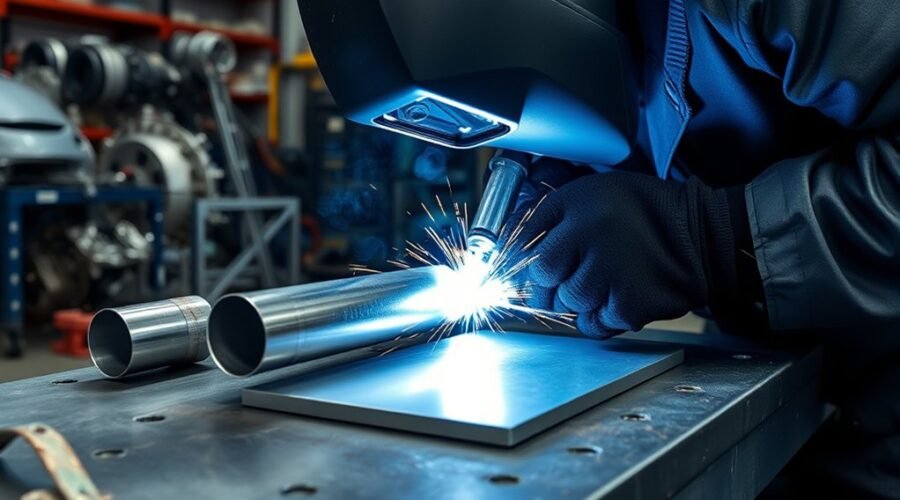
TIG welding, formally called gas tungsten arc welding (GTAW), is used when precise heat control, clean bead appearance, and consistent weld quality matter more than maximum production speed. It is especially useful for thin material, stainless steel, aluminum, titanium, tubing, visible joints, and high-spec fabrication in industries such as aerospace, automotive, sanitary processing, and manufacturing.
Quick Answer
TIG welding is mainly used for clean, precise welds on thin or heat-sensitive metals, including stainless steel, aluminum, titanium, nickel alloys, and mild steel. Common applications include aircraft components, automotive exhausts and roll cages, sanitary tubing, custom fabrication, repair work, and visible joints where heat control and appearance are important.
Key Takeaways
- TIG welding uses a non-consumable tungsten electrode and shielding gas to produce highly controlled welds.
- It is especially useful on thin material, stainless steel, aluminum, titanium, tubing, and visible joints.
- Aerospace, automotive, sanitary piping, manufacturing, repair, and custom fabrication are common TIG applications.
- AC is commonly used for TIG welding aluminum and magnesium, while steel and stainless steel are typically welded with DC electrode negative.
- TIG offers excellent control and low spatter, but it is slower, more skill-intensive, and more sensitive to shielding-gas disruption than several competing processes.
What TIG Welding Is Used For
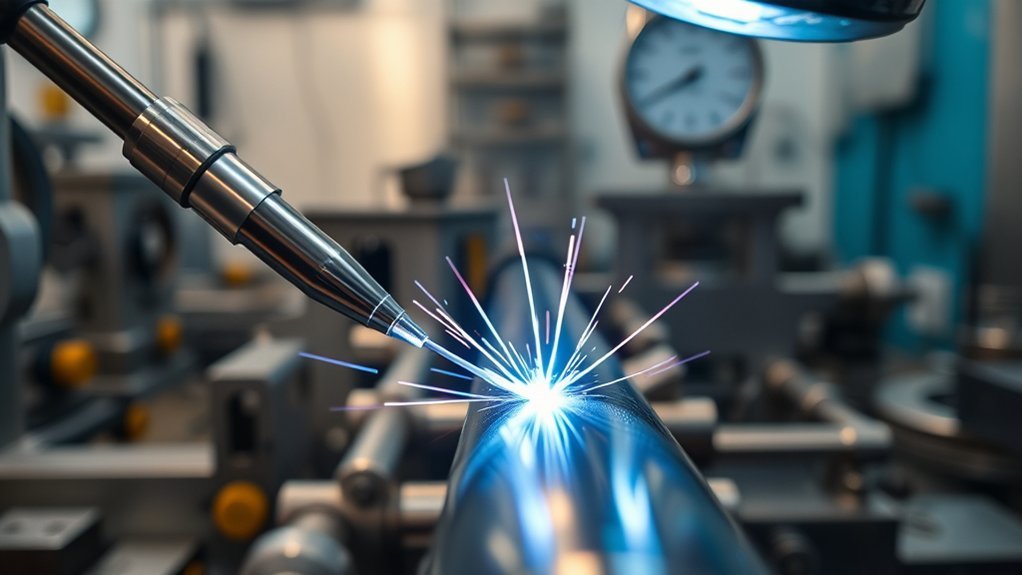
TIG welding is used when a fabricator needs close control over the arc, weld puddle, filler addition, and heat input. The process creates an arc between a non-consumable tungsten electrode and the workpiece while an inert shielding gas, usually argon or an argon-based mixture, protects the hot metal from atmospheric contamination.
The American Welding Society describes GTAW as especially useful for thin sections, non-ferrous alloys, and work requiring precise heat and puddle control. Filler metal can be fed separately when needed, or some closely fitted joints can be welded without added filler.
TIG’s main advantage is not simply that the bead looks clean. It is the operator’s ability to control heat, filler addition, and puddle size independently.
That control makes TIG useful for thin sheet, tubing, precision assemblies, stainless fabrication, aluminum parts, specialty alloys, and repair work where excess heat or cleanup would create problems. TIG is also used on complex joints and visible components because it produces little spatter and can create smooth, consistent beads when the material, tungsten, shielding gas, and settings are correct.
For shops comparing equipment, an AC/DC TIG welder under $2,000 can provide the flexibility needed to work on both ferrous metals and aluminum, depending on the machine’s specifications.
TIG Welding in Aerospace and Automotive
In aerospace fabrication and repair, GTAW is used where tight heat control, material quality, and repeatable fusion are important. Applications can include aircraft components, fuel-system parts, tubing, structural assemblies, and specialty-alloy components.
Aerospace welding is not simply a matter of choosing TIG and making a visually clean bead. Critical work is performed to qualified procedures and acceptance requirements. The American Welding Society’s AWS D17.1/D17.1M:2024 aerospace fusion-welding specification covers welding of aircraft and space hardware made from aluminum-, nickel-, iron-, cobalt-, magnesium-, titanium-, and other alloy systems.
Pulsed GTAW is particularly useful on thin or heat-sensitive aerospace components because alternating peak and background current can help manage weld-puddle size, heat input, distortion, and burn-through.
In automotive manufacturing, motorsports, restoration, and custom fabrication, TIG is commonly used for exhaust systems, roll cages, brackets, tanks, thin tubing, aluminum components, and visible custom work. It is attractive where bead appearance and control are more important than maximum deposition speed.
AC/DC equipment broadens the material range. Fabricators comparing machines can review AC/DC TIG welders for different budgets and shop needs before matching a machine to the metals they actually plan to weld.
TIG Welding for Stainless Steel and Aluminum
Stainless steel and aluminum are two of the materials most closely associated with TIG welding, but they require different machine settings, preparation, and filler choices.
For carbon steel and stainless steel, TIG is typically performed with DC electrode negative (DCEN). On stainless, the process can create smooth, low-spatter joints with good appearance and controlled heat input. Clean base metal, uncontaminated tungsten, correct gas coverage, appropriate filler, and proper purge practices where required are still essential; TIG does not make a weld automatically contamination-free.
For aluminum and magnesium, welders commonly use alternating current (AC). AC provides the oxide-cleaning action needed to deal with aluminum’s tenacious surface oxide while still directing useful heat into the workpiece. Miller’s current TIG setup guidance likewise recommends AC for aluminum and DC/DCEN for steel alloys.
Note: There is no single filler rod that is correct for every aluminum or stainless-steel job. Filler selection depends on the exact base alloy, joint design, desired mechanical properties, cracking tendency, corrosion requirements, service temperature, and any post-weld treatment.
Aluminum also demands careful preparation because moisture, hydrocarbons, and oxide contamination can contribute to porosity and lack of fusion. Very thin aluminum benefits from a machine with stable low-amperage control, while thicker sections may require more amperage, different shielding-gas choices, joint preparation, multiple passes, or another process depending on productivity requirements.
There is therefore no useful universal statement that TIG is limited to a fixed range such as “below 1 mm to 25 mm.” The practical range depends on the power source, alloy, joint design, position, procedure, and acceptable production rate.
For aluminum-capable equipment, compare AC/DC TIG welders under $1,000 and confirm that the machine’s amperage range, duty cycle, AC controls, and torch setup match the intended work.
TIG Welding in Manufacturing Shops
Manufacturing shops use TIG for precision fabrication, small batches, thin-wall tubing, stainless assemblies, aluminum components, prototypes, visible products, repair work, and jobs governed by procedures that call for GTAW.
The process produces low spatter and requires no flux or slag removal, so correctly performed TIG welds can reduce post-weld cleanup. Its controllable arc also helps when distortion, bead size, or heat-affected-zone control matters more than deposition speed.
TIG may also be useful in tool and die repair and other localized restoration work when the alloy and repair procedure are suitable. In these applications, small filler additions and controlled heat can help rebuild a worn edge or repair a localized defect without heating a much larger area than necessary.
Because GTAW can be performed in flat, horizontal, vertical, and overhead positions, it is useful on assemblies that cannot always be rotated into an ideal orientation. However, access, shielding coverage, operator position, and procedure requirements still determine whether TIG is practical in a confined joint.
Shops that need several welding processes from one power source may also compare multi-process MIG, TIG, and stick welders rather than buying a TIG-only machine.
TIG Welding on Thin Metals
TIG welding is especially effective on thin sheet and thin-wall tubing because the operator can make small adjustments to amperage and puddle size. On machines equipped with a foot pedal or fingertip amperage control, heat can be increased to establish the puddle and reduced as the joint heats up.
That control helps reduce burn-through and excessive distortion on stainless steel, mild steel, aluminum, titanium, and other suitable alloys. The exact minimum thickness a welder can handle is not a fixed TIG specification; it depends on the material, machine’s low-amperage stability, joint fit-up, tungsten, arc length, travel speed, and operator skill.
Pulsed TIG adds another level of heat control by alternating between a peak current and a lower background current. According to AWS, pulsed GTAW can help reduce distortion and burn-through in thin sections while improving puddle control.
Pro Tip: On thin material, focus first on clean fit-up, a short stable arc, appropriate tungsten size, sufficient shielding, and controllable low amperage. Do not add generic preheat simply because the metal is aluminum or magnesium; follow the alloy-specific welding procedure when preheat is required.
Beginners who want a machine suitable for practice can also compare MIG, TIG, and stick welders for beginners before deciding whether TIG’s additional coordination requirements fit their first projects.
TIG vs MIG and Stick: When Each Makes Sense
TIG is not automatically the best welding process simply because it provides excellent control. The right process depends on the material, environment, required production rate, joint design, appearance requirements, and operator skill.
| Factor | TIG / GTAW | MIG / GMAW | Stick / SMAW |
| Best known for | Precision, heat control, clean visible welds | Speed and productivity | Portability and field versatility |
| Thin material | Excellent with proper settings | Good with suitable transfer/settings | Usually less convenient for very thin sheet |
| Deposition speed | Lower | Higher | Moderate, application dependent |
| Outdoor wind | Sensitive because shielding gas can be disturbed | Gas-shielded MIG is also wind-sensitive | Often more practical for field work |
| Learning curve | Steeper | Generally easier to begin | Requires electrode and arc-length control |
For a visible stainless tube, thin aluminum assembly, or high-spec joint, TIG may offer the control you want. For long production welds on thicker material, MIG or another higher-deposition process may be more economical. For outdoor repair where wind makes external shielding gas difficult to maintain, stick welding may be the more practical choice.
When TIG Welding Is Not Ideal
Although TIG is highly controllable, it is not the best choice for every fabrication task. Its main limitation on heavy sections and high-volume production is lower filler-metal deposition compared with processes such as MIG/GMAW or flux-cored welding. TIG can weld substantial sections with the correct equipment and procedure, but production can be slower and more expensive.
The process also has a higher skill requirement. Manual TIG commonly asks the operator to maintain torch angle and arc length while feeding filler with the other hand and, in many setups, adjusting amperage with a foot or fingertip control.
Shielding gas is another limitation. Drafts or wind can disturb the argon envelope around the tungsten and weld pool, leading to oxidation, porosity, or other contamination. Miller’s TIG shielding-gas guidance emphasizes maintaining effective gas coverage and avoiding turbulence or inadequate shielding.
TIG can therefore be a poor fit when:
- High deposition rate and short cycle time are the top priorities.
- The joint is dirty, rusty, painted, or difficult to prepare properly.
- Strong outdoor drafts cannot be controlled.
- Access makes torch, filler, or shielding-gas coverage impractical.
- The operator does not yet have enough coordination for the required weld quality.
- A qualified procedure specifies another welding process.
For portable outdoor repair and other jobs where gas shielding is inconvenient, a dedicated stick welder for field and repair work may be the more practical option.
TIG Welding Safety Basics
TIG may produce less visible smoke and spatter than some welding processes, but it still exposes the operator to serious welding hazards. The Occupational Safety and Health Administration identifies metal fumes, ultraviolet radiation, burns, eye injury, electrical shock, and other hazards associated with welding and hot work.
Warning: Use an appropriate welding helmet and filter shade, protective clothing and gloves, adequate ventilation or local exhaust where required, and proper hot-work controls. Remove or shield combustible materials. Stainless-steel welding can involve chromium-containing fumes, so do not assume a clean-looking TIG arc means the air is safe to breathe.
OSHA also requires ventilation or other controls in situations where welding fumes can accumulate, especially in confined or enclosed spaces. The NIOSH Engineering Controls Database notes that welding fumes can contain complex mixtures of metals and metal oxides and that fumes from stainless and other alloyed metals may present greater hazards than ordinary mild-steel fumes.
Before welding, follow the power source and torch manufacturer’s instructions, inspect cables and gas connections, secure cylinders correctly, confirm work-clamp contact, and make sure coatings, solvents, oils, and unknown residues will not create an additional fire or fume hazard.
Frequently Asked Questions
What Is TIG Mostly Used For?
TIG welding is mostly used for precise, clean welding of thin material, stainless steel, aluminum, titanium, nickel alloys, tubing, and high-quality visible joints. Common applications include aerospace components, automotive and motorsports fabrication, sanitary piping, specialty manufacturing, custom metalwork, and precision repair.
Is TIG Welding Hard for Beginners?
TIG generally has a steeper learning curve than MIG because the operator must control the torch, maintain a short arc, manage the weld puddle, add filler separately, and often adjust amperage at the same time. There is no universal number of practice hours required. Consistent results come from repeated practice with clean material, correct setup, and controlled technique.
What Are the Downsides of TIG Welding?
The main disadvantages are slower deposition, a steeper learning curve, more demanding surface preparation, shielding-gas sensitivity to drafts, and potentially higher labor cost on long or heavy welds. The process is excellent where control and appearance matter, but it can be inefficient when production speed is the main priority.
What Is Stronger, MIG Welding or TIG Welding?
Neither TIG nor MIG is automatically stronger in every application. Final weld strength depends on the base metal, filler metal, joint design, penetration and fusion, heat input, procedure, preparation, and workmanship. TIG provides exceptional control on thin and precision work, while MIG can produce sound structural welds with much higher deposition rates when the correct procedure is used.
What Metals Can TIG Welding Be Used On?
TIG can be used on many metals and alloys, including carbon steel, stainless steel, aluminum, magnesium, titanium, nickel alloys, copper alloys, and chromoly. The required polarity, shielding gas, tungsten, filler metal, cleaning method, and welding procedure vary with the material.
Conclusion
TIG welding is used where control and weld quality matter more than maximum speed. Its most recognizable applications include aerospace components, automotive exhausts and roll cages, stainless-steel fabrication, aluminum work, thin sheet and tubing, sanitary systems, custom fabrication, and precision repair.
The familiar comparison to “drawing with molten metal” fits because the welder controls the torch, heat, puddle, and filler independently. That precision is TIG’s greatest advantage, but it comes with trade-offs: slower deposition, greater operator skill, careful preparation, and dependence on effective shielding gas. When those trade-offs match the job, TIG remains one of the most useful processes for clean, controlled, high-quality fabrication.
Sources
- American Welding Society — What Is GTAW Welding? — GTAW operation, advantages, limitations, materials, polarity, and common applications.
- American Welding Society — D17 Aerospace Welding Committee — current D17.1/D17.1M aerospace fusion-welding specification context.
- OSHA — Welding, Cutting, and Brazing Hazards and Solutions — welding PPE, UV, fumes, electrical, burn, and hot-work hazards.
- Miller — Guide to TIG Welding Basics — process setup, AC/DC selection, tungsten, materials, and basic TIG operation.
- Miller — Best Practices for Proper Shielding Gas in TIG Welding — shielding coverage, contamination, porosity, and gas-flow considerations.
- NIOSH — Welding Fumes and Fume Extraction — welding-fume composition, alloy-related hazards, and exposure-control context.