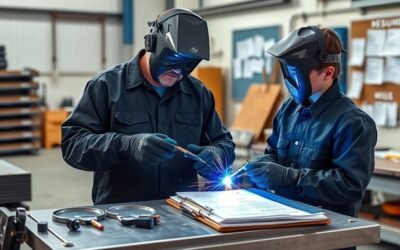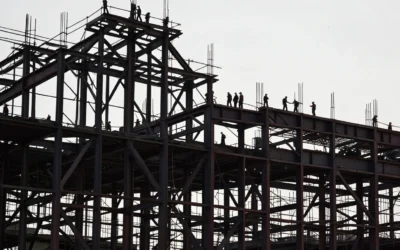
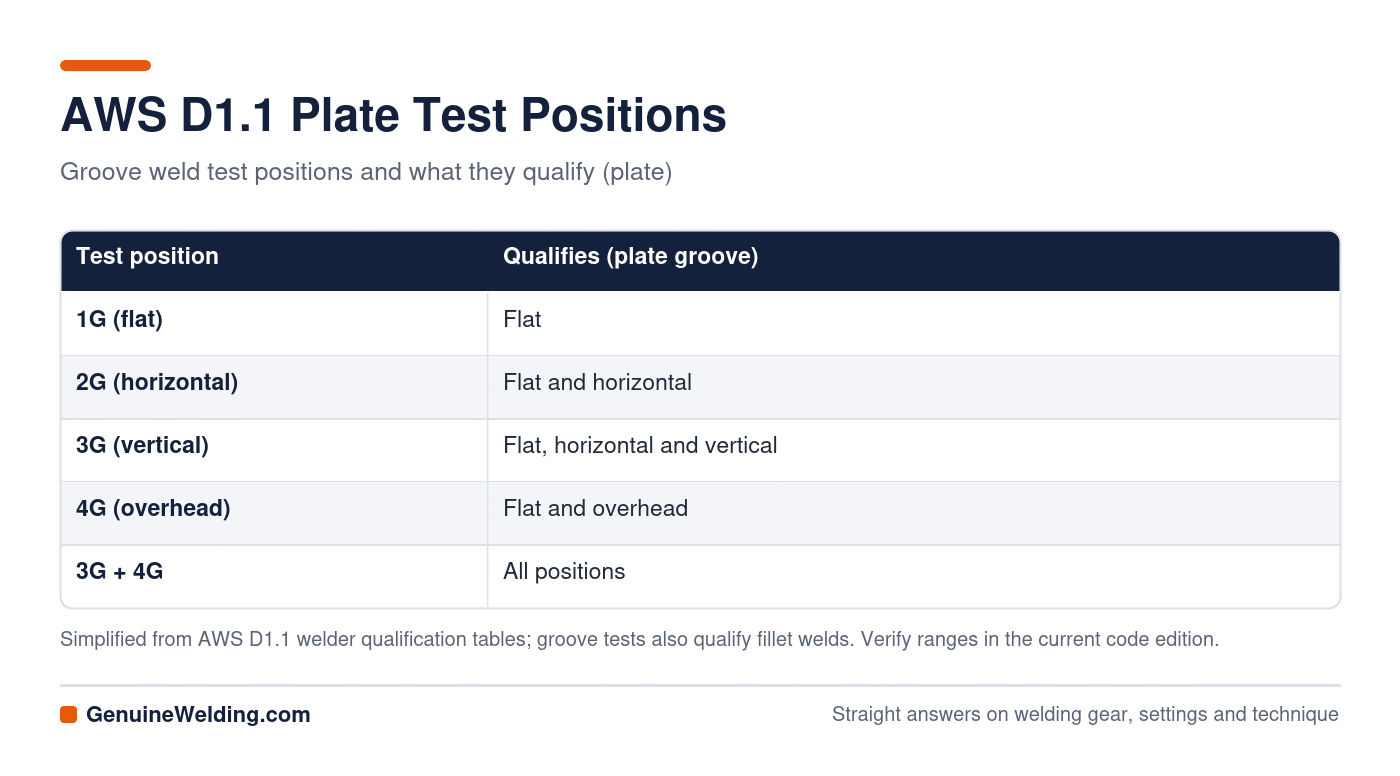
Structural welding joins the steel beams, columns, braces and plates that hold up buildings, bridges, towers and industrial structures, and in the U.S. it is governed by AWS D1.1, the Structural Welding Code – Steel. To work as a structural welder you typically pass a D1.1 plate test (most often 3G vertical and 4G overhead, which together qualify all positions), usually with stick or flux-cored welding. Pay varies: structural iron and steel workers earned a $62,780 median in May 2025, and welders overall earned $53,750, with union and overtime-heavy jobs paying more.
What Is Structural Welding?
Structural welders make the load-bearing welds in steel frameworks. Because those welds carry people, vehicles and equipment, they must be made to a written procedure and inspected. Typical work includes:
- Beam-to-column moment and shear connections
- Column splices and base plates
- Bracing, gusset plates, stairs and platforms
- Bridge girders, stiffeners and cross frames
- Towers, tanks, industrial supports and heavy equipment frames
- Embedded plates and rebar connections
Work happens in two settings: shop welding at a fabricator, and field welding during erection, often at height. Field welds are marked with a flag on drawings; see the field weld symbol.
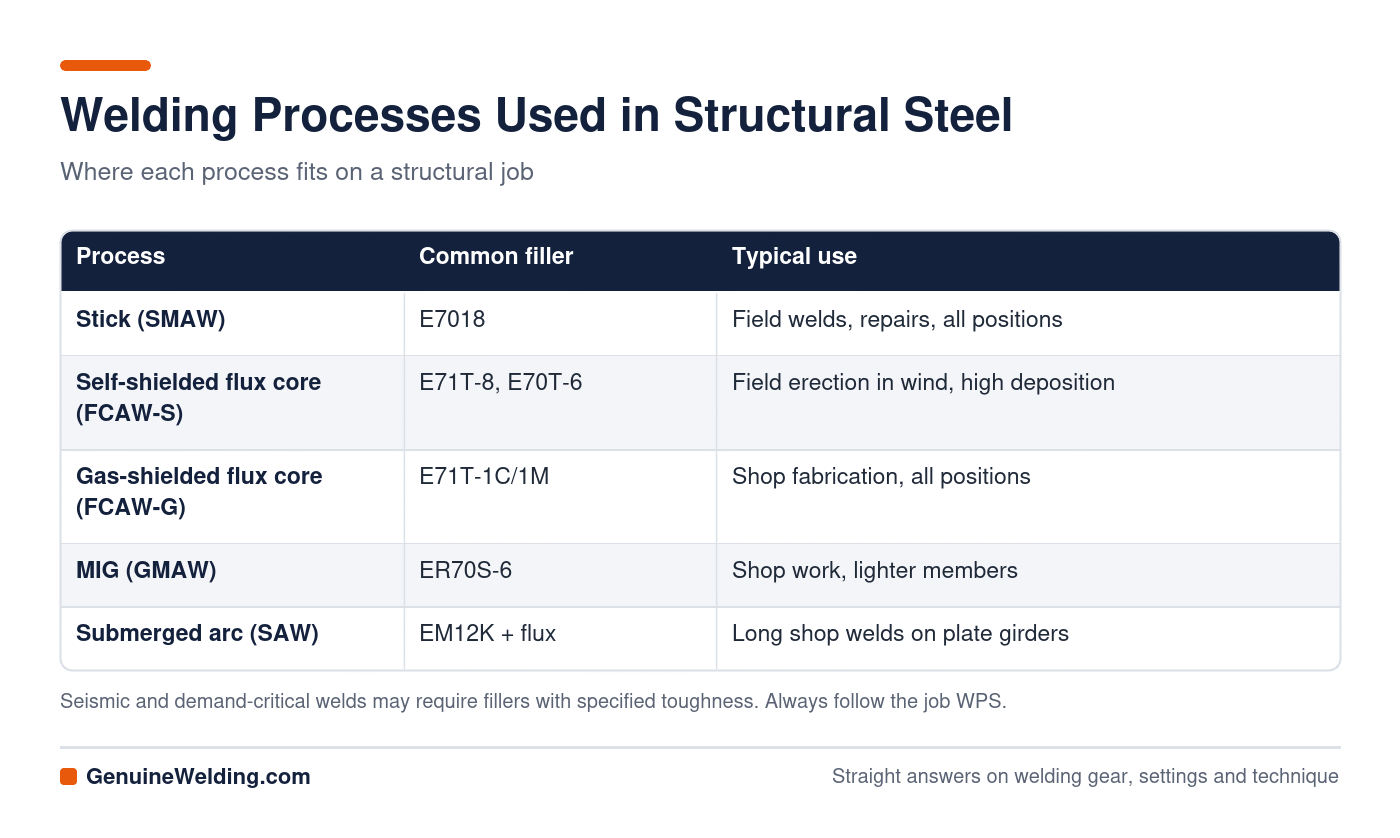
Common Processes in Structural Welding
The AWS D1.1 Certification Test
AWS D1.1 sets the rules for qualifying procedures (WPS) and welders. For welders, the test you take decides which positions and thicknesses you can weld in production.
Typical plate test setup
- Plate: carbon steel, commonly 3/8 in or 1 in thick, with a single-bevel or V groove and a steel backing bar.
- Groove: a common setup is a 45° included angle (22.5° per side) with a 1/4 in root opening; follow the test WPS.
- Process: stick (often E7018) or flux-cored (FCAW), as the employer needs.
- Thickness: a 1 in test plate generally qualifies a wider (unlimited) thickness range than a 3/8 in plate. Check the current D1.1 table for exact limits.
Positions and what they qualify
How the test is graded
- Visual inspection: no cracks, complete fusion, filled craters and limited undercut (D1.1 limits undercut on test welds to 1/32 in).
- Bend tests or radiography: coupons are usually cut into face and root bends (or side bends on thicker plate) and bent 180°. Open defects larger than 1/8 in fail.
See destructive weld testing and our welding certifications guide.
Keeping your certification
D1.1 welder qualifications remain in effect as long as you use the process within a set period (commonly six months) and your work isn’t in question. Most employers keep a continuity log to prove it. Lapse, and you retest.
Structural Welding Jobs
- Ironworker / structural welder: erects and welds steel on buildings and bridges, often union.
- Shop structural welder: welds beams, columns and assemblies in a fabrication shop.
- Bridge welder: welds to AWS D1.5, the Bridge Welding Code.
- Welder fabricator: lays out, fits and welds structural components; see welder fabricator.
- Structural welding inspector: checks welds against D1.1; see how to become a welding inspector.
Structural Welder Pay
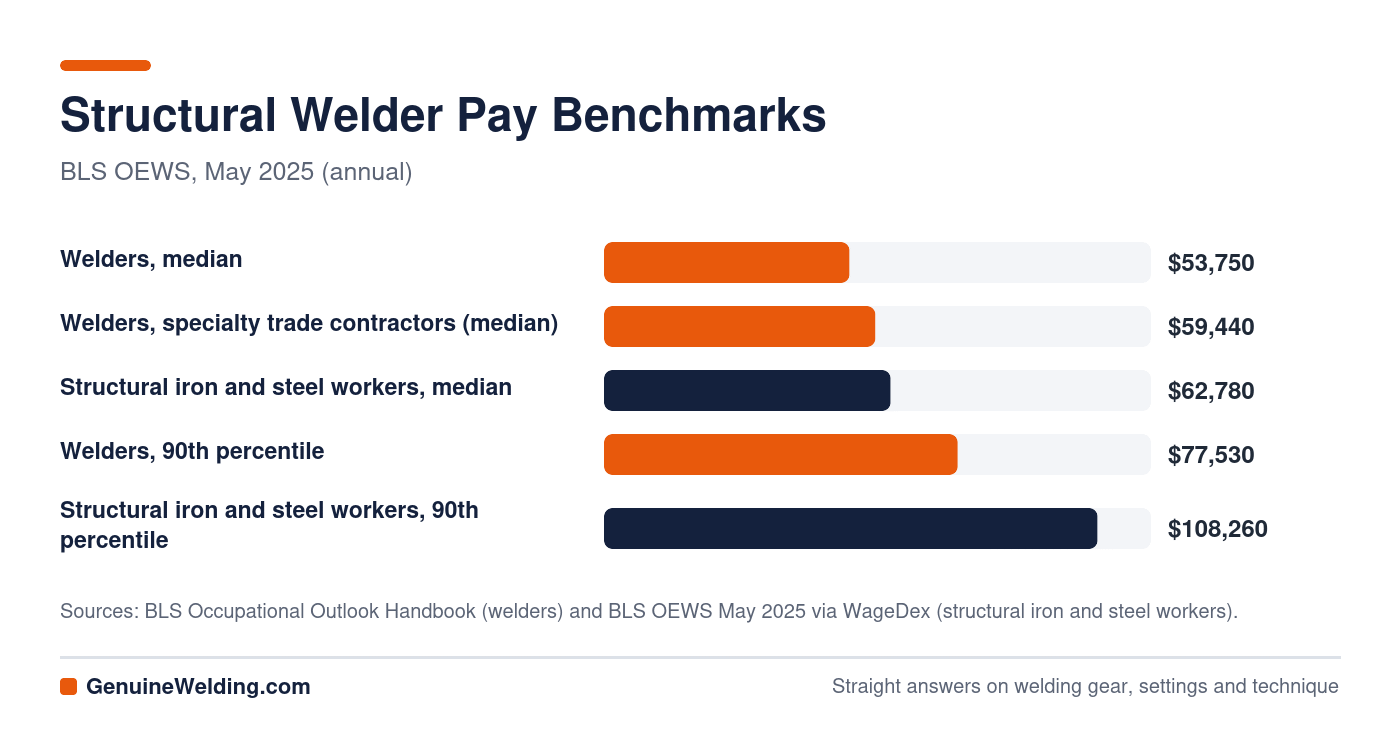
Union ironworkers on large commercial projects, welders with both stick and flux-core D1.1 certifications, and field welders working overtime typically earn toward the upper end. Explore more in highest paying welding jobs.
How to Become a Structural Welder
- Train in stick and flux core. A community college or trade school program with plate work in all positions is ideal. See how to become a welder.
- Master vertical and overhead. The 3G and 4G tests are where most people struggle. See overhead welding.
- Pass a D1.1 plate test at an AWS Accredited Test Facility or employer.
- Learn blueprints and weld symbols. Start with the welding symbols chart.
- Get safety training such as OSHA 10 or 30 and fall protection.
- Apply to fabricators, contractors or an Ironworkers apprenticeship.
Structural Welding Safety
- Fall protection for work at height (harness, lanyard, anchor points)
- Fire watch and hot-work permits on construction sites
- Fume control, especially when welding coated or galvanized steel
- Proper PPE and protection from falling sparks when welding overhead
More in our welding safety guide.
Structural Welding FAQs
What is AWS D1.1?
AWS D1.1 is the Structural Welding Code – Steel. It covers design, procedure qualification, welder qualification, fabrication and inspection of welded steel structures.
Which test qualifies for all positions in structural welding?
Passing both the 3G (vertical) and 4G (overhead) plate tests generally qualifies you for groove and fillet welds on plate in all positions.
Is structural welding hard?
The welding itself is mostly stick and flux core on carbon steel, but out-of-position work, field conditions and code inspections make it demanding.
Do structural welders need to read blueprints?
Yes. Reading shop drawings and welding symbols is essential, especially for weld size, length and location.
How long is an AWS D1.1 certification good for?
It stays valid as long as you keep using the process within the required time period and your welding quality isn’t in doubt.
Sources
- American Welding Society: AWS D1.1 Structural Welding Code – Steel
- BLS: Welders, Cutters, Solderers, and Brazers
- WageDex (BLS OEWS May 2025): Structural Iron and Steel Workers
- OSHA: Fall Protection