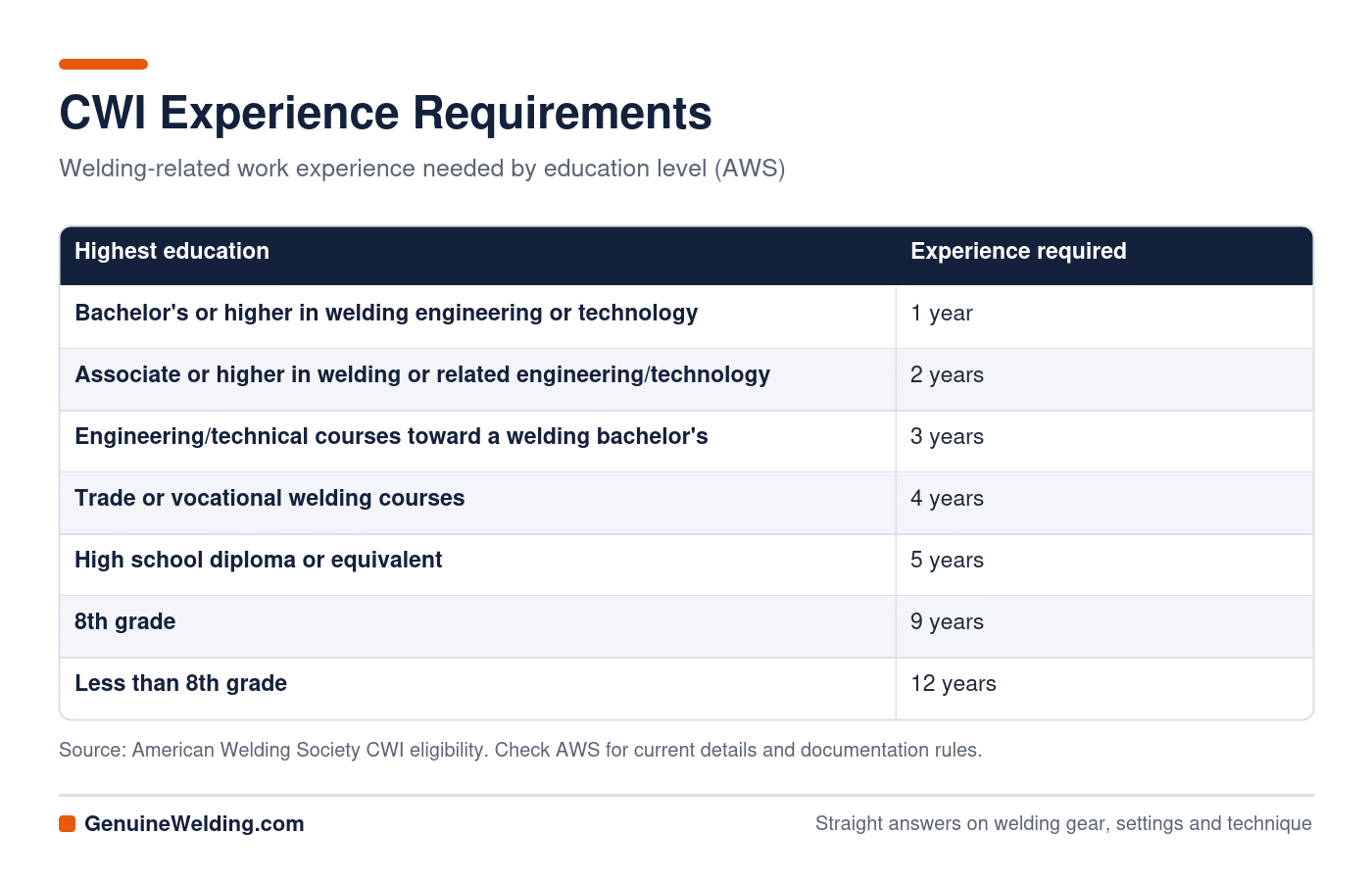
To become a Certified Welding Inspector (CWI), you need welding-related work experience (5 years with a high school diploma, or as little as 1 year with a welding engineering bachelor’s degree), a passing vision test, and passing scores of at least 72% on all three parts of the AWS CWI exam: Fundamentals (Part A), Practical (Part B) and Code Book (Part C). The exam costs about $1,255 for AWS members and $1,520 for non-members, or about $2,000 to $2,265 with Part B training. Certified welding inspectors earn about $34 an hour on average, with total pay commonly between $55,000 and $107,000.
Becoming a CWI is one of the most popular ways for experienced welders to move off the tools, earn more and stay in the trade longer. Here’s exactly how it works in 2026.
What Does a Welding Inspector Do?
- Review drawings, welding procedures (WPS/PQR) and welder qualifications
- Verify base metals, filler metals and consumable storage
- Check fit-up, preheat and interpass temperatures before and during welding
- Inspect finished welds visually and with gauges against code acceptance criteria
- Witness welder qualification tests and procedure tests
- Coordinate or interpret NDT such as UT, RT, MT and PT
- Write inspection reports and nonconformance reports
Inspectors work for fabricators, construction firms, engineering and testing companies, pipeline operators, power plants and government agencies. Learn the basics of what they look for in good weld vs bad weld and weld quality testing.
CWI Eligibility Requirements
Experience must be in a welding-related role, such as welding, fabrication, inspection, quality control, welding engineering or welding sales and service involving technical work. You’ll also need to pass a vision test documented on the AWS visual acuity form.
The AWS CWI Exam
- Part A – Fundamentals: 150 computer-based questions on welding processes, metallurgy, symbols, safety, NDT, inspector duties and more.
- Part B – Practical: hands-on inspection of weld replicas with gauges and tools, plus related questions (46 in the current format), using a provided specification book.
- Part C – Code Book: open-book questions (about 50 to 65) on your chosen code, such as AWS D1.1 (structural steel), API 1104 (pipelines), ASME or others.
You need at least 72% on each part. If you fail one part, you can retake just that part within the allowed time window.
CWI Exam Cost
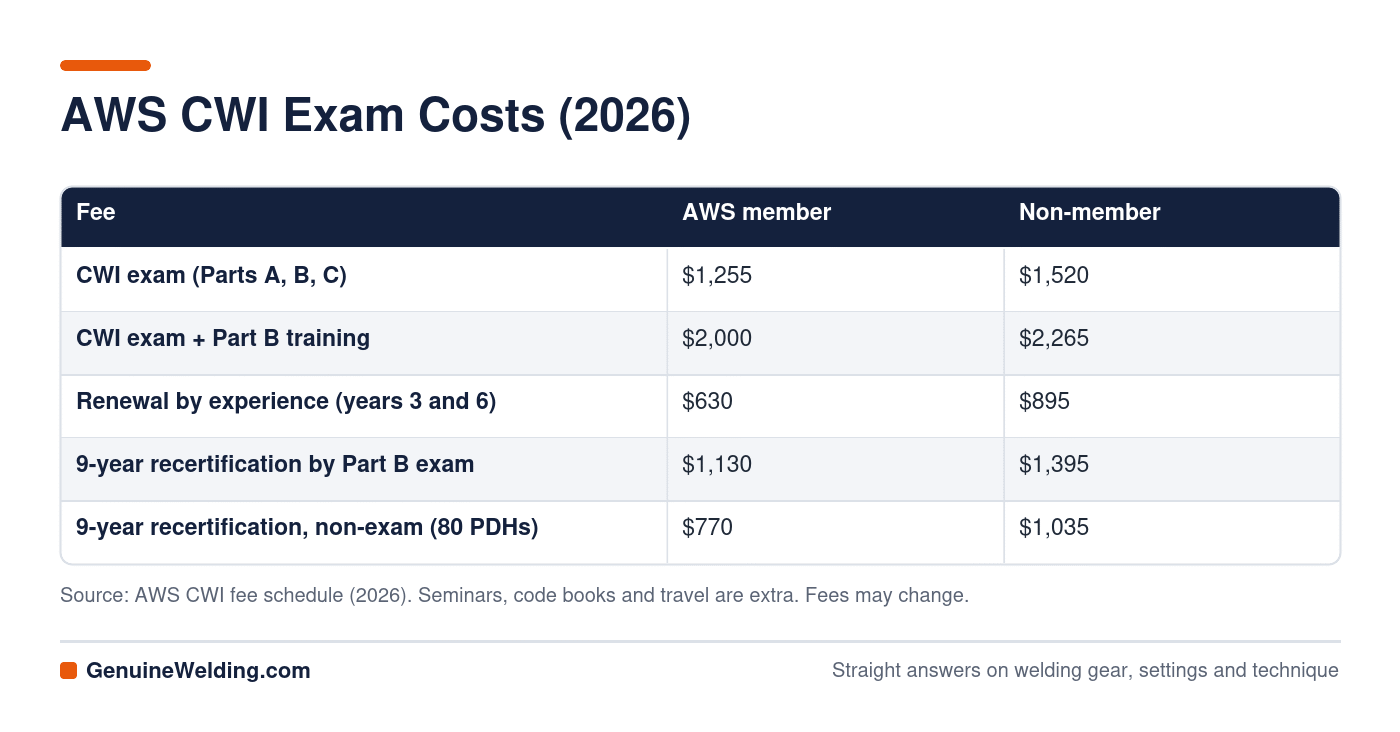
Prep seminars, code books and travel add to the cost. Many employers pay for the seminar and exam for experienced welders they want to promote.
Step-by-Step: How to Become a CWI
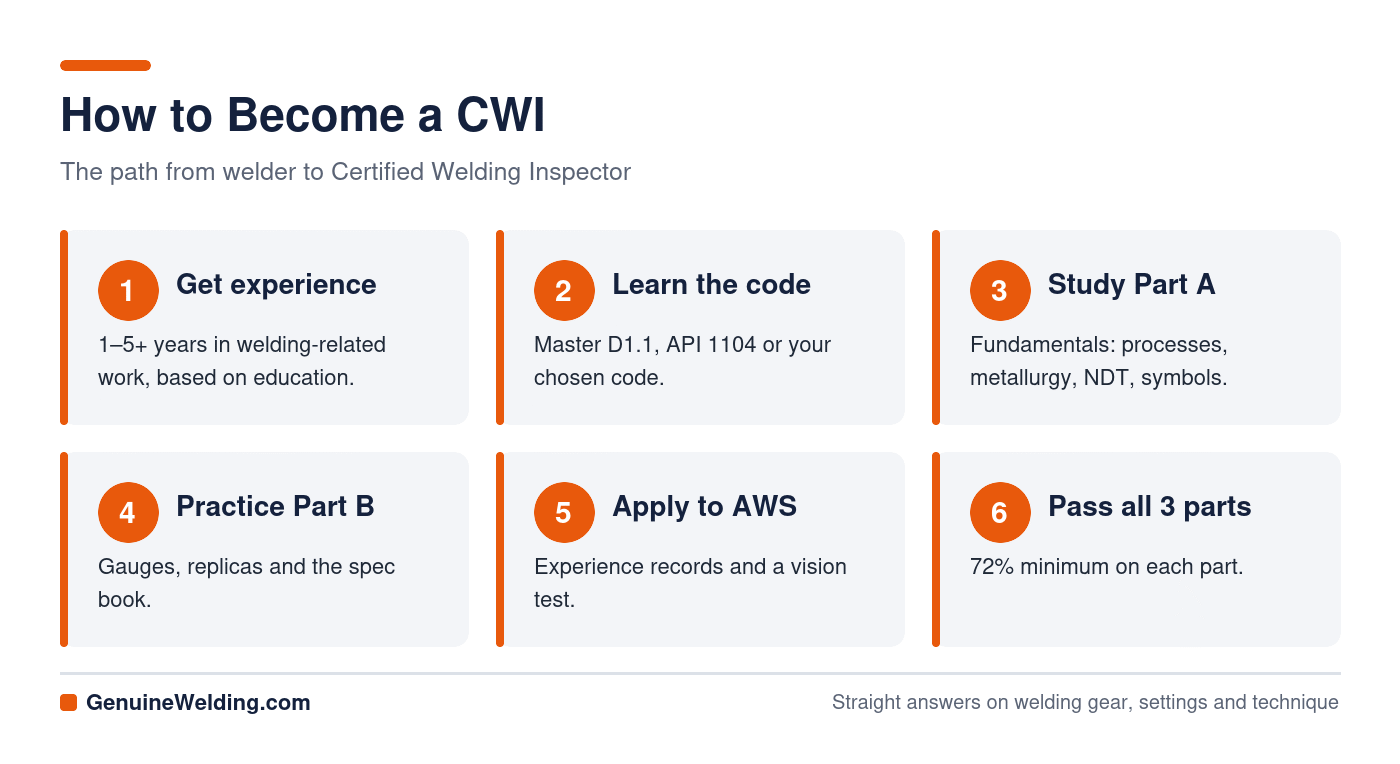
- Build welding experience. Work as a welder, fitter, QC technician or related role. Document dates and duties.
- Learn the codes. Get comfortable with AWS D1.1 or the code you’ll test on, plus welding symbols. See welding codes and standards.
- Study for Part A. Use the AWS Welding Inspection Handbook and practice exams.
- Practice Part B. Learn to use fillet gauges, undercut gauges, calipers and the spec book efficiently.
- Consider a prep seminar. Many candidates take a one- or two-week seminar right before the exam.
- Apply and schedule. Submit your application, experience documentation and vision test to AWS.
- Pass all three parts. Then maintain your certification with renewals.
Keeping Your CWI Certification
- CWI certification is valid for nine years.
- You renew at the 3-year and 6-year marks, usually by documenting continued work experience and paying a fee.
- At 9 years you recertify by exam (Part B), professional development hours or an approved course.
- Keep your vision test current as required.
CWI vs CAWI vs SCWI
| Level | What it is | Typical next step |
|---|---|---|
| CAWI (Certified Associate Welding Inspector) | Entry-level; works under a CWI | Upgrade to CWI with more experience |
| CWI (Certified Welding Inspector) | Fully certified inspector; can sign off on inspections | Add endorsements or move to SCWI |
| SCWI (Senior Certified Welding Inspector) | Senior level; supervises inspection programs | QA/QC management roles |
Endorsements for specific codes and NDT methods, plus certifications such as API 510/570/653, ASNT NDT levels or CSWIP, can raise your pay further.
Welding Inspector Salary
PayScale reports an average base pay of $34.42 an hour for certified welding inspectors as of June 2026, with the 10th to 90th percentile running from about $25.51 to $49.17 an hour. Total pay, including bonuses and profit sharing, ranges roughly from $55,000 to $107,000. Experienced inspectors who travel, work in oil and gas or hold multiple certifications can earn well above that. Compare with other careers in highest paying welding jobs.
How to Become a Welding Inspector: FAQs
How long does it take to become a CWI?
Most people need several years of welding experience first. With a high school diploma, plan on 5 years; with a welding engineering degree, as little as 1 year.
Is the CWI exam hard?
It’s challenging, especially Part B and the code book exam. Many candidates fail at least one part on the first try, so study and practice are essential.
Can I become a welding inspector without being a welder?
Yes, if you have qualifying welding-related experience such as QC, inspection or engineering work. Hands-on welding experience still helps a lot.
How much does the CWI exam cost?
About $1,255 for AWS members and $1,520 for non-members for the three-part exam, or about $2,000 to $2,265 including Part B training (AWS fee schedule).
Do welding inspectors need to travel?
Many do, especially in pipeline, power and construction work. Shop inspectors at fabricators usually work in one location.
Sources
- American Welding Society: Certified Welding Inspector (CWI)
- PayScale: Certified Welding Inspector Pay