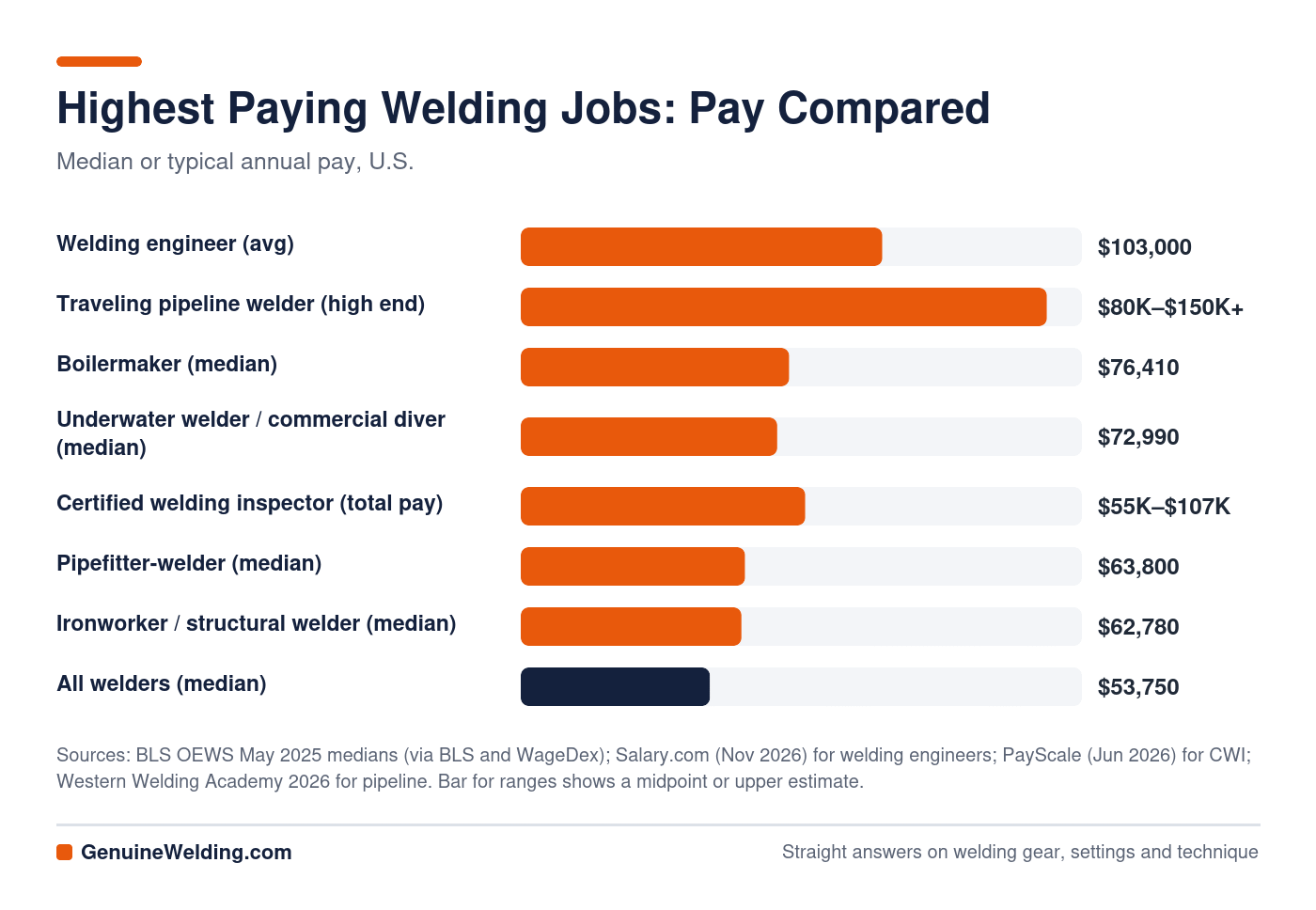
The highest paying welding jobs in 2026 are welding engineer (about $103,000 average), underwater welder (commercial divers earn a $72,990 median, with the top 10% above $157,000), traveling pipeline and rig welder ($80,000 to $150,000+ with per diem), boilermaker ($76,410 median), certified welding inspector, pipefitter-welder and union ironworker. They all pay more because they need advanced certifications, travel, danger pay or a degree.
For comparison, the median for all welders was $53,750 in May 2025 according to the U.S. Bureau of Labor Statistics. Below are the 10 best-paying paths, what they really pay and exactly how to get into each one.
1. Welding Engineer
Typical pay: about $103,000 average (Salary.com, November 2026), with most between $96,000 and $110,000. BLS lists materials engineers, a closely related field, at a $112,860 median.
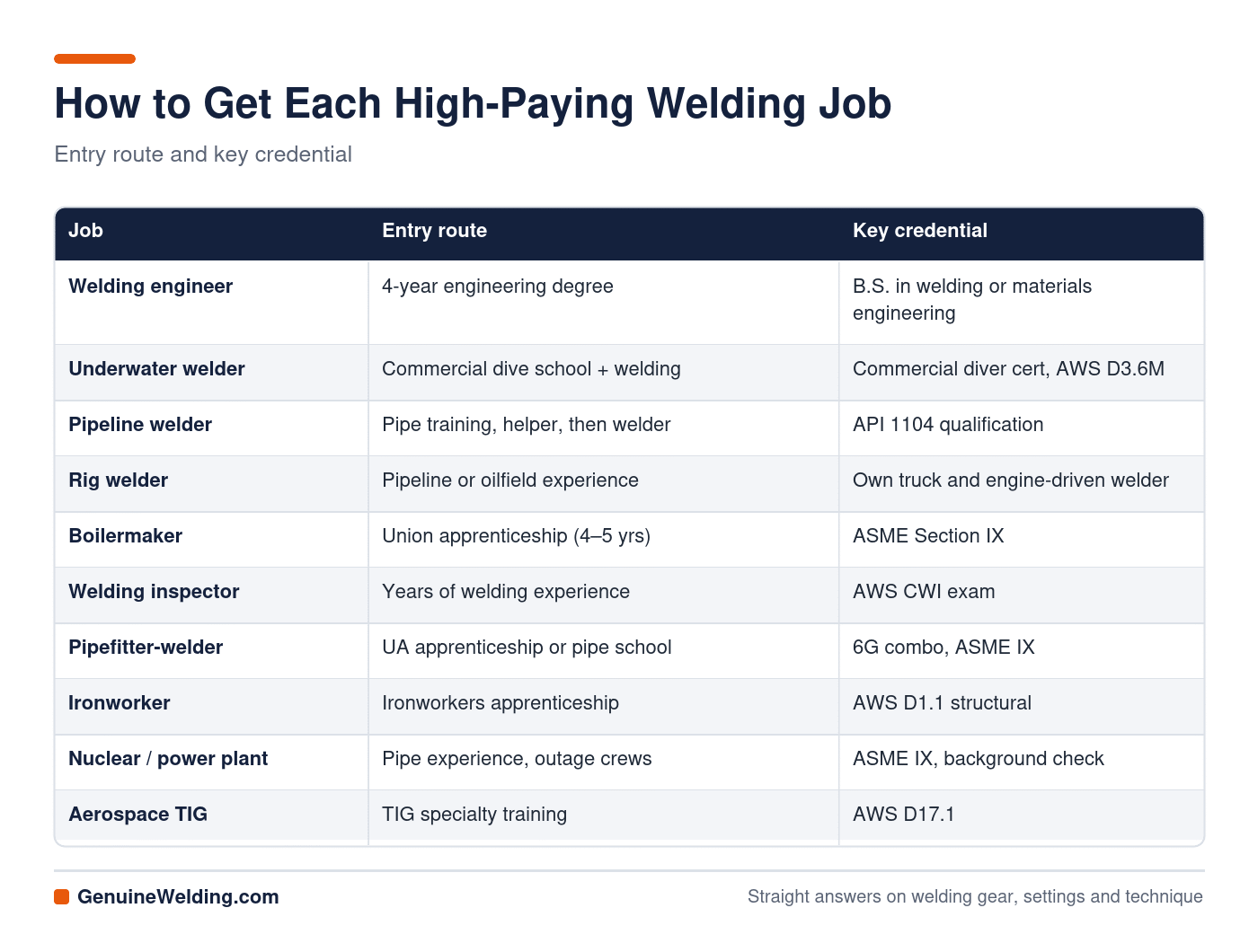
Welding engineers design joints, choose processes and filler metals, write welding procedures (WPS and PQR) and solve production problems. It is the top-paying role, but it needs a bachelor’s degree in welding engineering or a related engineering field. See our full guide to the welding engineer career.
2. Underwater Welder (Commercial Diver)
Typical pay: commercial divers earned a $72,990 median in May 2025, and the top 10% earned more than $157,790 (BLS via WageDex).
Underwater welders are commercial divers first. They repair offshore platforms, ships, docks, dams and pipelines. Pay is driven by depth, saturation diving and offshore work, and so is the risk. You need commercial dive school and a dive certification plus strong welding skills. Read our underwater welding guide.
3. Traveling Pipeline Welder
Typical pay: $80,000 to $150,000+ including overtime and per diem (Western Welding Academy 2026 estimates).
Cross-country pipeline welders work long weeks on oil and gas transmission lines and get a daily per diem on top of wages. Root and tie-in welders earn the most. Requirements: strong downhill stick skills and an API 1104 qualification. Full details in our pipeline welder guide.
4. Rig Welder (Oil, Gas and Offshore)
Typical pay: similar to or above pipeline welders, plus an hourly rig rate for supplying your own truck and welder.
Rig welders own a truck-mounted engine-driven welder and travel to oilfield, pipeline and plant jobs. Offshore rig welders often work rotations such as two weeks on, two weeks off. The rig is a big investment, but the rig pay adds up fast.
5. Boilermaker
Typical pay: $76,410 median and $110,370 at the 90th percentile (BLS, May 2025).
Boilermakers build and repair boilers, tanks and pressure vessels in power plants and refineries, much of it high-quality welding to ASME code. Most enter through a 4- to 5-year union apprenticeship with the International Brotherhood of Boilermakers.
6. Certified Welding Inspector (CWI)
Typical pay: $34.42 an hour average base pay, with total pay around $55,000 to $107,000 (PayScale, June 2026). Experienced inspectors with extra credentials (NDT, API, CSWIP) earn more.
CWIs check fit-up, welding procedures and finished welds against codes. You need welding experience (AWS requires several years depending on education) and must pass the three-part AWS CWI exam. It is a strong move for welders who want to get off the tools.
7. Pipefitter-Welder
Typical pay: $63,800 median and $108,420 at the 90th percentile for plumbers, pipefitters and steamfitters (BLS, May 2025).
Pipefitter-welders build process piping in refineries, chemical plants and power stations, usually with TIG roots and 7018 to ASME Section IX. Union UA apprenticeships combine fitting and welding and pay you while you learn. See our pipe welding guide.
8. Ironworker (Structural Welder)
Typical pay: $62,780 median and $108,260 at the 90th percentile for structural iron and steel workers (BLS, May 2025).
Ironworkers erect and weld steel frames for buildings, bridges and stadiums, often at height. Union ironworkers working overtime on big projects are among the better-paid structural welders. AWS D1.1 structural certifications are essential.
9. Nuclear and Power Plant Welder
Typical pay: above the welder median; outage work with heavy overtime can push annual earnings into six figures.
Nuclear welders work to some of the strictest procedures in the trade, often on stainless and nickel alloys. Short, intense “outage” jobs at power plants pay premium rates. Expect background checks, drug testing and ASME certifications.
10. Aerospace and Specialty TIG Welder
Typical pay: above the welder median, especially for welders certified to AWS D17.1 on aluminum, titanium and nickel alloys.
Aerospace, motorsports and semiconductor-piping welders do precise TIG and orbital work on thin, expensive metals. Clean, consistent work and specialty certifications command higher pay. Learn the basics in our TIG welding guide.
How to Get Into a High-Paying Welding Job
- Stack certifications. A 6G combination (TIG root, stick fill) certification is the key that opens pipe, power plant and refinery work. See the 6G welding test.
- Be willing to travel. Per diem and overtime are where many top earners make their money. Read our traveling welder guide.
- Join a union apprenticeship. UA, Boilermakers and Ironworkers apprenticeships pay you to learn and lead to scale wages and benefits.
- Learn more processes and metals. Stainless, aluminum, chrome-moly and nickel alloys pay more than mild steel.
- Move up. Inspection, supervision, engineering and training roles pay more over time.
Just starting out? Read how to become a welder and our welding certifications guide.
What Affects Welding Pay the Most?
- Certifications: code certifications (AWS D1.1, ASME IX, API 1104) prove skill and raise your rate.
- Location: Alaska, North Dakota, the Gulf Coast and big metro areas pay more.
- Industry: welders for specialty trade contractors earned a $59,440 median in May 2025, versus $51,210 in manufacturing.
- Union membership: union scale includes higher wages and benefits.
- Hours and travel: overtime and per diem can raise annual income by tens of thousands.
Highest Paying Welding Jobs: FAQs
What is the highest paying welding job?
Welding engineer is the highest-paying salaried role. Among hands-on welding jobs, underwater welders, traveling pipeline welders and rig welders have the highest earning potential.
Can welders make $100,000 a year?
Yes. Pipeline, rig, underwater, boilermaker and union pipefitter-welders regularly pass $100,000 with overtime, per diem and travel. It usually takes several years of experience and advanced certifications.
Which welding certification pays the most?
Pipe certifications such as the 6G combo, API 1104 and ASME Section IX tend to unlock the highest-paying jobs, followed by inspection credentials such as the AWS CWI.
Do underwater welders really make that much?
Top divers do, but many earn closer to the median. Pay depends on depth, offshore rotations and saturation diving, and the work carries serious risk.
Sources
- BLS: Welders, Cutters, Solderers, and Brazers
- WageDex (BLS OEWS May 2025): Commercial Divers
- WageDex (BLS OEWS May 2025): Boilermakers
- WageDex (BLS OEWS May 2025): Plumbers, Pipefitters, and Steamfitters
- WageDex (BLS OEWS May 2025): Structural Iron and Steel Workers
- Salary.com: Welding Engineer Salary
- PayScale: Certified Welding Inspector Pay
- Western Welding Academy: Pipeline Welder Salary 2026