
Laser, TIG, and MIG welding solve different fabrication problems. Laser welding can deliver very fast, low-distortion welds when parts fit accurately and the process is set up correctly. MIG is productive, accessible, and well suited to general fabrication. TIG gives the operator exceptional heat and puddle control when appearance and precision matter more than raw throughput.
Quick Answer
Laser welding is usually the strongest choice for repeatable thin-to-medium parts where speed, low distortion, and minimal finishing justify higher equipment and safety costs. MIG is the practical all-around choice for production and thicker fabrication. TIG is best when manual control, thin-material control, and cosmetic weld quality are the priorities.
Key Takeaways
Key Takeaways
- Laser welding can provide high travel speed, concentrated heat input, a narrow heat-affected zone, and low distortion, but results depend heavily on equipment, material, joint design, and fit-up.
- MIG welding, formally gas metal arc welding or GMAW, combines continuous wire feed with good productivity and a relatively short learning curve.
- TIG welding, formally gas tungsten arc welding or GTAW, provides excellent manual heat and puddle control and is widely used where appearance and precision matter.
- Laser equipment normally carries the highest total installed cost because the machine is only part of the investment; safety controls, extraction, training, electrical work, and possible enclosure costs also matter.
- Do not choose from speed alone. Material, thickness, joint gap, weld specification, production volume, finishing requirements, operator skill, and safety infrastructure can change the best choice.
How Laser, MIG, and TIG Differ
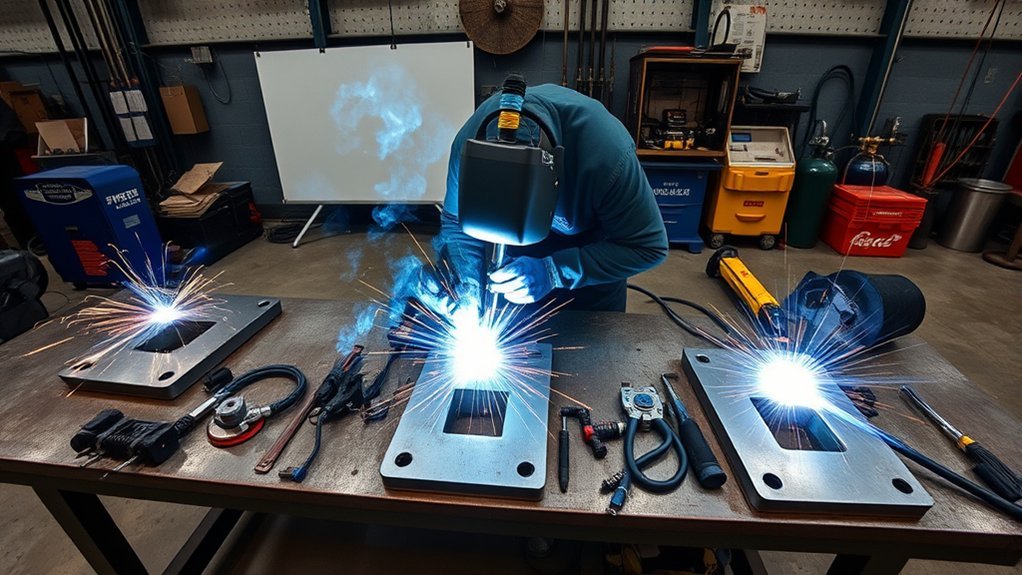
Laser, MIG, and TIG welding differ most clearly in how they create heat, how filler metal is supplied, how much operator control is required, and how sensitive the process is to joint preparation.
Laser welding uses a concentrated beam to deliver energy into a small area. Depending on the equipment and procedure, it can produce deep or narrow welds with relatively low overall heat input and limited distortion. Autogenous laser welding can join parts without filler metal, while other laser procedures use filler wire to improve joint fill, metallurgy, or gap tolerance.
MIG welding uses an automatically fed consumable wire electrode. The continuously supplied wire both carries the arc and adds filler metal. This makes MIG productive and relatively easy to learn for common fabrication work. Miller notes that MIG can be used on thin or thick metals and is generally easier to learn than TIG. For beginners comparing conventional machines, versatility in welding processes is also worth considering.
TIG welding uses a non-consumable tungsten electrode. The operator can add a separate filler rod when the joint requires it. The process gives fine control over the arc, heat input, and weld puddle, but that added control also increases coordination and training demands.
| Factor | Laser | MIG / GMAW | TIG / GTAW |
| Typical strength | Can meet demanding requirements when the procedure and joint are qualified | Strong, productive welds across many fabrication applications | Strong, high-quality welds with excellent manual control |
| Speed | Potentially very high, especially on repeatable parts | Generally high for manual arc welding | Usually slower because control and filler addition take time |
| Heat / distortion | Often low because energy is concentrated | Varies with transfer mode, settings, joint, and technique | Fine heat control, but travel speed and technique affect total heat input |
| Gap tolerance | Often least forgiving without filler or beam manipulation | Generally more forgiving for fabrication gaps | Good operator control, but fit-up still matters |
| Learning demand | Less hand coordination on preset systems, but high safety and system-training demands | Usually the easiest of the three conventional processes to learn | Highest manual coordination requirement |
| Upfront system cost | Highest in most comparisons | Usually lower | Usually lower than laser |
Each process therefore serves a different set of constraints. Laser favors repeatability and concentrated heat input, MIG favors productive general fabrication, and TIG favors direct operator control and refined weld appearance.
Laser vs MIG vs TIG Welding Speed
Welding speed cannot be reduced to one universal inches-per-minute number. Travel speed changes with material, thickness, joint geometry, welding position, penetration requirement, filler use, transfer mode, laser power, and whether the process is manual or automated.
Laser welding can be substantially faster than TIG in the right thin-sheet or repeat-production application, but published travel speed should always be tied to a specific machine, material, thickness, and joint.
Current handheld equipment shows why fixed ranges are misleading. Miller specifies a laser welding travel speed of 15–20 inches per minute for its OptX 2 kW system in listed steel, stainless steel, aluminum, and copper applications. IPG, meanwhile, states that its LightWELD platform can operate up to four times faster than TIG in suitable applications. Those statements describe particular products and procedures, not the physical limit of laser welding.
MIG welding is also highly application-dependent. Continuous wire feed gives it strong deposition capability and good production speed, especially when significant filler metal is required. Specialized high-deposition GMAW processes can increase deposition and travel speed further.
TIG welding is usually the slowest of these choices for manual production because the operator must coordinate the torch, arc length, travel, and often a separate filler rod. That slower pace is also what gives a skilled TIG welder time to control the puddle closely. Welders comparing equipment for detailed work may also value multi-process capability when one machine must cover several types of work.
For thin, repeatable parts with accurate fit-up, laser can reduce both welding time and post-weld straightening or finishing. For joints that need substantial filler deposition or tolerate more variation, MIG can be more practical even when a laser has a higher theoretical travel speed.
Which Welding Method Costs Less?
Among laser, MIG, and TIG, MIG welding usually has the lowest barrier to entry for general fabrication. Conventional MIG equipment is widely available, and setup does not require the specialized laser-controlled environment associated with high-power handheld laser systems.
Laser normally has the highest initial installed cost. The welding unit itself is only one part of that cost. A realistic budget can also include a compliant laser-controlled area or enclosure, interlocks, laser-rated eye and face protection, extraction, electrical work, training, maintenance support, and production fixturing.
Operating cost is more complicated. MIG continuously consumes wire and usually shielding gas. TIG uses shielding gas and may consume filler rod, tungsten electrodes, cups, and other torch parts. Laser can sometimes weld autogenously without filler, but laser filler-wire systems are also common. It is therefore inaccurate to assume that every laser weld eliminates filler material.
The right way to compare total cost is by finished part:
- Equipment and installation cost.
- Labor minutes per part.
- Filler wire or rod and shielding gas.
- Electrical consumption.
- Fixture and preparation time.
- Grinding, polishing, straightening, and other finishing.
- Scrap and rework.
- Inspection and procedure-qualification requirements.
- Maintenance, service, and downtime.
Laser can earn a strong long-term ROI when higher throughput and lower distortion remove an expensive production bottleneck. MIG often remains more economical when production volume is moderate, joints vary from part to part, or high filler deposition is necessary. TIG may have a low equipment cost relative to laser but a high labor cost per finished part when the work is slow and skill-intensive.
If you are comparing fabrication equipment more broadly, the same principle applies to performance versus equipment cost: the purchase price alone does not show the true cost of producing finished work.
Weld Quality and Finish Compared
Weld quality depends on the procedure, material, joint, cleanliness, settings, operator or automation system, and inspection requirements. No process automatically produces a structurally acceptable weld simply because it is laser, MIG, or TIG.
Laser welding can produce narrow, consistent welds with a small heat-affected zone and limited distortion. On well-prepared parts, less distortion can reduce straightening and cosmetic finishing after welding.
The best-looking process is not automatically the strongest process. A production weld must meet the joint’s design, procedure, inspection, and acceptance requirements.
TIG welding gives the operator exceptional control over the arc and weld pool. It also produces no MIG-style spatter and is widely valued for smooth, visually refined welds on stainless steel, aluminum, and other materials. Machines with TIG welding AC and DC capabilities can cover different material requirements when properly configured.
MIG can also produce clean, sound welds, but appearance depends strongly on transfer mode, settings, gas, wire, joint preparation, and technique. Some MIG applications generate more spatter and finishing work than TIG or well-controlled laser welding, while optimized GMAW processes can produce very clean results.
- Laser welding: strong repeatability and low distortion when part preparation and process control are consistent.
- TIG welding: excellent manual puddle control and cosmetic potential.
- MIG welding: strong productivity with weld appearance that ranges from very clean to cleanup-intensive depending on the procedure.
Which Metals Each Process Handles Best
Metal compatibility depends on the exact process, power source, filler, shielding gas, alloy, joint, and required mechanical properties.
Laser welding is widely used on steels, stainless steel, aluminum, nickel alloys, titanium, and other metals. Current handheld systems also list capabilities for copper and other reflective metals, although these materials can require equipment and parameters designed for the application. Laser is especially attractive when concentrated heat input and low distortion are useful.
MIG welding works well with common fabrication metals including mild steel, stainless steel, and aluminum when the correct wire, liner or feed system, polarity, and shielding gas are used. Continuous filler-wire delivery also makes MIG useful for joints that require substantial deposited metal.
TIG welding is widely used on stainless steel and non-ferrous metals such as aluminum, magnesium, copper alloys, nickel alloys, and titanium. Its direct heat control makes it particularly useful for thin, delicate, or appearance-sensitive work.
Equipment capability still matters. A welder advertised as “multi-process” does not automatically have equal performance on every metal. When comparing machines, factors such as output range, duty cycle, feeding system, AC capability, torch configuration, and duty cycle and cooling reliability can be as important as the process label.
Joint Fit-Up, Filler Metal, and Shielding Gas
Joint fit-up is one of the most important differences between laser and conventional arc welding.
Autogenous laser welding uses a small, concentrated beam and adds no filler. That makes the process efficient on accurately prepared joints, but it also reduces the amount of extra molten metal available to bridge a gap. TWI notes that conventional autogenous laser welding generally has less tolerance for poor joint fit-up than arc welding.
Pro Tip: If a laser-welded joint has inconsistent gaps, do not assume more laser power is the answer. Better fixturing, edge preparation, beam oscillation, filler wire, seam tracking, or a different welding process may be needed.
Laser filler wire can improve gap tolerance and modify the weld chemistry, although feeding and melting filler can reduce some of the speed advantage. MIG naturally supplies filler wire continuously, which helps make it practical for many fabrication joints. TIG allows the operator to add filler independently of the arc, giving precise control over how much metal is added.
Shielding requirements also vary. MIG and TIG commonly use shielding gas selected for the process and material. Laser welding may also require shielding gas. For example, current Miller handheld-laser data specifies nitrogen for listed steel/stainless and copper applications and argon for aluminum. Always follow the qualified procedure and equipment manufacturer’s recommendations rather than applying one gas rule to every laser system.
How Skill Level Affects Your Choice
Skill level is a major factor because the three processes put different demands on the operator.
MIG welding generally has the shortest manual learning curve. Wire feeds automatically, so a beginner can focus on gun angle, contact-tip distance, travel speed, and recognizing a stable weld puddle. Technique still matters, and a simple machine does not guarantee sound penetration or fusion.
TIG requires more coordination. The operator controls torch position and arc length while often adding filler with the other hand and adjusting amperage with a foot or fingertip control. This is why TIG is commonly considered the most demanding of these three processes to master manually.
Handheld laser welding can reduce some of the hand coordination associated with TIG, especially when the machine provides preset parameters. However, that does not make it a casual beginner tool. The operator must understand laser hazards, controlled-area procedures, equipment interlocks, correct parameter selection, reflections, material preparation, and the specific system’s operating instructions.
- MIG favors faster manual onboarding.
- TIG rewards refined hand coordination and puddle control.
- Laser shifts part of the challenge from arc manipulation to process setup, fit-up, system knowledge, and laser safety.
Traditional arc-welding experience can still be valuable, and understanding factors such as arc stability helps build broader knowledge of weld-pool behavior and heat control.
Laser Welding Safety vs MIG and TIG
All welding processes involve hazards, including hot metal, fire, fumes, gases, electrical hazards, and potentially dangerous radiation. Handheld laser welding adds a separate high-power laser hazard that requires controls beyond normal arc-welding PPE.
Warning: Industrial handheld laser welders are typically Class 4 laser systems. Direct and reflected beams can permanently damage eyes, burn skin, and ignite combustible material. Ordinary welding curtains, safety glasses, or a conventional welding helmet are not automatically adequate laser protection. Follow the manufacturer’s instructions and applicable laser-safety standards, and use a properly controlled work area.
The American Welding Society’s current handheld-laser guidance calls attention to safeguards such as key control, emergency stops, external interlocks, trained personnel, a laser-controlled area, and laser-specific eye and face protection selected for the system.
Reflection is especially important. A beam does not need to enter the eye directly from the torch to be dangerous. Specular and diffuse reflections from the workpiece can also create hazards depending on the laser and exposure conditions.
Ventilation must not be ignored either. OSHA guidance notes that laser welding, cutting, and other material interactions can generate hazardous fumes and vapors, just as conventional welding processes can. Use appropriate local exhaust or other ventilation based on the material and work environment.
Note: Faster learning of torch movement is not the same as lower overall risk. A laser welder may be easy to move along a seam while still requiring much more controlled safety infrastructure than a MIG or TIG machine.
Best Uses for Laser, MIG, and TIG
Laser welding is especially useful for repeatable sheet-metal and precision assemblies where tight fit-up, low distortion, and fast cycles matter. Depending on the equipment and qualified procedure, applications can include stainless fabrication, enclosures, cabinets, appliances, automotive components, battery-related manufacturing, aerospace parts, and medical-device components.
MIG welding is well suited to general fabrication, production welding, structural and equipment work, and joints where continuous filler deposition is useful. Its combination of productivity, common equipment, and relatively easy operation makes it one of the most practical shop processes.
TIG welding fits detailed fabrication where heat control, appearance, cleanliness, and manual precision are especially important. Stainless, aluminum, thin tubing, custom automotive work, aerospace fabrication, sanitary work, and high-quality repair are common examples.
For a home or small-shop buyer, equipment practicality can matter as much as theoretical process performance. This guide to welders for home use covers conventional options where a Class 4 laser installation would not be appropriate.
Material Thickness Range
There is no universal thickness range for an entire welding process. Machine output, alloy, joint type, position, required penetration, filler addition, number of passes, and procedure qualification all matter.
Laser welding is often attractive for thin-to-medium sections because concentrated energy can produce useful penetration with limited surrounding heat. As a specific current example rather than a universal limit, Miller rates its OptX 2 kW handheld laser for approximately 20 gauge through 1/4 inch on listed steel, stainless steel, and aluminum applications. Other industrial laser systems have different capabilities.
TIG is widely used on thin material because a skilled operator can control heat closely. It can also weld substantially thicker sections using suitable equipment, joint preparation, filler, and multiple passes, so a fixed 6 mm maximum is misleading.
MIG covers thin sheet through heavy fabrication depending on transfer mode, wire size, joint design, machine output, and number of passes. It becomes particularly attractive as filler deposition becomes a major part of the job.
- Thin, accurate parts: laser or TIG can provide excellent control; MIG can also be effective with the right short-circuit or pulsed setup.
- Medium material: all three may be viable, so production rate, fit-up, quality, and cost become more important.
- Heavy sections or large joints requiring substantial filler: MIG and other high-deposition arc processes are often more practical than handheld laser or manual TIG.
Production And Precision Uses
For production environments, laser becomes attractive when parts are repeatable, accurately fixtured, and expensive finishing or distortion is slowing output. Automation can magnify that advantage because robots or motion systems can reproduce the same path and parameters consistently.
MIG is also highly compatible with mechanization and robotic production. It remains widely useful when joints need filler metal, components vary more, or fabrication demands are not suited to narrow laser process windows.
TIG remains important when direct puddle control, appearance, special alloys, or low deposition rates are desirable. Automated TIG exists, but manual TIG is generally selected for precision rather than maximum throughput.
The practical choice comes down to part geometry, material, fit-up, required mechanical properties, production volume, available labor, inspection requirements, and how much post-weld correction is acceptable.
Which Welding Method Fits Your Project?
Choose the process by starting with the joint rather than with a marketing speed claim.
- Choose laser welding when parts repeat accurately, distortion must be minimized, throughput is valuable, and the business can support Class 4 laser safety controls, training, and process qualification.
- Choose MIG welding when you need productive general fabrication, continuous filler deposition, accessible equipment, relatively fast operator training, and better tolerance for ordinary fabrication variation. Buyers comparing conventional equipment can also review these MIG welders for different budgets.
- Choose TIG welding when appearance, manual control, thin-material work, specialty alloys, or precise filler addition matter more than maximum deposition speed.
Before committing to laser for production, test representative parts rather than ideal demonstration coupons. Use the real alloy, thickness, joint gap, surface condition, fixture, shielding setup, and acceptance criteria. A process that looks excellent on a perfectly fitted sample may behave very differently when normal production variation is introduced.
For code-controlled or safety-critical work, the applicable engineering specification and qualified welding procedure take priority over a general process comparison. AWS welding codes and procedure-qualification standards define requirements according to the specific application rather than declaring one welding process universally stronger than another.
Frequently Asked Questions
Are Laser Welds as Strong as TIG Welds?
They can be, but process name alone does not determine strength. Base metal, joint design, penetration, filler metal, heat input, defects, weld procedure, and inspection all affect performance. A laser weld and a TIG weld should be evaluated against the same engineering and acceptance requirements for the application.
What’s the Hardest Type of Welding to Learn?
Among MIG and TIG, TIG generally has the steeper manual learning curve because the operator manages torch position, arc length, heat input, travel, and often a separate filler rod at the same time. Handheld laser systems may simplify torch movement, but they introduce substantial equipment, process-control, and Class 4 laser-safety training requirements.
How Much Does a 1500 Watt Laser Welder Cost?
There is no dependable price based on wattage alone. In the 2026 market, public 1500-watt machine listings range from low-thousands import systems to premium supported equipment costing tens of thousands of dollars. Compare the delivered system, not just the machine: enclosure or controlled-area requirements, interlocks, extraction, PPE, training, freight, electrical work, warranty, service, and filler-wire equipment can materially change total installed cost.
What Is the Cheapest Method of Welding?
Among laser, MIG, and TIG, MIG usually offers the lowest practical entry cost for general fabrication, although the exact answer depends on machine size and application. If every welding process is included, small stick welders can also be extremely inexpensive. For production work, compare cost per finished part instead of equipment price alone.
Conclusion
Laser, MIG, and TIG welding optimize different parts of the fabrication process. Laser can deliver fast, repeatable welds with concentrated heat input and low distortion when joint preparation and safety infrastructure are suitable. MIG remains a practical production process because it combines continuous filler deposition, accessibility, and good throughput. TIG offers excellent manual control and clean weld appearance when precision matters more than speed.
The most reliable choice is therefore based on the actual material, joint geometry, gap tolerance, required penetration, production volume, finishing work, qualified procedure, operator capability, and total installed cost. Run representative test parts before changing a production process, especially when moving from MIG or TIG to handheld or automated laser welding.
Sources
- American Welding Society — Getting a Grip on Handheld Laser Safety — Class 4 handheld-laser hazards and safety controls.
- OSHA Technical Manual — Laser Hazards — laser hazards and ventilation considerations for laser welding and material processing.
- TWI — Laser Welding Joint Fit-Up — fit-up limitations and methods for improving gap tolerance.
- Miller — Guide to MIG and TIG Welding Processes — MIG learning curve, TIG control, materials, and process characteristics.
- Miller OptX 2 kW Specification Sheet — current example of handheld laser material thickness and travel-speed specifications.
- IPG Photonics LightWELD — current handheld laser capabilities and manufacturer speed comparison.