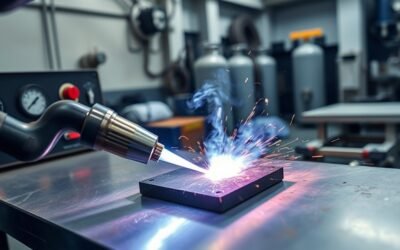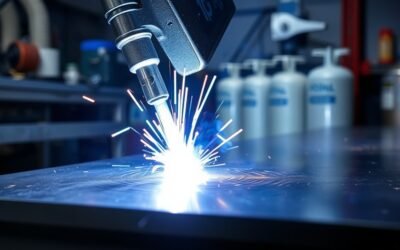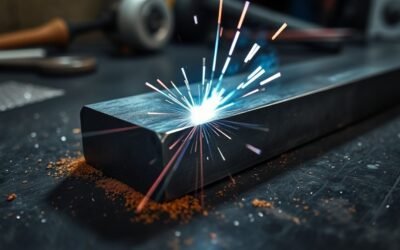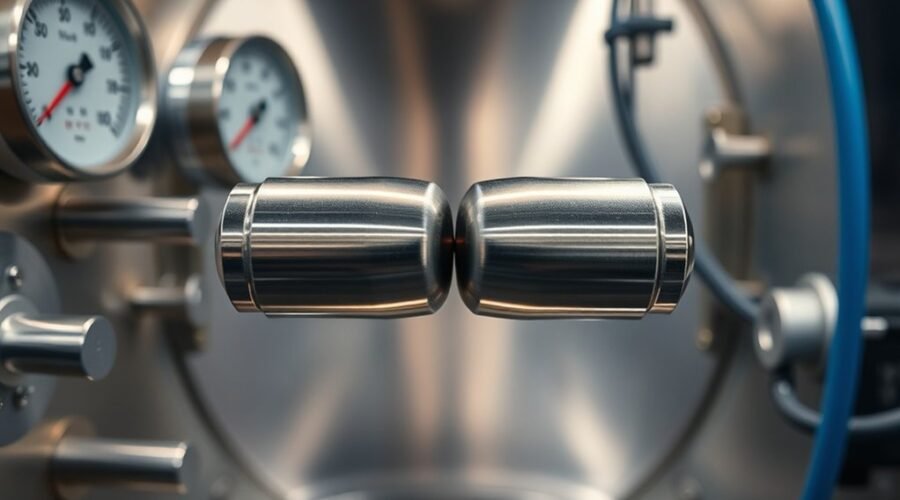
Cold welding joins metal without an arc, flame, or molten weld pool. The key is not a low metal temperature but plastic deformation: clean metal surfaces are forced into intimate contact until metallic bonds form. For most readers, the practical questions are which metals work, how the surfaces must be prepared, how much deformation is needed, and whether vacuum is actually required.
Quick Answer
Cold welding is a solid-state process that joins ductile metals by pressure rather than melting. The best results come from clean, oxide-disrupted surfaces that deform enough to expose fresh metal and create metallic bonds. Aluminum and copper are common choices. Vacuum can help preserve clean surfaces, but it is not required for industrial cold pressure welding.
Key Takeaways
- Cold welding depends on plastic deformation that breaks or displaces surface films and exposes clean metal.
- Aluminum, copper, gold, silver, nickel, zinc, and some brass alloys are among the more suitable materials.
- A properly made joint can approach the strength of the weaker parent material, but strength depends heavily on preparation and deformation.
- Wire splicing and electrical conductors are important industrial uses because the process adds no fusion heat.
- Space vacuum can increase cold-welding risk when surface films are disrupted, but vacuum alone does not make every pair of metals weld together.
What Is Cold Welding?
)
Cold welding, also called cold pressure welding or contact welding, is a solid-state joining process. The metals remain solid while pressure and deformation bring freshly exposed surfaces close enough for interatomic metallic bonding to develop.
This separates cold welding from fusion welding. MIG, TIG, stick, and similar processes create a molten weld pool, while cold welding relies mainly on mechanical force and surface condition. There is therefore no conventional fusion zone and no heat-affected zone created by an arc or flame.
ASM International’s description of cold pressure welding explains that deformation destroys surface oxide and contaminant layers, exposes clean metal, and allows interatomic forces to form the weld.
The process was scientifically demonstrated long before modern welding equipment existed. John Theophilus Desaguliers reported an experiment with lead pieces in 1724, while cold welding became more widely recognized as a welding phenomenon during the 1940s. TWI’s cold-welding overview also traces the technique to much earlier metalworking.
Cold welding is useful when adding fusion heat would create problems. It can preserve dimensions and material properties in thin conductors, small parts, and selected dissimilar-metal joints. That makes it different from the high-precision welding processes that still create heat through an electric arc.
How Cold Welding Works
Cold welding works by removing or breaking the films that normally keep two metals apart, then forcing fresh metal surfaces together. Pressure alone is not enough if oxides, grease, dirt, or limited deformation prevent true metal-to-metal contact.
- The surfaces are prepared. Oil, dirt, oxide, and other contamination must be controlled. Degreasing and mechanical cleaning are common approaches, although the exact preparation depends on the joint and equipment.
- The parts are aligned in the dies or tooling. Correct alignment keeps the intended contact area under controlled compression.
- Pressure creates plastic deformation. The softer metal flows rather than springing back or cracking. This deformation fractures, displaces, or expels surface films and exposes fresh material.
- Fresh surfaces make intimate contact. Once the opposing metals meet at sufficiently small separation, metallic bonding develops across parts of the interface.
For butt-welded wire, the upsetting action can force contaminated surface material outward into flash around the joint. Lap and sheet joints often depend more heavily on controlled surface preparation because contamination trapped at the interface can interrupt bonding.
Cold welding therefore favors ductile metals. A metal that plastically deforms can expose more fresh surface as pressure rises. A hard or brittle material is more likely to resist deformation or crack before a useful bonded area forms.
A vacuum can help keep freshly exposed surfaces from being contaminated again, but it is not a requirement for industrial cold pressure welding on Earth. Ordinary wire and conductor welding is routinely performed through mechanical deformation and controlled tooling. Understanding the broader range of welding processes and equipment also helps distinguish a cold-pressure welder from an arc-welding power source.
Warning: Cold-welding presses, dies, and clamping mechanisms can create serious pinch and crushing hazards. Use the machine’s guards and specified tooling, follow its operating instructions, and keep hands clear of the die area during a welding cycle.
A successful joint is not simply two pieces squeezed together. Surface condition, material ductility, contact geometry, pressure, and the amount of deformation all determine how much true metallic bonding develops.
Best Metals for Cold Welding
The best metals for cold welding are generally soft enough to undergo substantial plastic deformation without cracking. Aluminum and copper are especially important in industry, while gold, silver, nickel, zinc, and selected brass alloys can also be suitable.
| Metal or Group | Cold-Welding Suitability | Practical Point |
|---|---|---|
| Aluminum | Very common | Highly ductile, but its oxide film must be disrupted or displaced during joining. |
| Copper | Very common | Widely suited to wire and electrical-conductor joining. |
| Gold and silver | Suitable | Important in fine-scale and research applications; nanoscale welding can occur with very low applied force. |
| Nickel, zinc, and 70/30 brass | Suitable in selected forms | Commonly cited for cold-welded wire and related applications. |
| Stainless or hardened alloys | More difficult | Higher strength, work hardening, and persistent surface films can demand much greater pressure or specialized methods. |
Aluminum-to-copper joints are particularly useful because the two metals can be joined without creating a molten mixed weld pool. The process is widely associated with electrical conductors, where preserving conductivity and avoiding excessive heat are valuable.
Material compatibility is more complex than simply matching crystal structures. Alloy condition, hardness, surface films, geometry, deformation, and tooling all influence whether enough clean contact area develops.
At very small scales, the behavior can change dramatically. A Nature Nanotechnology study of ultrathin gold nanowires demonstrated cold welding of single-crystalline gold wires about 3–10 nm in diameter within seconds. It also demonstrated gold-to-silver and silver-to-silver joining.
The original idea that lead is a metal that does not cold weld is not reliable. Lead was used in the well-known 1724 Desaguliers experiment because its softness allowed intimate contact under mechanical force.
Cold welding also should not be confused with consumable selection in fusion welding. For example, low-hydrogen rods are relevant to certain arc-welding jobs, but cold pressure welding uses neither a welding rod nor a molten filler-metal deposit.
Cold Welding Uses in Industry and Space
Industrial cold welding is most useful where heat would complicate the joint or where ductile wires and conductors can be joined efficiently by pressure. In spacecraft engineering, the same bonding mechanism can also become an unwanted failure risk if clean metallic surfaces rub or press together.
Wire and Electrical Connections
Wire joining is one of the most established uses. Aluminum-to-aluminum, copper-to-copper, and selected dissimilar wire combinations can be joined without an arc, shielding gas, or filler wire.
The absence of fusion heat helps avoid a conventional heat-affected zone. It also allows manufacturers to join relatively small conductors without exposing nearby insulation or components to the temperatures associated with fusion welding.
Dissimilar-Metal Joining
Cold welding can join some metal combinations that are awkward to fusion weld. Aluminum and copper are a common example because the materials can be bonded in the solid state without first melting and mixing them.
That does not mean every dissimilar pair is suitable. The softer material still has to deform enough to expose fresh surface, and the interface must support a useful bonded area after pressure is removed.
Cold Welding in Space
Space presents a different problem. Vacuum limits the formation of new oxide films, so clean metal exposed by rubbing, impact, or fretting can become more prone to adhesion. The European Space Agency’s cold-welding assessment treats impact and fretting between separable spacecraft contacts as important design conditions.
Vacuum by itself is not enough to guarantee cold welding. A NASA review of Long Duration Exposure Facility hardware reported no significant on-orbit cold-welding events in the hardware examined and emphasized the need to distinguish cold welding from galling and friction-related seizure.
Galileo is frequently discussed in this context. A NASA 2024 explainer says studies of the spacecraft’s antenna deployment problem led investigators to conclude that cold welding had fused part of its mobile structure. Treating that as an attributed spacecraft case is more precise than assuming that exposed metals simply weld whenever they touch in space.
This need for controlled surfaces, motion, and contact conditions parallels the importance of precise controls in other welding processes, even though their joining mechanisms differ.
Cold Welding Pros and Cons
Cold welding offers major benefits when heat must be avoided, but those benefits come with tight material and process requirements. It is most effective as a specialized joining process rather than a universal replacement for arc, resistance, laser, or friction welding.
| Advantage | Why It Matters |
|---|---|
| No fusion heat | Avoids the conventional fusion zone and heat-affected zone produced by arc welding. |
| Can join selected dissimilar metals | Useful for combinations such as aluminum and copper where melting the two metals can complicate the joint. |
| No filler metal or shielding gas | The bond comes from pressure, deformation, and direct metallic contact. |
| Strong joints are possible | With suitable metals and process conditions, joint strength can approach that of the weaker parent material. |
| Limitation | Practical Effect |
|---|---|
| Surface condition matters greatly | Oxides, oil, debris, and other films can greatly reduce the bonded area. |
| High deformation may be required | The process can leave upset metal or flash that needs trimming. |
| Material choice is limited | Hard, brittle, severely work-hardened, or difficult-to-deform materials are much less suitable. |
| Special tooling is usually needed | Dies, presses, clamps, or purpose-built wire welders must create repeatable deformation and alignment. |
A conventional multi-process welder is therefore not a substitute for a cold-pressure welding machine. MIG, TIG, and stick equipment supplies electrical welding current, while cold welding requires mechanical tooling capable of producing controlled pressure and plastic flow.
Frequently Asked Questions
Are Cold Welders Any Good?
Yes, cold welders are highly effective for the jobs they are designed to handle. They are especially useful for compatible ductile wires, conductors, and selected sheet or rod joints. Their performance depends on correct dies, sufficient deformation, good alignment, and controlled surface condition, so they are not general substitutes for MIG, TIG, or stick welders.
Is Cold Welding as Strong as Hot Welding?
Cold welding can approach the strength of the weaker parent metal when the materials, surface condition, geometry, and deformation are suitable. It is not automatically stronger or weaker than a fusion weld. Strength must be judged for the specific joint because incomplete oxide disruption or insufficient plastic flow can leave a weak interface.
Is Cold Welding Possible on Earth?
Yes, cold welding is routinely possible on Earth. Industrial cold pressure welding uses dies or other tooling to deform properly prepared metals until fresh surfaces make intimate contact. A vacuum can help preserve a clean surface, but normal industrial wire and conductor cold welding does not require the workpieces to be placed in space or an ultra-high-vacuum chamber.
What Metals Don’t Cold Weld?
There is no simple universal list of metals that can never cold weld. Hardened, high-strength, brittle, or strongly passivated materials are generally much harder to join because they resist the plastic deformation needed to expose fresh metal. Stainless steel can require very high pressure or specialized conditions, while ductile aluminum and copper are much easier candidates.
Does Cold Welding Require a Vacuum?
No, a vacuum is not required for ordinary cold pressure welding. The mechanical deformation created by purpose-built dies can break and displace oxide and contamination layers on Earth. Vacuum becomes important in spacecraft discussions because freshly exposed metals cannot rebuild oxide films as readily, increasing adhesion risk when rubbing or fretting exposes clean surfaces.
Is Cold Welding the Same as Brazing or Soldering?
No, cold welding is different from both brazing and soldering. Brazing and soldering use a separate filler metal that melts and flows into a joint while the base materials remain solid. Cold welding normally adds no molten filler. Instead, pressure and plastic deformation expose fresh base metal and create a direct solid-state metallic bond.
Conclusion
Cold welding is most valuable when a joint needs solid-state bonding without fusion heat. Its success depends on choosing sufficiently ductile metals, controlling surface films, aligning the parts, and creating enough deformation to expose fresh metal.
Aluminum and copper remain practical examples, while nanoscale precious-metal welding and spacecraft adhesion show how widely the same basic physics can appear. The key distinction is simple: cold welding is not metal sticking merely because it is cold or in vacuum; it is a controlled metallic bond formed when suitably clean surfaces reach intimate contact.
Sources
- TWI — What Is Cold Welding?: Definition, history, suitable metals, applications, surface preparation, and joint-strength guidance.
- ASM International — Cold Welding: Surface-film disruption, clean-metal exposure, deformation, and interatomic bonding mechanism.
- European Space Agency — STM-279: Cold-welding risk from impact and fretting between spacecraft contact surfaces in vacuum.
- NASA Technical Reports Server — On-orbit Coldwelding: Fact or Friction?: LDEF findings and distinction between true cold welding, galling, and friction-related seizure.
- Nature Nanotechnology — Cold Welding of Ultrathin Gold Nanowires: Gold nanowire dimensions, rapid nanoscale bonding, strength, conductivity, and gold-silver joining.
- NASA — Interesting Fact of the Month 2024: NASA’s account connecting cold welding with the Galileo antenna deployment problem.