A traveling welder moves from job to job, often across states, for pipeline construction, refinery and power plant shutdowns, shipyards and industrial projects. Traveling welders typically earn an hourly wage plus heavy overtime and a daily per diem, commonly $75 to $175 a day, which is why experienced travelers often make $80,000 to $150,000 or more a year. To get started you need solid pipe or structural certifications, your own tools and transportation, and a willingness to live on the road.
For context, the median for all welders was $53,750 in May 2025, according to the BLS. Travel work is how many welders blow past that number. Here is how the pay works, what per diem really means and how to land your first travel job.
What Does a Traveling Welder Do?
Traveling welders go where the big projects are. Common travel work includes:
- Pipeline construction: cross-country oil, gas and water lines. See our pipeline welder guide.
- Shutdowns and turnarounds: short, intense maintenance jobs at refineries, chemical plants and power plants, often in spring and fall.
- Power plant outages: including nuclear outages with strict procedures and premium pay.
- Industrial construction: new plants, LNG terminals, mills and data centers.
- Shipyards and offshore: new builds, repairs and rotational offshore work.
- Structural and bridge work, wind and solar farms and mining projects.
How Traveling Welders Get Paid

Overtime is a big part of it. Many travel jobs schedule 50 to 84 hours a week (six 10s or seven 12s), and hours over 40 are usually paid at time-and-a-half.
What Is Per Diem for Welders?
Per diem (Latin for “per day”) is a daily allowance to cover lodging, meals and incidental costs while you work away from home. Most welding contractors pay a flat daily amount, often $75 to $175 depending on the job, location and union agreement.
Many employers use the federal GSA rates as a benchmark. For fiscal year 2026 (October 1, 2025 to September 30, 2026), GSA kept rates the same as FY2025; the standard rate for most of the continental U.S. is $110 for lodging plus $68 for meals and incidentals, and higher-cost cities have higher rates.
Is per diem taxable? It depends. Under IRS rules, per diem paid under an accountable plan up to the federal rate is generally tax-free when you keep a tax home and are traveling away from it. If you have no permanent home and live wherever you work, per diem may be taxable income. Rules are complex, so talk to a tax professional; we are not tax advisors.
How Much Do Traveling Welders Make?
Earnings swing widely with the type of work, hours and months on the road. Western Welding Academy estimates traveling pipeline welders at about $80,000 to $150,000+ a year. Here is how a single week can add up:
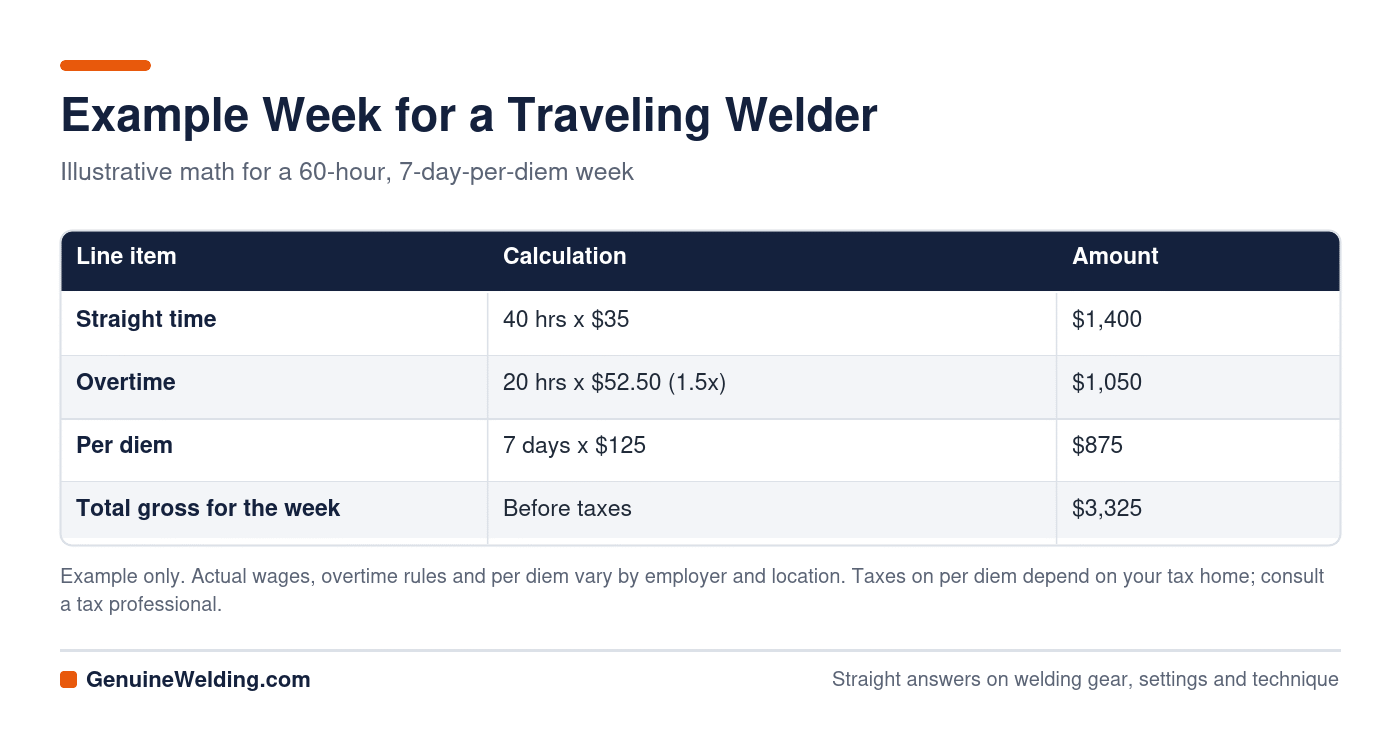
Remember that travel work is seasonal and project-based. Many welders work hard for nine or ten months and take time off between jobs. For more pay data, see how much welders make and the highest paying welding jobs.
How to Become a Traveling Welder
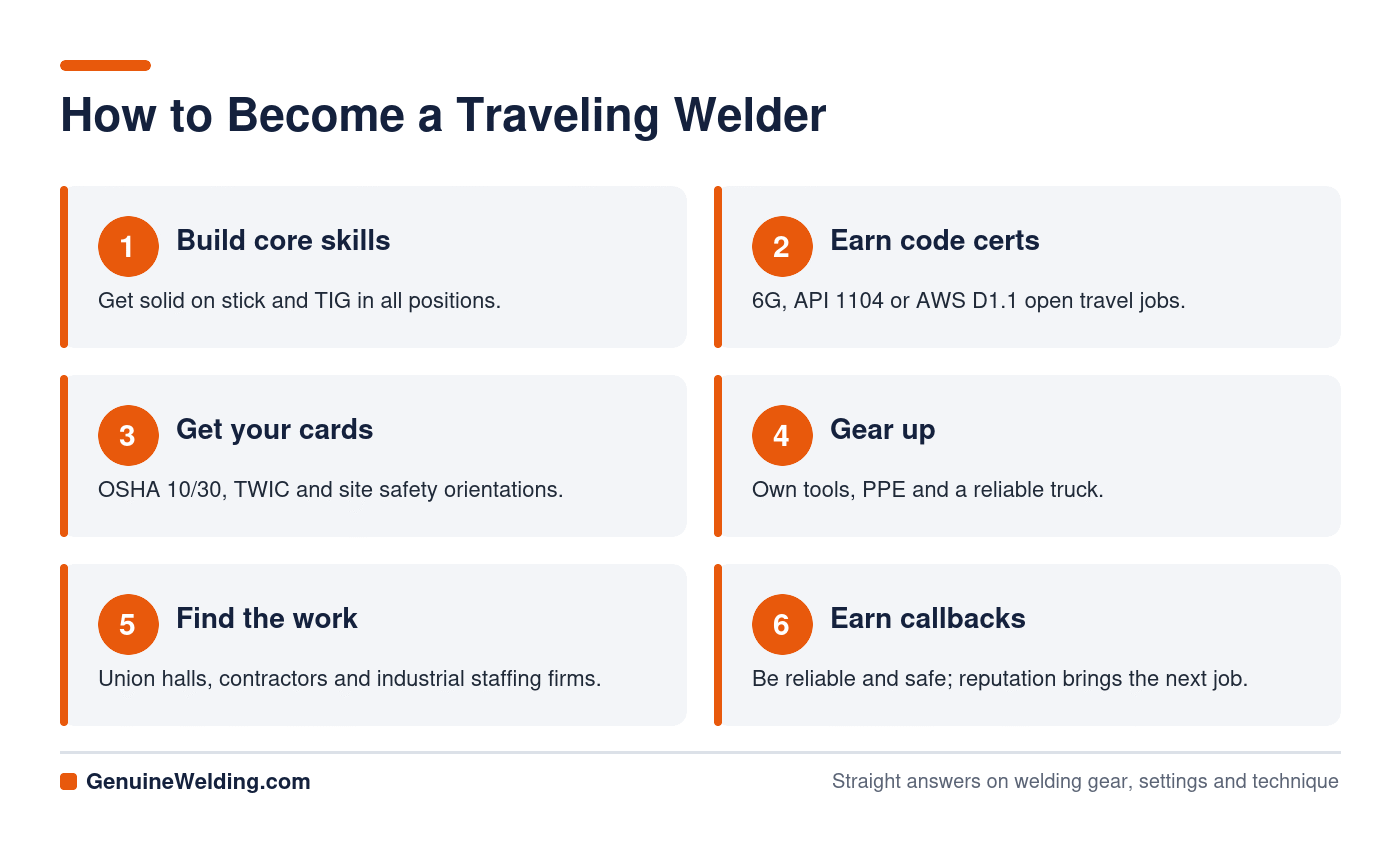
Certifications and cards that help
- Pipe: 6G stick or TIG/stick combo, ASME Section IX
- Pipeline: API 1104
- Structural: AWS D1.1 (3G and 4G plate)
- OSHA 10 or OSHA 30 construction safety
- TWIC card for ports, refineries and secure facilities
- Site safety orientations (for example, safety council basic orientation cards)
- A clean drug screen and a valid driver’s license
Where to find travel welding jobs
- Union halls: UA (pipefitters and pipeliners), Boilermakers and Ironworkers locals dispatch members to traveling work.
- Contractors: pipeline, mechanical and industrial maintenance contractors hire directly for projects and shutdowns.
- Industrial staffing agencies that place welders on turnarounds and outages.
- Job boards and word of mouth: in this trade, a good reputation from your last job is the best lead for the next one.
New to welding? Start with how to become a welder and how to get a welding job.
What to Bring on the Road
- Hood, jacket, gloves, steel-toe boots, safety glasses and hearing protection
- Grinders, wire brushes, chipping hammer, files and measuring tools
- A reliable truck (and a rig if you are a rig welder)
- Copies of your certifications and continuity logs
- A budget plan for lodging (hotel, rental, camper or RV)
Pros and Cons of Being a Traveling Welder
| Pros | Cons |
|---|---|
| Much higher earnings from overtime and per diem | Time away from family and friends |
| Fast skill growth on big, varied projects | Long days, tough weather, physical strain |
| See new places and build a national network | Gaps between jobs; work is not guaranteed |
| Ability to bank money quickly | Living costs on the road can eat per diem |
Tips to Make the Most of Travel Work
- Save a large share of your per diem by sharing housing or living in a camper.
- Track hours, per diem and expenses carefully for taxes.
- Keep your certifications current and your continuity documented.
- Show up early, pass your tests and stay safe: foremen remember and call back reliable hands.
- Build an emergency fund for the gaps between jobs.
Traveling Welder FAQs
Do traveling welders get paid more?
Usually, yes. Base wages may be similar to local jobs, but overtime, per diem and sometimes rig pay add significantly to weekly earnings.
How much is per diem for welders?
Commonly $75 to $175 a day, depending on the employer, location and union agreement. The federal standard benchmark for FY2026 is $110 lodging plus $68 meals and incidentals.
Can a new welder travel?
Some do, especially as helpers on pipelines and shutdowns. Most travel welding jobs want experience and code certifications, so plan on building skills locally first.
How long are traveling welding jobs?
Shutdowns can last two to eight weeks; pipeline and construction jobs can run several months to a year or more.
Sources
- BLS: Welders, Cutters, Solderers, and Brazers
- GSA: Per Diem Rates
- GSA: FY 2026 CONUS Per Diem Rates Announcement
- IRS Publication 463: Travel, Gift and Car Expenses
- Western Welding Academy: Pipeline Welder Salary 2026