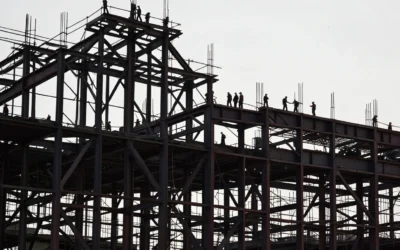
A pipeline welder joins the steel pipe that carries oil, natural gas, water and fuel across the country. Most work outdoors on cross-country construction “spreads,” welding pipe in fixed positions to API 1104 and passing X-ray inspection on every joint. Pay varies widely: the median welder earns $53,750 a year (BLS, May 2025), but experienced pipeline welders who travel, work long weeks and collect per diem and rig pay often earn $80,000 to $150,000 or more.
Pipeline welding is one of the best-paying paths in the trade, but it is also one of the hardest on your body and your schedule. This guide covers what pipeline welders actually do, how the crews work, what they earn and the steps to get your first pipeline job.
What Does a Pipeline Welder Do?
Pipeline welders weld lengths of pipe (called joints) end to end to build long transmission and gathering lines. The pipe is usually carbon or high-strength steel, from a few inches to more than 48 inches in diameter. Because the pipe sits on skids or in a ditch, nearly every weld is made in a fixed position, so welders must handle flat, vertical and overhead in a single joint.
Typical duties include:
- Welding girth (circumferential) joints with stick, mechanized MIG or flux-cored processes
- Running root, hot, fill and cap passes to a written welding procedure
- Preparing bevels, cleaning and grinding between passes
- Preheating pipe when the procedure requires it
- Making tie-in welds where pipe sections, valves or crossings meet
- Repairing welds that fail X-ray or ultrasonic inspection
- Following safety rules for trenches, heavy equipment, fire and hot work
- Maintaining a welding rig (truck and engine-driven welder) if you are a rig welder
Pipeline welding is different from in-plant pipe welding positions work in a refinery or shop. Cross-country pipeline welders mostly use cellulose rods such as 6010 and 8010 run downhill, which is fast and digs deep. Plant pipe welders usually run uphill with TIG roots and 7018 fill.
How a Pipeline Crew Works
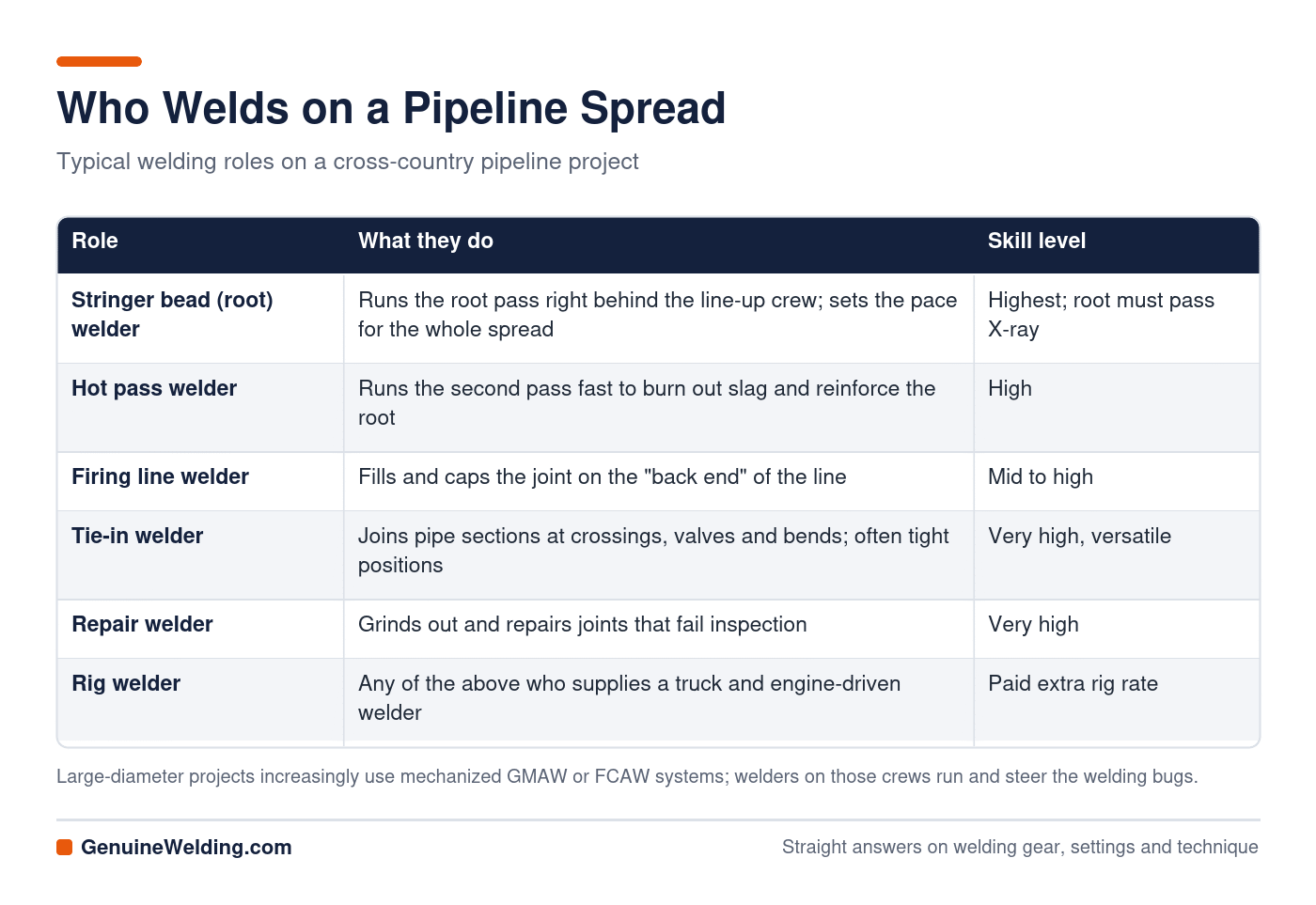
A pipeline construction project is organized into a “spread”: a moving assembly line of crews that line up pipe, weld it, coat it and lower it into the ditch. Welders fill several roles:
Pipeline Welder Salary
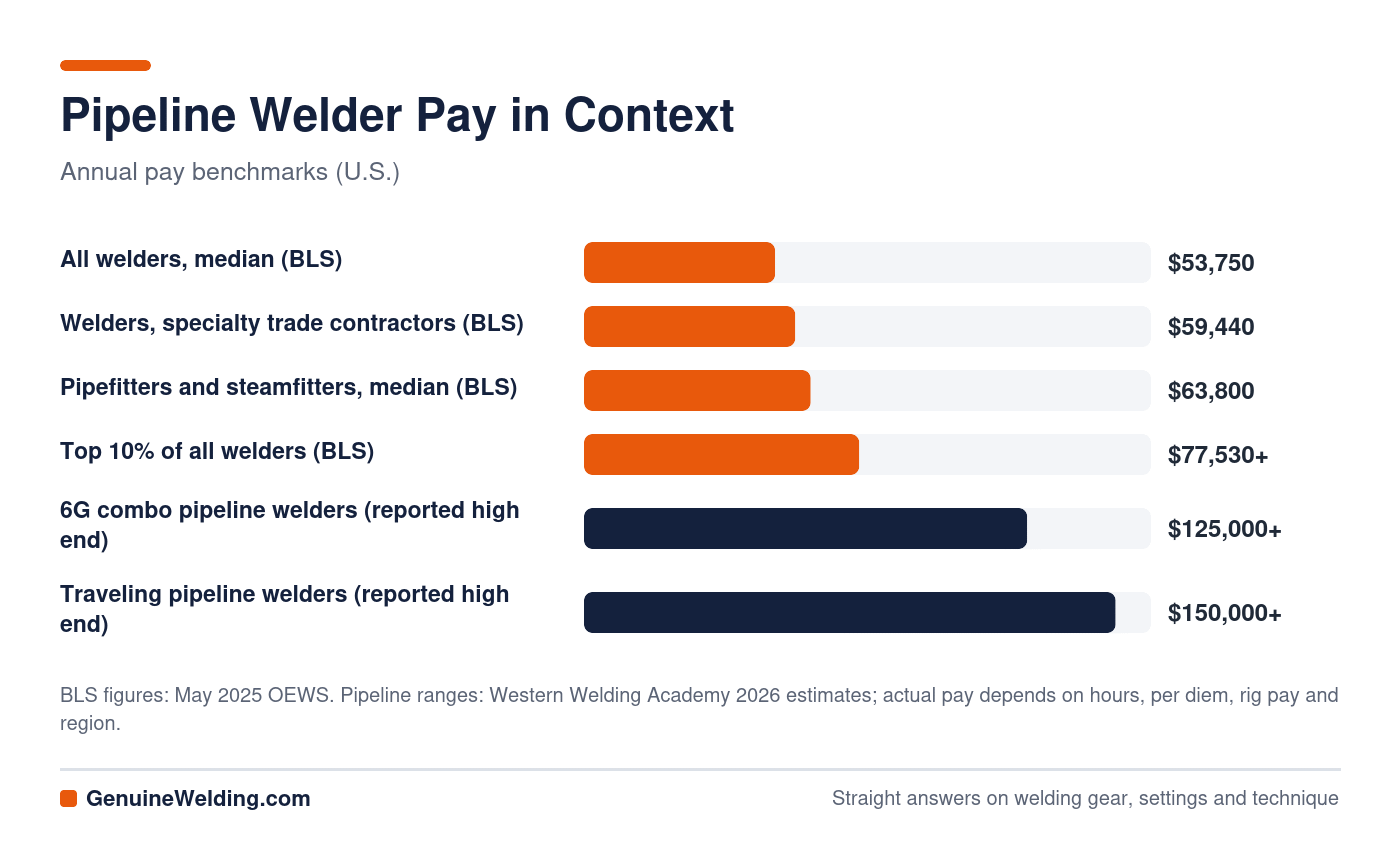
The U.S. Bureau of Labor Statistics does not publish a separate number for pipeline welders, but its data shows where they sit. All welders earned a median of $53,750 in May 2025, and the top 10% earned more than $77,530. Welders working for specialty trade contractors, which includes many pipeline and construction firms, had a higher median of $59,440.
Pipeline paychecks usually beat those numbers because of how the work is paid:
- Long hours: 10- to 12-hour days, six or seven days a week, mean a lot of overtime.
- Per diem: a daily allowance for lodging and meals, often $75 to $175 a day on cross-country jobs.
- Rig pay: welders who bring their own truck and welder are paid an extra hourly rig rate to cover fuel, wear and equipment.
- Union scale: union pipeline welders (UA Local 798, the Pipeliners Union) work under negotiated wage and benefit rates.
Western Welding Academy reports 2026 pipeline welder earnings from about $40,000 for local work to $125,000+ for welders with 6G combination certifications, with traveling welders reaching $150,000 or more. Pay depends heavily on certifications, region (Alaska, North Dakota, Texas and the Gulf Coast pay well) and how many months a year you work.
Want to compare with other welding careers? See how much welders make and the welding career guide.
How to Become a Pipeline Welder
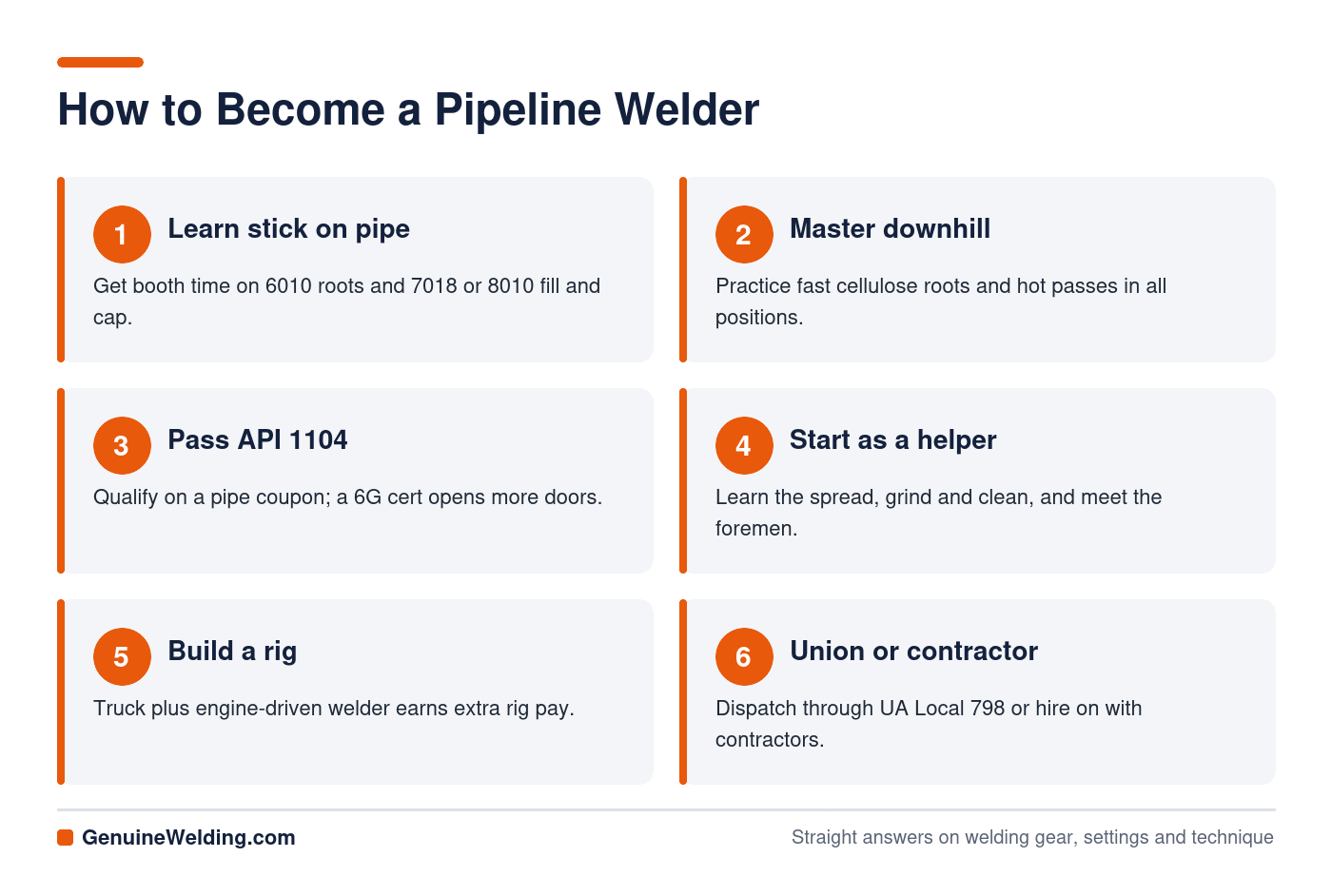
1. Learn to stick weld pipe
Start with stick welding (SMAW) basics, then move to pipe. A welding school pipe program, a community college course or an apprenticeship will get you booth time on 6010 roots and 7018 or 8010 fill and cap. Our guide on how to become a welder compares training paths and costs.
2. Practice downhill cellulose welding
Downhill 6010 and 8010 is a distinct skill. Practice running roots with a consistent keyhole and fast hot passes that burn out the “wagon tracks” of trapped slag beside the root.
3. Pass an API 1104 test
Pipeline welders qualify to API Standard 1104, usually on a pipe coupon tested by nick-break and bend tests or radiography. Many contractors test you on the job site before hiring. The 6G welding test is also valuable because it qualifies you in all positions under many codes.
4. Start as a helper
Many welders get on a spread first as a welder helper, grinding, cleaning and learning the flow of the line. It is also the best way to meet foremen who hire welders.
5. Build or buy a rig
Rig welders own a heavy-duty pickup with a bed-mounted engine-driven welder, leads, grinders, a generator, tools and storage. A good rig can cost $50,000 to $100,000 or more, which is why most welders work a few seasons first.
6. Join the union or find a contractor
Union welders get dispatched through UA Local 798 and other UA locals. Non-union welders find work through pipeline contractors, staffing agencies and word of mouth. Either way, a clean safety record and good X-ray history are your best references.
Skills and Certifications Pipeline Welders Need
- Stick welding with 6010, 8010 and 7018 in all positions
- API 1104 qualification; ASME Section IX helps for station and facility work
- Mechanized MIG or flux-cored welding for large-diameter projects
- Bevel prep, line-up clamps and grinding
- OSHA 10 or 30, plus site safety training such as H2S awareness
- A valid driver’s license and a clean drug test
- Physical stamina for heat, cold, mud and long days
See our full guide to welding certifications for costs and testing.
Pros and Cons of Pipeline Welding
| Pros | Cons |
|---|---|
| Some of the highest pay in welding | Weeks or months away from home |
| Per diem and rig pay on top of wages | Long hours in heat, cold, rain and mud |
| Strong demand for skilled stick welders | Work is seasonal and project-based |
| Clear path to tie-in, foreman or inspector roles | High startup cost for a rig |
| Every weld is tested, so skill is rewarded | Physically demanding on back and knees |
Pipeline Welder vs Pipe Welder
The terms overlap, but there is a practical difference. A pipeline welder builds long cross-country lines outdoors, usually welding downhill with cellulose rods or mechanized systems. A pipe welder (or pipefitter-welder) works in refineries, power plants and shops on process piping, often with TIG roots and uphill 7018 to ASME codes. Many welders do both over a career. Our pipe welding guide explains 5G and 6G technique in depth.
Pipeline Welder FAQs
How much do pipeline welders make per hour?
Base wages commonly range from the mid-$20s to $50+ an hour depending on experience, union status and region. Per diem and rig pay can add hundreds of dollars a day on top.
How long does it take to become a pipeline welder?
Most people need 6 to 18 months of training plus a season or two as a helper before they weld on a spread. Becoming a confident tie-in or rig welder usually takes several years.
What rods do pipeline welders use?
Cellulose electrodes such as E6010 for roots and E8010 for hot, fill and cap passes are the classic choice for downhill pipeline work. Low-hydrogen rods are used where the procedure requires them.
Is pipeline welding dangerous?
It carries real hazards: trenches, heavy equipment, fire, fumes, weather and long drives. Contractors control them with safety programs, but welders must stay alert. See our welding safety guide.
Do pipeline welders need to travel?
Usually, yes. Most high-paying pipeline work moves with the project. Learn more in our guide to traveling welder jobs, pay and per diem.
Sources
- BLS: Welders, Cutters, Solderers, and Brazers (May 2025 wages)
- Western Welding Academy: Pipeline Welder Salary in 2026
- American Petroleum Institute: Standards (API 1104)
- UA Local 798 (Pipeliners Union)