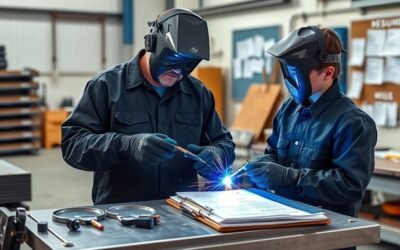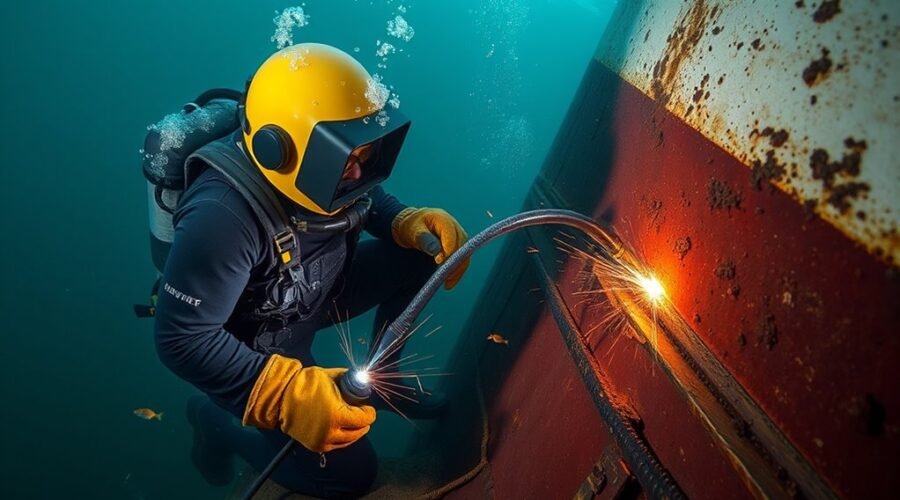
Underwater welders are commercial divers with welding skills who inspect, repair, cut, and join submerged metal structures such as ships, pipelines, bridges, dams, and offshore platforms. The career combines two demanding trades: professional welding and commercial diving. Pay can be strong, but training requirements, project qualifications, working conditions, travel, depth, and overtime all influence what a worker actually earns.
Quick Answer
To become an underwater welder, build solid welding skills, complete formal commercial-diver training, meet medical and safety requirements, and gain supervised field experience. U.S. commercial divers had a median annual wage of $72,990 in May 2025, although specialized underwater-welding assignments can pay more depending on experience, location, overtime, depth, and project demands.
Key Takeaways
- Underwater welders are commercial divers who may inspect, repair, cut, weld, install, and maintain submerged structures.
- The career requires both welding ability and formal commercial-diving training; recreational scuba certification is not a substitute.
- The U.S. Bureau of Labor Statistics reported a $72,990 median annual wage for commercial divers in May 2025.
- AWS career guidance reports higher earning potential for experienced underwater welders, but specialized pay should not be treated as guaranteed.
- Major hazards include drowning, decompression illness, pressure-related injuries, electrical exposure, hypothermia, poor visibility, entanglement, and heavy-equipment hazards.
- Commercial-diver credentials, welding qualifications, medical fitness, first-aid training, and employer or project requirements all matter for job access.
What Does an Underwater Welder Do?
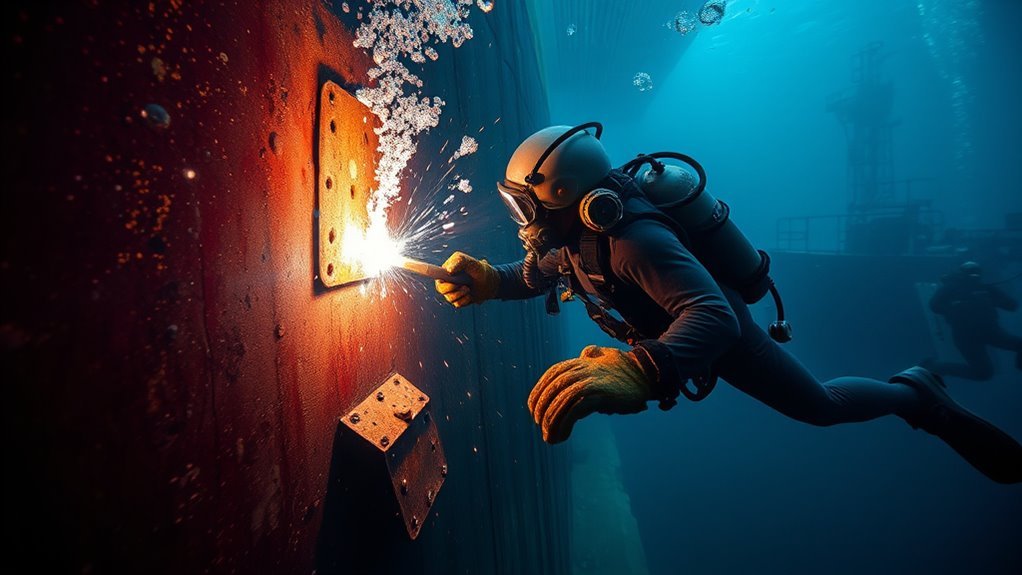
Underwater welders repair, maintain, inspect, cut, and help construct submerged structures. They are generally commercial divers first, with welding added as a specialized work skill.
The U.S. Department of Labor’s O*NET profile for commercial divers lists tasks such as inspecting underwater structures, repairing ships and bridge foundations, installing piping, performing nondestructive testing, operating underwater equipment, and cutting or welding steel.
Typical work sites can include:
- Ships and shipyards
- Offshore oil and gas structures
- Underwater pipelines
- Ports, docks, and pilings
- Bridge foundations
- Dams and water-control structures
- Industrial intake and discharge systems
Depending on the project, underwater welders may use wet welding, where the diver and welding arc are exposed directly to the water, or dry/hyperbaric welding, where water is displaced from the weld area with a pressurized enclosure.
The job is broader than simply running weld beads underwater. Divers may spend significant time preparing the work area, rigging equipment, inspecting structures, communicating with surface personnel, cleaning surfaces, positioning components, performing tests, and documenting repairs.
How to Become an Underwater Welder
The usual path combines welding training, commercial-diver education, medical fitness, emergency training, and supervised field experience. Employers and individual projects may impose additional qualifications.
At a Glance
| Time Required | Varies by welding program and diving school; ADCI’s entry-level commercial-diver standard calls for at least 625 documented training hours, followed by field experience. |
| Difficulty | High — the career combines professional diving, welding, physical work, technical procedures, and safety-critical teamwork. |
| Tools Needed | Welding training equipment plus specialized commercial-diving, communications, life-support, rigging, inspection, and underwater work equipment provided or controlled by the school or employer. |
| Cost | School tuition varies widely. ADCI currently lists a separate $75 fee for its entry-level certification card; tuition, medical exams, welding training, travel, and equipment costs are separate. |
Welding Skills First
Building a strong welding foundation is an important first step. Many candidates begin after earning a high school diploma or GED and completing a welding certificate, technical-school program, apprenticeship, or related hands-on training.
Useful skills can include:
- Shielded metal arc welding (SMAW/stick)
- Structural and pipe welding
- Joint preparation and fit-up
- Cutting and grinding
- Blueprint and welding-symbol reading
- Basic welding inspection and defect recognition
The American Welding Society lists an AWS Certified Welder credential as a recommended certification for the career. However, a topside welding certificate alone does not qualify someone to work as a commercial diver.
Commercial Diving Training
Formal commercial-diviving training is the second major part of the career path. The Association of Diving Contractors International states that entry-level commercial-diver training should include at least 625 documented hours of formal instruction under its current standards.
Training typically covers far more than welding. Subjects can include diving physics and physiology, surface-supplied diving systems, communications, emergency procedures, decompression principles, equipment operation, rigging, underwater tools, inspection techniques, and practical working-diver skills.
Note: Recreational scuba credentials such as ordinary open-water certifications are not substitutes for formal commercial-diver training. ADCI specifically distinguishes recreational scuba certification from qualifications required for commercial diving work.
Meet Medical and Emergency Training Requirements
Commercial diving exposes workers to hyperbaric conditions, strenuous work, and environments where a medical problem can quickly become serious. ADCI recommends an initial commercial-diver medical examination by a qualified physician and annual examinations for working divers exposed to hyperbaric conditions.
OSHA also requires dive-team members to have training appropriate to their assignments. Under 29 CFR 1910.410, dive-team members must be trained in CPR and first aid, while workers exposed to or controlling hyperbaric exposure need training in diving-related physics and physiology.
Gain Supervised Field Experience
Graduation from diving school does not normally mean a new diver immediately starts performing the industry’s most demanding welding assignments. Commercial divers build experience through supervised field work, often beginning in entry-level tender/diver positions.
Typical early responsibilities can include tending umbilicals, maintaining equipment, supporting dive operations, preparing tools, assisting experienced divers, performing inspections, and completing progressively more difficult underwater work.
ADCI’s certification system reflects this progression, with classifications for entry-level tender/diver, air diver, mixed-gas diver, saturation diver, and supervisory positions.
Qualify for Underwater Welding Work
Once a diver has the required commercial-diving background, welding work may require additional performance qualification under the employer’s welding procedure, project specification, classification-society rules, or an applicable welding code.
AWS D3.6M:2017, Underwater Welding Code, covers underwater welding in both wet and dry environments. It includes requirements for procedures, qualification, inspection, and different classes of underwater welds.
This distinction matters: there is not one universal government license called an “underwater welding certification.” A worker may need a combination of commercial-diver credentials, welding credentials, documented training, medical clearance, and project-specific welder qualification.
How Much Do Underwater Welders Make?
Pay varies significantly because underwater welding sits inside the broader commercial-diving occupation and because compensation can change with experience, location, depth, offshore work, travel, overtime, project duration, and specialized qualifications.
The U.S. Bureau of Labor Statistics reports a median annual wage of $72,990 for commercial divers in May 2025. BLS does not publish a separate national wage category exclusively for underwater welders.
AWS provides separate career guidance for underwater welding. Its current career profile cites Lightcast 2025 data showing about $62,000 for entry-level pay and a $68,000 national median, while AWS also notes that experienced commercial-diving welders can earn substantially more on specialized assignments.
The difference between these figures is a reminder that salary sources use different datasets and occupational definitions. Candidates should treat broad underwater-welding salary ranges as estimates rather than guaranteed pay.
Entry-Level Pay Range
New commercial divers often earn less than experienced workers because they are still building field days, logged dives, qualifications, and employer trust. AWS career guidance places entry-level underwater-welding earnings around the $40,000–$60,000 range and currently displays a $62,000 entry-level figure based on Lightcast 2025 data.
Actual starting compensation may vary with:
- Region and cost of living
- Inland versus offshore assignments
- Employer and contract type
- Amount of available overtime
- Travel and per-diem arrangements
- Existing welding and rigging skills
- Commercial-diving field experience
The best way to evaluate a job offer is to separate base pay from overtime, per diem, travel allowances, bonuses, and other project compensation.
Experienced Earnings Potential
Experienced underwater welders can earn considerably more when they combine commercial-diving experience with valuable welding, inspection, rigging, cutting, mixed-gas, or supervisory qualifications.
AWS career guidance states that experienced commercial-diving welders may earn roughly $80,000 to more than $150,000 annually, with specialized saturation work potentially paying more. These figures represent earning potential rather than a guaranteed industry salary.
For broader occupational context, BLS projects employment for commercial divers to grow 5% from 2025 to 2035, from about 4,000 jobs to approximately 4,200.
Extra Pay Factors
Underwater-welding compensation may include more than base wages. Depending on the contract, employer, and assignment, total compensation can be affected by:
- Overtime
- Hazard or specialty premiums
- Per diem
- Offshore rotations
- Travel requirements
- Depth and diving mode
- Mixed-gas or saturation experience
- Inspection or nondestructive-testing skills
- Supervisory qualifications
Higher compensation usually comes with higher experience requirements, more difficult conditions, greater responsibility, or longer and less predictable work schedules.
Dry Vs. Wet Underwater Welding
Underwater welding is commonly divided into wet welding and dry or hyperbaric welding. Both methods can be used professionally, but the environment, equipment, procedures, and qualification requirements differ.
Wet Underwater Welding
During wet welding, the diver works directly in the water and performs the weld without a mechanical barrier separating the welding arc from the surrounding water. Specialized electrodes and procedures are used.
Wet welding can be practical for repairs because crews do not have to install a large dry habitat around the work area. However, the diver must work with water movement, bubbles, reduced visibility, temperature loss, and other environmental limitations.
Dry or Hyperbaric Welding
Dry welding uses a chamber or enclosure that displaces water from the weld area. Depending on the system, the chamber may surround the weld area, part of the diver, or a larger working space.
The controlled environment can improve visibility and give welders greater control over the welding conditions. It also requires additional equipment, setup, pressure management, and project planning.
AWS D3.6M covers both wet and dry underwater welding and classifies welds according to applicable performance requirements. Therefore, it is more accurate to evaluate a weld against its qualified procedure, required weld class, inspection results, and project specification rather than assuming every wet weld is automatically unacceptable.
Underwater Welding Safety Risks
Underwater welding is a safety-critical commercial-diving activity. Hazards can include drowning, decompression sickness, barotrauma, hypothermia, poor visibility, entanglement, currents, heavy equipment, contaminated water, confined spaces, and electrical exposure.
Warning: Underwater welding is professional commercial-diving work and should not be attempted as a recreational or self-taught activity. Formal training, a qualified dive team, appropriate equipment, medical fitness, job-specific procedures, and compliance with applicable safety rules are essential.
NIOSH reports that U.S. commercial divers experienced 39 fatal occupational injuries during 2011–2017, along with hundreds of nonfatal injuries and illnesses involving days away from work. That figure is historical rather than a current annual fatality rate, but it shows why commercial-diving procedures are taken seriously.
OSHA’s commercial-diving rules include several protections directly relevant to underwater welding. For example:
- Dive-team members must have training appropriate to their assigned tasks.
- CPR and first-aid training are required for dive-team members.
- Surface-supplied divers must have operational voice communication with the dive team.
- A depth-time profile must be maintained during dives.
- Applicable decompression tables must be available at the dive location.
- Hand-held electrical equipment is controlled to prevent unintended energization.
- For underwater welding or burning, a surface dive-team member in voice communication with the diver must tend the current-supply interrupt switch.
Decompression sickness can occur when dissolved inert gas forms bubbles in the body during or after pressure reduction. Safe ascent, decompression procedures, dive profiles, emergency planning, and access to appropriate medical resources therefore form part of professional dive operations.
Equipment inspection, communications, teamwork, reliable life-support systems, environmental assessment, and adherence to an approved dive plan are fundamental parts of reducing risk.
Underwater Welding Certifications to Get
There is no single credential that automatically qualifies someone for every underwater-welding job. A professional normally builds several layers of training and qualification.
Commercial Diver Credential
A formal commercial-diver qualification is foundational. ADCI’s entry-level tender/diver standard requires at least 625 documented hours of commercial-diving instruction from a recognized program or equivalent pathway.
Recreational scuba cards are not accepted by ADCI as a substitute for formal commercial-diver training.
Welding Credentials
A recognized welding qualification can demonstrate topside welding competency. AWS lists its Certified Welder credential as a recommended certification for underwater-welding career preparation, particularly where structural or pipe-welding skills are relevant.
Underwater Welder Performance Qualification
For actual underwater production welding, a worker may need to demonstrate the ability to weld to a specific procedure or code. AWS D3.6M:2017 includes requirements related to underwater welding procedure and welder qualification for wet and dry environments.
Employers, owners, engineering specifications, classification societies, or contracts may impose additional requirements beyond a general welding certificate.
First Aid, CPR, and Medical Fitness
OSHA requires CPR and first-aid training for commercial dive-team members. ADCI also publishes medical standards for commercial divers and recommends an initial examination and annual examinations by physicians qualified to evaluate commercial-diving fitness.
Advanced Credentials
As workers gain experience, additional skills can support advancement into inspection, nondestructive testing, mixed-gas diving, saturation diving, life-support, or dive-supervision positions.
An AWS Certified Welding Inspector credential can be valuable for inspection-oriented welding careers, but it is not a substitute for commercial-diver training and is not an entry-level requirement for becoming an underwater welder.
Pro Tip: When comparing schools, ask whether the program meets recognized commercial-diver training standards, how many documented training hours it provides, what credentials graduates are eligible for, which equipment is included, and what field-placement support is available. Do not choose a program based only on an advertised “underwater welding certificate.”
Frequently Asked Questions
How Do You Get Certified in Underwater Welding?
There is no single universal underwater-welding license. A typical U.S. path is to develop welding skills, complete recognized commercial-diver training, meet medical and safety requirements, and then qualify for underwater welding under the procedure or code required by the employer or project. AWS D3.6M is a major underwater-welding code, while ADCI credentials address commercial-diver classifications.
Do Underwater Welders Make $100 an Hour?
Some specialized contracts, deep-diving assignments, overtime-heavy jobs, or saturation-diving work may produce very high effective hourly earnings, but $100 an hour is not a reliable industry-wide expectation. BLS reports a $72,990 median annual wage for the broader commercial-diver occupation in May 2025, while specialized underwater-welding compensation varies substantially by assignment.
How Much Does It Cost to Get an Underwater Welder Certification?
There is no single price because commercial-diving tuition, welding education, medical examinations, equipment, travel, and credential fees are separate costs. ADCI currently lists a $75 fee for its entry-level certification card, but that is only the credential fee and does not include commercial-diving school tuition. Prospective students should obtain a complete written cost breakdown directly from each recognized training program.
Can You Make $200,000 as a Welder?
Very high annual compensation can occur in specialized welding or commercial-diving careers when unusual skill requirements, offshore rotations, saturation diving, extensive overtime, supervisory duties, or other premiums are involved. However, $200,000 should be viewed as an exceptional outcome rather than a normal underwater-welder salary. Official BLS wage data does not publish a separate $200,000 underwater-welder pay category.
How Long Does It Take to Become an Underwater Welder?
The total timeline varies because welding education and commercial-diving education are separate. ADCI’s current entry-level standard calls for at least 625 documented hours of formal commercial-diver training. Candidates may also spend months learning welding before dive school, followed by additional supervised field experience before qualifying for demanding underwater-welding work.
Do You Need a Scuba Certification Before Commercial Diving School?
A recreational scuba certification may provide personal diving experience, but it is not a substitute for commercial-diver training. ADCI states that recreational certifications such as ordinary PADI or NAUI cards do not qualify a person to perform commercial-diving work without additional formal commercial-diver training.
Conclusion
Underwater welding combines professional welding with commercial diving, making it one of the more specialized paths in the skilled trades. The work can involve ships, pipelines, bridges, offshore structures, and other critical infrastructure, but it also carries significant physical and environmental risk.
A realistic path starts with strong welding fundamentals, recognized commercial-diver training, medical fitness, emergency-response skills, and supervised field experience. Specialized qualifications can then open access to more advanced welding, inspection, mixed-gas, saturation, and supervisory work. Earnings can rise substantially with experience, but applicants should compare salary claims with current BLS data and evaluate each job’s base wage, overtime, per diem, travel, and working conditions separately.
Sources
- U.S. Bureau of Labor Statistics — Commercial Divers — current median wage, employment, education level, and 2025–2035 occupational outlook.
- American Welding Society — Underwater Welder Career Profile — career duties, welding credentials, training path, and salary guidance.
- American Welding Society — Underwater Welding Safety — wet versus dry welding, hazards, safety practices, and career preparation.
- Association of Diving Contractors International — Certifications — commercial-diver classifications and distinction from recreational scuba certification.
- OSHA 29 CFR 1910.410 — Qualifications of Dive Team — training, CPR, first-aid, physics, physiology, and assignment requirements.
- OSHA 29 CFR 1910.422 — Procedures During Dive — communications, decompression information, electrical tools, and underwater welding/burning controls.